Flashback to August 2018

This post is from some quick notes I made in August 2018. I’m only just getting around to publishing it now, 8 months later, as part of this series. Today, at ~230 pounds, 215 seems like a dream.

I’m recently back from traveling to Denmark and France to attend two Parkour events back-to-back. As usual when I’m traveling, I don’t attempt to keep up my normal routines so there’s no data recorded for most of July 2018.

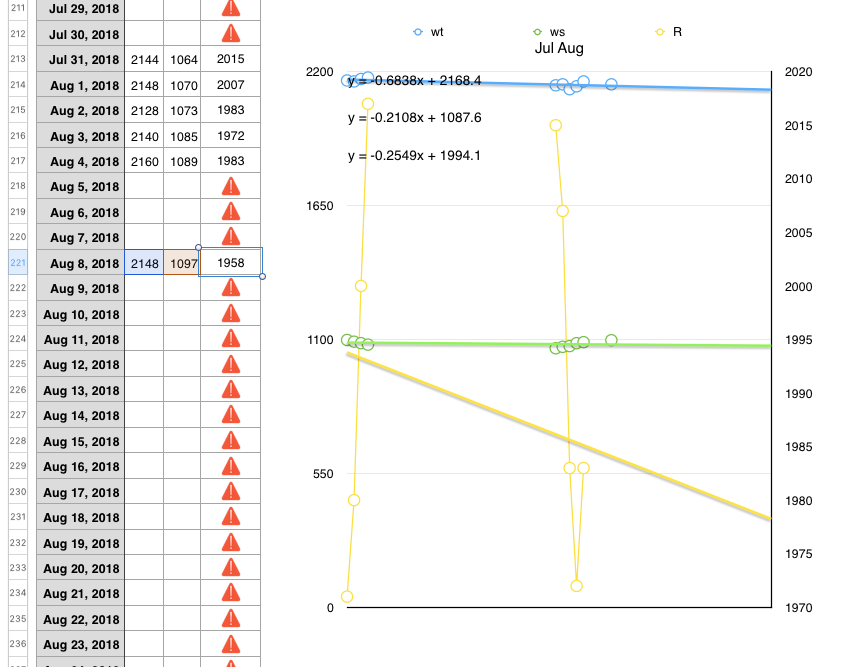
I’m happy to return still around 215 as I try to get back to my routine of “chaining together” my mornings. Compared to July, I’m not as active, but I’m trying to AVOID the, “let’s be super active and try the 100-days-of-activity challenge,” mistake I made in 2017 when I came home from the same events all excited about movement.

Anyway, what about that ratio of 1958? …it’s so low that it’s not even on the graph! This reminds me of two things I believe I’ve noticed:

  1. The ratio lags behind when I’m actively losing weight. My guess is that the different components (water, subcutaneous fat, visceral fat, and muscle) change at different rates. So when losing fat from calorie deficit, the peripheral/subcutaneous is liberated first—which aligns with my recollection that visceral fat is more tenacious.
  2. The best ratio is very hard to find—to actually see it in the measurements. I have to lose weight gradually, and then stay at the new weight for many weeks to see the ratio rebound to above 2000. (Reminder, the ratio is in wacky units of “tenths of pounds per millimeter midriff circumference” because of how I record the numbers. The numerical value of the ratio is of no concern; It’s only useful for trending.)

PK Move: Community partnership, programs, and seniors

What factors contribute to the success of PK Move’s mission to make Parkour accessible to underserved communities and older adults?

PK Move founders Nancy Lorentz, Jean Lam, and Rosy Noguchi sit down to discuss everything PK Move; how they started, the challenges they face as a non-profit, and the unique relationship they have with their community. The team explains PK Move’s mission, the specific groups they serve, and the programs they run, including their PK Silver seniors program. They unpack the details of the recent study conducted on the PK Silver program before delving into the pop-up playground program, and their current goals and opportunities.

We wanted to go to them, people who had some barrier to getting to the gym. Sometimes it is financial. Sometimes it is being intimidated.

~ Nancy Lorentz (10:50)

PK Move’s founders discuss their nonprofit’s mission to bring Parkour to underserved populations, particularly seniors and communities with limited access to traditional fitness facilities. They detail the origins of PK Move, describing how personal experiences and a shared passion for Parkour led them to develop programs that focus on inclusivity, confidence-building, and strength development. A major part of their work includes the PK Silver program, designed for older adults, which offers step-by-step Parkour training tailored to the needs of participants with low fitness levels.

The conversation explores the challenges PK Move faces as a nonprofit, such as fundraising and obtaining grants. They explain how they forged partnerships with local governments and community organizations to provide free and low-cost classes. The team highlights the success of their recent study, which demonstrates the effectiveness of PK Silver in improving cardiovascular health and strength among participants aged 60 to 80. Additionally, they touch on their pop-up Parkour playground initiative, which brings portable Parkour equipment to community parks to encourage physical activity in children and families.

(more…)

Roberto Regueiro Santiago: Rowing, mastery, and games

What are the personal transformations that occur through competitive rowing and movement practices like Parkour?

Roberto Regueiro Santiago discusses his years rowing crew, both as an athlete and a coach, and his thoughts on the competitive nature of the sport. Roberto shares how an injury changed his perspective and opened up his possibilities, leading him to Fighting Monkey and parkour. He explains his ideas of mastery, as well as his approach to games and training.

I don’t think it’s totally necessary to master everything that you do in your own practice. But master something which gives you a deep understanding — what the thing is, [and] feels [like] in the first moment that you feel like that song, like the flow state — is when you really master something.

~ Roberto Rugueiro Santiago (1:29)

Roberto Santiago reflects on his journey from competitive rowing to movement disciplines like Parkour and Fighting Monkey. He describes rowing as the first activity where he truly experienced mastery, emphasizing the deep bond and unity formed within rowing teams. Roberto shares how the rigorous nature of rowing, with its intense focus on competition, shaped his understanding of perseverance and teamwork. However, an injury ultimately shifted his priorities, leading him to explore movement practices that prioritize longevity and holistic development over winning.

In discussing his transition to Parkour and coaching, Roberto highlights the importance of sharing his passion with others, describing coaching as a way to create training partners and foster community. He values the playful, game-centered approach in Parkour, which contrasts sharply with the rigid, competition-driven world of rowing. Games, he notes, allow for self-exploration, creativity, and growth without the pressure to outperform others, fostering a sustainable and enjoyable practice.

(more…)

Blake Evitt: Travel, community and personal growth

What role does community involvement and accessibility play in shaping inclusive, multigenerational spaces for Parkour and movement practice?

Blake Evitt discusses the importance of partnering with your community, creating multigenerational spaces for training, as well as how he does that in his hometown of Boston. He unpacks the influence that traveling had on his training, coaching, and business, as well as his own personal growth. Blake shares his thoughts on a number of subjects, including becoming vegetarian, the ADAPT coaching qualifications, and the United States Parkour Association.

Our goal with the park was to make a multigenerational movement space, not just a place where Parkour can happen but also a place where people can explore and be comfortable.

~ Blake Evitt (3:37)

The conversation explores how Parkour can serve as a tool for creating inclusive, multigenerational community spaces. A key focus is the development of public Parkour spaces, particularly in Somerville, Boston, where Parkour generations have helped design and steward municipally funded parks. The dialogue highlights the integration of Parkour for all ages, with specific classes for children, adults, and older practitioners, ensuring accessibility and fostering a communal experience. The discussion underscores the importance of designing spaces that allow for interaction across generations and between different activities, such as skateboarding and basketball.

Blake Evitt’s personal journey through international travel and cultural exchange plays a significant role in shaping his approach to Parkour and community building. His experiences training with Parkour groups worldwide inform his leadership in Parkour Generations Americas and the growth of Parkour Generations Boston. The interview touches on Evitt’s coaching philosophy, the significance of adapting Parkour for older adults, and the broader value of Parkour as a means of personal development, community engagement, and positive social change.

(more…)

Cordelia Storm: Flips, competition, and representation

What does it mean to make movement more accessible and inclusive for everyone, regardless of background or athletic ability?

In this episode Cordelia Storm unpacks her thoughts about accessibility, the effects of a gym on a community, and her motivation for learning flips. She delves into her personal journey, as well as her relationship with competition. Cordelia mentions her documentary project, and finishes by tackling the concepts of gender, age, and representation in the parkour space.

In that moment I realized that my voice did matter. Now what? From then on, that just became a big passion— to have people love movement, love feeling their bodies, and like playing.

~ Cordelia Storm (30:55)

The conversation centers on the transformative power of parkour, not just as a physical discipline but as a tool for personal growth, inclusivity, and empowerment. Cordelia Storm shares her journey into parkour, starting from a background in theater and video games, and how the practice helped her overcome personal struggles, including bulimia. A large part of the discussion revolves around how parkour promotes accessibility and how Cordelia works to make movement available to a wider audience. She highlights how parkour shifted her relationship with her body, turning exercise from a punitive activity into a joyful and empowering experience.

Another key topic explored is the emotional impact of losing a community gym and how it challenged the parkour community to adapt and rebuild. Cordelia discusses the importance of outdoor classes and fostering micro-communities within them to maintain connection and continuity. The conversation also touches on gender representation in parkour, the evolving nature of competition, and the broader social and cultural implications of making movement inclusive. Cordelia’s passion for flips and overcoming fear is used as a metaphor for confronting personal barriers, showing how physical challenges in parkour mirror deeper internal struggles and victories.

(more…)

Mark Toorock: Commercialization, representation, and play

What role should competition and commercialization play in shaping the future of Parkour?

Mark Toorock shares his thoughts on the commercialization of parkour, FIG and competitions, as well as the direction parkour is headed. He also opens up about his personal goals for parkour, raising the socially acceptable age of play, and how he sees himself within the community. Mark wraps up by discussing the power of parkour to benefit all people.

The thing for me about Parkour is, if I can make one person that used to walk with their head down, walk with their head up, that’s the change in the world. We don’t change the world, we change a person.

~ Mark Toorock (32:32)

The conversation explores the evolving landscape of Parkour, focusing on commercialization, competition, and the community’s shifting mindset. Mark Toorock reflects on the initial resistance within the Parkour community to monetization and contrasts it with the growing acceptance as practitioners age and recognize the need to sustain their passion financially. The discussion highlights the complexity of maintaining Parkour’s spirit while enabling financial opportunities, drawing parallels to artists who monetize their craft without compromising authenticity.

Competition is another critical focus, with Mark advocating for a non-competitive foundation in Parkour while embracing competitions based on Parkour movements. He stresses that competition need not undermine the spirit of Parkour and can coexist with a community-driven, collaborative ethos. The conversation touches on the potential risks of external organizations, like the International Gymnastics Federation, attempting to control Parkour competitions and the broader implications for public perception. Additionally, Mark emphasizes the importance of maintaining play as a socially acceptable activity for adults, advocating for a culture that values lifelong movement and exploration.

(more…)

Emily Tung: Breaking, puppetry, and unsolicited advice

What motivates someone to push beyond personal limits in dance, Parkour, and other movement disciplines to achieve mastery?

Emily Tung shares her journey and goals in both breaking and parkour, as well as the differences between those two practices and communities. She also discusses her diverse movement practices, from stunt work, contortion, to pole dancing, as well as her lesser known skills in puppetry. Emily finishes by unpacking her thoughts on coaching, unsolicited advice, and speaking up for yourself.

For me then, it’s not about what is the correct or right way. It’s, what is your goal? And what’s your body like? And what can I do, and what applies best, and I have to decide that I have to be strong about that. I think that was another plateau. I had it back in my old life where I always listened to exactly what I was told.

~ Emily Tung (56:13)

The conversation explores how committing to ambitious goals reshapes personal habits, training, and overall lifestyle. Emily recounts how a decision to pursue world-level breakdancing battles triggered a broader transformation, leading to better nutrition, rest, and learning from mentors. This commitment highlighted the importance of focus and intentionality in practice, contrasting with periods of stagnant growth when goals were less defined.

The discussion also touches on the cross-disciplinary nature of movement arts, showing how Parkour, dance, and martial arts influence each other. Emily reflects on how Parkour provided a sense of community and freedom not always found in the dance world, fostering creativity and resilience. The journey through stunt work, puppetry, and contortion further illustrates the diverse ways movement disciplines intersect, shaping not just physical skills but also mental perspectives and personal identity.

(more…)

Don Beeson | Wilderness Survival and Evasion

On Castbox.fm — Don Beeson | Wilderness Survival and Evasion

What skills and experiences are gained when parkour practitioners apply principles of stealth, teamwork, and adaptation in unconventional environments?

Adapting to dynamic challenges creates opportunities for growth in unconventional environments.

I wanted to present a framework for civilians, who don’t normally have access to training that you would see with military personnel, to get a little bit of that hands-on, but in a fun way.

~ Don Beeson (0:54)

The conversation revolves around a unique training experience blending parkour with stealth and survival techniques, conducted during a leadership and education retreat in the Cascade Mountains. Participants engaged in skill sessions that introduced military-inspired strategies for stealth and evasion, culminating in night missions designed to apply these lessons in practice. These activities challenged attendees to slow down, communicate non-verbally, and adapt to unfamiliar environments.

The discussion also highlights specific moments from the night missions, such as encounters with a “monster” in a ghillie suit and the use of distraction tactics. Participants demonstrated creativity and teamwork, employing methods taught earlier in the day to achieve objectives. The experience underscored the value of applying parkour principles in new contexts, encouraging practitioners to explore stealth and adaptability beyond their usual environments.

Takeaways

The value of slowing down — Participants learned how deliberate, slow movement can be more effective in certain contexts than speed.

Stealth as a skill — Techniques for evasion and camouflage were introduced, demonstrating their practical and creative applications.

Non-verbal communication — The exercises emphasized teamwork through silent coordination, fostering new ways of interaction.

Adapting parkour to unconventional settings — Participants explored how parkour skills can extend beyond urban environments into stealth and evasion scenarios.

Confidence through mastery — Success in the missions built participants’ confidence in applying new techniques effectively.

Integration of fantasy and strategy — Incorporating creative elements like riddles and challenges enhanced engagement and problem-solving.

Resources

Parkour Leadership and Education Retreat — Annual event fostering skill development and community among parkour practitioners.

(Written with help from Chat-GPT.)

ɕ


Kasturi Torchia | Study into Lack of Progression

On Castbox.fm — Kasturi Torchia | Study into Lack of Progression

What can be learned from integrating therapeutic psychology into Parkour practices to address mental health and personal growth?

Exploring the therapeutic potential of Art du Déplacement within mental health contexts.

I wanted to show what a discipline of psychology that is human, humanistic person centered, could bring to this.

~ Kasturi Torchia (2:02)

The conversation focuses on Kasturi Torchia’s work integrating counseling psychology with Parkour through her model developed at Esprit Concrete. She discusses how Art du Déplacement can serve as a therapeutic tool, emphasizing the humanistic, person-centered approach that fosters self-awareness and addresses individual mental health needs. The talk also highlights the potential for retraumatization in Parkour training and the importance of recognizing and mitigating these risks through reflective practices.

Kasturi explains how movement can reveal unconscious patterns in participants’ lives, providing opportunities for personal growth and healing. She shares questions and strategies to encourage reflective practice, cautioning that probing too deeply without expertise can be dangerous. She underscores the importance of training coaches to apply these concepts effectively and safely.

Takeaways

Integrating counseling psychology with movement practices — Combining psychological interventions with Art du Déplacement to foster mental health and personal growth.

Humanistic and person-centered approach — Emphasizing individualized care while maintaining group values in Parkour coaching.

Risks of retraumatization in Parkour — Recognizing the unconscious potential for retraumatization and addressing it through therapeutic models.

Importance of reflective practice — Encouraging participants to explore patterns in their movements to uncover deeper emotional and psychological connections.

Challenges in coaching — Highlighting the need for caution and proper training when addressing psychological elements in Parkour instruction.

Movement as a mirror for life patterns — Exploring how challenges encountered in training often reflect broader life struggles.

Therapeutic questions for self-reflection — Using guided questions to help participants gain insights into their emotions and experiences.

Training coaches in therapeutic methods — Developing structured workshops to teach coaches safe and effective applications of psychological practices in movement contexts.

Resources

Esprit Concrete — The organization where Kasturi Torchia applies her therapeutic model blending counseling psychology and Parkour.

Art of Retreat

(Written with help from Chat-GPT.)

ɕ


Niko Pal | Holistics Biomechanics

On Castbox.fm — Niko Pal | Holistics Biomechanics

What is the interplay between the body’s systems and stress responses in shaping movement and awareness?

The integration of the nervous system, fascia, and circulatory systems redefines movement and stress management.

Holistic biomechanics is sort of the study of how the body works as a whole, how the mind and body are connected, as opposed to two separate entities.

~ Niko Pal (0:43)

The conversation explores the concept of holistic biomechanics, focusing on the interconnectedness of the nervous, circulatory, and fascial systems. These systems are discussed in terms of their roles in stress response, movement, and awareness. Nico explains how the body’s response to stress can be categorized into active and conservation stages, emphasizing the effects of prolonged stress on physical and mental health. He also introduces a reclassification of stress responses into adaptive and reflexive modes, offering a fresh perspective on how we perceive and manage stress.

Nico shares his personal experience presenting these ideas for the first time, highlighting the challenges of discussing complex topics in front of a large audience. He also discusses practical applications of mindfulness, such as developing sensory awareness of the body’s position in space. These techniques are presented as tools for enhancing movement efficiency and managing stress by fostering a deeper connection between mind and body.

Takeaways

Holistic systems — The nervous, circulatory, and fascial systems work together to support movement and stress management.

Stress response stages — Stress is experienced in active stages like fight or flight and conservation stages like collapse.

Adaptive versus reflexive — Stress responses can be viewed as adaptive (resting) or reflexive (survival-driven).

Fascial system’s role — Fascia connects the body structurally and influences how nerves communicate.

Sensory awareness — Developing body awareness improves both physical structure and stress response management.

Mindfulness in biomechanics — Practical techniques focus on integrating environmental awareness with bodily sensations.

Resources

Forge Parkour, Portland, Oregon — A parkour training center where Nico is the head coach.

Art of Retreat — A leadership and education conference for parkour and movement disciplines.

(Written with help from Chat-GPT.)

ɕ