§3 – Reviewing

This entry is part 3 of 5 in the series Travel Gear

This third part — the last of the think-y pieces, I promise! — is about the process of reviewing and continuous improvement. The subsequent parts of this series are small ideas and inspirations about the literal things to take with you traveling.

Hey, great trip. Welcome home. Drop your bag. Sleep if you need to. But now it’s time to review!

Overture: Missing or broken.

Here you’re reviewing the things you did not have with you. You’re trolling your recent experience in search of things to add to your packing. Either things to always carry, or maybe just things to have on hand, ready to pack, to give you more options on future trips.

If you recorded any notes, (“I wish I had brought…,” “Widget is broken,”) go over those notes and turn them into decisions:

Buy some thing, (or add it to your general list of things to do, “buy this thing when I have spare cash”,) find a solution for some problem, (or add “find solution to the problem” to your to-do list,) etc. Then get rid of the notes!

Aside: Those notes are the result of what is called “capture.” You had an idea, you captured it, but that’s not a solution. You have to convert that “captured” item into something; buy it, fix it, or turn it into however you keep track of things to do.

Beginner level: Did I use it?

As you handle everything you’re unpacking, ask: Did I use it?

YES? Great, put it away. (Working it to neutral of course! Wash it, refill it, fix it, etc.)

NO? Why did I pack it? Should I pack it next time?

Some things always get a pass. For example, my medical/urgency kit usually does not get used, but I’m always going to carry it. Ditto for a few things like my travel flashlight. I put all of these “they get a pass even though I did not use them” items away first.

Anything left? Great! These are your first batch of things to review. Ask yourself: Why did I pack this in the first place? What was I thinking? What was I preparing for? In the future, would I be ok without this?

Aside: I once went over-night hiking along the Appalachian trail. Although we were planning to stay in a shelter, we brought a tent in case the shelter was full. I carried a hammer in case we had to drive tent stakes. I brought a hammer on a hike along a mountain full of rocks on the chance we might need to drive tent stakes. By the end of that hike, I had learned a very important lesson about carrying things which I only _might_ use.

Intermediate: Start keeping track of what you pack.

Along the way, I started keeping lists– eventually very detailed lists– of everything I packed. I started by writing a list of what I was thinking of packing. Then as I packed, and added or decided against packing items, I kept the list up to date. When I returned, I would sometimes add notes about things I didn’t use, along with my decisions about whether I should pack that next time. For me this was particularly helpful for some of the less-used things I kept forgetting.

At the “Beginner” level, we gave a pass to anything we used. But at this level, we want to start thinking about anti-packing things even though we’ve used them.

Advanced: Actively removing items and weight.

Once you know what you are packing, you can go after obvious things to save weight and space:

One of the heaviest things in my bag turned out to be my iPad with its attached keyboard-cover in a Pelican case. I realized that for $20 I could buy a smaller version of the same keyboard cover, which not only weighed less, but also fit into the next size smaller Pelican case. This ended up being a huge weight and volume savings.

I travel with an external battery and charge devices from the battery. I charge the battery when power is available. I realized that I never drained the battery completely, and sometimes I’d go entire trips without recharging the battery. Since I was already carrying the charging cable and power brick, I bought a smaller battery which weighs half as much.

Soon I had “minimized” all the big items, and reached a point where I could fit everything I needed into my bag. At this point I was traveling comfortably. As my trips became more complicated and involved more movement, (walking longer distances, more complex transportation combinations, etc..) it became obvious that weight was the limiting factor.

I eventually went so far as to weigh everything. I literally weighed every individual item, to the gram, and put them in an outline with sub-totals. I can literally pack using the outline and predict what the final pack will weigh.

Why on Earth would I want to do that?!

When I had things in an outline with sub-totalled lists, I could look at each unit, (M’Urgency kit, bathroom kit, sleep system, etc) and look at the heaviest ones. I could then search for solutions to shave weight a tiny bit at a time. It adds up, and I was easily able to turn a 30 pound pack into a 25 pound pack, and know exactly what to pack if wanted to set a weight limit. (For example, if I know I have to be out-and-about for long periods with my entire pack. I can pack ultra-light sacrificing some comfort of course.)

Wrap up

This part concludes the large introduction pieces of this series. The following parts are actually the parts of the series which I first began writing. As I collected and organized them, I realized I needed to capture all the information in these first posts.

I hope you’ve found these introductory parts useful, and I hope you find more useful ideas in the following posts!

ɕ


§5 – Sleep

This entry is part 5 of 13 in the series Changes and Results

Q: I’ve been entirely preoccupied by a most frightening experience of my own. A couple of hours ago, I realized that my body was no longer functioning properly. I felt weak, I could no longer stand. The life was oozing out of me, I lost consciousness.

Picard: You fell asleep.

sigh Sleep. Sweet. Rejuvenating. Blissful. …when you can get it.

Preamble

There is a huge amount of information about sleep available on the Internet. Over the years, I’ve collected a wide range of references upon which I’ve based my actions and opinions. I do this for a lot different topics, and I have a companion web site where I collect all the health related information I’ve found. In the case of Sleep, please see Sleep Quality, Light Sensitivity in the Human Brain, and Magnesium and Sleep over on Hilbert’s Library.

Darkness

I sleep best in complete darkness.

Long ago, I had no idea that light was messing up my sleep quality. Light is everywhere in modern life: it comes from windows, from doorways, from the alarm clock’s LED numerals, from the blinking LEDs on the WiFi router. But, after a lot of reading, and over ten years of experimenting, I’m convinced that light is enemy number one.

Sure there are other things which will wake me, (noise, movement, etc) but light is pervasive. Light is subtle. Light is insidious. Rage! Rage against the light!

So the goal for me is complete darkness.

Aside: Yes, I’ve considered using a sleep mask to cover my eyes. However, the human brain is broadly sensitive to light, so I’m not convinced a light mask is as good as a good old-fashioned dark room. See Light Sensitivity in the Human Brain.

My life is organized around the time on the clock, so I do not have the luxury of arranging my sleep around the sun’s rise and set. Therefore, I needed to manipulate my environment. When I began hacking my sleep at our apartment, my first light source to tackle was a street light that completely illuminated our bedroom through a high window in our cathedral ceiling. I had to buy a tall ladder just so I could climb up and cover the entire window with cardboard wrapped in velvet. Although we only had nearly-useless mini-blinds on all the other windows, this first light-reduction hack made an improvement in my sleep quality.

When we bought a house, the bedroom was the first room we remodeled. We set it up to be PITCH BLACK. The alarm clock is dimmed, there are no chargers or electronics in the room, and I added black-out curtains to the windows. Each night, when I first lie down to sleep, I cannot perceive a difference between having my eyes open or closed. (Of course, by the middle of the night, my dark adapted eyes can easily tell the difference.) If I step out of the bedroom in the wee hours of the night, the rest of the house seems so bright! There’s a light on the smoke detector, all the windows admit outside light, the microwave’s clock, the standby light on the TV, and on and on.

So my first suggestion is to get as close as you can to pitch black. Change things, move things, buy things, whatever — sleep is the most important part of your life.

The alarm clock

Initially, I had a generic alarm clock… beep beep beep BEEEEP! There’s nothing like waking up with a shot of adrenaline and cortisol to start me off on the wrong foot for the day.

First, I changed to an alarm clock which played music, but it had blindingly bright green numerals. Eventually I read about alarm clocks which have a bright light which slowly — over a half hour — fades up to fully illuminate the room. (Search for “Philips HF3470”; It’s discontinued, but it will get you going in the right direction.) Some mornings, the fact that “the sun has come up” in the room is enough to wake me up. But usually, the alarm clock proceeds to an audible alarm, and ours urges us by playing various tweeting bird sounds. (If I wasn’t so deaf, the light would probably wake me up enough to hear the actual birds outside.)

When to sleep

If you have all the above under control, you can technically sleep at any time of day. But there’s a catch: You need time to physiologically wind down before going to sleep. If it’s bright daylight when you want to sleep, you’ll need to craft a dimmed, calm space where you can relax and wind down. (But not where you actually sleep, don’t lay on the bed to wind down. More on not making your bed a multi-use space below.)

Consistency in sleep times is key. There are physiological processes which occur in the body which are not under conscious control. The body works on habit (and environmental cues) and it’s sluggish about changes. Wonky work shifts that make you change your sleeping patters are not healthy; if you’re into that type of work, just realize you’re trading your quality of life to accomplish your job. Be sure it’s worth it.

Remember: For me, sleep is the most important thing in my life. Work, play, scheduling, consistency… these are all things I’m will to work on, hack on, and change, to improve my sleep schedule because poor sleep leads to a poor life.

Temperature

Slightly cooler works for me (and agrees with what I’ve read.) But it doesn’t seem to matter too much. As long as you’re comfortable. But if the temperature is consistently UN-comfortable, you need to correct that.

There are obvious ways to hack the temperature, (e.g., air conditioning, a fan,) but you can also hack the general room environment. Figure out where the air moves through the room. (For example, if air normally moves from your open window to the door, move your bed to be near the window.) Get creative and sling a hammock across your room and sleep close to the floor, (where it’s cooler in summer, or closer to the ceiling where it’s warmer in winter.) Find the room with the best sleeping temperature and move your bedroom there.

Different mattress and sheet surfaces will feel cooler or warmer, so experiment to find what works best for you. Different types and extent of clothing obviously matters, but have you actually experimented to see how what you wear (or don’t wear) affects your perception of temperature?

Comfort

In general, splurge on things for your bed: Mattress, sheets, covers, comforters, pillows etc. Buy the most comfortable mattress, and the sheets you love to slide into. Then go another step and buy two sets of the sheets you love. (When you change the sheets you can strip and immediately remake the bed with clean linen.)

Improve the psychological comfort of your bed. Make changes, and build habits, which make the bed a comfortable, inherently relaxing, space. Room details such as color (hint: darker hues and blues are relaxing), lighting and general “busyness” of the room all have a subtle effect on your mood.

Slightly less obvious is to make your bed every morning. It doesn’t have to be fancy with specific folds or tucks, just make it up to whatever your definition of “made up” is. Later, each time you see the bed it will look inviting all made up, and you’ll look forward to peeling it open and sliding in.

Because it is a large, clear, open, space it will generally attract — but especially if you make it up each morning — random items throughout the day. Pay attention to what ends up on the bed and find proper homes, or invent systems, to keep those things off the bed. (For example: Clothes go ‘here’, worn-but-still-wearable items go ‘there’, pets are excluded by closing the door, put a chair in the room for sitting when dressing, etc.)

Avoidance

I’ve read various things about avoiding blue light in general, computer screens, TV, etc. But I’ve found that simply avoiding whatever it is that “winds me up” is sufficient to not sabotage my sleep. So, while I will look at my computer or phone near bed time, I don’t go to web sites or apps where I know I’ll get sucked down the rabbit hole. Instead, I’ll read through news feeds, e-books, or review my personal productivity systems and to-do lists. A lot of being able to readily fall asleep is related to my thinking-brain being relaxed. If there are things on my mind then I find I’ll be stuck laying awake in bed.

Eating

As with everything here, the key is to figure out what foods, and what eating times, affect your sleep.

I try to avoid eating within a few hours of going to sleep.
(In another part of this series, I’ll talk about intermittent fasting.) I find that I can sleep very well after a meal, particularly if I’ve had a couple hours for my digestion to get started.

What I’ve eaten also has a huge impact on my ability to fall asleep, and on my sleep quality. Too many sweets, or almost any amount of alcohol, to close to bed time will affect my sleep; I can fall asleep, but after an hour or so I find I’m wide awake. Same thing if I drink too much coffee. I’m pretty sure the stimulants (sugar, caffeine) and depressants (alcohol) affect my ability to reach the deeper sleep levels, and so I wake up instead of sleeping deeply. There’s a tremendous amount of information available about food and diet. Related to sleep, it’s worth looking into issues of digestion and experimenting to see what works for you.

Magnesium

There is solid evidence that Magnesium deficiency can cause sleep problems (restless legs, muscle cramps and more.) It is also a well-known relaxant. So that’s doubly suggestive that Magnesium (reading, experimentation, supplementation) could be very useful in improving your sleep. See Magnesium and Sleep.

Technology

There’s a lot you can do in terms of tracking sleep with things like Fitbits and Beddits. (Tracking is part of the “quantified self” movement.) Here again, the goal would be to measure something (sleep duration, quality, presence of sleep apnea, number of sleep cycles, etc.,) correlate that with how you feel and how it affects your life, and then make adjustments to your sleeping environment, habits and life in general. I did a small amount of tracking with a Fitbit. (I didn’t like the blindingly-bright green lights it uses for the pulse sensor. That’s how dark it is where I sleep.) But, for the period of time when I was tracking my sleep quality, it certainly helped focus my attention and efforts on improving my sleep.

Mental Activity

If I have too much on my mind, I sometimes have trouble falling asleep. When I first started working on my sleep I wasn’t yet journaling. Years later I started journaling and I found that emptying my brain in the evening was a wonderfully relaxing way to prepare for bed. Over the years, it became clear that as my time ran out each day, sitting down consistently to journal was difficult. So these days, I don’t regularly journal in the evening. (Instead, I write as part of my morning routine.) But sometimes I will journal to empty my thoughts if I feel that I’ve too much on my mind to readily fall asleep.

Room Usage

Don’t do anything other than sleep in your bed. Don’t read in bed, watch tv, or use digital devices. Whatever you do regularly, that is what you’re training yourself to do in that space. Have a “going to bed” routine, and turn out the lights.

Napping

For me, I can take a half hour blink-nap in the afternoon without it missing up my sleep. (A blink-nap is where I’m thinking, “I feel like I need a nap,” I lay down, blink, and a half hour has elapsed.)

Next up…

A few things I have not tried…

ɕ


§2 – Unpacking

This entry is part 2 of 5 in the series Travel Gear

Every time someone was looking for something my grandfather would bark out:

Put it where you got it! It’ll be there when you go for it!

When I was little, I thought that was pretty cool. Turns out it’s a variation of the old adage:

A place for everything, and everything in its place.

Unpacking begins with things having a place

In certain productivity and self-improvement circles there is an idea called Clearing to Neutral. Simply put, when ceasing work on something think ahead to the next time a task will be worked on, and eliminate as much start-up friction as possible.

Having all your travel and packing items in their place means packing for a trip is simply taking things out and putting them into your bag. (And perhaps some things should simply be kept in your bag.) That’s as close to zero-friction as possible. So clearing to neutral suggests I prepare for the next trip by immediately putting everything away.

So where to keep the stuff? The first iteration is to simply have a pile of things on a shelf, or in a drawer, where you know you keep “the travel stuff.” The next iteration might be a dedicated bag, or large box. But the best solution I’ve found is to use translucent plastic filing tubs. (For example, these filing tubs.)

These tubs are perfect; you can see what is in them and they are easy to handle. I have one which holds things I grab most frequently; for example, my micro-flashlight and M’Urgency kit. I have another tub which holds the less-used random stuff; for example, the replacement o-rings for my flashlight, those little toothpaste tubes the dentist gives me, refills for my cartridge razor, and my rarely used, travel laundry kit. When packing, I just pull the tubs out and grab what I need.

The tubs can be stored on a high shelf, on the floor in the back of a closet, or in the garage. Regardless how exactly you store your travel gear, it should have a dedicated home where things don’t get dirty, lost, or eaten by your cat.

Exploding

So now everything has its place, and I’m mentally prepared to spend time putting things away when I return. But I have a problem: When I return, some — often most — of my stuff is not ready to be stored.

I gave out a bandaid from my M’Urgency kit which needs to be replaced. The sheet from my sleep system needs to be washed. I lost a zipper-pull on my backpack that needs to be replaced. My flashlight needs a new battery. My razor needs a new cartridge. I need a new bar of soap. …and on and on.

Each of these issues is a very small thing to take care of, and it is tempting to leave these small tasks for later. But this is exactly the moment where a little work now leads to zero-friction later. This is where the magic of clearing to neutral shines. All of those little issues would slow me down — or worse, leave me in the lurch during a trip — when next I pack to travel. By taking care of them when I return, I eliminate all the friction and make packing a breeze when the next opportunity arises.

If I’m exhausted, I may simply set my bag down and go to sleep. But when I’m ready to unpack I explode everything in one place. I pull everything out and if it’s ready to store, (that is to say, it is ready to use again when I next travel,) I put it away immediately. If it needs something, I leave it in the exploded area. Normally, this is right in the middle of the floor, in the middle of a room. So the goal is to clean up the entire pile. Laundry into the laundry basket, or better yet, right into the washing machine. Get a fresh battery, change it and put the flashlight away. Grab a spare zipper pull and fix the backpack. Grab a bandaid and razor cartridges from the spares tub and fill up the M’Urgency and bathroom kits; then put them away. Zip, zap, done.

Aside: I clear everything to neutral. Years ago, my Hueco backpack came with spare zipper-pulls. I put them in a ziplock bag, with a 3×5 card that says “spare zipper pulls for Hueco” in the tub of less-used items. By the time I lost a zipper-pull, I had completely forgotten it had come with spares. But I knew that _if_ I had spare zipper-pulls, they’d be in the less-used tub. And there they were!

Using processes like this will expand outward into the rest of your life. I just used the last of the spare razor catridges from the storage tub to refill my bathroom kit? Add “razor cartridges” to the shopping list that we keep in its assigned place, so everything is on the list when someone goes to the market. Go to the market, buy what is on the list.

As you’re unpacking, sorting, cleaning, repairing, etc all your stuff, you’ll find you’re automatically reviewing; Which is the next part of this series.

ɕ


Bookending

This entry is part 62 of 72 in the series My Journey

For as long as I can remember, I’ve had an idea I call “bookending.”

While most of life is reasonably flexible, there are certain important events which are scheduled at firmly fixed times. Bookending is planning, starting with the fixed event and working backwards. From the fixed event, I can imagine in reverse all the preceding steps, and how much time each requires. I can then determine the time at which I must begin the first step in the chain. From the beginning of that first step, through to the fixed event, defines a wide bookend during which all my actions are more or less known.

As I was writing my series on Parkour Travel, it became clear that bookending is critical to my success with traveling. A Parkour trip tends to be very random and unorganized (those are good things,) but that means it’s even easier to get surprised by firmly scheduled things sneaking up.

Bookending is simply a visualization practice. Various professions use visualization to minimize mistakes. They visualize each step happening successfully, as a complete chain of events, which leads to the desired outcome. When they face time constraints, visualizing the important details of each action they will take reduces errors and increases the likelihood of success.

Here’s an example from traveling:

My flight leaves at 11:00. I don’t have any checked luggage, so I’ll plan to arrive an hour and a half before my flight departs. I’m now thinking, “9:30.” There’s a bus which leaves at 8:00 and arrives at the airport at 9:27. That’s too close for my personal preference. I’ve already bookended the time before the flight: It’s not, “flight at 11:00”, the fixed event is now “be at airport at 9:30.” The previous bus leaves at 7:00, I’ll plan on that one. Now I’m thinking, “bus leaves at 7:00.” I need 15 minutes to drive to the bus terminal, and let’s aim to be 15 minutes early for the bus. That’s now 6:30. I need to park, buy a bus ticket, probably stop at the bathroom, and I need a cup of coffee somewhere along the way, so I’ll throw in another half an hour. I’m now thinking, “6:00.” My bookend is from 6:00 through 11:00. When I begin at 6:00, everything falls into place, bumps in the road don’t cause significant problems and I’ve plenty of time at each step of the way.

Before I learned to bookend, I used to remember the time of the firmly scheduled event (“my flight departs at 11:00”), and then I’d have in mind how long I needed before that (“I need five hours to get there.”) People would ask me, “What are you doing tomorrow?” and my train of thought each time was always, “Flight at 11, I need 5 hours… Five hours? Really?! Yes, I’ve already thought about this. I should leave at 6:00. Ouch. That’s pretty early.” And then I would finally say, “I have a flight at 11:00 and I want to leave about 6:00.”

With my old “method” is was, “Flight at 11:00 and then here are more details that aren’t important, but actually 6:00.” In my mind, and everyone else’s, it’s 11-and-then-all-these-other-details. In my mind, and everyone else’s, we’re always second-guessing why I seem to want to start so early. How did a flight at 11:00 lead to wanting to leave at 6:00?

A large part of what makes bookending useful is that it flips the thinking to, “I would like to leave at 6.” I’m thinking 6:00. I’m saying 6:00. 6:00 is what’s bouncing around in my head. 6:00 comes around and the entire planned sequence of events for the bookend is cued. Off I go, and on time I am.

As I got used to this process, I discovered other benefits: People who host or who are helping you when you travel, understand when you do NOT need their help. If I say “I have a flight at 11:00,” does that imply I’d like a ride to the airport? Perhaps. But if I say, “I’m leaving at 6:00,” that implies I have a plan to get wherever it is that I’m going.

There’s another huge benefit that sneaks in. Having extra time padded in, leads to little chunks of time for me to read. I keep a collection of read-this-later items in my phone (via services like Pocket or Read It Later.) As I find pockets of spare time I always have things to read rather than wasting time in social media or bookface.

ɕ


§1 – Introduction

This entry is part 1 of 5 in the series Travel Gear

This series covers all the physical things I’ve discovered which make light-weight traveling easier and more fun. (My thoughts on the philosophy, etiquette, and mindset of traveling are in a separate series.) This series of posts is only meant to give you ideas; I certainly don’t expect you use the exact same solutions. For me, the challenge was not to pack as light as possible, but to pack as light as is reasonable.

I’ve read countless articles on travel, written by everyone from ultra-light hikers to seasoned business travelers. Sometimes, I stumbled over useful ideas and then figured out how to apply them. At other times I went searching for a solution to some specific problem I was having. Over the years, I’ve come up with a collection of items, and related tips and tricks, that I find extremely useful.

It’s obviously important to know what to pack, and to be able to pack well. But I believe the most important part of traveling “light” is developing two habits: unpacking and reviewing. Unpacking ensures I’m always ready, and reviewing ensures I’m always improving. The next two parts of this series will go into these two habits.

Why

But first, why travel lightweight? Why not simply grab the largest bag I have, stuff it with everything I might need, and head out the door? Why spend time and money fiddling with travel gear and solutions? I found my answers to those questions by sorting out the following: I’m most free when I have just the clothes on my back, but I will be unhappy, stressed, or in physical danger when I don’t have whatever-it-is that I happen to need. So at the most basic level, packing light is simply the balance of freedom versus preparedness.

There is also a deeper mental level to that balance. Do I feel free and relaxed, or am I worried? For me, it turns out that simply packing more things does not make me feel more prepared or relaxed. Rather, it’s the idea that I know I am prepared which enables me to be comfortable.

Clearly, the less I have to carry, the easier physically are my travels: In a packed car, my bag can fit on my lap. On a bus, it fits in the over-head, where it’s handy through the trip. On a plane, I can travel with just a carry-on-bag, saving me time and money on checked baggage. It’s also easier to not unpack — to just live out of the bag at my destination. It’s quicker to settle down in the evening, and quicker to pack out in the morning. It’s even easier to keep track of my stuff the less of it there is.

Certainly, there are lots of challenges and trade-offs with traveling light. It is not all champagne and roses. But by investing the time to solve problems and get better at the process, I’m able to have a lot more fun. So my challenge was to pack as light as I can, and still have everything I need.

My first task was then to figure out, “What exactly do I need?”

How

The more I dug into these ideas, the more I realized that the only way to know I was prepared — to truly feel prepared — was to thoroughly examine what I was packing and carrying. I wound up asking myself a litany of questions and exploring the answers and solutions: Why am I uncomfortable right now? What could I have brought that I could use right now? I never used this thing-i-packed, so why did I bring it? I’m exhausted after carrying my pack all day; Why does it weigh 30 pounds?

This process of examining all my worries, habits, and situations led me to search for solutions. My habits of unpacking and reviewing, which I mentioned at the beginning, are the result of all this questioning and refining of my travel gear.

Along the way, I learned to not pack based on fear or uncertainty; To not pack anticipating everything that might go wrong. Instead, I learned to prepare only for the scenarios that matter — safety items, spare cash, medication. I also learned to feel comfortable in knowing what I could obtain at my destination if things didn’t go according to plan. This became a sort of “anti-packing,” where I learned what not to pack.

Eventually, I wound up with “systems”, or “kits”, for just about everything. A sleep system, in one stuff sack, that has everything I need to sleep on a bare floor. A bathroom kit, in one zipper-bag, which has everything I need for bathing, shaving, etc. A medical/urgent kit (the “m’urgency” kit) that has what I frequently use, plus what I feel is sufficient for common urgencies.

The more I tuned my gear and systems, the easier packing became. These days, I don’t grab my toothbrush out of the bathroom, find my razor, and wonder what soap may be at my destination; I pick up the small, black, zipper-bag that is my bathroom kit. If I might be sleeping on the floor I grab my sleep system. I always grab the m’urgency kit. I grab the clothes I want, and a stuff sack to pack them. I add in various other things, (described in coming posts,) grab my favorite backpack, stuff the contents, and go!

An exercise

If you really want to get a feel for how much your packing improves, try doing a “test packing” as a starting point for future reference. Note the time, and go pack for a 5 day, 4 night Parkour trip. Let’s presume mild weather, sleeping indoors but on a bare hardwood floor. Let’s say you will be training 3 of the days. Pretend you have no idea what the host conditions are, but assume you have access to a bathroom, shower, wifi and whatever electricity outlets you are used to. (Dealing with not-your-usual electrical systems is a post in this series.) When you are ready to walk out your door, note the time again. Now weigh your stuff and write down the time it took to pack, the weight, and maybe some notes about how you’d feel carrying all that stuff while trying to board a bus, a plane or hop in a car.

Now, as you put everything away, imagine dropping all that on the floor at your host. What if they have to move it while you’re out for the day? Is their dog/cat/toddler going to get into your stuff? Maybe also note your worries: I don’t have a sleeping bag or pad for sleeping on a floor! How do I dry my hair? Look at all these clothes! What if this trip had been to a place with weather extremes, say, you had to train outdoors in freezing temps? What if you knew you’d be video recorded during one of your training days? What if your destination had different electrical power? What if someone threw, or sat on, your bag?! What if… What if…

Recall the two habits I mentioned: unpack and review? You have just done your first unpack and review after an imaginary trip!

ɕ


All Training is Sacrifice

To train successfully, you must be willing to sacrifice portions of your present self-concept to a future, higher version of the self created by your ego. It is your ego, god-like, that is initiating and driving the process of self-transformation and becoming. This process requires you to exchange something you have for something you want. Nothing worth anything is truly free, and everything worth having requires some kind of sacrifice.

Instead of “killing your ego” — instead of fighting yourself — approach training as a sacrifice of a part of yourself to a higher self.

~ Jack Donovan from «http://www.jack-donovan.com/axis/2016/08/all-training-is-sacrifice-stw-episode-18/»

ɕ


Post class thoughts

This entry is part 5 of 37 in the series Study inspired by Pakour & Art du Déplacement by V. Thibault

As I expected, I pretty much forgot about this project once I was on my way to class. So this is just my looking back at my experiences in class through the lens of this first section of the book. (I’m betting this is what’s going to happen another 89 times.)

I’m not going to pick apart every moment from class; I’ll just go over a few that come immediately to mind:

Balancing at height – We started practicing purposely bailing off a low rail and worked up to some climb-over tasks in a playground. Eventually we worked up to a “find something that’s high enough to be moderately uncomfortable” level of individual balancing. I headed for a 7-foot high long bar (like where swings would hang. sorta.) and struggled my way up onto the bar — that was a challenge in and of itself. So I definitely went straight at something that was challenging — falling from standing on a 7-foot bar is not trivial. I down-graded though after falling, because climbing up multiple times wasn’t worth the little bit of balancing I was managing.

Balancing on a rail – We were working with partners. We ended up mostly taking turns challenging each other. Try this, try this variation, etc making it increasingly difficult. At one point, I quietly headed off to the side for a rail to work on a sequence of variations. (Off to the side so as not to be a distracting, apparent-show-off.) So again here, definitely operating in the mind set where “the obstacle is the path”.

QM exercise – We ended with a laps challenge. For me, 3 laps of QM around a small-ish basketball court, followed by a running lap around the school. I pushed this really hard and it was here that I think the mind set really paid off . . .

In a discussion with Tracy after class, I came up with the idea that I seem to be using this mind set as a “razor”; An immediate yes/no testing tool. Your mind is busy with a stream of thoughts as you grind you way through hard work. In hindsight, I realize I was fast-processing everything with this combination of the mindset and a dash of stoicism. “Caution, quad nearly cramping,” is something I can affect; pause and unload that leg, or stretch it, or slow down. “Ow, stone in my hand,” shake it off when next I lift that hand. “I want to quit,” what? no, that’s not going to move me forward towards my goal. “How is [other student] still going so fast,” ignore that I cannot affect that. So it seems to have been just this long (long LONG) series of thoughts. Sometimes I’m certain I wasn’t finished with one thought before another preempted it; Which is fine, the really important stuff will preempt silly thoughts about a cool drink of water.

So it was nice to come away believing that I’m already applying this mind set in a big way.

Light bulb

But wait a second, here’s a new [for me] thought: This mind set also means there’s a difference between “stopping” and “quiting”, even though outwardly they look identical to an observer. I can STOP for the RIGHT reason, or QUIT for the WRONG reason. Stop before an actual cramp, verus quit because I’m demoralized. That’s another facet of using this mind set as a “razor”.

ɕ


Heartbleed: For want of one nail, the kingdom is lost

The Heartbleed OpenSSL problem is big news ( http://heartbleed.com if you’ve been under a rock ). What’s wrong?

In short, Heartbeat allows one endpoint to go “I’m sending you some data, echo it back to me”. It supports up to 64 KiB. You send both a length figure and the data itself. Unfortunately, if you use the length figure to claim “I’m sending 64 KiB of data” (for example) and then only actually send, say, one byte, OpenSSL would send you back your one byte — plus 64 KiB minus one byte of other data from RAM.

Whoops!

Matt Nordhoff from, How exactly does the OpenSSL TLS heartbeat (Heartbleed) exploit work?

So this one, tiny-looking problem brings our entire sand-castle Internet kingdom down. “Secure” web sites turn out aren’t necessarily secure. Worse, they haven’t been secure for some uncertain amount of time. So, anything communicated insecurely, during some uncertain time-frame… is, uh, possibly snooped, stolen, etc. The system admins have to patch the fix in, then redo site certificates, then everything everyone has put to/from those sites, (your login and password for example!) has to all be considered stolen/tainted and has to be reentered.

Bonus: it’s even worse than I’m making it sound: Try this on…

http://security.stackexchange.com/questions/55116/how-exactly-does-the-openssl-tls-heartbeat-heartbleed-exploit-work

http://security.stackexchange.com/questions/55097/can-heartbleed-be-used-to-obtain-memory-from-other-processes

ɕ


Splitting Firewood

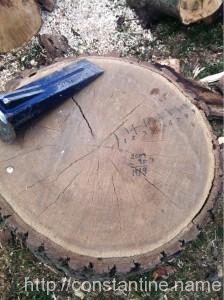
red oak round

Red Oak round. Part of a standing-dead tree felled by my father in 2009.

It’s a beautiful Spring day — perhaps a little too breezy for the 50-something temperature — in the cute little neighborhood where we live. Laid out in the ’50s, our lots are about 60 feet wide and organized into neat rows of little 2- and 3-bedroom homes. From the back patio, I can see directly into the yards of at least a dozen of my neighbors.

We have a wood stove. It’s a magnificently efficient, modern marvel that fills our living room with the distinct glow and flicker of a one hundred thousand year-old technology. The little stove remains cold on the back, gets inconceivably hot on the front, and can heat the entire 1,400 square feet of our little ranch in the dead of winter. It does all that while consuming one big-ass piece of firewood every 90 minutes or so.

In other words, I’m polluting the world. I’m also releasing carbon-dioxide and a host of other truly hazardous chemicals into the neighborhood. (For example, read this revelation of horrors.) In my defense, this is Pennsylvania, the slopes of a wooded mountain start a block from our house, and every house in our neighborhood heats with oil or wood because natural gas is not available.

I digress.

I grew up in a house on a wooded lot, where loss of electric power was not uncommon in the winter. Every Spring, my father, (and later, my father and I,) set about laying up firewood. When he was younger and I was indefatigable, we would cut our own trees, or cut and remove trees for neighbors. The cut rounds would then be laboriously split by hand with wedges and sledge, (no fancy-schmancy log splitters for my dad,) over the course of weeks and months until we had a season’s worth of firewood. Each year we’d burn the wood we’d layed-up two Springs back.

I possess a swirled mass of happy memories related to a deafening chain saw — a kick-ass early ’70s “Mac10” (yes I still have it, no it’s not for sale) — huge bow saws, splittin’ wedges, mauls, worn work gloves, wood chips in all your clothing and socks. I distinctly remember being deemed too young to be allowed to swing the sledge, and being relegated to wedge-starting duty working with a four pound maul. I also distinctly remember my dad wincing as I quickly wrecked the hickory handle of his sledge hammer once I was deemed old enough.

Split your own firewood; It will warm you twice.

They’ve stopped already??

See, I started writing this piece because “the young kids” two yards over were splitting firewood, and I just noticed they have already stopped some time ago. ha! Kids these days.

We’ve a section of shadow box fencing on the side of our yard, so I could only see them in glimpses through the slits. But I could hear the whootin’ and a-hollerin’, and the not-as-rhythmic-as-it-should-be banging and whacking, and also the missin’ and cussin’ and the sound of a sledge handle hitting things.

I could see they were swinging the sledge the way one would swing a tennis racket for an overhand serve. They were hurrying the swings, instead of making each strike count. They were excited when the wood split, rather than being excited by the process of producing firewood with their own hands.

You see, to split with a sledge, you draw the handle back by sliding it through your top hand until your hand nears the head of the sledge. Then you send the head straight up, pushing with your lower hand that is at the end of the handle and sliding your top hand down to meet your bottom hand. As your hands meet, the head of the sledge is up in the clouds. Then — all together — bend your knees slightly, lower your whole body, pull down your arms, and bring everything to focus on the top of that wedge. If you’ve done it correctly, the sledge strikes with a solid BAM! and stays on the wedge with a succinct “da-tink”-sounding hop. When a log splits clean, the wedge sings out, “PLING!”

Last spring I split firewood for hours on end. Carefully. Methodically. For the long haul. While thinking of my father.

BAM-da-tink. BAM-da-tink. PLING!

Splitting firewood as a metaphor for life

Choose the right work.

It’s not enough to choose to do the splitting. You have to split the right wood, at the right time of year. You need a place to do the splitting. You need a place to stack the wood so your labors are ultimately useful. You also need family or friends with which to share the warm glow of the fire as the fruits of your labor.

Use the right tools.

A mechanized log splitter is fine for commercial firewood sellers. But humans splitting their own firewood use hand tools. You need the correct tools; No more, no less. Your pride in your work shall show in the maintenance of your tools.

Strike decisively.

Aim. Strike. Strike correctly. Strike hard enough, but no harder. Strike so that you can strike again and again and again, until your work is well and truly done.

See, this here our fathers wrought for us.

ɕ


A Mile Too Far

a_mile_too_far

Al and I sprawled in the cockpit of “Golly Gee,” our chartered Landfall 43. We were both exhausted.

“This boat is a mess,” I said.

“Real pig sty,” Al commented unenthusiastically.

It was clear we had reached a low point in our vacation. Our energy was drained from the long day it had taken us to sail the 55 or so miles from the French island of Guadeloupe to the British island of Antigua. Also, we had made the serious mistake of skipping lunch since no one felt salty enough to go below while sailing hard on the wind. Furthermore, I had not adequately compensated for leeway and we reached our land fall about two miles down wind. Motoring directly into the big seas for the last two miles didn’t help matters any. Add to this, an anchoring drill worthy of real landlubbers, and it becomes obvious why our spirits were so low.

The smell of hot soup drifted into the cockpit from below. I suddenly realized just how hungry I was. When my wife, Terry, called, “it’s ready,” we moved without hesitation toward the galley. About halfway through the meal I silently promised myself that tomorrow we were not going to skip lunch, even if we had to pack lunch in the morning before getting underway.

After supper, and a short rest below, I returned to the cockpit and looked around picturesque English Harbor at sunset. There was no wind now and yachts anchored around us sat motionless on the glass-like water. Lights were beginning to flicker on and send shimmering reflections across th surface. I could feel my spirits and energy level returning. Our yacht still needed to be squared away, so I set about the task; cover the compass, coil the sheets and halyards, stow the life jackets, rig chafing gear to the anchor line. Al came topside with the sail cover in his arms and, without speaking, we began to wrestle the stiff cloth over the main sail. As we worked in silence, my thoughts drifted back to the events of the day.

Actually, we had made the long sail in excellent ime. Sailing with reefed main and storm jib, we still managed a speed of eight knots in the stiff wind, which I estimated to be about twenty five knots with higher gusts. I wished I had taken the time to gauge the wind accurately with the “windicator” I had brought along, but at the time, the huge waves demanded constant attention at the helm. Even though the yacht performed well in those conditions, the apprehension expressed by Terry seemed to be contagious and soon had everyone nervous. In retrospect, it seemed to me that sailing for hours with that uneasy feeling caused more fatigue than the physical work involved. Tomorrow would be another long day of sailing since our charter was nearly over, and we were still a long way from Parham Harbor, where we started. The many reefs along our path would require careful… no, meticulous navigation. Most everyone enjoys coastal cruising with gorgeous tropical scenery but, I worry more about reefs than big waves.

The next day dawned bright and sunny with puffy cumulus clouds moving high over head. Most of the harbor was quiet and still, except for one dinghy motoring slowly toward shore; its wake sending endless ripples across the otherwise undisturbed water. On shore, the restored government buildings created the illusion that we had somehow traveled backward through time to an era of greater simplicity. I could almost see square-rigged sailing ships against the city dock. The trials and tribulations of the previous day seemed insignificant now, and well worth enduring, in  light of this spectacular tropical splendor.

We went ashore early with all our documents to find the customs officer. We located him near the docks, but he told us we were to wait on our yacht, and he would come out to board and check us through. So we all did an about-face and returned to the dinghy to ride back. In a short time, the customers officer did come alongside in his boat. After exchanging cordial greetings we went below and began the paper work. We showed him our ship’s papers, passports, and cruising permit while filling out several forms. He was very official in appearance and manor, but his big smile and friendly attitude made us all feel at ease.

“Sign here, keep this copy, and give this to the immigration officer.”

“The immigration officer? Where do I find him?” I asked.

“In the police station. The yellow building beyond Nelson’s Dock Yard,” was the answer.

We exchanged cordial farewells, shoved off the customs boat, and began to collect our passports and other papers in preparation for going ashore again. We boarded the dinghy, started the outboard, and set off once more for the city dock. Al drove the dinghy a little faster this trip. Perhaps his thoughts were on the many sea miles we still had to cover before the day’s end. Mine were. With the dinghy secured, our landing party began walking through the dockyard in the direction of the police station. Some natives were setting up there stands at the local flea market. Though it was still early, it was hot, so when the girls stopped to look through some dresses and tee shirts, I bought an almost cold soft drink from a vendor with a cooler. As I sat in the shade, Al took some pictures of our yacht anchored across the harbor. The girls returned with packages, and immediately began to compare their latest shell jewelry and tee shirts. Having finished all this, we were at last ready to move on, except that Al’s wife, Brenda, had to stop and take some pictures of our yacht anchored across the harbor. Parham Harbor sure wasn’t getting any closer.

The police station finally came into sight. We walked into the main room which contained one front counter and nothing else. There was no one in sight. We stood around talking louder than necessary for a few minutes and even faked a loud cough or two hoping to attract someone’s attention. At last a slender fellow in street clothes shuffled into the room and noticed us with some surprise.

“May I help you?”

“Yes,” I responded. “We would like to see the immigration officer.”

Without saying a word the man walked slowly out of the room and was gone for some time. When he did come back, he handed us a form and began to leave the room.

“We already have this form,” I said, showing him the filled-out papers the customer officer had given us. He looked briefly at the papers and left the room again. Be patient I told myself, knowing from experience there was no way to speed up this process. The man returned, this time with another man wearing a uniform-type coat with regular street pants and no shoes. This must be the immigration officer, I thought. I explained once again that the customs officer had given us these forms after which both men left the room. When they returned, the man in the uniform coat asked to see our immigration declaration. After a lengthy conversation, we ascertained that the paper in question had been given to us at the airport upon our arrival two weeks earlier. The man insisted he could not make up new copies even though there was only basic information such as our names, addresses and occupations on the form. Worst of all was the realization that this all-important paper was aboard Golly Gee in the folder containing our airline tickets! So… we all did another about-face to fetch same.

After walking a short distance, the girls volunteered to make the trip back to the yacht since it was not necessary for all of us to go, and Brenda wanted to drive the dinghy. I sat down in the shade with Al to wait. From this vantage point we could see Terry and Brenda heading across the harbor and returning some time later. We could also see them stopping in the flea market one more time. At last they returned, papers in hand.

Back in the police station, we handed the papers to the immigration officer which he took and left the room. When he returned, he was holding a book of receipts. He filled out several lines on each sheet, then his assistant entered the room carrying a rubber stamp and ink pad. The new papers were all filled out in triplicate, separated, and spread on the counter in preparation for the official stamp. Now we are really getting somewhere, I thought. The assistant laid the broken and dried up ink pad on the counter, raised the rubber stamp high above his head, and slammed it down on the ink pad with a resounding BOOM! Each paper was stamped individually in the same manner. BOOM! …BOOM! …BOOM! Now all that remained was to give us our copies. But wait, there was yet another mix up! The papers had been torn out of their book in the wrong sequence and the receipt numbers did not match the originals. The officer and his assistant were now involved in a four-handed paper shuffling drill that included tearing, arrangement, stapling, and re-arrangement, and lasted at least five minutes. Their antics were so comical, that an involuntary smile began building in my cheeks. I looked at Terry in disbelief. Her eyes looked toward the ceiling. Is this for real? Maybe we’re on Candid Camera!

“Sign here, keep this copy, and give this to the port authority officer.”

“The port authority? Where do I find him?” I asked.

“There,” was the answer as he pointed across the way toward Nelson’s Dock Yard.

At the port authority office we were greeted by a well-dressed young man who set about his paper work without speaking. Upon completion, he asked many questions about where we had sailed and how long we had stayed at his place or that. I answered accurately. Then he produced another form and asked for a large sum of money; I can’t recall the exact amount.

“What’s this for?” I asked trying to sound polite.

“Cruising permit,” was the answer.

“But I already have one.” I said, again trying to sound polite. I showed him the document given to me by the charter company. It was a pre-paid, one-year, cruising permit.

“You should have showed this to me before,” he said.

I would have, I thought to myself, if you had asked me or indicated what you were doing. He examined the paper carefully, Including the reverse side (which was blank) several times, and then sat down and began crossing out and writing over most of what he had filled in. Having completed the rewrite, he returned to the counter and asked for a smaller amount of money. We were charged for harbor dues, port of entry charge, and landing fee per person. The entire amount came to about eighteen dollars [USD]. I had neither the time nor the will to argue so I paid the tariff. The man collected my cash then sat down and began writing again.

“Is that it?” I asked after waiting a while. He nodded; we left.

Straight-away we heeded for Golly Gee and made immediate preparations for getting under way. The sun was already high in the sky as Al and I hauled in the anchor. Brenda handled the helm and throttle according to my directions. Everything went smoothly.

“This anchor gets heavier every time we go through this!” we both agreed.

“It is heavier this time!” I said looking over the side.

There was at least twenty pounds of black mud clinging to the anchor and chain. Buckets of sea water and lots of scrubbing only served to spread the gooey stuff. We ended up scrubbing the entire deck before we were through. As we motored seaward, we all took one last look around with that sad feeling in our hearts that accompanies leaving.

Sails were hoisted before we cleared the old fort. It was a fabulous day with a fair breeze from the right direction. Pulling the diesel kill lever worked its regular magic as noise and vibration ceased, and our sleek craft joined in the rhythm of the sea. Knowing there were no hazards to navigation in this area, my mind soon realized it had nothing in particular on which to concentrate. I relaxed in the cockpit while soaking in the pristine environment and warm Caribbean sun with all my sense. Cloud shadows slid silently across the majestic green mountain peaks of Antigua’s western shore. Thick palm groves lined the coast. Soon my exhilaration turned to elation in a way that words or picture cannot describe! I wondered how I had allowed myself to become hassled earlier. It all seemed so petty now.

The next several hours were spent with charts in one hand and binoculars in the other. Antigua has an abundance of nasty things to bump into off shore; all very harmless actually. All you have to do is avoid them! The wind began to fail as we sailed in the lee of the island. Some chart work and math gave me the unwanted answer I expected. We would have to maintain a speed of at least four knots to reach our intended anchorage at a reasonable time of day. This meant starting the diesel whenever our boat speed dropped. Soon it was necessary to take down the sails and run the engine constantly. The miles slipped by and it was late in the day when we finally reached the buoy marking the entrance to Parham Harbor. Once inside, we motored toward the small islands on the eastern perimeter of the harbor. It was our plan to anchor there for the night. This would allow us plenty of time to make the short ride to the charter company’s dock in the morning. After securing the yacht and checking the anchor, we made a hasty departure for some last minute snorkeling and a dinghy ride ashore to watch the sunset.

There was plenty to see ashore even though Bird Island is tiny and uninhabited. It’s cozy cove led to a small beach with a low grassy area beyond. About a hundred yards distant was the other side of he island and another sandy beach. To the right, a steep hill seemed to be calling, “come and see what is on the other side,” and of course we did. The summit revelaed a sheer cliff dropping straigh to the sea with the vast, open ocean beyond. Behind us, Golly Gee lay peacefully awaiting our return while the sun disappeared behind Antigua.

The sun was also setting on our vacation. By comparison, this charter had really gone smoothly. We had visited Antigua, Guadelope, Isles de Saintes and Dominica, and covered approximately 220 nautical miles. We encountered only minor problems which must be expected with a trip of this complexity. Sailing vacations can be more work than relaxation, especially on a bareboat charter. But this is not something I have only recently discovered. However, never before had we tried to cover so many islands and so many miles. I didn’t regret for a moment sailing as far as luscious Dominica, a mountainous, green-clad country of running waters and forests of mahogany, cedar and bamboo; the most unspoiled island I’ve seen. Although the schedule we had to maintain to get it all in, could have ruined our vacation. Yes… that was the problem… the schedule. Having to be there on time can take the fun out of getting there. Dealing with the natives can be exasperating if you are in a hurry. I may have been fooling myself by thinking, “I’m not in harry,” but my true thoughts were on the many sea miles left to cover in the time remaining. Also, jumping from island to island in an international area can necessitate checking in and out of customs and immigrations repeatedly. This can be tedious and expensive. You could spend days or even weeks at places we saw only breifely. For that matter, there is nothing wrong with cruising the same are more than once, since there is always more to see, and it’s never the same vacation.

Some charter companies send charts early so you can look them over ahead of time. This is great! However, making a sailing plan, even a tentative one, is a mistake. The next time I get the chance to charter, I’m going to stick my hook in the first nice place I come to and stay there until I’m good and ready to move on.

~ Bruce Constantine

ɕ