To be in any kind of balance state, especially if it’s new is incredibly valuable to bring you into this moment, because the moment is in constant change. That’s why we call it infinite, right? You can’t grab hold of it and then be there. The second you’re there, it’s gone and you’re in the next one, and that’s this awake kind of living. Balance is the fastest way to enter into that space.
The Victorian love letter and the text message, the memoir and the Instagram selfie — they are all fragments of self-expression frozen in time, expressing a self fragmentary and discontinuous across the sweep of a life, fragments that can never reconstitute for posterity a complete and cohesive portrait of a person, because to be a person is to be perpetually contradictory and incomplete.
Today was a good day. Any day wherein I stumble upon a word I do not know is a good day. I think it’s just right as rain that Huxley would be the source of the “salutary” which caused me to reach for my dictionary. (If it’s also new to you, I’ll give you a hint: It has nothing to do with “salutation,” as I had presumed.)
In addition to the unexpectedly salutary new word—a second hint—I was pleasantly held up in my light reading by Popova’s sentiment. I’m certainly not going to truly understand someone in one brief conversation. But I am definitely better off for each of those experiences spending time visiting another island universe. (That’s one of Huxley’s metaphors. Click thru already!)
Even, a lot of times, those people who you’re not connecting with on a conversational level, you start moving together though— And you find a very deep connection. And now you’re moving in their world or they’re moving in yours, or whatever it is, but you found this other way to connect with somebody that you would have never known if you just worked with them or whatever the case may be.
What drives the creation and evolution of a podcast that inspires and educates young entrepreneurs?
The discussion highlights the role of curiosity and intentional storytelling in podcasting.
I realized I wanted to spend more time actually researching before the interview, and not just try to churn them out. But really try to find the best— find the most useful bits from, people’s story and insights, and go deep.
~ Sanat Singhal (13:17)
The conversation goes into the evolving journey of podcasting, focusing on creating meaningful, impactful content. The challenges of guest selection, maintaining enthusiasm, and crafting episodes that inspire and educate are central themes. Sanat shares insights on transitioning from broad topics to a narrower, more intentional focus to better serve an audience of young entrepreneurs. He also emphasize the importance of preparation, storytelling, and personal curiosity in driving engaging conversations.
The discussion reflects on the value of podcasts in fostering connections, such as listeners engaging with guests or guests connecting with one another. It also explores the personal growth experienced by the podcaster, who recognizes the need to shift from mechanical production to more deeply intentional creation. Themes of inspiration, impact, and curiosity are woven throughout, highlighting the transformative potential of podcasts.
Takeaways
The power of storytelling — Sharing personal journeys can inspire and motivate others.
Intentional focus — Narrowing the scope of a podcast can lead to more impactful content.
Curiosity as a driver — Following personal curiosity often leads to the most engaging discussions.
Preparation is key — Deep research enhances the quality and depth of interviews.
Fostering connections — Podcasts can create unexpected relationships and collaborations.
Balancing entertainment and education — An engaging delivery ensures listeners stay connected to the message.
Refining personal values — A clear understanding of impact can shape content direction.
The privilege of podcasting — Hosting allows sharing diverse perspectives with a broader audience.
Pain is inevitable. Suffering is optional. Say you’re running and you think, “man, this hurts, I can’t take it anymore.” The “hurt” part is an unavoidable reality, but whether or not you can stand anymore is up to the runner himself.
The same way having a diversity of traits within a population is optimal (yet uncomfortable) in nature, and having a diversity of personalities/beliefs/backgrounds is optimal (yet uncomfortable) in society, I would argue that possessing a diversity of values, perspectives, and inclinations as an individual is optimal (yet uncomfortable) for our psychology.
In certain circles there are some oft-posed rhetorical questions: What’s the work only you can do? What, if you ceased doing it, would people miss? …because there’s a lot of other stuff you could choose to do. Stuff which is easy, and which can be done by anyone. And then there’s the other stuff: The stuff that requires us to balance competing priorities, to resolve conflicting requirements, and to choose among exclusive options.
When’s the last time you made a sub-optimal decision knowing that doing so was better than doing nothing?
[F]ear is not a sign of personal weakness, but rather a natural state of discomfort that occurs whenever you’re out of your comfort zone. It’s there not to sabotage you, but to help you come alive, be more focused, and put you into the present moment and a heightened state of excitement and awareness. If you push the fear away, the only version of fear available to you will be its crazy, irrational, or contorted version. If you’re willing to feel it, and merge with it, its energy and wisdom will appear.
What strategies can help individuals manage personal challenges, including emotional and creative struggles, while maintaining growth and resilience?
A conversation navigating the complexities of identity, mental health, and artistic expression.
What I’ve realized is that, for me, I’m trying to just honestly recognize how I feel, when I feel it, and acknowledge it. [The] history of old-school Parkour, art school, and then doing stunts for film, kind of made me very good at ignoring how I feel and powering through it anyway.
~ Brian A. Prince (4:40)
The conversation examines personal challenges and strategies for resilience, emphasizing self-awareness and self-care. The discussion explores how external events, such as the pandemic and sociopolitical movements, prompted introspection and adjustments in mental health approaches. Techniques for recognizing and managing emotional states are shared, with a focus on therapy and understanding triggers.
Creativity and career balance are recurring themes, highlighting how transitioning creative pursuits into professional roles can lead to burnout. Brian reflects on finding sustainable ways to maintain artistic passion and adapting their career to preserve personal expression. Self-awareness, communication, and the need for support systems are underscored as critical to navigating these experiences.
Takeaways
Recognizing emotions — Accepting and addressing feelings is a vital step toward self-care.
Impact of external events — Significant global events can trigger deep personal reflection and change.
Balancing creativity and career — Turning creative pursuits into work can be rewarding but requires boundaries to avoid burnout.
Role of support systems — Having supportive relationships aids in managing challenges and maintaining growth.
Therapy as a tool — Understanding specific therapy needs improves its effectiveness.
Shifting priorities — Adjusting life goals and expectations is often necessary during transitions.
Creativity and well-being — Art and expression remain central to personal satisfaction and resilience.
What strategies can podcasters use to manage the complexities of content creation and sustain their passion over time?
The conversation explores how podcasters balance creative ambitions with practical constraints.
I think what would be a nice way to wrap it— would be, to create some kind of an ebook, or something like that, to condense a lot of the learnings into something.
~ James Fricker (12:24)
The conversation discusses the challenges podcasters face in managing their creative ambitions alongside time and resource constraints. Strategies for prioritizing tasks, such as focusing on specific platforms and using tools to repurpose content efficiently, are explored. The discussion also touches on how podcasters can manage information overload and set boundaries to maintain sustainability.
Career growth and the role of podcasting as a learning tool are significant themes. The potential for podcasting to foster connections within organizations is considered, with an example of private podcasts enhancing workplace culture. Inspirations like Tim Ferriss demonstrate the importance of preparation and structure in creating impactful episodes. The idea of consolidating podcast learnings into formats like ebooks is presented as a way to conclude a series thoughtfully.
Takeaways
Prioritizing tasks — Necessary for balancing podcasting with other commitments.
Repurposing content — Tools can help extend the reach of episodes across platforms.
Career growth through podcasting — Engaging with guests offers valuable personal insights.
Workplace podcasting — Potential for private podcasts to build organizational connections.
Concluding a podcast — Ideas like creating an ebook provide a meaningful closure.
Drawing inspiration — Examples like Tim Ferriss illustrate the importance of preparation.
Knowing limits — Recognizing when to stop fine-tuning an episode is essential.
The player of the inner game comes to value the art of relaxed concentration above all other skills; He discovers the true basis for self-confidence; And he learns that the secret to winning any game lies in not trying too hard.
I love the proverb: If there’s somewhere you need to be, you need to start walking. And the only place where I can start walking? …is right where I am now.
I’ve written a smattering of stuff about my training over the years. Once, in college, (age: 20) I was briefly in shape thanks to several semesters’ of effort put into Taekwondo. But in all that time since, I’ve always done well when someone else tells me what to do. “Do this today at this class. Come back for more.” I’ve also done well following the pack. There was an epoch where I was riding my mountain bike excessively, but I really got in shape when I started meeting up with others and trying to keep-in-sight people much better than me.
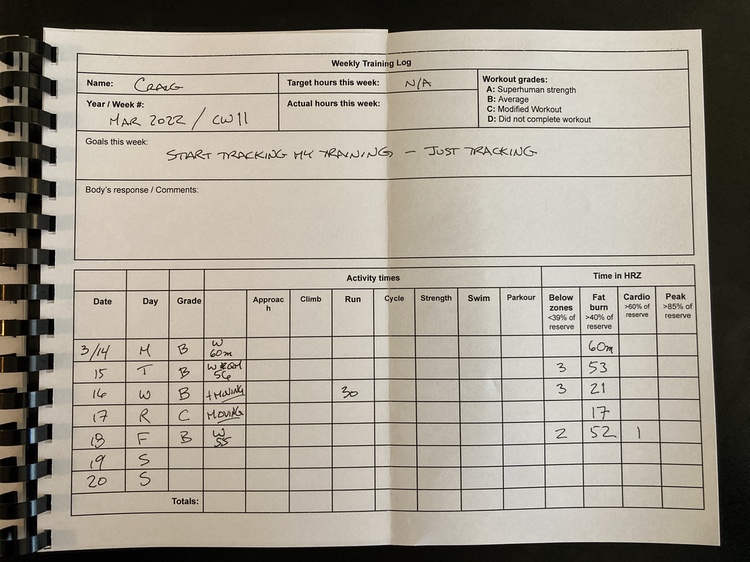
Last year, as the sun disappeared in a Pennsylvania grey winter, I began plotting a way to take what I had experienced when a seriously dedicated friend of mine had been planning my training, and turn it into something I could use in a self-directed fashion. I’m not a professional athlete and I don’t want to train like one. And on the other hand, simply “living my life” being active when I find those opportunities arising is not enough. I need some planning. So I’m working on that. Today, I’m just talking about the first piece of my plan: Tracking activity.
I have an older FitBit. It works fine, it’s not fancy-schmancy… but critically, I refuse to pay them monthly for extra bells-n-whistles. So this tracking sheet lets me take some notes about what I did each day, and to simply copy down the totals of time from the 4 zones that that FitBit tracks. Simply having the tracking system encourages me to be more mindful about activity—for example, it’s rather nice today, and I’ve a run in mind for later this afternoon.
The next piece of the puzzle is to begin working in activities that are more strenght-training in nature. A QM session, (there is one there on Tuesday,) some simple free-weight exercises, some bouldering, etc..
When viewed through an evolutionary or naturalistic lens, to walk, run and move barefoot is, of course, the default human condition. Any alteration of this is an alteration of not just millions of years of bipedal hominid function, but hundreds of millions of years of natural selection’s honing and refining of foot structure.
This is a stupendous deep-dive into our feet. I love the clarity of, “[a]ny alteration of this”. Am I barefoot? (At this instant, yes. With my feet on very rough, old, worn concrete, on my patio, in 50°F weather.) If I am not barefoot, I want that to always have been a conscious choice—some specific reason for why I’ve chosen to alter the function of my feet.
I just want to say that sometimes the things we do online have outsized consequences in the real world. It’s easy to forget that there are real people behind every screen. I forget about that almost every day but better people than me provide some good reminders.
My title refers to the fact that it’s only been four months, and this link has already rotted. In September 2021 I marked this for later reading, (note the /2021/09/ in that URL,) and I only just got around to reading it. I read it as a locally-cached copy in my read-later software, and then realized the link was dead when I tried to write this blog post… :(
I’m so sorry. It was a nice piece about how he had reread some Vonnegut over the pandemic year and… and… it’s already gone?!
Everyone wants freedom. We want to be physically free and mentally free. We want to be financially free and we want more free time. But where does that freedom come from? How do we get it? The answer is the opposite of freedom. The answer is discipline. You want more free time? Follow a more disciplined time-management system. You want financial freedom? Implement long-term financial discipline in your life. Do you want to be physically free to move how you want, and to be free from many health issues caused by poor lifestyle choices? Then you have to have the discipline to eat healthy food and consistently work out. We all want freedom. Discipline is the only way to get it.
No matter what challenge or obstacle you face, whether it’s personal, professional, or global, there’s a path ahead. It’s all figure-out-able. you’ll find a way or make a way, if you’re willing to be relentless, stay nimble, and keep taking action. It’s especially useful to remember when things go wrong, because rather than wasting time or energy on the problem, you shift immediately to brainstorming solutions.
Our lack of perfect information about the world gives rise to all of probability theory, and its usefulness. We know now that the future is inherently unpredictable because not all variables can be known and even the smallest error imaginable in our data very quickly throws off our predictions. The best we can do is estimate the future by generating realistic, useful probabilities.
It’s a good article—of course, why would I link you to something I think you should not read?
To be fair, I skimmed it. But all I could think about was this one graduate course I took on Chaos Theory. It sounds like it should be a Star Trek episode. (Star Trek: The Next Generation was in its initial airing at the time.) But it was really an eye-opening class. Here’s this simple idea, called Chaos. And it explains a whole lot of how the universe works. Over-simplified, Chaos is when it is not possible to predict the future state of a system beyond some short timeframe. Somehow, information about the system is lost as time moves forward. (For example, this physical system of a pendulum, hanging from a pendulum… how hard could that be?)
In creative fields, I think networking actually hurts you in most cases. Don’t waste your time socializing with people who you think can help you. Just get better, and opportunities will naturally present themselves once you deserve them. Only focus on things within your control. And if you don’t know what those things are, find someone who can tell you. Don’t network, just work.