For me, fully internalizing this one powerful piece of inspiring profanity has been transformative. But I still find that returning regularly to the well makes all this work even better. So I downloaded both of the Goggins’s audiobooks and worked through them in little chunks on my morning walks over the period of a month. Then I moved on to Peter Attia’s Outlive, and Jocko Willink’s Extreme Ownership.
I really do know what I should be doing. (I have no idea if you, or anyone else, does too.) But I can tell you that even though I know… it’s still tough to do the soul-crushing work. I’ve not read any of the books above—although Outlive is on my to-read pile.
Our mission, as podcasters is to say “I don’t know” when that is the case, and even more importantly, to make our guests feel delighted to say they don’t know when that’s the case.
At the end of the day there’s an awful lot of what I do as an actor that I don’t necessarily understand – nor should I. One of the necessary evils of acting is doing an awful lot of interviews, which is interesting when you’re asked good questions but it can sometimes be mind-numbing. You feel like, “Why do I have to explain myself? I have nothing to say.” You’re not allowed to say, “I don’t know,” but you don’t always know why you did what you did.
Let’s bend relationship advice to apply to podcasting: Feeling stuck in a rut with your podcasting? Go have a conversation with a guest where your entire intention is to be of service to them.
The asymmetry between wanting to know others and being known by them presents an inherent problem, because relationships require reciprocity: If I don’t do the work to know you deeply, a relationship doesn’t form in which you will know me. This vicious cycle—Poe syndrome again—is made much worse when you are lonely to begin with […] In other words, if no one knows you well and you are thus lonely, that may make you more self-focused and less interested in others, making it much less likely for others to want to get to know you well.
Question: What would happen, if your intention with a podcast episode, was to help some else’s well-being— if your intention was only to demonstrate to them that you care? What if you go into it hoping for nothing for yourself?
So not an intention of, “I want to know X, so I’ll ask good questions.”
But rather, “I think they’d enjoy talking about X, so I’ll ask good questions.”
Answer: It’s totally amazing. It alters your own life. You should go do it 500 times.
(Wether or not you turn those conversation into podcasts is irrelevant of course.)
The How Sound episode, “Getting inside someone else’s skin” (May 14, 2019 from the Sound School Podcast) contains insightful comments regarding why in-person is so great.
(Sorry, I cannot find a web-page specifically for this episode. You’ll have to find it in your favorite podcast app.)
Too long; didn’t listen? Here are my thoughts and opinions…
Listeners can tell when we have captured “humans being” and that can only be done when we humans are in our natural environment. That’s field-recording… pointing a mic at someone in the real-world.
Anything else is not the same thing. Wether that’s in a full studio, over a call even with video on, or when I carry a bunch of gear and give them a mic and great headphones sitting in their home… none of those are the same as field-recording a human being (and I intend both meanings there.)
Anything else is some degree of “disembodied and silenced” — quoted because that is a nugget taken from the podcast.
I do not intend to take dangerous chances, both because I have no wish to get hurt and because a fall would stop my experimenting, which I would not like at all. The man who wishes to keep at the problem long enough to really learn anything positively must not take dangerous risks.
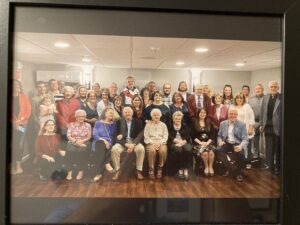
I’ve given a lot of birthday gifts in my years. (I’m sure you have too!) But this photo is a gift I’m particularly proud of.
First, a map: My mother is one of 27 first-cousins. (Her mother was one of eight children.) My mother is one of the youngest of those first cousins (perhaps the youngest, I forget.) Two of my mother’s first-cousins are the man seated center (in the front row, his wife’s arm interlocked) and next to him is his sister, Cocetta (who everyone called Connie).
Several years ago, Connie had a birthday party. An enormous party. An enormous party of boisterous people. At one point, I started going around and forcefully demanding family members proceed into the other room. This wasn’t appreciated by many in the moment, but once I got a dozen people moving, it caught on. And then many people passed their phones to a few volunteers to start snapping. I expect you’ve experienced being corralled into a group photo such as I’m describing. It’s not the greatest family photo ever taken. But it was taken.
Then—and this is the part that few do—after the party I hounded several people until I found the best photo and I ordered professionally printed and framed versions of this photo. I ordered one, quite large version of this photo which was given to Connie for her home. Several smaller versions were given to her closest relatives (like the one in my hallway, shown above.)
Don’t just take those photos, considering gifting them as physical mementos too.