ɕ

9/11 Memorial →

Wow →
Awesome!
ɕ

1WTC →
headed down town! Thanks for the great class and a ride downtown :)
ɕ

Big Apple →
Oh hello Bryant Park, ice skaters and HOT apple cider!
ɕ
500 pullups behind →
As my 10k project plods onward, I’m making good progress. With some renewed motivation to keep knocking out the numbers, I’ve been making a weekly plan and sticking to it for several weeks now. (A big thank you goes out to my “accountability partner”, Clif!)
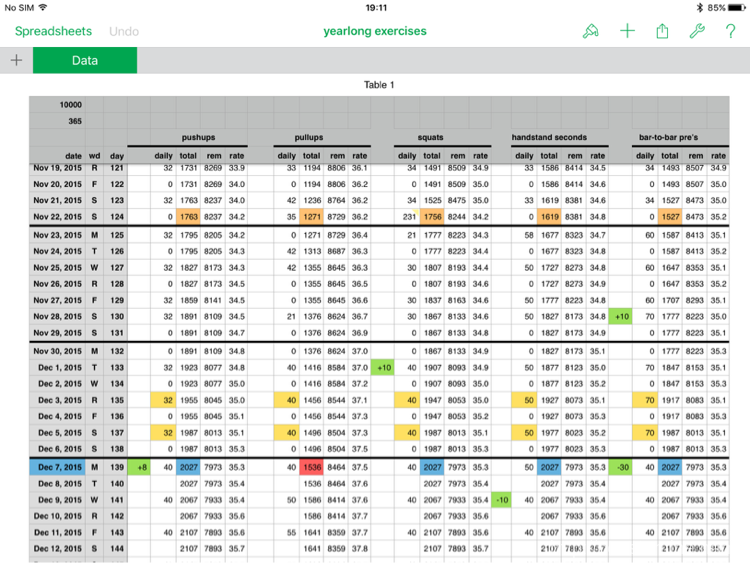
Through November 22 (day 124 of the year-long challenge) I’ve been doing various numbers of exercises. In particular, I’ve recently been doing a “pull-ups program” designed to get me from being able to only do 2 or 3 lousy pullups, to being able to do a few sets.
The orange cells show [what I call] the “odometer problem”: pushups and squats are close in the 1800 range, but pullups are way behind, with handstand-seconds and bar-to-bar precisions adrift in the midlands. Green cells remind me where I’m changing numbers, and yellow cells are planned; That’s the number of reps I should do — so this screenshot is from before December 3rd.
For the last week of November and the first week of December I’m focusing on brining four of the activities into line. Low reps of pushups, easy squat numbers, and a load of bar pre’s. On Monday the 7th, the blue cells show the four coming together. And, after a bit of fiddling, they will also all pass over the 2,000 reps count in the same workout. (Yeah short term goals! :)
That leaves pullups (the red cell) a wopping 500 reps behind the other four. Going forward from the 7th, I’ll keep the other four activities in lock-step and work as hard as I can (without injuring myself) to crank on that pullups number. If I get the math right, I think I can make all five activities come together AND pass 3,000 in a workout near the end of January.
ɕ
30/30 squat challenge redux →
Back at the end of October, I decided I was going to try Ido Portal’s 30/30 Squat Challenge. Basically, attempting to sit (a rest position) in a deep squat for a total of 30 minutes, every day for the month of November.
How did I do? Actually, not so well. I only racked up an average of 11 minutes per day. A few days had only a few minutes, and only on TWO days did I get the full 30 minutes in. It turns out, that making time to sit (squat) down isn’t easy. Most of the time, I just plain forgot. I did best when I set a timer while working at my desk. Every 10 or 15 minutes, the timer would go off and I’d do a one-minute squat.
But, I can see/feel the improvement in ankle and hip flexibility. Initially, I could only manage to squat on the balls of my feet, or rest flat footed if I held onto something VERY sturdy to keep from falling over backwards. Now, it only takes a gentle assistance to sit flat footed. So I think with another, more serious, go at this challenge in December — I’ve gotten all 30 minutes in for the first three days of December — I can finally reach a flat footed, deep squat.
ɕ

Wreath’s up →
Ok, where’s the snow??
ɕ
Peace →
Nothing can bring you peace but yourself. Nothing can bring you peace but the triumph of principles.
~ Ralph Waldo Emerson
Elsewhere, this is 4a37. — slipbox
Book is now available in print →
Quick update to point out that Parkour and the Art du déplacement is now available in print or E versions.
ɕ

Friendsgiving →
In Brooklyn at Jesse and Caitlin’s!!!
ɕ