If no one thinks you can,
~ unknown
then you have to.
slip:4a177.
If no one thinks you can,
~ unknown
then you have to.
slip:4a177.
Another finding of this recent research was that those who believed weight is primarily determined by activity generally ate more than those who believed diet is more important. I am wondering if this observation is, at least in part, a reflection of a belief some have that they can eat relatively freely as long as they ‘exercise it off’. For the reasons I’ve listed above, I’m not sure this strategy is likely to work out too well. And on top of this, sometimes the issue can be compounded by individuals ‘rewarding’ themselves after exercise with food or drink.
~ John Briffa from, «http://www.drbriffa.com/2013/06/20/how-our-beliefs-about-what-controls-our-weight-may-actually-affect-our-weight/»
slip:4udiho1.
Exercise is a huge part of my health (my goals, my reasons for success, etc). But it has, basically, nothing to do with my loss of weight.
ɕ
Hike mountains.
~ unknown
Run through meadows.
Explore forests.
Swim the sea.
Climb trees.
Breath wild air.
Gaze at the stars.
Enjoy the natural world.
slip:4a498.
What role do community, creativity, and challenge play in connecting personal passions with physical disciplines?
Jonny Hart shares the role of parkour in his life, and how that fits in with his career as an artist. He explains the parkour and anatomy art classes that he helped develop, and discusses the joy he finds in coaching and teaching. Jonny finishes by unpacking his thoughts on breaking jumps, and shares the story of the first jump he ever broke.
I specifically make sure that there’s something in there that I have no idea how to do. And none of my skill set has prepared me for it.
~ Jonny Hart (15:30)
The conversation explores Jonny Hart’s journey from fine arts to becoming an advocate and teacher of Parkour, merging art with movement. He shares his early fascination with Parkour, describing its intensity and the unique community bonds it fosters. He reflects on how his artistic background influences his Parkour practice, providing insights into anatomy and movement, and how this cross-disciplinary knowledge enriches his teaching and personal growth.
The discussion also digs into fear and challenges, likening “breaking the jump” in Parkour to creative hurdles in art. Jonny emphasizes how facing uncertainty in both fields leads to personal breakthroughs and joy. His innovative teaching approach combines drawing, anatomy, and physical movement, aiming to make art and Parkour accessible and transformative for kids and others in the community.
Takeaways
Community as a unifier — The Parkour community fosters connections among individuals from diverse backgrounds, emphasizing shared movement practices over other differences.
Art and movement integration — Teaching combines anatomy, drawing, and Parkour to help kids and participants understand their bodies and creativity.
Fear as a teacher — The concept of “breaking the jump” in Parkour parallels overcoming artistic challenges, showing the transformative power of fear.
Non-commercial passions — Jonny Hart emphasizes the value of keeping Parkour as a passion rather than a profession to maintain its joy and authenticity.
The role of teaching — Hart finds fulfillment in teaching classes he loves, recharging his energy and positively impacting his students.
Parkour as a global culture — The Parkour community’s values and connections extend across different cities and countries, fostering a universal sense of belonging.
Resources
Movement Creative — A New York-based organization teaching Parkour and movement skills.
Müv Magazine — A Parkour magazine featuring articles, stories, and illustrations by and for the community.
Parkour Visions — A Parkour nonprofit dedicated to promoting movement education and accessibility.
Tempest Freerunning — A Los Angeles-based Parkour gym that inspired Hart’s initial interest in the discipline.
(Written with help from Chat-GPT.)
ɕ
My level of motivation varies tremendously, and it took me far too long to learn that it was cyclical. I used to think I had these huge swaths of motivated productivity with an occasional, unexplained crash. I used to think I just needed to figure out how to avoid those anomalous crashes, and I spent too much precious time fighting with myself in the down-turns. I now see that I was wrong; My motivation is inherently cyclical.
When I am highly motivated, it’s alluring to believe that I should spend my time working only on focused and directed things. I used to fall into the trap of trying to focus all of my time and energy on moving forward. I felt that if I wasn’t on-task, then I was wasting time, and that feeling fed into my sense of guilt.
Because I now expect the inevitable down-turns, I feel justified spending time on things which support my motivation in the long run. I work intermittently in two directions: I spend some of my time working on-task towards achieving my goals, and some time goofing-off cultivating my motivation and inspiration. In effect, I’m prolonging the motivational peaks by spreading them out wider. At the highest points, I may not be as motivated as I once was, but I maintain a productive level of motivation for a much longer time.
(To be fair, I have a pretty organized way of goofing-off. I read from a wide range of online sources and books, from health, wellness and exercise blogs to physiology text books. I constantly fiddle with new exercises to try, places to go, health tweaks, and habits. I make plans to travel near and far, where I can meet new people, and visit old friends. I even have no-thinking-required things — music playlists, and monotonous chores — which I can draw on when I need to be off-task.)
But eventually, I head into a down-turn. They vary from mild bouts of, “meh,” where I simply feel unmotivated to do any of the things I’ve set out for myself, to dark moods of depression. Regardless of the depth, when I’m heading into a motivational down-turn, my best tactic is to stop doing — to stop trying — and to simply be. It’s as if I’m at the crest of the first hill on a roller-coaster; I see what’s coming, and prepare for the inevitable ride.
At the bottom of that huge, thrill-less, depressing hill it is agonizing to lay in a puddle of “meh” and believe that this is exactly what I need to be doing right now. But that is the truth. After countless cycles of ebb and flow, I’ve learned to think: “Right now, laying in this puddle is exactly what I need.”
…and that is the key to my success.
I remind myself to roll with this down-turn, guilt-free. I try to avoid “should’ing” on myself. (I should stop this. I should do that.) I remind myself this down-turn is only one phase of a healthy cycle.
I rest.
I mope.
Maybe I watch a movie and have some popcorn. Maybe I nap. Maybe I nap in the hammock if it’s warm outside. Maybe I bask before the fire, or lay in the sun. I do whatever it is I feel like doing, which may well be absolutely nothing at all. I throw down the reigns which my executive-level mind normally holds with an iron grip. I set my thoughts and body free. They weren’t listening anyway.
And then I could write a long diatribe where I try to explain how it feels as if there’s this big, gloomy, moping, dog that sits around keeping me stuck in the down-turn. And eventually that dog gets bored and I can convince it to go away. And, honestly, it’s a stupid metaphor. Except for the fact that here I am, stuck writing some lousy metaphor, making me hate writing this, which — it turns out — is exactly the sort of perfect metaphor for feeling lousy when I’m stuck in a down-turn…
I’m going for a walk.
Just the tiniest little stroll.
But…
Walking invariably loosens up my mind. Sometimes it takes days of doing nothing interspersed with some walking before I see the light at the end of the tunnel. Soon, I find I have at least a few things on my mind that need to be unloaded. When I hear that quiet calling, I write whatever-it-is into my journal. Writing things down — moods, worries, plans, ideas — unjumbles my mind. So I record my thoughts as inspiration for future projects, and as reminders to expect future down-turns.
Eventually, I simply find the thought of working on something might actually be fun. At which point I realize I’m headed back towards the next up-turn.
When things go badly, relax; It will not last.
When things go well, relax; It will not last.
ɕ
Always focus on how far you’ve come,
~ unknown
rather than how far you have to go.
slip:4a492.
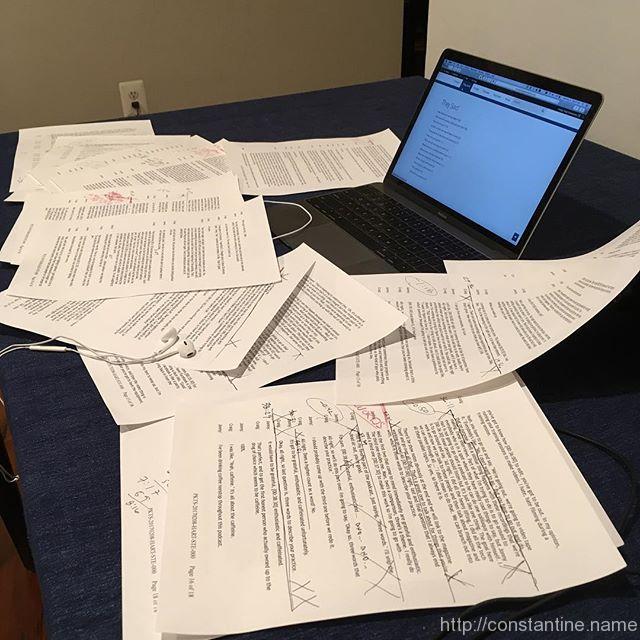
There’s a TON of work goes into each episode. This is the full transcript of a raw interview, marked up. From this we create a cue sheet for the audio engineer. The markings are notes for cutting, and sound cleanup/repairs. #behindthescenes
ɕ
If you don’t stick to your values when they’re being tested, they’re not values: They’re hobbies.
~ Jon Stewart
slip:4a487.
What shall I find?
It’s funny, I thought, if you could hear me, I could hang on, somehow. Silly me. Silly old Doctor. When you wake up, you’ll have a mum and dad, and you won’t even remember me. Well, you’ll remember me a little. I’ll be a story in your head. But that’s OK: we’re all stories, in the end. Just make it a good one, eh?
~ Doctor Who, in Doctor Who (“The Big Bang”), (s5e13, 2010 TV series)
slip:4a1133.
When I travel, I am writing my story.
I am not travelling in search of something.
I am not travelling to escape.
I am not travelling as a search for fulfillment.
I am not lacking some key experience that I can only find by travelling.
What shall I find? …nothing in particular. And then I’m free to find everything.
What shall I experience?
Travel is fatal to prejudice, bigotry, and narrow-mindedness, and many of our people need it sorely on these accounts. Broad, wholesome, charitable views of men and things cannot be acquired by vegetating in one little corner of the earth all one’s lifetime.
~ Mark Twain
slip:4a1120.
I travel because I want to meet new people. I want to learn about their culture, their ideas, their hopes, dreams and passions, their way of thinking, their language, their ancestors, and their philosophy.
I travel because I want to see things. The world — all of it, near and far — is an amazing place. I want to see new vistas, new architecture, new mountains, new valleys, new weather, new plants, new animals, and new art.
I travel because, in the end, I am just a story. There’s no finish line, no definition of “having arrived”, “having suceeded”, or “having it all”. Hearses do not have luggage racks. I am not taking anything with me. I can spend my days sitting at home, collecting and counting and organizing my things, toiling to create a pocket of order in the chaos of the universe. Only, I remain absolutely certain that everything I collect, create, organize, build, and buy will not matter to me in the end.
In the end, I am just a story. And I’d very much like to enjoy the writing of it.
ɕ
It’s funny, I thought, if you could hear me, I could hang on, somehow. Silly me. Silly old Doctor. When you wake up, you’ll have a mum and dad, and you won’t even remember me. Well, you’ll remember me a little. I’ll be a story in your head. But that’s OK: we’re all stories, in the end. Just make it a good one, eh?
~ Doctor Who, in Doctor Who (“The Big Bang”), (s5e13, 2010 TV series)
slip:4a1133.