Optionality lets you do things no one would give you permission to do. It lets you write excellent software and give it away for free if you choose. It lets you do things that don’t make sense in the current climate, but will long-term. It lets you be early while eventually catches up.
Our beloved podcasting is built upon technology from the free (as in freedom and money) World Wide Web. We’ve come to take it for granted, so we just call it the web without even a capital-W.
Every podcast creator talks about getting more listeners. There are billions of people using the web. Searching on the web has to lead to a web site.
My challenge to you is:
Type “Your Show Title podcast” into a few search engines…
(You could also search for the title, or some critical words, or a guest name, from a recent episode.)
What did you get?
How far down those results is it to something that you actually control?
Is there even anything you control, anywhere in the results?
The only thing you can actually control on the web, is your own domain name.
If you want to make a positive difference in the world—or simply maintain your sanity—you need to step back. You need to learn how to be more philosophical—which means being more discerning about what you let into your mind and learning how to see the big picture, calmly and with perspective.
Just in case you had a negative reaction to the word philosophical: I distinctly recall when I thought “being philosophical” meant telling others how to do things, or at least pontificating about how I do things better. I distinctly recall learning that the word comes from “the love of truth”—and how that struck me deeply. I distinctly recall that the more I learned about philosophy in general, the more I wanted to learn about my philosophy—first discovering that I didn’t have a definitely chosen one, and then beginning to choose.
That’s why people stay behind – not because they lack perspective, or self-discipline, or because their dopamine loops have been hacked by evil techbro sorcerers who used Big Data to fashion history’s first functional mind-control ray. They are locked in by real, material things.
There are many things I deeply appreciate and enjoy about the way I do short-form blogging. But one thing I am aware is missing, is more-considered analyses. I do believe that federated systems are the way to keep things from getting completely out of control—as they are today with the big platforms and their enormous machinery behind the scenes. But that belief of mine remains stymied by the reality of how people and communities actually work in real life.
It’s easy to misunderstand the idea of agile and the minimum viable product. We shouldn’t forget that the unspoken rule is: Don’t ship junk. We send a message to the market when we’re in such a hurry that we don’t put in the care and focus needed to do great work.
What Godin is pointing at, I refer to as “being professional.” A professional is someone who understands what he’s talking about, strives be what he’s talking about, and—most importantly—is slightly annoyed by people who are not professional. If non-professional people don’t annoy you (a little bit), you need to recheck your self-assessment. Professionals recognize other professionals (regardless of their respective professions) and professionals prefer to associate with other professionals.
2025? Inconceivable! Still, it’s time to settle on my yearly touch phrase for 2025.
SERENITY
In 2012 I began selecting a phrase or word to use as a guide. David Bourne pointed out there’s a word for that: Cynosure.
When I picked the phrase in 2012, I didn’t imagine it would become a yearly ritual. It required significant reading through my journals to realize I even had chosen cynosures for 2012 and 2015. Over the years I’ve used the following:
2012 – Will-power and self-possession 2015 – simplify 2017 – “A dream is just a dream. A goal is a plan and a deadline.” ~ unknown 2018 – hell yes! or, NO. 2019 – NO. 2020 – get less done 2021 – festina lente 2022 – choose wisely 2023 – choose today 2024 – HUMILITY
There are echoes. For example 2022’s is effectively a refinement of 2012’s. And there’s an over-arching story of simplification and increasing self-awareness. What more could I ask for?
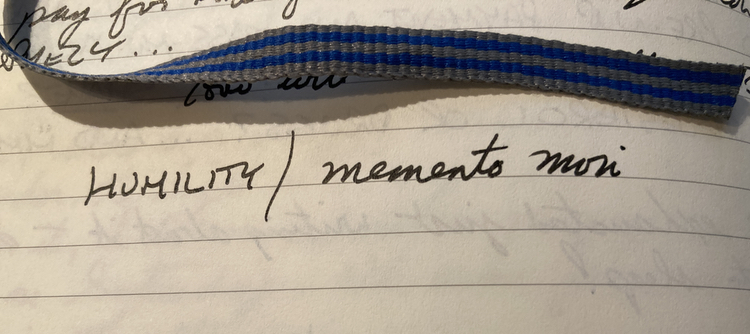
Mostly I use these cynosures in my journaling. I generally end each entry by writing it, followed by memento mori. Here’s the end of 2024…
I’m obviously reminding myself of these ideas. I’m also preparing for my certain death. I will one day write a final journal entry, and it would be fitting to have “memento mori” be my final journaled words.
My choice for 2025 is meant to be aspirational. In some journal entries in December I was writing about themes I might seek more of in the new year; Tranquility, contentment, or perhaps gratitude? Serenity won out because I’d like to maintain my serenity, at all times. Even when active. Even in the midst of chaos.
The amateur believes he must first overcome his fear; Then he can do his work. The professional knows that fear can never be overcome. He knows there is no such thing as a fearless warrior or a dread-free artist.
Life is rich and colorful but to justify the habit you tell yourself that your phone will somehow be more interesting. This is an excuse. If you’re bored by the situation you’re in it’s your own damn fault.
Yes, absolutely. There are levels to this art of being switched on. First is to be come self-aware enough to notice that you are generally off. Second, being able to notice in the moment when you are off. Third, being on. Fourth—and this makes the first three seem easy—being truly happy when others around you are switched off.
If we possess inward solitude we do not fear being alone, for we know that we are not alone. Neither do we fear being with others, for they do not control us. In the midst of noise and confusion we are settled into a deep inner silence. Whether alone or among people, we always carry with us a portable sanctuary of the heart.
*hunh* I’ve been incorrectly using the phrase, “hauling the mail,” forever. I was going to use it as the title for a post about something else and went to see if I could find something interesting to quote… only to realize it means to move things at high speed. I’ve always thought it meant to do something that was once really amazing or challenging, but which is now so regular and routine as to be forgotten—that’s literally what hauling the mail is. Who (besides me?) notices all the hauling of mail which gets done? Anyway. Okay, mental data updated—and I’ll never use it again since it makes not sense for it to be about moving things quickly. ¯\_(ツ)_/¯