Mastering others is strength. Mastering yourself is true power.
~ Lao Tzu
slip:4a252.
Mastering others is strength. Mastering yourself is true power.
~ Lao Tzu
slip:4a252.
When you apply Roundup® to it — as we find with some other Roundup-ready crops — then that disease becomes very intense because the Roundup® will nullify the genetic resistence. So in corn for instance, in 2012 we lost one Billion bushel of corn to a disease that was considered a very wimpy disease of no significant economic consequence througout the corn belt, and that’s Goss’s Wilt.
~ Dr. Don Huber from, «https://blog.bulletproof.com/don-huber-318/»
slip:4ubudo1.
Dr. Huber is — this is my personal take on the matter — the original whistle-blower on Roundup®. I do not like Dave Asprey’s interview style, but I gladly sat through Dave to hear Dr. Huber. If you’re not yet ready to commit to listening, here’s a few things to make you either listen, or rage-quit industrialized food entirely:
Roundup® is a brand name for a (relatively) simple molecule first used to remove scale from the inside of boilers. Generally, the chemical is called Glyphosate. Originally discovered in 1950, in 1964 it was first used as a “chelator” — that is a chemical that will grab and bind minerals such as magnesium, copper, zinc — to remove scale.
Wait. So why does it kill plants? Why is it used as a weed killer? Turns out that trace minerals are like keys to many biologic processes. A zinc atom unlocks this process, a magnesium atom unlocks that process, etc.. If you expose a plant to a chelator, each molecule of the chelator locks on to a mineral atom, and the plant dies for lack of minerals. (Glyphosate is special in that it locks on to MANY minerals. Most other known chelators only grab a specific mineral.) So Glyphosate kills all plants. (Actually, if you think about it, it would kill anything which relies on the minerals that the chelator locks on to. Care to guess if animals rely on minerals too?)
So at first look, chelators are NOT very useful on crops because they kill the crops along with the weeds. This is where the GMO versions of our food crops come into the picture: They are modified (bred, selected, etc.) to resist the chelator. So you can now spray the chelator on the entire field and only the crop survives.
I don’t know about you, but I find that all pretty depressing. But wait! It’s actually so much worse…
Bonus round 1: Does the modified food crop have any other differences? What if the GMO crop was entirely wiped out — as in erased from the planet — by some disease it was formally resistant to? (hint: pull quote above)
Bonus round 2: Does the chelator remain in the food crop? Does it end up in our food products? Is it present in sufficient quantity in the food products to have a meaningful affect?
Bonus round 3: What would happen to proteins in one’s body if the Glyphosate molecule (the chelator meant to pull minerals from the scale inside boilers) happened to be chemically similar enough to one of our normal amino acids (glycine)?
Bonus round 4: What’s the half-life (how many years must elapse before 1/2 of the stuff remains) of Glyphosate? How long after it’s sprayed on a field will it continue being picked up by anything that grows there?
ɕ
Society has any number of pressing needs that are crying out to be tackled. But there’s a need that everyone can start addressing immediately — no experience or Kickstarter campaign required: regularly showing more human kindness.
~ Brett McKay from, What Good Shall I Do This Day?
slip:4uaowa1.
Many years ago, my mother bought me a little metal rectangular paper weight which says, “No act of kindness, no matter how small, is ever wasted.” The type is laid in lines, and the, “no matter how small” is teeny-tiny so each time I read it, I have to look closely.
It also helps me remember to look a little more closely throughout my day.
ɕ
What drives personal growth and resilience in the face of immense physical, emotional, and cultural challenges?
Ševo Saša is best-known as an amazing and creative mover, and the founder of the Skochypstiks clothing line. In this interview he shares the story of his Parkour beginnings after the collapse of Yugoslavia, and his motivation for overcoming a devastating injury in his youth. Sasa’s love of people and profound discipline have enabled him to thrive amidst the cycles of life, and have lead him to tremendous personal growth.
It doesn’t happen with everyone. Everybody can motivate us in different ways, this is true, but this special moment is something that I will remember forever. Because I did something that I really didn’t want to do, I kind of refused it with all my body, with everything, and when we ended I think I hugged him so hard, I was so happy doing this.
~ Ševo Saša (14:00)
The conversation explores the transformative journey from a war-torn Balkan region, navigating through cultural and personal challenges to find purpose and resilience in parkour. The discussion begins with the historical context of Yugoslavia’s dissolution and the challenges of displacement, providing a backdrop to his initial experiences with movement and the foundational influence of his father. Overcoming severe physical injuries, Saša develops discipline through self-directed training and a deep love for movement.
The narrative progresses into his parkour evolution, shaped by diverse environments and communities. From training in Serbia to pioneering connections between neighboring Balkan countries through parkour, the conversation emphasizes the significance of shared experiences. Saša reflects on the broader cultural impact of these connections, uniting people across former divisions, and concludes by highlighting the importance of love, discipline, and people in his practice.
Takeaways
Love for movement — A central theme that inspired dedication and growth in parkour.
Impact of displacement — How personal and cultural history shaped his outlook and resilience.
Discipline as a foundation — Rigorous self-training and perseverance despite physical and mental barriers.
Role of community — The importance of shared experiences in parkour to build connections and unity.
Parkour as a bridge — Its role in uniting people across post-war Balkan countries.
Adapting to environments — Embracing change and new challenges to drive personal growth.
Transformative experiences — How struggles, such as the 101 training, pushed personal limits and created lasting memories.
The power of connection — Focusing on people and relationships over obstacles or achievements.
Resources
Laurent Piemontesi — Insight into the “101” quadrupedal training exercises.
Colin McRae Rally Video Game — A part of Sasa’s recovery story and early life context.
(Written with help from Chat-GPT.)
ɕ
Over the years, I have been collecting and reflecting upon questions that have helped me improve my people judgment, especially around personality and attitude. Here are ten key questions to help you better understand the intrinsic “why” and “how” behind a person:
~ Anthony Tjan from, Becoming a Better Judge of People
slip:4uhobe1.
I read this simple (super simple) article with a list of ten questions… and I all I could think was:
Forget about asking this about OTHER PEOPLE… I’m going to start regularly asking these ABOUT MYSELF!
ɕ
There’s nothing magic about printing on paper and editing with a pen. To me it’s all about changing context, putting my brain in an at least slightly different mode. That’s why I love Lopp’s imperative to “Sit in a different place” — you need to see your own words in a different light.
~ John Gruber from, HOW TO WRITE
slip:4udali2.
Changing context is so critical. There’s deep magic to be found in having loving crafted spaces where you work, think, read, etc.
ɕ
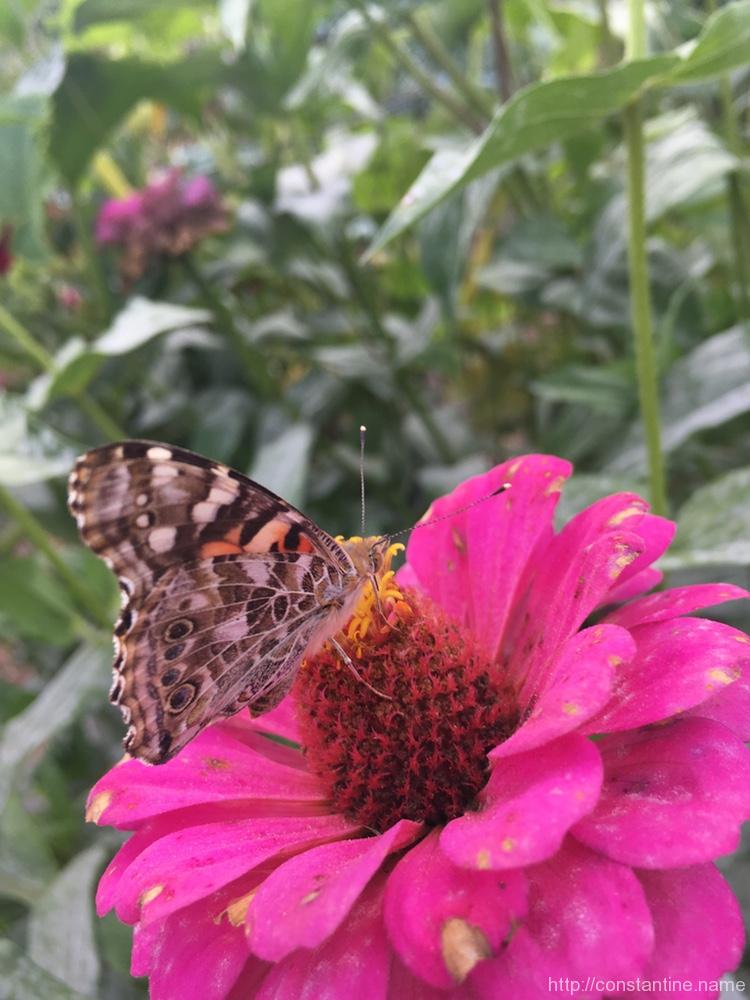
I really thought this was a moth. Turns out it’s a member of the Cynthia Group.
ɕ
… the microbes are holding the reigns to a lot of what’s going on. If we were not doing a good job at passaging them around to additional culturing flasks — specifically other humans — they would undoubtedly discover ways to make us better at doing that.
I think a more optimistic, or different way to frame this, is just that we’re composite organisms. I think we traditionally think of ourselves — the human body — as a collection of human cells. And what we really are is an ecosystem. We have microbial and human parts that come together to work in a concerted fashion to make up this
~ Dr. J Sonnenburg from, Is a Disrupted Gut Microbiome at the Root of Modern Disease?
super-organism. And we can’t forget about the microbes because they’re really an important part of our biology.
slip:4uciia1.
If you haven’t heard much about how important are all the teeny little microbes living in your digestive track, this is a good podcast to get started.
ɕ
The big umbrella for me is this idea of “master the day.” The whole idea is that life doesn’t change — wether it’s weight loss, success, happiness, marriage. It doesn’t change until something today changes. And that by itself is a huge revelation. Because most of us, we may have heard that idea. But if all we did was change something today, then that would already put us on the path we want to be on. And that, again, right there, there’s a philosophical change. Because if we knew that it just took changing small things, and that by changing something small today it would be easeir to change something small tomrorrow, a lot of us would have a much easier time reaching our goals.
So how do you change on a daily level? When you think about it, the average person only reflects about what needs changing, once a year. Right? The New Year we write our resolutions and that’s the only time we reflect on what’s working and what’s not working. One time in 365 days. Imagine if you did that every day. Imagine if you did that 365 times now. Imagine how quickly you could iterate on your behavior and your habits.
~ Alexander Heyne from, «https://becomingasuperhuman.com/habit-mastery-weight-loss-the-secrets-of-success-w-alexander-heyne/»
I sure wish I’d read, (or heard,) this about 10 years ago. Took me an embarrassingly long time to discover this on my own. This is literally the it’s-not-actually-a-secret to all of my success. Small daily changes. Even in the face of catastrophically stupid, self-imposed set-backs. Small daily changes. Every day, one step forward.
ɕ
In your career, you’ve had a lot of soup. You’ve had tomato, chicken noodle, potato leek, and countless others. More importantly, you’ve had different variations of each soup. Big huge noodle chicken noodle. Some amazing type of cream on that tomato soup. This soup journey has taught you a lot about soup. Now, when presented with a new bowl of soup, the moment that counts is the first taste. You taste a bit and wonder, “What is going on with this soup?”
~ Rands, from Act Last, Read the Room, and Taste the Soup
slip:4uraai6.
I don’t intentionally read the room when I’m interacting with a group. (That may very well be a great thing for managers to do. I am not a manager.)
In the last few years however, I have learned to shut up more, and listen more. I feel this has been a huge part of my success at . . . maybe “success” isn’t the right word.
Somewhere in my brain I have the ideas from an article that described interactions between people as boundary/border negotiations between countries; some have walls, some have armed forces, some are open, some are dividing waste-lands, and some have a frequent exchange of ideas. The people on either side of the border can be soft marshmallows (they shape easily to their borders), malleable (they can be shaped by sufficient outside force), etc. I digress.
By learning to listen, I feel people now put up less razor-wire-topped walls to protect their border with me. Less walls means more interaction, and that interaction has been a driver of my progress of self-improvement.
…and reading that linked article from Rands, now I see that it — reading the room, listening, being a person with an open border — is a widely useful skill.
ɕ