Too close to the machines

The programmer, who needs clarity, who must talk all day to a machine that demands declarations, hunkers down into a low-grade annoyance. It is here that the stereotype of the programmer, sitting in a dim room, growling from behind Coke cans, has its origins. The disorder of the desk, the floor; the yellow Post-it notes everywhere; the whiteboards covered with scrawl: all this is the outward manifestation of the messiness of human thought. The messiness cannot go into the program; it piles up around the programmer.

~ Ellen Ullman from, Close to the Machine

slip:4ubaco2.

“The messiness cannot go into the program.”

I’ve never thought of it quite that way before. Every once in a great while, you feel the ground move beneath your feet. That sentence moved the ground for me.

I spent an enormous amount of time being a thorn in people’s sides as I clamored to get them to resolve the messiness so I could then manipulate the machines. I tried explaining the machines. I tried explaining the messiness and what I thought might be ways to resolve it. None of that turned out well for the machines, the people or me. Along the way, I realized that dealing with that every day has fundamentally changed how I think. Up until that sentence at the top, I didn’t have a good way to explain my predicament. I only had this fuzzy idea that reality is one thing, computers work this other way, and here I am stuck in the middle.

The messiness cannot go into the computer.

Maaaaybe, I can use that to remind myself that some particular bits of messiness are okay to ignore?

ɕ


On reading

In this age, which believes that there is a short cut to everything, the greatest lesson to be learned is that the most difficult way is, in the long run, the easiest. All that is set forth in books, all that seems so terribly vital and significant, is but an iota of that from which it stems and which it is within everyone’s power to tap. Our whole theory of education is based on the absurd notion that we must learn to swim on land before tackling the water. It applies to the pursuit of the arts as well as to the pursuit of knowledge. Men are still being taught to create by studying other men’s works or by making plans and sketches never intended to materialize. The art of writing is taught in the classroom instead of in the thick of life. Students are still being handed models which are supposed to fit all temperaments, all kinds of intelligence. No wonder we produce better engineers than writers, better industrial experts than painters.

~ Henry Miller from, Henry Miller on Reading, the Life of the Mind, and How to Fix Education

slip:4ubahe2.

This reminds me of how moving seems to be the only way to sort myself out. Studying movement won’t do.

I often remind myself to always “deploy forward.” Assess. Make a choice. Move. (That would be a move “forward” by definition, since “assess” and “choose” are how I figure out which way “forward” is.) Except in the most extreme cases—so rare as to be almost not worth mentioning—never try to undo (what programs would call “roll-back”) a step. Simply assess, choose and move from the new position.

ɕ


Except by a steady, long continued process

Some day, in the years to come, you will be wrestling with the great temptation, or trembling under the great sorrow of your life. But the real struggle is here, now … NOW it is being decided whether in the day of your supreme sorrow or temptation, you shall miserably fail or gloriously conquer. Character cannot be made except by a steady, long continued process.

~ Phillips Brooks

slip:4a246.


Democracy and civic duty

Many people are uncomfortable with the idea of not voting because they feel like they would then be forfeiting the only power they have over who governs. But your vote contains no power. It is a virtually inert token of your participation, which does carry some sentimental value to some people. But it has no election-swinging ability. There are plenty of actions that can make a difference but casting your vote isn’t one of them.

In the media, your vote is billed as a precious choice with resounding consequences, which means you should watch a lot of election coverage so that you don’t screw it up. Now think for a moment: who might have an interest in having you vastly overestimate the importance of your vote? The candidates, and the news organizations that talk about them 24 hours a day.

You’ve been had. They don’t want your choice to be logical, they want it to remain emotional.

~ David Cain, from If the election really mattered to you, you’d do more than just vote

slip:4uraie1.

Next election, when you see me not wearing an “I Voted!” sticker, go ahead and ask me if I voted.

I’ve stopped looking at everyone’s lapels to see if they voted, and I’ve stopped asking people if they are going to vote. If and when politics comes up, I talk about topics that matter to me. My civic duty—and I believe it is a duty which I fulfill partly in exchange for reaping the benefits of living in a civil society—is to participate in the demoncratic process. That process includes a tiny, irrelevant show of theatre where some people see me at the local polling place. That democratic process also includes a much larger amount of other stuff; my working to understand the issues that interest me so I have an informed opinion. …and then using my brain to participate in the democratic process by browsing, negotiating, buying and selling in the Marketplace of Ideas. I hope to see you there here.

Thanks for browsing my wares!

ɕ


Crowding us out

If chatbots are approaching the stage where they can answer diagnostic questions as well or better than human doctors, then it’s possible they might eventually reach or surpass our levels of political sophistication. And it is naïve to suppose that in the future bots will share the limitations of those we see today.

~ Jamie Susskind, from Chatbots Are a Danger to Democracy

slip:4unyoi7.

This is an interesting read surveying a variety of ways that chatbots might crowd humans out of the very spaces we created.

It struck me that while, yes, chatbots are primitive (compared to “real” AI), they are still having a real affect on our social spaces. Not simply, “it’s noisy in here with all these chatbots,” but rather that our social spaces are in danger of being lost to chatbots.

ɕ


Ten-years and About that “diet”…

This entry is part 69 of 72 in the series My Journey

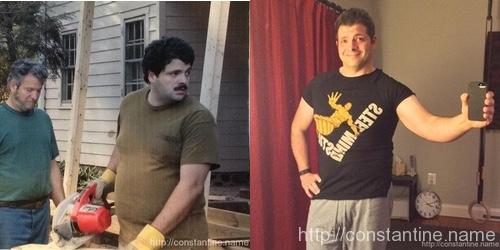
Recently a friend of mine emailed me and asked, “Hey Craig, tell me about that diet you went on a few years ago.” He was referring to what I did from ~2008 to ~2016—the photos above were taken in 2008 and 2016. Below is my response and this just happens to all coincide with the “ten year challenge” currently all over social media.


I did a few things. Each of these took a few months of trying/fiddling until they felt comfortable.

I tried to avoid refined carbs like the plague; I tried to eliminate all added sugar, all refined grain (bread, pasta, etc), and even eliminated granola which was a go-to breakfast staple (with plain yogurt). What really happened was that it forced me to become aware of the carbohydrates I was eating. I still ate pasta and bread and even sweets, but by focusing on, “I am the type of person who eats fish, meat and veggies,” I was able to shift my diet significantly. I started to make choices such as, “if I’m going to eat pasta, I’m not eating shitty pasta, I’m going to my favorite Italian restaurant so I really enjoy it.” I did not count calories. This was not fun as I [in my opinion] was addicted to the blood sugar spikes from eating a lot of carbohydrates. Shifting my dietary balance had the effect of changing my energy metabolism; it caused changes in my liver function and cellular mitochondria performance.

After many months of that, I next worked on my addiction to eating. I started intermittent fasting. (Without consulting my doctor I just jumped all in.) I did (and still do, many years later) “16/8” intermittent fasting; meaning I’m fasting 16 hours-a-day, and permit myself an 8-hour “feeding window.” (Aside: What I now call ‘normal human eating.’) The way I like to do this is to aim for consuming no food after about 7:30pm. That makes it easy to have a normal dinner, including social eating which is super important to me. Then I basically don’t eat breakfast. Around 11:30, (16 hours after 7:30 the previous day,) I have my break-fast while everyone else is calling it “lunch.” Most people never notice I’m doing this. I could talk for hours about intermittent fasting. BE CAREFUL with this; you can faint, or have low-blood sugar problems depending on how wacked your metabolism is.

It’s important to note that I did the above things separately, one after the other. My reading indicated that reducing carbohydrate intake would force my cells to up-regulate all the cellular processes for burning fat—my own pre-installed fat. So my “lower carbohydrates” work was in preparation for the intermittent fasting work. If I was planning to not eat for 16 hours, my body will have to switch to mobilizing the fat from fat cells; the liver has to be able to put glucose into my blood stream from stored-like-a-battery glycogen in the liver, and from glucose created chemically from other substrates. Those in particular were cellular processes that I was hardly using for decades, when I was always-eating and eating lots of carbohydrates.

So the big picture for me was to change my energy metabolism—to recover my [natural, normal, hey humans are awesome] ability to run on various fuels, (be that carbohydrates, protein, or fat I put in my face, or the pre-installed fat.) I did that by first reducing carbohydrates, and then starting to fast.

I’ve written some of my thoughts up on my web site, but it’s all scattered about. Let me know if you want more information on any of the above and I can give you more and point you to specific resources. If you want to learn more, start with my health or self-improvement tags.

All that said…

I’M INSANELY HAPPY I DID ALL THE ABOVE.

I can train like a machine all morning, not having eaten—in fact, if I eat I feel worse when I try to work hard. I’m considering using longer fasts (days, even up to a week) because there are long-term benefits seen in some studies; fast for a week, have improved blood markers for months. But this is definitely out in the land of, “I’m experimenting on myself.” (If you want to learn about long-term fasts, check out Peter Atia’s podcast, The Nothing Burger, it’s a long discussion of a one-week long fast he did with insane amounts of medical science.)

Finally—this is subtle but important—I did not intentionally increase my physical activity. It was not, “I’m exercising to get in shape.” My activity level spontaneously went up in response to feeling better. “I feel like running 2 miles,” is a thought I now have [sometimes] and now I can go run just for fun. It’s a virtuous cycle though; I feel better, I feel like more activity, I feel more better, I feel like more activity, …

ɕ

Marc Mason | Motivational Psychology

On Castbox.fm — Marc Mason | Motivational Psychology

What strategies can educators use to motivate individuals of varying levels and interests to engage meaningfully in physical activities?

Motivational psychology uncovers how to inspire diverse groups to engage in physical activities.

Am I doing enough to get my people, my participants involved in the content?

~ Marc Mason (12:50)

The conversation explores motivational psychology and its applications in sports and education, focusing on strategies to inspire participation in physical activities. Mark discusses his research on eighth-grade students’ reluctance to participate in early-morning physical education classes. He highlights strategies such as incorporating students’ preferences, creating enjoyable activities, and using technology to measure engagement.

A key theme is the interplay between fear and motivation, especially in challenging activities like Parkour. The discussion examines how individuals perceive challenges, and the importance of providing tools to overcome fear. Broader applications of motivational strategies, such as in business or personal development, are also considered, emphasizing self-awareness and active listening.

Takeaways

Motivational determinants — Strategies to inspire individuals to engage in meaningful physical activities.

Fear and motivation — The role of fear in hindering or enhancing participation in challenges.

Listening to students — The value of incorporating participant feedback into activity design.

Engagement through enjoyment — Using fun and relatable activities to foster motivation.

Instruction adjustments — The importance of concise, clear, and meaningful instruction.

Technology in education — Leveraging tools like heart rate monitors to measure and encourage participation.

Autonomy in learning — Creating spaces for individuals to explore and practice without pressure.

Maslow’s hierarchy — Applying the hierarchy of needs to identify and meet participants’ motivational levels.

Universal applicability — Extending motivational strategies beyond sports into other areas of life.

Resources

Maslow’s hierarchy of needs — A psychological framework for understanding motivation and personal growth.

(Written with help from Chat-GPT.)

ɕ


Thought experiment

We should apply the same ruthlessness to our own habits. In fact, we are studying philosophy precisely to break ourselves of rote behavior. Find what you do out of rote memory or routine. Ask yourself: Is this really the best way to do it? Know why you do what you do—do it for the right reasons.

~ Ryan Holiday, p24 The Daily Stoic

I sometimes imagine that the things I can choose to do can be placed on an aspirational spectrum. It’s not a linear, ordered list, but rather a thought experiment to do the pair-ordering; for any two things I could do right now, which is higher on the aspirational spectrum?

I could go even farther than just the pair-wise comparing and imagine all the things in my life might be orderable as…

a b c d e f g h i j k l m n o p q r s t u v w x y z

Fortunately—not a typo—the incessant work of ordering things to pick what to do next is exhausting. It forces me to notice that when I zoom out, I could imagine I’m doing things in the “j” through “q” range…

a b c d e f g h i ( j k l m n o p q ) r s t u v w x y z

I can make things better simply by making some space in my life. If I just drop that “j”-thing entirely I can be comfortable in knowing I’m improving, without having to actively micro-worry about everything all day. Dropping that “j”-thing leaves me with…

a b c d e f g h i j ( k l m n o p q ) r s t u v w x y z

Whereas before my average was between “m” and “n”, just by eliminating something from the lower side, my average moves up. Clearly I can improve my life appreciably by occassionally thinking about all the things I’m doing, and identifying a lower-end thing to drop.

Yes, of course things aren’t really this simple. But it took me a long time to learn the lesson that removing something can produce marked improvement. Some would say that removing is the very definition of how to approach perfection.

ɕ


Instead we spend our time watching TV

Most of our mental development and study discipline comes through formal education. But as soon as we leave the external discipline of school, many of us let our minds atrophy. We don’t do any more serious reading, we don’t explore new subjects in any real depth outside our action fields, we don’t think analytically, we don’t write — at least not critically or in a way that tests our ability to express ourselves in distilled, clear, and concise language. Instead we spend our time watching TV.

~ Stephen Covey

slip:4a526.


The absurdity

We usually (though not always) recognize the absurdity in blaming animals, inanimate objects, or the weather for the annoyances they cause us. Shit happens, and most reasonable people can accept that. But somehow, if we can in any way pin the inconveniences in our lives on a failing of another human being, we are quick to do it.

~ David Cain, from Do You Make a Moral Issue Out of Being Inconvenienced?

slip:4urado1.

Replace every instance of we with I in the above quote and it once fit me perfectly. I sometime mention the fundamental attribution error and that is a significant part of what he’s talking about. But there’s more to it than just that error.

This is something I’ve managed to transform into a snide condescnesion; for example, when driving, I often think, “…aaaaaand, cut me off,” just before drivers do so. I recall how I used to get angry in such situations. Really angry. Fortunately, more than a decade ago, after a lot of meditation, I learned to first witness the anger, then to know when to expect it, and finally to not bother creating it.

Current project: Witness the condescention. Learn to expect the condescension.

ɕ