The parents’ duty to their children is not to cram as many social advantages as possible into their first eighteen years. The parents’ duty is to make sure that when it comes time for the child to pull himself up by his bootstraps, he actually has the bootstraps to pull up.
What experiences and practices shape the transition from structured movement disciplines to embodied, intuitive forms of movement and healing?
Weena Pauly-Tarr shares her history of dance, her brief encounter with parkour, and how those experiences have led to where she is now. She unpacks her work with somatic therapy, and the profound changes motherhood has brought to her life and practice. Weena reflects on her current interests in embodiment and impulse, and discusses her search for what is next.
The only thing I’ve ever wanted in my life—clearly and said out loud—was to be a mom. not to be a dancer, or not to move to New York… none of that was the thing. It was to be a mom. […] And so when I became pregnant, it was like the biggest gift I’ve ever been given. It was like getting the one thing you’ve always wanted, your whole life. It’s terrifying. Because what if it gets taken away, all that starts to come up. So I think what happened is, I had to grapple with receiving the thing I’ve always wanted.
~ Weena Pauly-Tarr (30:31)
The conversation covers how personal experiences with dance, Parkour, and somatic therapy intersect in a lifelong exploration of movement and healing. Weena’s dance background, including work with impactful movement styles like Streb’s Pop Action, shaped her understanding of strength, fear, and embodiment. Parkour later emerged as a natural extension of this interest, allowing for further exploration of dynamic movement in unconventional settings.
Motherhood significantly shifted her perspective, introducing new layers of vulnerability and embodiment. This experience influenced her shift from performance-based movement to therapeutic and somatic practices. She discusses her evolving approach to working with clients, focusing on impulse, somatic healing, and authentic movement. Her exploration of trauma through somatic experiencing highlighted the connections between past injuries and subconscious movement patterns.
I myself have been building a list of things that I want out of my practice. I want it to open options for me, to keep myself curious, deepen my understanding and push my boundaries. I want it to allow me to live more authentic experiences and ultimately fill me with gratitude for being on this Earth.
I find myself at a strange place. “Wants” and “goals” seem to be less interesting for me. Sometimes, I can simply sit for an hour. There’s no sense of accomplishment, and no sense of, “I should be doing …”
Sometimes.
Often though, I’m still driven to line up a tremendous amounts of work, to crush myself trying, to feel I’ve failed when I only manage to accomplish a large portion of the insane goal.
For several years I’ve been writing up a key thought to focus on through the year. 2019’s is, “no.” Coming up on halfway through the year, and I’m beginning to make some progress on shifting my default behavior to listening, sharing, and waiting. Less doing. Less trying. Fewer goals. No reasons.
Our soul is sometimes a king, and sometimes a tyrant. A king, by attending to what is honorable, protects the good health of the body in its care, and gives it no base or sordid command. But an uncontrolled, desire-fueled, over-indulged soul is turned from a king into that most feared and detested thing — a tyrant.
What role does competition play in shaping the growth and community of Parkour?
Michael ‘Frosti Fresh’ Zernow discusses his career, passion for community building, and his experiences with the Red Bull Art of Motion competition. He shares his views on competition in general, his unique perspective on how parkour has grown, and the potential it has as it continues to grow. Frosti explains his involvement in the United States Parkour association, his love of collaboration, and how he’s found and followed his passions throughout his journey.
I think competitions can help create an understandable way for the outside world to connect with this amazing community that we’re building and if we can be involved in it in a way where our voices are heard and where our presence is known then we can build something really beautiful.
~ Michael Zernow (38:23)
The conversation explores the evolving relationship between Parkour and competition, focusing on how competitions, such as Red Bull’s Art of Motion, have shaped the sport. The discussion reveals how Frosti navigates being an athlete, host, and entrepreneur, balancing personal growth with the desire to grow the Parkour community. His experiences shed light on the importance of community building and outreach, as well as the role of organizations like the United States Parkour Association (USPK).
Frosti reflects on his career trajectory, highlighting how competitions and collaborations have allowed him to stay involved in the Parkour scene beyond just being a performer. The conversation touches on the philosophical divide within Parkour about whether competition enhances or detracts from the sport’s core values. Frosti’s perspective emphasizes the need for competition to inspire and provide opportunities for young athletes, while maintaining respect for those who choose to pursue non-competitive avenues.
Everybody is too busy with their own lives to give a damn about your book, painting, screenplay etc, especially if you haven’t sold it yet. And the ones that aren’t, you don’t want in your life anyway.
This entry is part 5 of 5 in the series Travel Gear
I sometimes call this the “M’urgency” kit as it covers both emergency and urgency situations. After the small convenience bag, this is my most-used, ready-to-go item.
First off, you have to decide wether you need a full, commercial, medical kit. If, like me, your primary concern is the common items you need, then I recommend going the route described here. There’s an unavoidable trade-off between size/weight and preparedness which you have to evaluate for yourself.
Deciding what to include was difficult. I began by searching the internet for emergency kits, but all of them had way too much stuff. On the other hand, I could create two separate kits: A micro-sized kit of a few ounces, and a larger one for more serious traveling. In the end, I settled on the kit described here as the best of both worlds. It is worth its weight in gold. Any time I have a bag, this kit is inside.
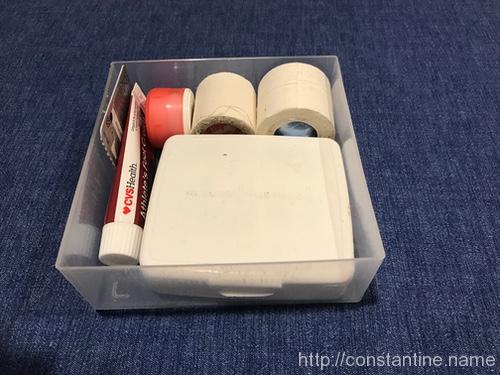
I’m a huge believer in having things pre-packed. “Containerizing” everything does use some additional space and weight, but it’s worth it if you can find the perfect size containers. For this kit, you want a sturdy container that will resist crushing, since this kit is going to take tons of abuse; It will be thrown around, leaned on, jostled and stuffed in/out of bags countless times before that one day when you need it.
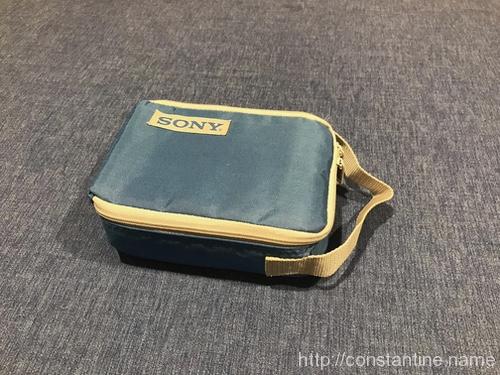
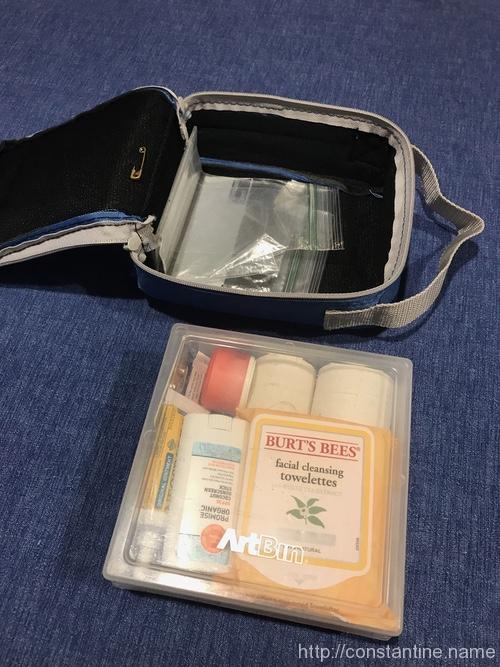
My kit began with a clear-plastic “art box” — unfortunately, I’m not sure where this box came from. In my first iterations, I used this box, held closed with some rubber bands. One day I realized that this box would fit inside a zippered-bag I had laying around. The bag was an ’80s cassette-tape case, which I literally had from the ’80s for storing cassettes. I tossed the cassettes and the internal hard plastic organizer, and the art box fits easily but cannot open once zipped inside.
Eventually, the already tired case came apart and I had to buy a new one off eBay. You might have trouble finding these now because I bought most of them off eBay when I realized they were becoming rare. Since they are different colors, they are easy to find when rummaging in a backpack. (Another one of these bags will appear in a subsequent post.)
large, heavy-duty plastic bag for every time I wish I had a bag for trash, food… and emergency phone storage when getting soaked unexpectedly.
safety pin; pinning, but also can eject SIM cards
…and the plastic box; the really hard part is to pack the box so it does not rattle when you shake it :)
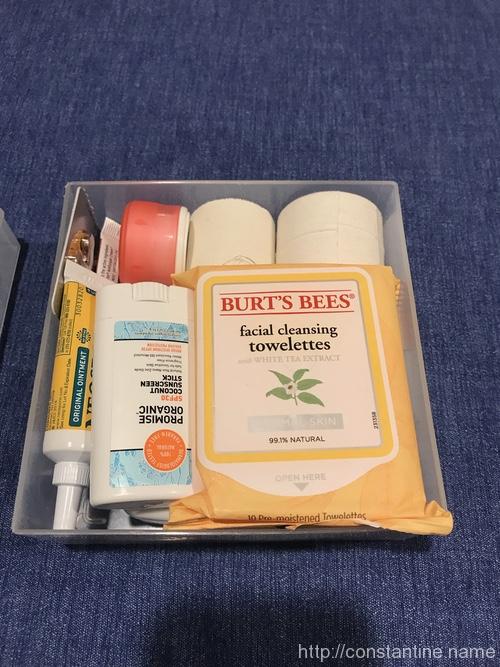
facial towelettes are awesome; a bathroom sink, one of these used for more than “face”, and a clean shirt.
I don’t normally use sunscreen; but the day you need it a swipe-on stick of facial sunscreen can save you and several friends
next layer down (I’m a child of Tetris :)
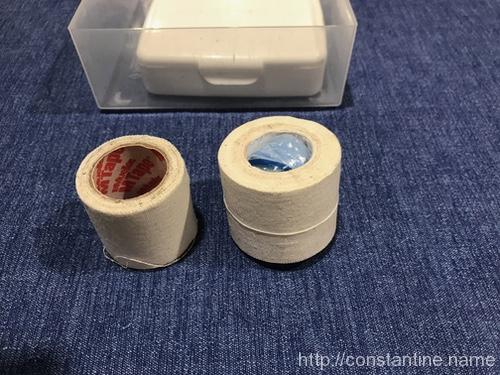
save some athletic tape rolls near their end and they fit. Useful for taping anything of course. Similar to wrapping some tape around your water bottle for random use
there’s a space in the tape rolls!
on the right is a tiny plastic bag with 3 nylon gloves. Yes three, because you always tear one.
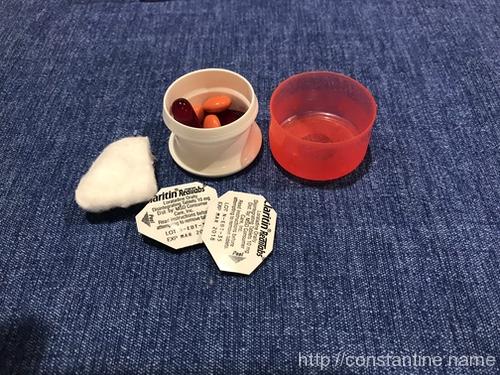
this tiny little pill holder is amazing. You can open it with one hand by pinching it anywhere around it’s middle and it *clicks* open immediately.
packed in here are my preferred selection of drugs. A few standard pain killers and my preferred allergy drug.
the cotton ball ensures things don’t rattle. Here, it’s important to keep the pills from jiggling into powder as well as to eliminate noise.
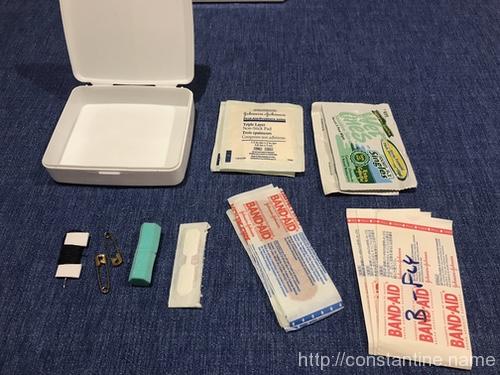
top row…
a small band-aid box I found somewhere. It was a standard pack of various band-aid sizes which I’ve repurposed.
couple of small gauze pads and some alcohol wipes
bottom row…
a needle and a few yards of thread
two safety pins
disposable ear-plugs
small and large butterfly “sutures” and band-aids
Clearly, this also requires some maintenance. What I usually do is any time I use something (say, I give someone some Advil) instead of refilling the pills, I toss ALL the pills and replace the stockpile to keep them fresh. Anything you keep in here can go out of date or dry up etc. and keeping this kit “fresh” is as important as creating it in the first place.
As I said at the top, I don’t expect you to build this exact kit. :) But I do hope that it has given you a few ideas for what you might want to keep on hand.
Teresa Vazquez-Dodero: Motherhood, stereotypes, and risk →
What impact does practicing Parkour have on personal transformation and navigating the challenges of motherhood?
Teresa Vazquez-Dodero describes the changes and sacrifices of motherhood, both in body and mind. She explains her initial experiences with parkour, how the community drew her in, and her views on defying stereotypes in parkour. Teresa discusses her unique perspective of risk, her studies in multiculturalism, and finishes by sharing the benefits of parkour for all ages.
I would describe this relationship as the most liberating body— or relationship with my body and relationship with my environment that I’ve ever had in any sports situation.
~ Teresa Vazquez-Dodero (1:14)
The conversation explores the transformative effect Parkour has on physical and mental well-being, particularly through the lens of motherhood. It highlights the dramatic changes and sacrifices involved in raising twins and the physical challenges that accompany it. Through Parkour, Teresa discovers a liberating relationship with her body, which contrasts starkly with her previous struggles after pregnancy. She emphasizes how Parkour reconnects her with movement, allowing her to reclaim aspects of herself that were sidelined during motherhood.
Another focus is on breaking societal norms and defying stereotypes, particularly those surrounding age, gender, and motherhood. Teresa reflects on her initial fears of not fitting into the Parkour community but ultimately finds acceptance and encouragement. Her insights extend to broader topics such as risk perception, personal responsibility in maintaining physical health, and the importance of continuous movement. She draws parallels between movement, personal growth, and larger societal observations derived from her academic background in multiculturalism and race studies.
A political victory, a rise in rents, the recovery of your sick, or return of your absent friend, or some other quite external event, raises your spirits, and you think good days are preparing for you. Do not believe it. Nothing can bring you peace but yourself. Nothing can bring you peace by the triumph of principles.