Not to be driven this way and that, but always to behave with justice and see things as they are.
~ Marcus Aurelius
slip:4a1068.
Not to be driven this way and that, but always to behave with justice and see things as they are.
~ Marcus Aurelius
slip:4a1068.
While it’s true (and wise) that…
Not to be driven this way and that, but always to behave with justice and see things as they are.
~ Marcus Aurelius
slip:4a1068.
…counsels a steady hand on the rudder of one’s life, it is equally important to know when to tack.
There’s a terrific bit of “life wisdom” you learn from sailing which goes as follows. But first you need the four rules for sailing:
The “trivial” exercise of operating the sailboat in various conditions is left for the reader.
Your challenge then is to get to your destination while following the rules. Interesting journeys will involve being near land, (beware Rule 1 because it’s the wet land that always gets you!) or cover long distances, (beware Rule 2 and 3 because their affects are cumulative and vary with time.) Interesting journeys will involve a specific destination which, thanks to unwritten Rule 5 are always to windward, so you cannot go directly there as per Rule 4.
…but you can go sort of towards it if you aim to the left of the wind’s source. And then you can tack, by turning quickly through the wind and going sort of towards your destination aiming to the right of the wind’s source. Doing so is called “tacking to windward.” Modern sailboats are pretty good at doing this. Ancient sailboats had to switch to rowing, or wait for different wind.
Finally, I can get to this part:
You’re going to be paying a lot of attention, sitting relatively still and watching the sailboat sail. You will also be paying attention to your destination which is almost certainly not directly in front of you. Untrained observers, (if they know your destination,) will be thinking, “why are you going in that direction?” Tacking isn’t very hard, but it slows you down and takes time and effort—you’d rather be sailing along, than tacking many times. (Perhaps at this point you’re thinking about geometry and those related-speeds word-problems you saw as a kid?)
While it’s true (and wise) that, “Not to be driven this way and that, but always to behave with justice and see things as they are.” counsels a steady hand on the rudder of one’s life, it is equally important to know when to tack.
ɕ
On Castbox.fm — Rafe Kelley | The Adaptive Athlete
How can ecological dynamics and adaptive learning principles enhance movement training and skill development?
Skilled athletes show more variability in their movement patterns, contradicting the idea that precision comes from rigid consistency.
What matters isn’t that you did a jump. It’s what the jump did for you. So that’s the first realization. And once you make that realization, then the way that you look at it changes.
~ Rafe Kelley (14:52)
The conversation explores the application of ecological dynamics and adaptive learning in movement training. Rafe explains how human movement is not mechanical but emerges from the interaction between the body and its environment. He emphasizes that movement training should focus on fostering adaptability by creating environments where athletes self-organize solutions to physical challenges, rather than relying solely on prescriptive coaching.
A significant part of the discussion centers on the emotional and social dimensions of training. Rafe highlights how effective coaching requires not only designing physical tasks but also cultivating supportive emotional spaces that encourage growth. He shares stories of students whose personal growth through movement translated into other areas of life, reinforcing the broader value of movement practices as tools for character development.
Takeaways
Movement practice serves personal growth — The goal is not the jump itself but the transformation that occurs through achieving it.
Ecological dynamics shapes learning — Adaptive movement stems from interaction with the environment, fostering natural self-organization.
Emotional space in coaching — Creating a supportive environment allows athletes to thrive and explore beyond physical limitations.
Variability is key to mastery — Skilled athletes demonstrate variability in their movement paths, showing adaptability rather than strict repetition.
Storytelling enhances teaching — Sharing personal stories and experiences deepens the impact of lessons and connects with students on a human level.
Social connection strengthens practice — Incorporating partner-based or group training creates relational growth alongside physical development.
Insight generation through journaling — Reflecting on training experiences solidifies lessons and integrates personal growth.
Resources
Evolve Move Play — Rafe Kelley’s website featuring workshops, podcasts, and movement resources.
Art of Retreat — Information about the event series focused on Parkour leadership and education.
(Written with help from Chat-GPT.)
ɕ
All excesses are injurious, but immoderate prosperity is the most dangerous of all. It affects the brain, it conjures empty fantasies up in the mind, and it befogs the distinction between true and false with a confusing cloud. Is it not better to endure everlasting misfortune, with virtue’s help, than to burst with endless and immoderate prosperity? Death by starvation comes gently, gluttony makes men explode.
~ Seneca
slip:4a431.
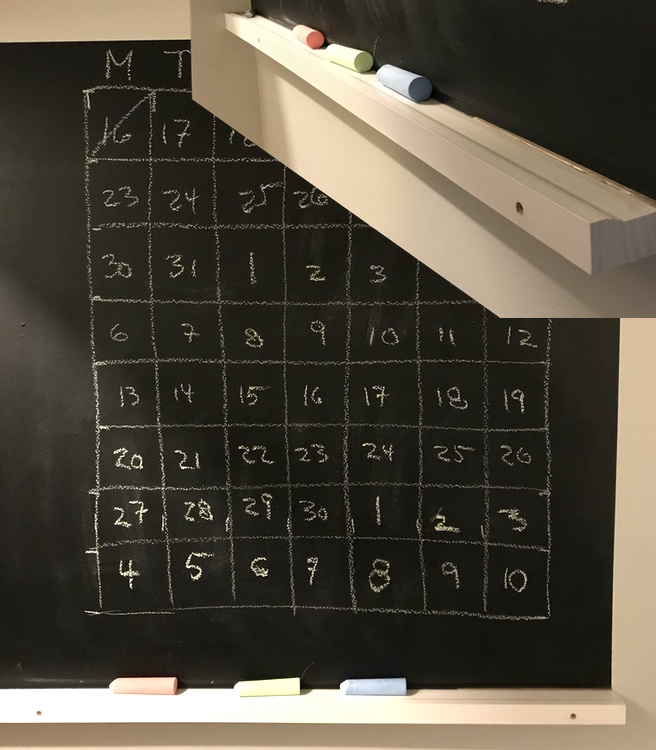
Sometimes you just need to scribble on the walls. In recent weeks, I’ve fallen off of a morning exercise habit—long story. Just takes a few seconds for me to scribble out a calendar grid so I can begin a “don’t break the chain” reboot.
We have three of these chalk boards in our house now. It’s simply paint, (it actually has a lot of blue in it, as real slate does,) and you can probably find labeled-as “chalk board” paint anywhere you buy paint. The trick that no one mentions is that you have to sand the wall with fine sandpaper—chalk boards are smooth, and walls are actually not very. Then a few feet of what’s called “brick mould” cross drilled and screwed to the wall, and finally a few sticks of sidewalk chalk.
Oh, one more trick: If you look closely at the image, midway down on the left, there’s a tiny, smooth, rounded nail head barely visible. I drove that fully into the wall, before I painted the chalk board. It enables me to stick magnets to the wall in a few places, so it’s easy to tack up pieces of paper with little magnets too.
ɕ
I don’t think that anymore. Those fantasies are silly really. As the character Judge Smails played by Ted Knight in Caddyshack so aptly put it, “The world needs ditch diggers too.” … Accepting the fact that you are a contributor to a larger community as opposed to being a Demi-God uberman is not just humbling…it’s a huge relief.
~ Steven Pressfield from, «https://stevenpressfield.com/2014/10/old-dog-new-tricks-2/»
But my biggest challenge is the closely-related problem of continuously thinking about all the things I “should” do. Where, “should,” is a self-evaluated judgement that arises from my thinking about all the things I could do. …and HFS I could do all sorts of things.
Having happily set down all the Big Picture “shoulds,” I’m currently trying to pick off all the true “shoulds.” I’ve learned to stop looking to the stars, and to instead set my sights on the next hilltop. I should put the finishing touches on the garden we built last year. I should get that tree trimmed professionally so it’s good for another 10 years. …those aren’t so bad. But some: I should finish going through all this photography. I should find a home for this pool table. …I’ve been trying to get done for like 10 years.
Overall, there’s a pretty big list, but importantly, the list has not been growing in recent years. On the other hand, it weighs on my mind none the less.
ɕ
So it is: The life we receive is not short but we make it so; we are not ill provided but use what we have wastefully. Kingly riches are dissipated in an instant if they fall into the hands of a bad master, but even moderate wealth increases with use in the hands of a careful steward; just so does our life provide ample scope if it is well managed.
~ Seneca
slip:4a428.
Because soap really does work best, we continue to hear the medical profession instructing we wash our hands with warm water and soap.
But how can your grandmother’s soap—that ancient and simple human technology—work so well?
What is a lipid? A lipid is a substance that repels water, the way a great raincoat repels water. Fats—all of the types of fat you can think of—are lipids. Lipids stick together and make impenetrable stuff like you find baked onto your casserole dish.
What’s in soap? Some of the molecules in soap are surfactants. Surfactants are certain molecules which actively separate lipids. Surfactants separate lipids the way bouncers break up bar fights: They forcefully insert themselves and separate the individual lipids. That’s why soaking your casserole dish in soap and water magically turns the impossibly-baked-on gunk into easily-rinsed-away gunk.
How are lipids relevant to viruses? Viruses have an outer envelope—imagine a rain coat shaped into a beach ball—that surrounds and protects the contents of the virus. That outer envelope is made from lipids. It’s tough like the baked-on-gunk on a casserole dish is tough.
What’s inside a virus particle? Viruses contain a long string of instructions. Your cells contain your personal set of instructions, called your DNA. Viruses contain a set of instructions similar enough that your cells can follow those instructions. When a virus’s instructions get into your cell, the cell is duped into making more viruses rather doing whatever it normally would do.
What does soap do to the lipid envelope of a virus? It does the same thing soap and warm water do to the crud stuck on your casserole disk. Soap makes the lipid envelope fall apart, exposing the virus’ payload of instructions.
What happens to the virus’ instructions without the protective lipid envelope? The instructions are quickly damaged and made useless. The instructions in the virus are extremely delicate. Exposure to oxygen, (1/5 of our atmosphere is Oxygen,) or light, (we have a lot of that too,) or several things found in soap, will quickly destroy the instructions. The DNA in your cells is just as delicate, but your cells have structures and processes to protect and repair your DNA. But unlike your cells, viruses are very simple; all they have protecting their instructions is a lipid envelope wrapped around the outside.
ɕ
Overall I am ending this research more confused than when I started it. I think the most likely dietary change I make is to try to avoid foods with soybean, corn, or safflower oil, since this is probably a good stand-in for “foods processed enough that they count as processed foods and you should avoid them”. I don’t think the evidence is good for avoiding fish oil and olive oil, and there’s enough evidence from elsewhere that these foods are healthy that I’m going to keep trying to eat them. I don’t think the evidence is good for saturated fats being especially good, and there seems to be at least equally strong evidence that they’re bad, so although I’m not going to work too hard to avoid them I’m definitely not going to optimize my diet for getting as many of them as possible.
~ Scott Alexander from, For, Then Against, Hight-Saturated-Fat Diets
slip:4usafo1.
That’s the very last paragraph from a not-overly long piece from Alexander. Overall, yes I agree, I am more confused than when I started trying to sort out my eating.
Which is rather depressing; ~100 years of nutritional science and all we have are a lot of questions. I’ve put a lot of time into trying to figure out what works best for me—for maintaining a healthy weight—and I still am unable to control my weight to a degree that I’d like.
I can say for certain, (n=1, my anecdote, ymmv, etc.,) that there are interlocking causes which I am unable to control. I’ve spent 15 years working very hard, and while I have some ideas of what works, I do not have control.
If you want to read a terrific book that will expand your diet knowledge in some new directions, check out S. Guyenet’s, The Hungry Brain.
ɕ
This is a topic I revisit often in my personal reflection. When I write, I sometimes remember to search my own site to see what else I’ve written on the topic at hand. Lose no time, is exactly as useful to me—hint: incredibly—as when I first wrote it.
I find that things go well once I’m heads-down tinkering away on some specific task. I’ve also learned, but relatively recently in my journey if I’m being honest, to enjoy myself at a relaxed pace in the times leading up to important things; that phone call in an hour, the doctor’s appointment tomorrow morning, etc. In those two cases where it quite clearly could, the urgency demon does not actually come knocking on my door.
As you’re expecting, I’m going to say that there is a third case where the urgency demon does show up, bites off my head, and dances on my chest: When I’m thinking. A thought drifts through the living room of my mind; “that’s a good point, I should do such-and-so about that.” Another thought arrives on the stoop and rings the bell; “oh, yeah that’s probably important and if I just nip it in the bud…” And another thought slips in with the second thought when I open the front door; “actually, I busted my ass on that and now I’m stuck waiting on…” Those three thoughts, now in my living room, realize it’s a party, they each message three friends, and nine new thoughts arrive; “I thought I had all this stuff under control [you should see my systems!] how are there a dozen of you partying in my house? …who brought music?!” Another thought streaks through unbidden; “hey wait, I totally know I had that sorted out, and you agreed to wear clothing…” The pizza delivery guy arrives to feed all the thoughts. Ride-shares queue up my block to pick up the drunken revelers barfing on my lawn. The cops do a second slow-roll after the third noise complaint. And how is there a bonfire in the yard?!
I eventually panic, and flee to food or distraction.
It’s not quite splitting; I sometimes do that, but knowing what it is makes it pretty easy to avoid. It’s not quite catastrophizing; again, been there, know what that is. I think it’s simply mental overload—in the sense of physical exhaustion combined with some feedback looping. The sure sign, for me at least, is when everything starts to seem urgent. When everything seems urgent, (and none of the things are actually urgent in the way choking or a heart attack are urgent,) that’s a sure sign to call, “bullshit!” and to walk—not run—to something other than thinking. Rather than wait until I panic and flee to negative distractions, I’m working on throwing my hands up much sooner at that party: “Well, this is clearly going to get out of hand. I’m outta’ here.”
ɕ