To serve relevant ads and, in return, increase its CPM for advertisers, Spotify needs to know its users intimately. This means that Spotify needs its users to spend as much of their digital lives as possible in its walled garden. The quickest way for Spotify to enable this is to build a podcast streaming capability and stream all available podcasts through its music app.
In the end, Spotify has managed to create a large garden and they’ve enclosed a large portion of the revenue.
The beauty of the Internet—for as long as this remains true—is that it is open. Open technology, open connectivity, open space. That means no wall garden can ever completely contol the thing it encloses. And that’s not even what Spotify wants to do. They’re simply trying to run a business.
And anyone who wants to be an independent podcaster, that too simply goes on.
I’ve started thinking about a touch phrase for 2021. (2020’s was the superbly helpful, “Get less done.”) As part of the thinking, I was browsing the old blog, and wondered when I last missed a daily post. That turns out to be November 18, 2019. It’s simply a random day with nothing posted.
For a few weeks leading up to that 18th, there’s a post on each day. But October of 2019 is Swiss cheese—actually, it’s more hole than cheese. But early to mid 2019 things look mostly solidly-posted. ¯\_(ツ)_/¯ I also know that in the very beginning of this blog I wasn’t even intending to post daily; In the beginning it was just a place for me to put things that I felt I needed some place to put. Unsurprisingly, character by character this blog was built like a drifting sand dune. In 2021 this blog will turn 10. Hello World was posted on August 13, 2011. If I continue, and I see no reason to stop, post number 3,000 should appear in late December 2021.
I bring this up because this time of year is traditionally a time for wrapping things up, and striking out anew, perhaps with a fresh start or a new commitment, into the new year. meh. That never works for me. But you know what has been working well—year-round, not just during this completely arbitrary calendar roll-over point—
LOOK BACK!
Look back at some of the things you’ve accomplished or experienced and think: “Well if that isn’t nice, I don’t know what is.” Seriously. I’m not going to end this post on a, “but if you don’t like what you see…”. No.
Take some time during the arbitrary end-of-the-year machinations to look back and think:
Application and capacity. Eminence requires both. When both are present, eminence outdoes itself. The mediocre people who apply themselves go further than the superior people who don’t. Work makes worth.
Only recently did I become aware of the key point of a Slipbox: It can capture your thinking and enables you to have a discussion with your own thinking. I’m aware of this key point, but I’m not entirely certain it will work. I am convinced that the only way to find out is for me to try the experience.
There are many ways to do capture, and those ways are useful for various things. For example, capturing information with the context necessary to use, or do, the thing captured:
GTD is based on storing, tracking, and retrieving the information related to the things that need to get done. Mental blocks we encounter are caused by insufficient ‘front-end’ planning. This means thinking in advance, generating a series of actions which can later be undertaken without further planning. The mind’s “reminder system” is inefficient and seldom reminds us of what we need to do at the time and place when we can do it. Consequently, the “next actions” stored by context in the “trusted system” act as an external support which ensures that we are presented with the right reminders at the right time.
Other examples are: A collection of books (at personal or institutional scale); personal journals; note-taking (think school studying); at-scale capture of information (Evernote, and ad hoc ways of doing that oneself). There are many more: Personal or team Wikis; Online collaboration systems (Miro, Emvi, et al).
I’ve tried all of the above. Some I’m still using—big time using! Collections of books, notes, journals, Wiki’s, and others.
And yet, something was still missing. The first problem was that I could only sometimes sense there was something missing. The best I can describe it: It’s like hearing a sound and not being sure you heard it. Later, in a very different location, you think you heard the sound. Eventually, you know the sound, without being able to describe it. It’s a sort of pattern in my mind, into which something should fit.
So the current experiment with a Slipbox is my attempt to place a ‘something’ into this pattern— this concept-shaped hole. I will continue to write about this as I go along. Today I wanted to try to take a snapshot of the hole.
ɕ
Angie Flynn-McIver: Intention, communication, and storytelling →
What role does intentionality play in effective communication and personal growth?
Although she is officially an ‘expert’ in communication, Angie Flynn-McIver simply considers herself constantly fascinated by it. Angie Flynn-McIver discusses intention; What it is, coaching it, and practicing it. She shares her own stories of intention, coaching, and travel, and gives advice on finding your guiding stars. Angie unpacks her thoughts on the power of storytelling and how to use your intention to chart your course.
The answer to all of that is intention. The answer to all of that is actually you have to do some really deep personal work to figure out where you’re coming from and what motivates you.
~ Angie Flynn-McIver (12:54)
Angie Flynn-McIver is a communication expert, theater director, and business woman based in North Carolina. As the founder of Ignite CSP, she uses her theater experience to coach others in effective and intentional communication. Angie and her husband are also the founders of the North Carolina Stage Company, an award winning theater in it’s 19th season.
The conversation explores how intentionality shapes communication and personal growth, particularly in coaching and storytelling. It begins by examining the concept of deliberate versus default intentions, explaining how our unexamined patterns often drive behavior and how adopting deliberate intentions fosters meaningful interactions. Insights are shared about how actors use intention to create authenticity, with parallels drawn to everyday communication challenges.
Another focal point is the role of storytelling as both a coaching tool and a human experience. Stories connect intention to outcomes, providing a narrative framework for understanding and navigating life. Practical advice is offered, such as practicing intention in mundane settings like grocery stores to build self-awareness. The conversation highlights the importance of narrative, not just as an enhancer of coaching but as a foundational tool for aligning actions with goals.
Today, a deep dive into how slips get added to the Slipbox. I’ve been working on the Slipbox the last few days—I cannot wait to look back on these posts and the Slipbox in another decade. :) But mostly it’s been meta work: Deciding on format for the slips, and beginning to sketch out the conceptual superstructure of the Slipbox, … tedious and boring and the sort of process and organization work which I flippin’ love. *ahem* What follows here is a story, with photos. I’m going to go through adding three new slips to the Slipbox.
First slip
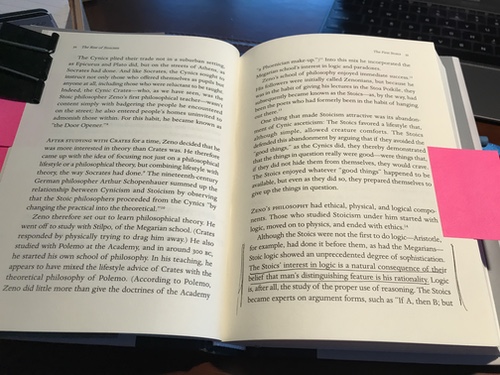
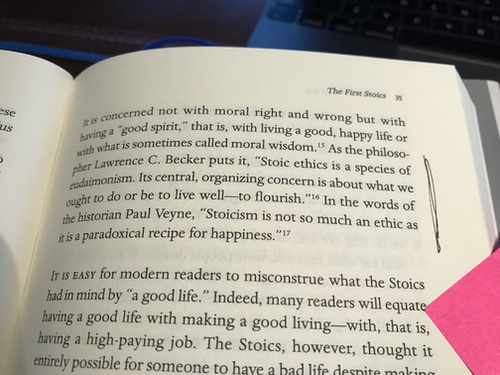
I was reading this book (image below) and I came to the section in the lower right. I thought that was interesting. The underlined bit in particular is a really great sentence about Stoicism. (I’ll get to the actual sentence in a moment.)
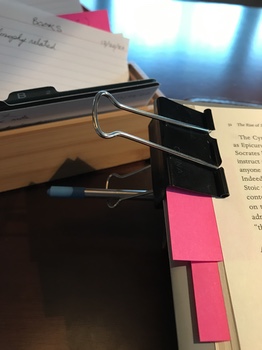
You might be wondering how I manage to make books lie open so neatly. There’s a clever hack (image below) for that. See also, Book holder for paperbacks. I’ve graduated from using a pencil, as I describe in the Life Hack linked, to using these gorgeous steel rods I found. Furthermore, because I’m insane, I used heat-shrink tubing in a lovely shade of blue to cover the ends so they don’t mark up tables and such.
Back to that sentence which caught my eye as I was reading.
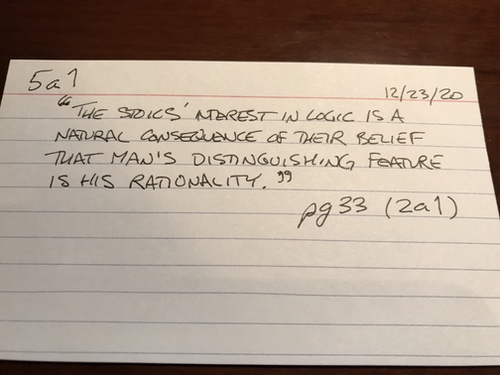
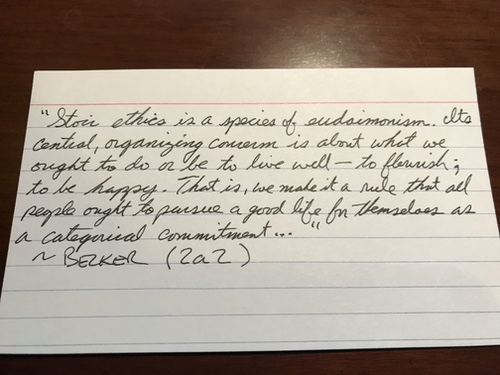
I grabbed a blank 3×5 card—what I’m using for the “slips” in my Slipbox—and I copied the bit I want from the book. (image below) I did not write that “5a1” at the top initially; After I did a lot more of what I describe in this post, it occurred to me to write this post, and I didn’t feel like rewriting this slip to take a photo without the “5a1”.
This slip has the bit I wanted to capture, then the page number, and the “(2a1)” is a slip reference; it’s the address of this particular book’s slip in the Slipbox. These things don’t have to be in any particular layout. They are all obvious in the context. What page number could I possibly mean, other than page 33 in the book itself? What could possibly be a (2a1) in the Slipbox—a book, but I could also just go look at (2a1).
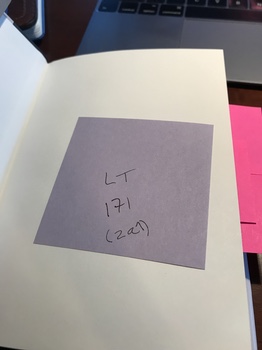
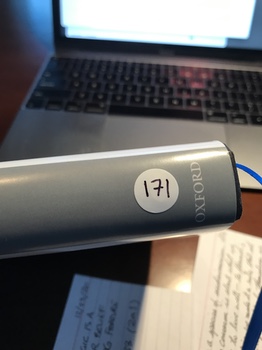
All our books have a note in the front (image below) which say “LT” and which has the major Dewey Decimal System number. I’ll let it settle in, the level of commitment it takes to have done this for every book in the house. But it’s easy to maintain, just do it for each new book as they arrive. The “LT” is a reference to Library Thing, which is a magical web site that tracks library contents. In LT I know every book I’ve ever owned, which are currently in the house, I have a wishlist, etc..—going to a bookstore is magical when armed with that knowledge.
I may as well mention that the Dewey number is on the spine too. (image below) Yes, on every book. Yes, the books in the house are also shelved by Dewey Decimal. I learned a lot about what librarians actually do when I tried to find the Dewey Decimal number for a book—hint, it’s an art, not a science.
So it’s easy to figure out that the book I’m quoting from on this new slip is in the Slipbox at (2a1) because it’s on the postit in the book. I jot that on the slip, “this is where I got this from: Page 33 from the book at slip 2a1.”
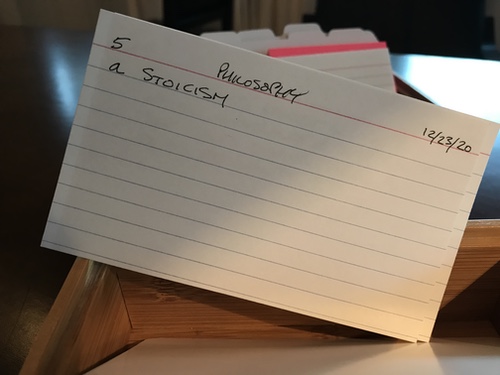
Ok, I’ve capture that little quote. Where do I put this new slip in the Slipbox? Well, I think it’s a great idea about Stoicism, and Stoicism is in the Slipbox already. Below is a photo of the slip whose address is (5)—that’s the “5” at the top left. This is an “early days” slip so it has a silly-short address. This slip is just a list of topics I have under “Philosophy,” today just the “a” section for Stoicism. There is a boring “5a” too (not shown.) This seems silly, until I get to “g” under Philosophy, and that slip is 200 slips farther along in the box. Then I’ll be flipping through looking for that “silly” (5g) slip.
So (5a) already exists, and it is the home of “Stoicism” in my Slipbox. So where do I put my newest slip with this little quote from book (2a1)? I flip to (5a) and realize there’s nothing after it. So this new slip becomes (5a1). I wrote that (5a1) on there dead-last. And then I tossed it into the Slipbox behind (5a).
Second slip
I did all that stuff to make that new (5a1) slip, and then I went back to reading the book. A few pages later I find this…
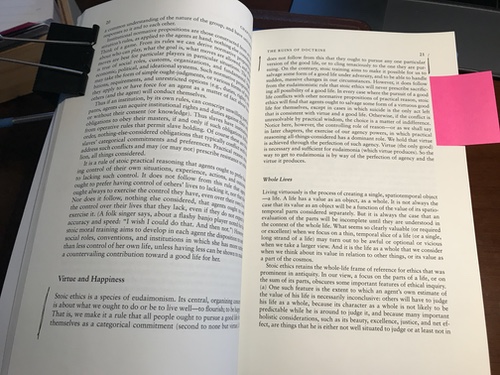
I scribble on the margin (above) since this is interesting. There’s a tiny “16” there. I look at this book’s notes—the book I’m reading in the photo—and it’s a reference to a book I actually have. (There’s also a tiny “17,” but it’s not a book I have.) I grab the referenced book and find the referenced page, starts lower-left (image below)… (I’d love to say the Dewey shelving was handy, but I am also reading this book! So it was sitting close at hand already.)
I had started reading this book before I had a Slipbox. When I looked at it today though, I realized that I’d have captured this exact bit… if I’d had a Slipbox.
Not shown: I made a (2a2) in for this book. Looks much like the (2a1) image above. I added (2a2) to the note in the front of the book.
Then I made a new slip (image below) for this bit about Stoicism… (I also added “pg 20” after taking this photo.) The note in the front of the book says “LT 171 (2a2)”—but I just made (2a2) anyway.
The cool part about this is the slip can lay around if I feel like having it close by. It’s a thought, and I know where I got the thought. When (if!) I want to put it into the Slipbox…
I flip to (5a) for Stoicism… there’s a (5a1) already, so this slip becomes (5a2). I add “5a2” to the top of the slip, I date the slip (the dates are “when it was added” to the Slipbox, not “when I wrote it”,) and toss it in the Slipbox.
Third slip
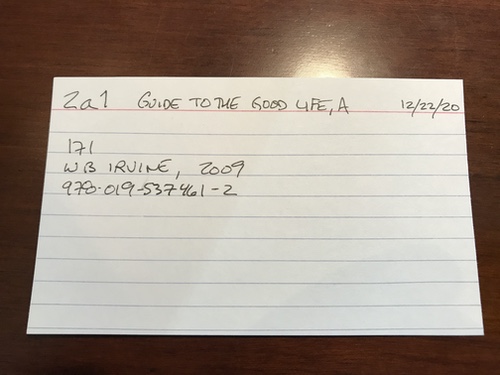
A Guide to the Good Life by WB Irvine is the first book, way above. That’s the one I was reading this morning that started all of this. The next image is (2a1), the slip I created for this book.
Don’t panic. I’m not adding a slip for every book. This isn’t a card catalog for the entire library. This slip got added to create a home for the next card…
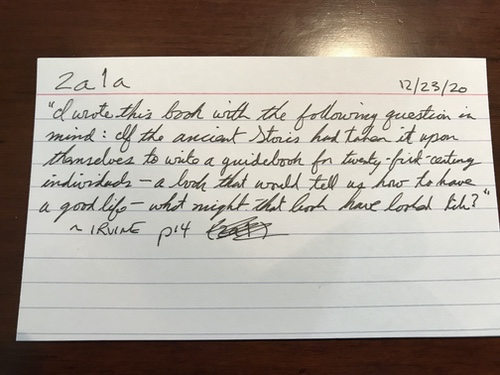
I have a feeling that this book is going to be referred to often. (Often enough to warrant adding it to the Slipbox.) Now, as I find (2a1)—aka references in the Slipbox to this book—when I flip to (2a1), I immediately see (2a1a) which tells me what the book is about. Or least what Irvine hopes the book is about. :)
Consider all that you’ve gone through, all that you’ve survived. And that the story of your life is done, your assignment complete. How many good things have you seen? How much pain and pleasure have you resisted? How many honors have you declined? How many unkind people have you been kind to?
Continuing my thinking about personal knowledge management systems, it’s time to set down my method for pointing to the things on the Internet from a paper system.
The obvious way to do this is to simply write the URL. This is also horrible. URLs are long, and worse they are often, (but not always,) case-sensitive. I’m never going to write a URL in cursive, so I’m left with printing it, and my preference is an all-caps block style, which doesn’t render lowercase characters. The solution of course is what’s called a URL shortener. Hold that thought.
But there is a bigger problem: URLs change. Or more correctly, the resource goes away or is moved. This is referred to as “link rot.” I want to create links in the context of a Slipbox, which I’m expecting to use for a few decades. All the URLs will surely rot. So I’d love to find a way to make links to URLs a little more like a reference to a book, journal, or other physical object.
First, it’s important to remember that such a link would be in the context of a slip in my Slipbox. So the “why is this interesting” will be on the slip. If, (when!) that link rots, I’ve obviously not lost what I captured on the card. What I want, in my solution for linking from paper to the Internet, is some way to capture a little bit of the actual resource—the thing the URL refers to.
Hey! I have that already, it’s my blog. I frequently quote a little and then describe what I’m linking to, and then perhaps riff off that, go deeper, or make some connection.
Recall that every slip in a Slipbox has an address. It’s a baklava-layering of letters and numbers and they are easy to read/write. So I could create redirections on my blog, (this is easy to do.) I could make “a42o17x3”, (some card’s address on which I want to link to a URL) would lead to the blog post with the actual full URL. On the card, I just leave an indication that there’s a URL—maybe that’s a litlte ↬ or something easy to write. Then, when creating the slip to capture the link (and its context/why) I go to the blog and create that redirection (and the actual blog post of course.)
I suspect you’re boggled, but to me that’s easy. But I can make it easier: Just put the slip’s address somewhere in the blog post. Now I’ve eliminated the entire redirection / URL-shortening system. (Which is digital, and therefore will eventually break or become overloaded and crash etc.) I’m already working hard to backup and protect the contents of my blog, so just add a tiny little string in the blog post; I could simply type slip:a42o17x3 and I’m done.
There’s another thing that clicks into place: All the URLs I’ve already captured on my blog might be things I want to import into the Slipbox. How on Earth would I do that? Turns out it’s easy. I already have a website serialize tool that knows how to “show me one year ago today” as a link to my own site. (and any other year-back, so each day I glance at a few previous year’s today’s posts.) This ensures I’ll soon glance at all the URLs I’ve already captured giving me the opportunity to create slips in the Slipbox.
I feel like some things are starting to come together here. ymmv. :)
Weeks ago, I wrote a number of posts about my quest for a personal knowledge system. (See my tag, Knowledge systems.) I’ve continued to think about this, and I’ve conducted a few more experiments. Today I want to unpack my thoughts about using a physical system.
I started into this quest with an open mind. Any physical system—slips of paper, note cards, etc.—will not have the features of a digital system. When thinking about “features” I’m imagining what that feature enables, if anything. So both types (physical/digital) capture data, but the digital system is easily searched, and so on. My thinking was that the digital system (there are actually several) had all of the features of the physical system, and I’d steered towards digital.
One misconception about digital is that it is more durable. I contend that physical slips, (3×5 cards, etc.,) are more durable. Nothing short of theft or a catastrophic fire endangers them. Digital, on the other hand I don’t trust at all—I know enough about how things really work, and I’ve seen enough problems in my 25+ years in tech. But I’d thought, “the digital system is the enemy I know,” and I thought I’d be willing to invest the extra effort needed to maintain the digital system. (Yes, I believe the digital system is more effort to protect and maintain.)
But I think the deal breaker on the digital side is a missing feature of the physical system: The ability to hold many notes in view at once. In a digital system, I’m limited by my display space. In a physical system, I can cover my desk, a table, the entire floor even, (I’ve done it,) with notes and sweep over it quickly. Short of a touch screen the size of my desktop, (have you seen the touch-wall in Minority Report? …jealous,) any digital system will fall short on this feature.
I’m left with one feature missing in a physical system: How to capture URLs. How do I capture links to resources on the Internet? I have an idea about that…