We create stuff

I was going to put together a little post to geek out about the helicopter that flew successfully on Mars. (Just in case you hadn’t heard about that: I’ll pause here, while you re-read that sentence.)

Anyway, turns out that pretty much everyone else on the Internet has done a better job than I could have. For example, here’re four things you should see:

Nasa’s Ingenuity Helicopter succeeds in Historic First Flight. Yes, they attached a wee bit of the original Wright Flyer to that helicopter.

XKCD is… well… it’s XKCD: Aviation Firsts

And Universe Today, (which you should follow and read every word, forever) has, You Wouldn’t Believe What I Just Saw. I demand that you click through that link to see the selfie tweeted by the Perseverance rover. Selfie. Persey even has it’s own Twitter account.

We are the Creator Species. We create stuff. From learning how to make a fire to painting the Sistine Chapel to putting drones on Mars, that’s our jam.

~ Gaping Void from, «https://www.gapingvoid.com/blog/2021/04/19/human-potential-mars-style/»

slip:4ugabo6.

Hey look. I put together a little post to geek out about . . .

ɕ


The fruit of a man’s mind

No great thing comes into being all of a sudden; … Now if the fruit of a fig-tree is not brought to perfection suddenly and in a single hour, would you expext to gather the fruit of a man’s mind in so short a time, and so easily? I tell you, expect no such thing.

~ Epictetus

slip:4a527.


Podcast fracturing continues

Exciting times! Facebook is getting into the game of making Yet Another ™ place that podcast creators will have to jump through hoops to get their podcast shows heard.

Isn’t this all so strange? I mean, shouldn’t the content creators have the power? Shouldn’t entities looking to create a business model have to deal fairly with the creators? It’s as if we, the podcast creators, are doing something fundamentally wrong…

https://openpodcastdirectory.org/

ɕ


Anything noteworthy since

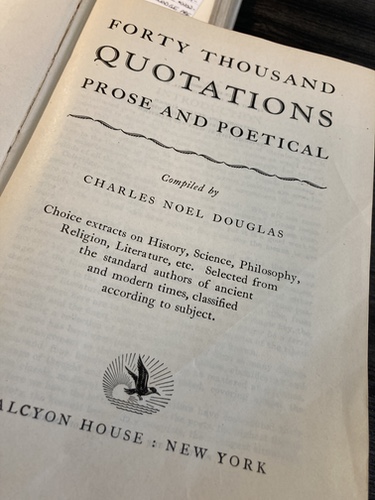
One of my recent acquisitions is this door-stop of a volume, Forty Thousand Quotations Prose and Poetical, published in 1940. Several thoughts spring to mind at this point:

Obviously, this book is 80 years old. Wait, no, that was not obvious to me. I was thinking, “1940… Wow, that’s like 60 years ago,” followed not as quickly as it should have been by, “…no wait, that’s 80 years ago.” So the first thought I’ll share here is that the years pile on like onion-skin pages. Year after year after year after year and before you realize it: Door stop. (Both you have a door stop, and you are a door stop.)

Upon arrival I immediately flipped through it to see what I’d gotten for my $14-plus-shipping. The book says, “prose and poetical,” but I don’t know diddly-squat about this Douglas fellow. There could be forty thousand stinkers better left forgotten. My verdict: The density is low. Perhaps 1 in 4 strike me as even worthy of inclusion in the book. Still, ten thousand quotations prose and poetical are worth 2/10 of one cent each, (in my book.)

It’s said—I’ve heard it said, I’ve said it myself now many times—that our favorite quotations say more about ourselves than of those we’ve quoted.

Is this book a snapshot of 1930’s America? Let this sink in: There’s not a single quote from anyone related in any way to World War II. There isn’t a single modern tech genius in here either. But wait! It was printed in 1940, yes. However the copyrights are 1904, 1914 and 1917. This book is a time machine come to me across more than a century.

I generally give books the page 88 test. That’s laughably near the front of a book which has— (Wait, wat?! This book has exactly 2,000 numbered pages! That’s another tangent I’m not following. Ahem.) Page 88 is laughably near the front of a 2,000 page book. As I carefully flipped towards 88, I was briefly anxious when I thought the entries under “anxiety” might run to page 88, but fortunately, no. The two columns of page 88 cover the tail end of, Apothegm (“a short, pithy and instructive saying or formulation,” honestly, I had to look that up,) then Apparel, and then Apparitions runs onward to page 89.

The first full entry on page 88 is:

A few words worthy to be remembered suffice to give an idea of a great mind. There are single thoughts that contain the essence of a whole volume, single sentences that have the beauties of a large work, a simplicity so finished and so perfect that it equals in merit and in excellence a large and glorious composition.

~ Joubert

slip:4a616.

ɕ


The joy of being wrong

Now more than ever, opinions divide us. Meanwhile, our ability to effectively communicate has degraded, fueled by social media algorithms and self-selected information silos that confirm our biases, calcify our world views, and consequently drive us even further apart. As a result we suffer—individually and as a collective.

~ Rich Roll from, Adam Grant: How To Be a Resilient Thinker

slip:4uripo1.

I’ve been cherry-picking episodes of the Rich Roll Podcast, and this is another superlative one. Roll’s discussion—about a half hour in if memory serves—of trying to be a “lighthouse” makes clear an important point about modeling behavior: Be the change you want to see in the world.

Grant and Roll talk a lot about Grant’s new book; That’s a model for a podcast episode which I usually do not like. And they talk almost as much about competitive swimming and diving, which are two more things I’m generally disinterested in. But to my delight, I enjoyed through (contrast with the more usual ‘sat through’) the first half, and currently have the second half awaiting my ears.

ɕ


Enjoyment

The greatest enjoyment is experienced when there is no concern for its duration.

~ Wu Hsin

slip:4a355.


Peach baskets

In conversation there must be, as in love and in war, some hazarding, some rattling on; nor need twenty falls affect you, so long as you take cheerfulness and good humor for your guides; but careful and measured conversation is always, though perfectly correct, extremely dull and tedious—a vast blunder from first to last.

~ Arthur Martine from, Martine’s Hand-book of Etiquette and Guide to True Politeness

slip:4a610.

“Kid, anyone can fix it with the right tools. It takes a real mechanic to fix it with a peach basket full of junk,” was the punch-line life-lesson from a story my dad used to tell from his first days in the elevator trade.

I’ve mentioned this book by Martine before. Large parts of it are patently ridiculous. But there are parts of it which are solid.

Anyone can learn something from a well-written book. But it takes a first-rate mind, and a lot of practice, to read through a peach-basket full of assorted crap, find the right parts, and find a lesson or three along the way.

ɕ


Flashback: Public service announcement

This post from exactly three years ago bears re-reading: Don’t give away details about yourself

ɕ


Baked geese crap

Everything we do matters — whether it’s making smoothies to save up money or studying for the bar — even after we’ve already achieved the success we sought. Everything is a chance to do and be our best. Only self-absorbed assholes think they are too good for whatever their current station requires. Wherever we are, whatever we’re doing and wherever we are going, we owe it to ourselves, to our art, to the world to do it well. That’s our primary duty. And our obligation. When action is our priority, vanity falls away.

~ Ryan Holiday from, How You Do Anything Is How You Do Everything

slip:4uryho1.

I sometimes think back to a summer I spent working on a golf course. As a grounds keeper. These days, I’m still pretty fast with a string trimmer. A job string-trimming a golf course teaches certain skills. Every day that summer I hopped on my trusty red 10-speed bike—I think it was actually originally my mom’s bike—and ride… just for fun I Google’d it… 5 miles to work. I distinctly remember the coolish Pennsylvania mornings.

It just this moment occurs to me that my “the weather today will be…” prognostication skills are generally quite good. Probably something to do with riding a half hour while wondering if I was going to get roasted in the sun, soaked in the rain, or pleasantly browned.

Meanwhile I learned many things. About getting along with other people to greater or lesser degrees of success. About how laughter makes work lighter. And about good healthy, sweat labor. I already mentioned the string trimming. But my favorite was how we used to edge the sand traps. Every day—at least as far as I can remember—there’d be the same work to do; we’d simply advance our way around the course based on our boss’s early-morning directions on a whiteboard. “edge traps 8/9” for example… along with a few more. One guy was the greens keeper. His responsibility was just to mow the putting greens and tend that grass. Move the pins (the tall flags stand inside special metal cups set into the ground) periodically. Another guy—an aged adult, so he was probably like 38 at the time—was the fairway mower. Willie was his name. I remember his last name, but I don’t want anyone hunting him down. He’d drive a large farm-sized tractor pulling gang-mowers like a flock of geese behind him. All the grass was always cut with reel mowers.

Anyway. Sand traps. We used to edge them with a machete. You see, the edge of the trap, where the grass meets the sand, has interesting geometry. The lawn may not be level, it often was sloped or curving like a little hill. So the “cut” is not just, “hey yo, no blade of grass sticking out that way!” but also, a perpendicular (to the plane of the grass bed) curb of sod (the grass, roots carpet part) and dirt. A string trimmer just sort of beats things up into a rounded mess. With a machete—and a crap-ton of stooping, back-breaking, labor—you can cut everything in a perfect plane. It’s as if you made the perfect cut through layer cake, creating a smoothly undulating curb perimeter, angled perfectly. wack wack wack wack …we’d just walk around the trap backwards, walking on the grass. wack wack wack wack… fifty, maybe a hundred swings. Every sand trap is different. Then we’d clean the trap. Weed it, rake it, sift it, then shape the sand. When we moved on, there’d be not a single bit of anything besides sand in the trap. It’d be gorgeous.

Craftsmanship.

One day, “trim the lake” was on the board. Again. We’d just done that the other day. It was one of the most god-awful horrible jobs. It was basically a very big pond, with not much water flow, particularly mid-summer. The bottom was muck-tastically nasty with geese crap and—wait for it—9 gazillion golf balls making for treacherous footing. The weeds grew in the water. With a string trimmer you can actually trim a bit below the water level if you’re adamant about it. (As we were.) When doing this chore you had a choice: You could stroll into the water and muck to reach the weeds 6 feet out in the pond, or wreck your back, (I don’t care how young you are, this wrecks it,) straining all around the lake to reach out there with the trimmer. Regardless, in the heat of summer, those water-whatever weeds needed a wacking every few days.

On this day, I stood by the artificial rock weir that impounded the pond. I looked at my work boots, being well-shod to deal with the muck, but not so much for standing directly in the water to trim. I looked at the weir. I thought about having to sacrifice my back to reach the weeds. At the weir. I looked at my golf cart—we had the best ones. Special motors for hauling trailers and actual loads and extra batteries. And my we don’t screw around here double-string trimmer and gas can. My face shield. I looked back at the weir.

And I went for it.

I strolled into the stream, moved a bunch of rocks and pierced the maybe 2-foot tall weir… and drained the entire lake. Then I spun up my trimmer and… there are two ways to string trim: One way is a sort of judicious, scalpel wielding, if I twitch it leaves a mark that takes a week to grow away, and I’m going to have to clean up all the mess I make. And the other way is BANSHEE STYLE! I strolled into that disgusting muck and strode around the entire thing with the trimmer throttled wide open… non-stop… at like 6:30am. Muck, geese crap, golf balls, weeds… everything flying every which way… none of it on me of course because, duh, string-trimming guru.

Meanwhile, the sun crept higher.

I don’t know how long it took me. Not long. I don’t think I even had to refill the trimmer’s gas tank. But all the while, the sun started to bake the mud and muck.

Now the area (the general regional area I mean) had a lot of farms and you got used to all sort of smells. Pennsylvania smells (to me) like petrichor, and maybe a dash of cow or horse manure baking on a field. Us Pennsylvanians are all like, *yawn* “whatever bro’.” But baking geese crap and muck, as it turns out, is another thing.

Yes, when I finished trimming I reassembled the weir, but as I mentioned, the little creek’s flow rate was low, and it took all stinking-to-high-heaven day for that thing to fill submerging the muck. I was vindicated amongst the groundskeepers, including my boss who went to bat for me so I could keep my job, because we all freakin’ loved it. It looked awesome and stayed awesome for like TWO WEEKS!

But to my knowledge, no one ever did it again.

That was the first time I effectively closed an entire golf course.

ɕ

Fundamentally

What is this, fundamentally? What is its nature and substance, its reason for being? What is it doing in the world? How long is it here for?

~ Marcus Aurelius

slip:4a518.