To paraphrase Jim [Loehr]: The power broker in your life is the voice that no one ever hears. How well you revisit the tone and content of your private voice is what determines the quality of your life. It is the master storyteller, and the stories we tell ourselves are our reality. For instance, how do you speak to yourself when you make a mistake that upsets you? Would you speak that way to a dear freind when they’ve made a mistake? If not, you have work to do. Trust me, we all have work to do.
Excellence is the next five minutes, improvement is the next five minutes, happiness is the next five minutes. This doesn’t mean you ingore planning. I encourage you to make ambitious plans. Just rememeber that the big-beyond-belief things are accomplished when you deconstruct them into the smallest possible pieces and focus on each “moment of impact,” one step at a time.
To laugh often and much, to win the respect of intelligent people and the affection of children […] to leave the world a bit better […] to know even one life has breathed easier because you lived. This is to have succeeded
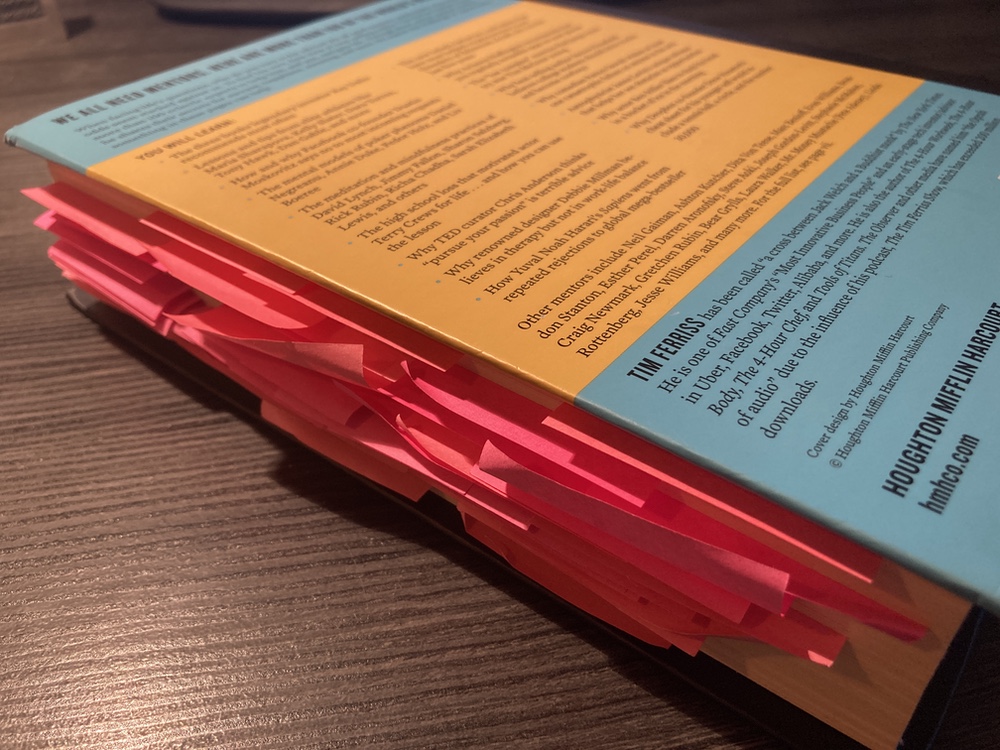
Ferriss’s Tribe of Mentors was published in 2017, and arrived in my collection as a gift in 2018. It took me three years—until 2021, March of this year in fact—before I was finally ready to read it. I have a couple, (and “couple” always means two,) of things to say about the book.
Excellence is the next five minutes, improvement is the next five minutes, happiness is the next five minutes. This doesn’t mean you ingore planning. I encourage you to make ambitious plans. Just rememeber that the big-beyond-belief things are accomplished when you deconstruct them into the smallest possible pieces and focus on each “moment of impact,” one step at a time.
As I was reading, I marked about 50 quotes. I didn’t count the markers I inserted, and some of them are at sections with several quotes. There are quotes from the people in the book, there are quotes that Ferriss included in single-page, “quotes I’m pondering” section breaks, and there are precisely three quotes from Ferriss himself. (All three are here, in this post.)
The first thing I want to share about this book is that it’s not really Ferriss’s book. He didn’t write a book. The vast bulk is other people’s work and writing. Some of those people impressed me, some were “just” solid humans being their best, and some struck me as self-deluded; which makes it a superlative book. Where—let’s be honest—can one get insight on 100 different people and tuck it under your arm? Insight on people you’ve heard of, people you’ve not yet heard of, and even some people you’ll probably never care to hear of. Furthermore, having myself done a bunch of, “you’re just capturing what other people say,” work, I’m qualified to say: He did the deceptively difficult work of asking. He asked and followed up and nudged and organized (and indexed and cross-indexed) and cast light on people he thought were worth giving a platform.
To paraphrase Jim [Loehr]: The power broker in your life is the voice that no one ever hears. How well you revisit the tone and content of your private voice is what determines the quality of your life. It is the master storyteller, and the stories we tell ourselves are our reality. For instance, how do you speak to yourself when you make a mistake that upsets you? Would you speak that way to a dear freind when they’ve made a mistake? If not, you have work to do. Trust me, we all have work to do.
Which brings me to the second thing: There’s a very slim section hiding at the back. If I noted its existence when I read the Table of Contents, (I always read Tables of Contents,) six months later I’d certinaly forgotten the section existed. I could very easily have put the book down most of the way through and completely missed it. If you read nothing else in the book, this last section is the part you should read. I checked and it’s not published as a blog post by Ferriss, (but it’s small enough it could be.) Borrow or buy the book if just to read the last section.
Based on everything I’ve seen, a simple recipe can work: Focus on what’s in front of you, design great days to create a great life, and try not to make the same mistake twice. That’s it. Stop hitting net balls and try something else, perhaps even the opposite. If you really want extra credit, try not to be a dick, and you’ll be a Voltron-level superstar.
How do podcasts create opportunities for connection, learning, and personal growth?
Exploring how veterinarians use podcasting to promote well-being and personal development.
We don’t take care of ourselves very well. We focus on the caregiving for the animal and for the owner and we tend to put ourselves last, so my podcast focuses on well-being and personal development.
~ Stacey Cordivano (8:03)
The conversation examines how podcasting fosters connections and opportunities for growth. It discusses how starting a podcast can lead to new professional and personal relationships, opening doors to collaboration and unexpected outcomes. Stacey reflects on the challenges and rewards of podcasting, emphasizing the importance of consistent effort and feedback from the audience. She also note how social media has complemented these efforts, particularly within niche communities like veterinary professionals.
Another focus of the discussion is the unique perspective veterinarians bring to podcasting, rooted in their caregiving nature and their need to adapt and problem-solve. Stacey shares how her podcast addresses mental health and personal development within the veterinary field, aiming to provide resources and insights that are not typically emphasized in their professional training. She also highlight the joy of learning and how their podcast keeps them accountable and motivated.
What role does curiosity play in shaping movement, interactions, and personal growth?
The nuanced relationship between uncertainty and opportunity defines how we engage with challenges.
If you protect yourself from all uncertainty, maybe you are protecting yourself from falling down a well or getting eaten by a bear, but you’re also protecting yourself from love.
~ Flynn Disney (8:05)
The conversation begins with an exploration of curiosity as a driving force behind personal growth and movement practices. Curiosity is described as a positive sense of uncertainty, where individuals embrace the unknown with hope rather than fear. This attitude ties directly to embodied experiences, where physical movement reflects the mental and emotional processes involved in navigating uncertainty.
The discussion touches on boundaries, games, and goals, emphasizing their roles in learning and engagement. A notable insight is the idea that boundaries create meaning in challenges, as seen in activities like parkour and games. The interplay of failure and success, described as the resolution of uncertainty, is vital for developing curiosity and staying motivated. Personal anecdotes, such as training dogs and solving puzzles, highlight how curiosity manifests across diverse contexts.
I’m a child of the vinyl album era. We had a collection—about 5 feet of shelf space—of classic rock, some jazz, the usual suspects collected during the 60s, 70s and into the 80s. There was sublime magic in that vinyl. My dad wasn’t an audiophile per se, but he had a few nice things that comprised the stereo system, and the crown jewel was a Marantz turn-table. We had special soft-cloth cylinders for gently lifting dust off the surfaces. We even had a little space-ray-gun-looking thing that [as far as I recall] neutralized static charge on the vinyl, (which apparently can accumulate when you pull them out of their sleeves.) A classic Pioneer amp… at one point he found someone who rebuilt his speakers for him—repair rather than replace was, at one time, the norm in America. There was a dedicated cabinet for the gear, with a built-in power strip, and lighting…
And the CD was invented while I was a kid. We—society at large—had endless arguments about sound. I even did a high-school presentation about how CDs actually work to encode the sound digitally, and how that encoding uses compression, and how quality is lost… and I bought more and more CDs. I skipped right over collecting cassette tapes; I made countless of my own from albums and CDs, but I don’t believe I ever bought a single one. The Sony Walkman was the driver for my recording cassettes. Then the portable CD players arrived and all hell broke loose. I only purchased a handful of vinyl albums and I never ever set up the Marantz after my dad died. (I passed it to my cousin who did get into collecting vinyl as a kid. I made him promise to spin the helll out of it, and play music loud— damn loud.) And my CD collection grew to thousands. Then I mixed in my dad’s extensive CD collection which had almost zero overlap with mine. My stereo? I keep a scary-old little AirPort Express plugged in, with a cheap-ass set of “computer” speakers, with a woofer, plugged into the AirPort’s 3.5mm headphone jack.
This morning… “I think some Mozart would be nice.” Click, click… and click… and Symphony no. 39, recorded in 1977 by the Berlin Philharmonic Orchestra streams from the little stereo. Rather loudly I might add.