There’s more than we can ever do

While I’m distracted by doing all the things I really need to do I know deep down I’m avoiding all the things I really need to do

~ Jesse Danger, from Robbing Peter to pay Paul

My friend Jesse writes now and then. It’s not that what he writes is good (it is), rather it’s that what he writes is very often in sync with what I’m thinking. This one sat a bit before I hit publish, so if you go over, there are few more things to read published since.

I often (“constantly” almost works here) talk about how my default mode is to sit before the computer and do stuff, when the default mode I wish I had was— frankly, anything other than touch a computer. The key to unlocking that is to fixate on this: The computer is a tool. Tools are technology for doing something. Therefore, as I head towards a computer, what exactly am I going to do, and what exactly is the definition of done (so I then know to go back to the normal life I wish I had)?

This? The point was to sit with this thought, and to attempt to shine some attention towards Jesse’s writing. Done.

ɕ


You are not alone

When I set out to document the inner workings of sludge, I had in mind the dull architecture of delays and deferrals. But I had started to notice my own inner workings. The aggravation was adding up, and so was the fatigue. Arguing was exhausting. Being transferred to argue with a different person was exhausting. The illogic was exhausting.

Chris Colin, from That Dropped Call With Customer Service? It Was On Purpose

First I want to just say: You are not alone. That complex thing— that bureaucracy you’re trying to wade through— those phone systems, web site chat bots, email exchanges… we are all facing that. That’s the first piece. Take a breath and realize that the problem is not you. Yes, you may have actually broken whatever it is you’re trying to fix… or, you’re trying to save some moeny… or, countless other things that will lead you into the maze of twisty passages, all alike. But the problem is not you. Exceptional things happen, and—counterintuitively—they happen frequently. It’s not you.

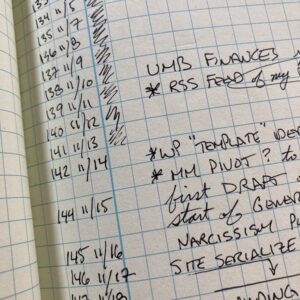
Second I want to say that the best way to move through the sludge of a stupefyingly vast bureaucracy is to take good notes. As soon as you realize you are entering the realm of bureaucracy sludge, start taking notes. Put your notes into something dedicated—a single digital file, a separate notebook, a tablet, or just grab a stack of recycled paper and staple the corner. Start every note with the date. Write as much as you can and CRITICALLY after each interaction—each email or message you read, each phone call you attempt—take the time to READ your notes and THINK about what happened and make MORE NOTES right there.

This second part will NOT, in the least, make you more successful at “winning.” But it will save your sanity. Not having to rely on your memory will go a long way towards preserving your sanity.

ɕ


How we feel about it

We don’t get to choose what happens to us, but we can always choose how we feel about it. And why on earth would you choose to feel anything but good? We can choose to render a good account of ourselves. If the event must occur, Amor Fati (a love of fate) is the response.

Ryan Holiday

slip:4a1568.


Seven dwelling places

This morning I was rummaging through a notebook and I was reminded of a great article I’d read about Saint Teresa of Ávila. More specifically, I was reminded that I had wanted to add some self-reflection prompts about Saint Teresa’s “seven dwellings” ideas. And then after some searching I realized I’d never even posted about the article either— or at least, I can’t find it here in the blog… I digress.

Imagine your inner self as a new love interest. You would get to know them by spending time and doing things together. Similarly, to know yourself better, you intentionally carve out space for introspective reflection.

Skye C Cleary, from Saint Teresa of Ávila

slip:4upyie20.

Self-knowledge. That’s the first dwelling place.

ɕ


The Mental Swirl Problem

You know the feeling: journal, yoga, that project, call mom, the other thing you’ve been meaning to get to. They’re all there, circling. You can’t settle into any one of them because the others keep interrupting.

Here’s the problem with making a list: an ordered list implies sequence and commitment. Your brain reads “1, 2, 3” as a contract you’re already failing.

But if you don’t externalize the swirl somehow, it keeps consuming mental energy.

There’s a technique I call the Jumble Bullet. Make a quick scribble—a small squiggle, just one fast stroke that looks like a tiny mess. Then write the items horizontally on that line, separated by slashes:

journal / yoga / call mom / that email / budget thing

That’s it. One line. No hierarchy. No sequence. Just peers, captured.

The scribble looks like what it represents—mental clutter you’re getting out of your head. The horizontal format reinforces “these are options, not steps.”

Sometimes just writing it down is enough—you can let go and settle into one of the items because the others are captured. Sometimes you’ll look at it later and realize one thing matters more than the rest. Sometimes you’ll ignore it entirely.

The point is to get it out of your head so you can stop holding it there.

ɕ

This is part of a series about Hand-Write. Think Better.—a method for using paper to think more clearly. Get the book →


My way?

For me, all these complex valences reach their peak in one song. And you know which one I’m talking about.

Ted Gioia, from “My Way” or the Highway?

slip:4uhopy2.

There was a time—20 years ago, I’d say—when I sang along. It was of course aspirational— or— I’m looking for a word; not quite “aspirational.” I was singing along as if the song in any way represents my actual story. In reality, I’m only acting as if I’d actually tried to do even a few of the things expressed, let alone actually accomplished all the things expressed. Is that posturing? …playacting? …attempting to borrow someone’s bravado?

I’m going to go with: self-deception.

There was a time, not too long ago, when I sang along in self-deception. Now the song reminds me that I’ve never actually even tried to do anything… let alone accomplished anything worth singing about.

ɕ


Like letter-writing?

There are broadly two types of sources we identify when studying history: narrative sources and relics […] The former are things designed to convey something to future generations, […] Relics [sic] the other hand were not intended for future generations. They do not have a “transmission intent”. While they often hold true to the beliefs of the person producing them they tend to have little to no large-scale bias in recording history. They are also excellent records equivalent to oral history and can serve as both primary sources and secondary sources that are closer to an original event than subsequent scholarly literature.

~ Venkatram Harish Belvadi, from Relics of the future

slip:4uvere1.

I’ve now been typing away on this blog for fifteen years and what I have posted here has varied wildly in that time.

While it has occurred to me to wonder what happens to the blog after I die, it had never occurred to me to wonder if there might be actual value to historians here.

I’m honestly not sure what to do with that. Do I keep posting? Do I close the garage door?

ɕ


Part 6: The Brain

I’ve been doing 16:8 intermittent fasting for years and recently started 48-hour fasts — dropping about three pounds each fast, gaining one or two back, and trending steadily downward. I wanted to understand what the research actually says about what I’m doing to myself, so I worked with Claude (Anthropic’s AI) to produce this series. I set the structure, chose the topics, pushed back on claims that felt hand-wavy, and guided the editorial tone. Claude did the writing and research synthesis. My curiosity driving Claude’s research and prose.

Mental Clarity, BDNF, and Ketone Fuel

Research brief — what happens in the brain during extended fasting. The subjective experience of mental clarity is real and widely reported; the science behind it is more complicated than the popular narrative suggests.

The Clarity People Report

Many people describe a distinct shift during extended fasting — typically somewhere after the 24–36 hour mark — from brain fog to unusual mental clarity. This is one of the most consistently reported subjective experiences of fasting, across cultures and contexts. It’s real. The question is why.

Three candidate explanations, not mutually exclusive:

  1. Ketone metabolism — the brain runs efficiently on beta-hydroxybutyrate (BHB)
  2. BDNF upregulation — fasting may increase brain-derived neurotrophic factor
  3. Stable fuel supply — no more blood sugar fluctuations from meals

The first and third have strong physiological grounding. The second is where the science gets shaky.

(more…)

Part 5: Inflammation and Immune Renewal

I’ve been doing 16:8 intermittent fasting for years and recently started 48-hour fasts — dropping about three pounds each fast, gaining one or two back, and trending steadily downward. I wanted to understand what the research actually says about what I’m doing to myself, so I worked with Claude (Anthropic’s AI) to produce this series. I set the structure, chose the topics, pushed back on claims that felt hand-wavy, and guided the editorial tone. Claude did the writing and research synthesis. My curiosity driving Claude’s research and prose.

Inflammation and Immune Renewal

Research brief — how fasting reduces systemic inflammation and primes the immune system for regeneration. Two distinct but related mechanisms.

Inflammation Reduction

Jordan et al. 2019 — Stefan Jordan, Navpreet Tung, and colleagues at the Icahn School of Medicine at Mount Sinai, led by Miriam Merad. Published in Cell, 178:1102-1114. (1)

This study directly tied caloric intake to the circulating inflammatory monocyte pool — a key driver of systemic inflammation.

What they found:

  • Short-term fasting reduced monocyte metabolic and inflammatory activity and drastically reduced the number of circulating monocytes
  • The mechanism: fasting activates AMPK in hepatocytes (liver cells) and suppresses systemic CCL2 production via PPARα, which reduces monocyte mobilization from bone marrow
  • Fasting improved chronic inflammatory diseases without compromising emergency immune mobilization during acute infection — the immune system’s ability to respond to real threats remained intact
(more…)

Part 4: Hormonal Shifts

I’ve been doing 16:8 intermittent fasting for years and recently started 48-hour fasts — dropping about three pounds each fast, gaining one or two back, and trending steadily downward. I wanted to understand what the research actually says about what I’m doing to myself, so I worked with Claude (Anthropic’s AI) to produce this series. I set the structure, chose the topics, pushed back on claims that felt hand-wavy, and guided the editorial tone. Claude did the writing and research synthesis. My curiosity driving Claude’s research and prose.

Growth Hormone and Insulin Sensitivity

Research brief — the two best-evidenced hormonal responses to extended fasting, with direct human measurements.

Growth Hormone Surge

Human growth hormone (HGH) secretion increases substantially during fasting. This is among the best-measured effects of fasting in humans — researchers have drawn blood every 5 minutes over 24-hour periods to capture the pulsatile secretion patterns.

Ho et al. 1988 — Examined 24-hour GH secretion patterns in six normal adult men during fed and fasting states (day 1 and day 5 of a 5-day fast). Found that fasting enhances GH secretion through both increased pulse frequency and amplitude. (1)

Hartman et al. 1992 — The definitive study. Nine normal men, blood sampling every 5 minutes over 24 hours. Found a *-fold increase in 24-hour endogenous GH production during a two-day fast, mediated by increased secretory burst frequency and amplitude. Notably, IGF-1 concentrations were unchanged after 56 hours of fasting. (2)

(more…)