Physical or digital? →
Published August 19, 2022 · All posts on Aug 19
In the past couple weeks I’ve been thinking a lot about whether or not to keep my slipbox physical or if I should switch to a digital system. There are specific reasons for having it be physical:
- Physical “viewing” is vastly better. I can do countless things with markings, colored sticky notes, standing cards up/on-angles, pulling cards out and spreading them on my desk, it’s faster to make a few marks on paper than it is on digital. Some of that can be done with vastly complicated systems (always a bad idea to build those), but physical is simply better.
- The small size of each paper slip (I’m using 3″x5″ cards) is a feature. Any digital system is going to let me put way too much on each digital slip. There’s value gained by forcing myself to think about just what to put on a slip.
- It’s not digital. Any time I have to use a digital device, I’m that much closer to the things which cause me problems. Any time I can avoid digital systems, that’s a Good Thing™.
I knew all that when I started. That’s why I created a physical slipbox. But lately, the following things have become a problem, and led me to reconsider going fully digital:
- I have a fairly small collection of things I refer to that I want to be able to find quickly when I have computers handy. Where’s that awesome grammar and punctuation site that I love? What’s that odd–ball command to do that thing I have to do only rarely? It’s all stuff that I could figure out again by searching the Internet, but if I just had a little digital note, I’d be moving forward again in an instant. For this type of lookup, the computer is faster than the physical slipbox.
- Sometimes I really do want to put a lot of content “on” one slip. For example, I have these fairly large digital files of research on people that I’d like to be able to connect to people who are in the slipbox. If I’m working with the slipbox, and I find Jane Doe, then I want to know that I have a digital file for that person.
- For those larger digital files, I want to be able to write a URL which instantly takes me to viewing them.
It’s that last item which is really a big deal for me. To solve those three issues I was considering changing the entire slipbox to be digital (and giving up all the other positives of a physical slipbox.)
Fortunately, I kept thinking, reading and experimenting and I figured out I can have both worlds.
I eventually realized that I already have really large “slips” in the slipbox. I already have a collection of digital books, essays, and articles that are in PDF format. For those digital files, their corresponding physical slip has a doodle (it looks like a piece of paper with one corner turned down) that reminds me there’s also a digital file. All of those files are currently “on” slips below the “2” address in the slipbox. (e.g.: The “2tu3” slip has a digital file doodle, and there’s a “2tu3 – Whatever the Title Is.pdf” file.)
For my item 2 above (big digital files of research on people) I just do the same thing for those people. “Jane Doe” would already be on slip “4c1do” (which is a listing of “Doe”, “Donatta”, “Droge”, etc.) I can simply toss in a slip “4c2do1” with a digital-file mark (and name the digital file “4c2do1 – Jane Doe”.) The next person on “4c2do” who needs a digital file gets to be “4c1do2”, and so on.
For item 1 in my list, there’s no reason I can’t have a bunch of files where I keep little “remember this” notes. So I added physical slip “4c3”, and then every slip that might ever go under that address is a digital file. For example, my grammar web site is on “4c3wi1a”. But I never have to know or remember that. I just search for “grammar” and I land on that digital file.
It was item 3 from my list that had me stumped until I remembered Obsidian!
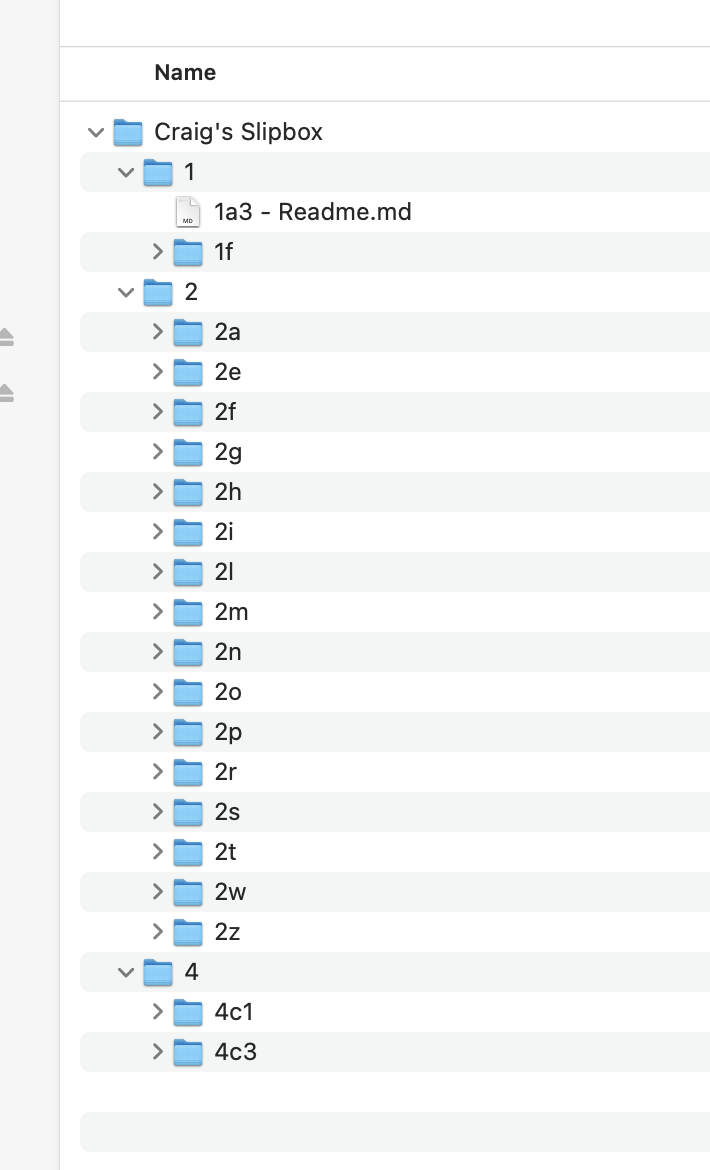
I simply have a folder full of folders and text files in the same organizational structure as my physical slipbox. Where I once had a bunch of digital books, essays, and articles tossed in one folder; those are now all stored under “2”. And there’s a now a “4” folder, with a “4c1” for people’s digital files, and a “4c3” for those “remember this” items. Back over in the physical slipbox, any slip that has a digital-file mark, I’ll find the digital file in the parallel universe of this tree of folders.
Finally, I pointed Obsidian at the outermost folder. Voila! For anything in this tree of folders, in the Obsidian app I can click “copy Obsidian URL…” and I get a URL like this one which I paste anywhere I want:
obsidian://open?vault=Craig's%20Slipbox&file=2%2F2i%2F2io1%20-%20Inconsistent%20yet%20persistent
I have the Obsidian app installed on all my devices. Any time I try to navigate to an obsidian:// method URL, it open the app, and Obsidian opens that file.
Physical? Digital? I can’t choose… How about: Mostly physical, but digital when it needs to be? Nice.
ɕ