Thank you, Miss Merrill

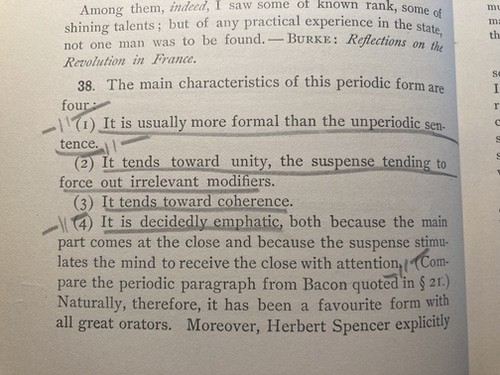
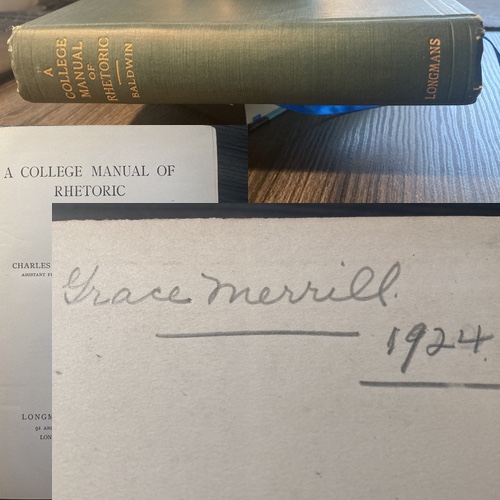
Last weekend, while helping friends pack-house, I found this book:

Wait! Don’t do the math on a book from 1907, and a college student taking Rhetoric in 1924. :)

Instead of packing it, I borrowed the book wondering if this James Sears Baldwin might just be the Baldwin. This is a dry book. But it’s also teaching me a ton about writing. The author hasn’t cracked even the slightest smile in the first 37 pages of this 400+ page tome. But the Baldwin quote I’d love to find within, might just be the sort of pithy thing this author would drop near the end.

Yes, I am willing to read a 400+ page tome on the off chance that I find the quote and get the once-in-a-lifetime thrill of finding an original attribution for a well-known quote. I digress.

By page 30, I had seen a whole bunch these little diagonal marks, but hadn’t really figured out what she was trying to imply.

Then it hit me. Quotes! It’s a diagonal line with a quote on the diagonal line. She’s delineating quotations. I’m guessing that she must have written a paper—who’d expect that in a Rhetoric class, right?—and I bet she came back through and marked the quotation sections. At the same instant that I figured it out, my up-to-then habit of drawing a full line across the page, (often a long line, then up or down a line, and then finish going across, to “cut” in the middle of a line,) seemed dumb.

Thank you Miss Merrill. This looks just way cooler:

ɕ


Futurism with Karena de Souza

How can parents and younger generations better prepare for an uncertain future shaped by technology, education, and climate change?

A personal journey reveals the link between decision-making and courageous parenting.

I realized that the future that I thought—as a parent, who grew up as somebody else’s child—I was parenting as I was parented, not as my intellect was telling me I should parent.

~ Karena de Souza (8:23)

This conversation explores the intersection of futurism, parenting, and the challenges of preparing for an unpredictable world. Karena discusses her journey into podcasting and book writing, driven by a desire to engage younger generations and their parents in critical discussions about technology, education, and societal shifts. She emphasizes the importance of equipping children with the skills and mindset needed to thrive in a future dominated by uncertainty and rapid change.

Key themes include the evolving nature of work and the need for parents to adapt their approaches to align with new realities. Karena shares her insights into how decision-making skills can be cultivated and applied, using anecdotes from her life and travels. Climate change is highlighted as a significant focus, with an emphasis on fostering hope and resilience while addressing the challenges it presents to future generations.

Takeaways

Futurism as a mindset — Imagining both positive and negative scenarios to prepare for an uncertain future.

Parenting challenges — Encouraging parents to reconsider traditional advice to better align with technological and societal changes.

Generational shifts — Exploring how Generation Z’s unique position as digital natives influences their approach to work and life.

Decision-making skills — Using real-life examples to illustrate how structured decision-making can improve adaptability.

Climate change and hope — Addressing the intersection of environmental issues and the future of work while fostering optimism.

Effective communication — Tailoring messages for diverse audiences, such as parents and younger generations.

Bookwriting journey — Sharing the creative process of connecting futurist themes with personal experiences.

Resources

Karena de Souza on LinkedIn

Contours of Courageous Parenting — Karena’s book focused on helping parents equip their children with skills to navigate an uncertain future.

Akimbo Podcasting Fellowship — A program that introduces participants to the world of podcasting.

Rules for Radicals — A book by Saul Alinsky mentioned in the discussion for its insights into effecting change.

Generational Z Research — Research on the unique traits and challenges facing Generation Z.

Future of Work Studies — Studies examining how technology and societal changes shape work environments.

(Written with help from Chat-GPT.)

ɕ


Dreams

Dreams come true. You just have to be willing to work for them.

~ Annie Mist Þórisdóttir

slip:4a748.


Intelligent dissent

Find more pleasure in intelligent dissent than in passive agreement, for, if you value intelligence as you should, the former implies a deeper agreement than the latter.

~ Bertrand Russell

slip:4a368.


Where to file a Thorn?

Dreams come true. You just have to be willing to work for them.

~ Annie Mist Þórisdóttir

slip:4a748.

Apparently, these two-fer posts aren’t as rare as I thought.

Without thinking, as I transcribed that quote, I used their preferred way of writing their name—at least, that’s how they are attributed in the source I had at hand. (Every web site I find romanizes it to Thorisdottir, offensively—in my opinion—sterilizing the family name to simple roman letters.) I was feeling all proud about even being able to write that character.

And then I went to file the quote in the slipbox. Uh… “Houston, we have a problem here.”

Step one: What is it? It’s a Thorn. Wikipedia helpfully, (that’s sarcasm,) explains:

[…] in modern Icelandic, it is pronounced as a laminalvoiceless alveolar non-sibilant fricative [θ̠],[1][2] similar to th as in the English word thick, or a (usually apicalvoiced alveolar non-sibilant fricative [ð̠],[1][2] similar to th as in the English word the. Modern Icelandic usage generally excludes the latter, which is instead represented with the letter ðæt ⟨Ð, ð⟩; however, [ð̠] may occur as an allophone of /θ̠/, and written ⟨þ⟩, when it appears in an unstressed pronoun or adverb after a voiced sound.[3]

~ https://en.wikipedia.org/wiki/Thorn_(letter)

I didn’t quote the part where they say, it’s not actually related to the letter P, which we get from Greek.

Well it looks like a P. That suggests filing this person under “PO”.

Iceland is the only place that has not, long ago, replaced it with “th”, and it’s pronounced like “th”ick. So I’m going to treat it like “TH,” and then Þórisdóttir gets filed under “TO”. (Wait, why not under, “TH”. Because my index of people is arranged by first-letter, plus next-vowel—not by the first two letters.)

ɕ


Leadership with Anette Carlisle

How has podcasting impacted Anette Carlisle’s life, goals, and creative journey?

Creative fulfillment emerges as a significant benefit of building a body of podcasting work.

It’s been a way to share some really relevant information around the issues happening right now you know not just in Texas or Amarillo. But across the nation when it was important to do that.

~ Anette Carlisle (1:36)

The conversation explores the transformative power of podcasting in the speaker’s life, emphasizing its role as a creative outlet and a platform for sharing meaningful stories. Topics include the logistical and emotional shifts caused by the pandemic, leading to a more focused approach to podcasting. Anette discusses the transition from in-person interviews to remote ones and highlights the adaptability needed to address contemporary issues effectively through the medium.

The dialogue also addresses Anette’s evolution in communication styles, transitioning from data-heavy presentations to more engaging narrative storytelling. Insights into goal setting and creative fulfillment emerge as central themes, with reflections on how podcasting has influenced personal and professional growth. She values the permanence of podcast episodes as a body of work and appreciates the opportunity to engage in meaningful conversations that align with their broader goals.

Takeaways

Podcasting as a creative outlet — It fulfills creative needs and provides a sense of pride in building a body of work.

Adaptability in podcasting — The pandemic brought shifts in interview methods and focus, emphasizing flexibility.

Value of storytelling — Narrative storytelling becomes a central skill, moving away from data-driven methods.

Impact on personal growth — Podcasting encourages reflection, goal setting, and professional development.

Connection through podcasting — The medium allows for meaningful sharing of community stories and knowledge.

Resources

Annette on Education podcast — A podcast focused on education and related issues, hosted by Annette.

Podcasting Fellowship — A program that supports podcasters in their creative and technical journeys.

Seth Godin’s blog — Inspiration for creating impactful projects, mentioned as a key influence.

Zencastr — A remote recording tool used for high-quality podcast interviews.

(Written with help from Chat-GPT.)

ɕ


Vitality

Brett McKay: But how can men maintain that vitality, even when they have those responsibilities they have at home?

Vic Verdier: I personally use two strategies, if you want. The first one is very easy. It’s to read books, books and biographies, novels, books of adventures, books of people taking risk. I’m thinking Hemingway, Jack London, but also biographies of great leaders who took risks, and thanks to you, Brett, I learned more about Theodore Roosevelt and the way he reinvented himself all the time, challenging himself. And when you read those books, you realize that you don’t really have anything to lose by trying new things all the time. So that’s my first strategy, getting some inspiration from reading. The second strategy for me is to, on a weekly basis, to do some kind of self-assessment, meaning every week I’m thinking about my life and what I’m doing, and when I start to settle down, I know it’s time to do something different. Do you remember this movie, Groundhog Day, when Bill Murray is repeating the same day over and over again?

Brett McKay: Of course.

Vic Verdier: I think… If I live twice the same day, somehow I wasted one day. So I try to have some diversity in my life, and every time I think that I fall into some kind of routine, I know I have to explore something else or go somewhere else or do… Take another course or learn some new skills.

~ From How to Stay Physically Fit As You Get Older | Art of Manliness

slip:4uaoai14.

slip:4c2he1c.

This wide-ranging conversation with Verdier touches on everything from his military and deep diving careers, to Parkour, MoveNat and general ways to stay fit and healthy. Worth a listen, and doubly-so if you’re a dude over 40. (Or know one.)

There’s an embedded player on that page, or find episode 704 of The Art of Manliness podcast, How to Keep Your Edge as You Get Older.

ɕ


Intention with Yolande Conradie

How does transforming a face-to-face course into an audio and digital format affect the teaching process, and what lessons arise from that experience?

Shifting to virtual teaching reveals how technology and podcast-like approaches can deeply connect with students.

I think it’s interesting. [I] try and think now of where do I get that energy from, when I come and sit in front of microphone or video. But I think, from years of face-to-face lecturing, and I’ve learned to almost fetch that from somewhere inside before I start.

~ Yolande Conradie (8:46)

The conversation explores the process of transforming traditional face-to-face teaching into a fully digital and audio-based format during the lockdown period. One significant focus is the effort required to adapt classroom exercises for online learning while ensuring engagement and energy remain high. Yolande shares her discovery of unexpectedly manageable aspects, like working with green screens and layered videos, alongside the technical challenges of ensuring high-quality audio.

Yolande also reflects on the importance of delivering content with energy and intentionality, even when speaking to an unseen audience. Years of face-to-face lecturing have helped her prepare mentally to connect with virtual learners effectively. Additionally, the discussion touches on how her listening habits for podcasts—particularly those with innovative soundscapes and storytelling—have influenced her approach to teaching and audio content creation.

Takeaways

Transforming teaching formats — She adapts a face-to-face leadership course into an audio and video-based digital format.

Energy in virtual teaching — Bringing intentional energy to online lectures helps maintain a connection with students.

Student engagement — Feedback highlights the importance of making audio and video content personal and relatable.

Adapting content — Exercises and interactions need to be restructured creatively for a virtual environment.

Podcast inspiration — Listening to diverse podcasts enhances her understanding of sound design and engagement techniques.

Immediate group dynamics — Each group’s unique needs influence how course material is presented in real-time.

Unexpected challenges — The digital shift brings hurdles, but some aspects, like video editing, turn out easier than expected.

Long-term impact — Lessons learned from online teaching will influence future education methods, even post-pandemic.

Resources

The BBC Word of Mouth Podcast — A podcast about language and its development.

True Crime Bullsh** — A meticulously researched true crime podcast.

Mind Tools L&D Podcast — A learning and development podcast covering professional skills.

BBC Discovery — A science podcast offering insights into discoveries worldwide.

The Christland Podcast — A podcast celebrated for its innovative use of sound and music.

(Written with help from Chat-GPT.)

ɕ


Forge on ahead

Why all this guesswork? You can see what needs to be done. If you can see the road, follow it. Cheerfully, without turning back. If not, hold up and get the best advice you can. If anything gets in the way, forge on ahead, making good use of what you have on hand, sticking to what seems right. (The best goal to achieve, and the one we fall short of when we fail.)

~ Marcus Aurelius

slip:4a464.


The real fake-it-til-you-make-it

The improvements in Eliza’s speech alone do not confer the opportunities. But being able to speak like a duchess puts her in the company of people from whom she can learn the sentiments and sensibilities of the upper class. When she begins to speak like them, they treat her differently, giving her an opening to expand her capabilities.

~ Shane Parrish from, The Pygmalion Effect: Proving Them Right

slip:4ufote7.

I’ve always been unhappy with the phrase, “fake it ’til you make it.” It’s always seemed that there was something missing. (Yes, sure, it’s meant to be short and simple, not long and accurate.) But this bit from Parrish hits it on the head.

By acting as if I already were the thing I want to be, I’m practicing being the thing. That’s obvious. What’s not obvious is that doing so creates a positive feedback loop as other people then treat me as if I really were the thing. I make a change, and then as if by magic, other people offer me new opportunities. I use the work magic because what I might change—for example, how I speak, as in Eliza’s case—should have no bearing on what opportunities I am offered. But it does.

Why? Other. People.

ɕ


Deep dive into books

Today I thought I’d share a thorough explanation of what I do “to” a book these days. This process—which to be honest I don’t follow for every book I read—is the result of combining a few different ideas:

  • I love the physicality of books. The typography, the paper, writing in them, desultory bookmarks, (I add my own ribbon bookmarks,) and numerous sticky-notes poking out the side.
  • I love the peaceful, inertness of books. They literally sit there and do nothing. There are no alerts, and no interaction, (from anyone beyond the author’s original magic spell.)
  • I’ve always wanted to retain more of the knowledge from a book once I’ve read it.
  • I’ve wanted to be free of my self-imposed rule of reading every page.
  • These days I have a slipbox, and I want it to grow.
  • I love to collect quotes.
  • I’ve always wanted a set of crib notes, summary, or something that I could lay hand on after reading a book.

Arrival

Fortunately, books arrive slowly. It took practice, but I learned to do all of the following in a minute or two.

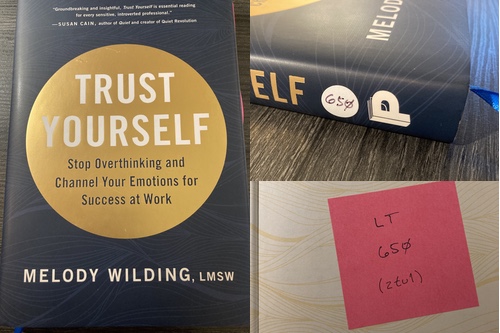
If it’s a new book, I take a few moments to prepare the spine. (Please tell me you know how to do that.) I affix a small, white, circular label on the spine, and I slap a sticky-note on the first face opposite the cover.

I skip over to librarything.com and find the book in “Your Books”—my books, that is. Most arriving books are coming in after already being in my “wishlist” collection; They get moved to the “library” collection. Otherwise they get searched for and added to my collection. Books get tagged as “physical,” (as opposed to those tagged “PDF,” “iBooks”, or “Kindle,” because, yeup, I track those too.) I see what MDS number Library Thing says the librarians of the world have chosen.

On the sticky-note, I write “LT”, (for “this book is entered into Library Thing,) and the MDS number. I write the main, three-digit part of the MDS number on the label on the spine.

Finally, I skip over to bookmooch.com and remove it from my Wishlist over there to ensure I don’t forget about it. (Lest I accidentally “spend” my Book Mooch points requesting a book I now have.) If this is a book that someone sent me because of Book Mooch, I hit the “Received!” button instead.

This book is now “ours.” And some amazing things are now possible just by having spent a couple minutes on each book as it arrives. (Please ignore the entire week I spent bootstrapping ~500 books when I started doing all this. :)

  • Physical bookstores are fun again! What books are on my wishlist? (500+ at the moment) …okay, what wishlist books are tagged, “priority”? (about 250 — yes I have a problem.) Picking up a book… “this looks interesting…” Do I already have it in the house, maybe now is the time to buy it? Did I once have it, and it’s no longer in our collection, (part of my collections in Library Thing is “had but gone now”)?
  • Long-term storage of books doesn’t mean they are lost. A big portion of the books in our house are here because we want to keep them. They sit for years untouched. Those are shelved by MDS number. Ask me for a book, and I can walk directly to it; It’s either laying about somewhere and top of mind, or it’s shelved where it can be found immediately.
  • This is morbid, but if the house burned down I could decide what books to replace.

Books are for reading

Well, technically, one can also build a thing called an anti-library. But eventually, hopefully, or at least this is what I keep telling myself: I start reading the book.

I do tend to read the entire book. But generally I read the table of contents first to see what I’m getting into. If I think the book is going to be a really deep read—something I want to read more than once, refer to, and really ingest—I probably read the Afterword first. The Afterword was written dead-last, after the book was done and the author is a different person at that point. Then maybe the Foreword, or some books have a Summary, or a Preface, whatever.

I’ve no qualms about skipping parts. For example, in books like Trust Yourself by M Wilding I skipped all the anecdotes and skipped all the workbook/exercises stuff. I ended up reading only about one-third of all of the pages. (Still, a good book by the way.)

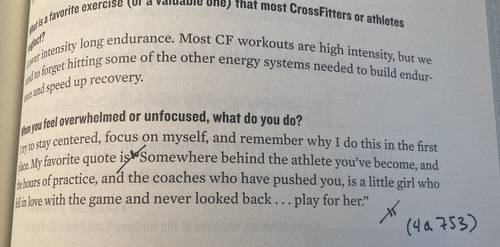
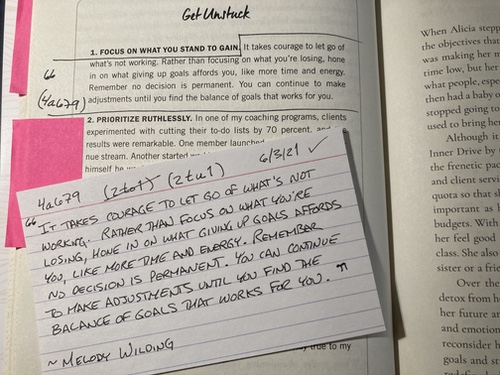
As I’m reading, if anything quotable jumps out, I’ll capture that on the spot. This leads to me making some marks, allocating a slipbox slip address, and I’ll leave a small post-it sticking out the side. I’ve never met a book worth reading that didn’t have at least one quotable bit awaiting me within.

Slipbox

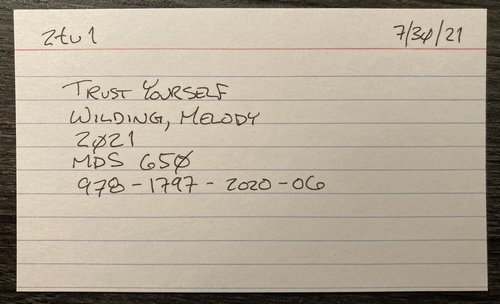
As soon as the first slip gets created from the book, that slip needs to refer to the book. That means the book itself needs to be in the slipbox. Apparently, I always wanted to be a librarian.

And now I can leave a “(2tu1)” reference on the quote’s slip.

So that’s a bit of detour, but it really only takes me about a minute. You’ll notice—first photo at top—that the sticky-note for this example book has a slipbox reference, “(2tu1)”—the parens mean “this is a reference”. I didn’t put that on the sticky-note when the book arrived. That was added when I put the book into the slipbox by creating slip “2tu1”.

But mostly, I’m just reading the book.

Identify summarizing bits

One day, I’m finished reading.

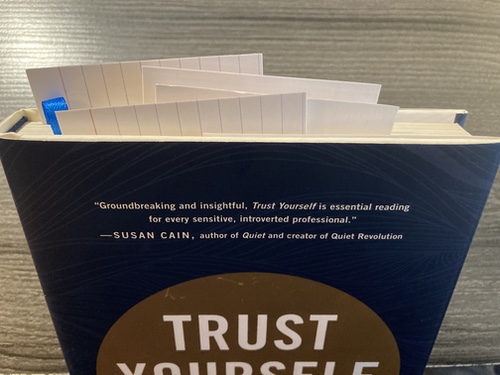
I find that even if it took me months to finish, the book’s contents remain pretty fresh in my mind. I flip through the book cover-to-cover, just skimming and noticing what I recall from reading. When I see a good, representative bit, I simply stick in a blank card at those spots. This lets me gauge how many slips my “summary” will be; Two is too few, and 20 might be too many.

Each spot has some key point that I want to include in my summary. I don’t write anything at this point. The goal is just to stick the cards into all the places that I want to include in my summary.

(I once tried using a printed template whose layout facilitated taking brief notes and had pre-printed page numbers. Folded, it doubled as a bookmark so I could build some notes as I read. When an idea leapt out, I’d find the page number on the sheet and jot a note. It was a neat idea, but didn’t work out for me.)

Summarization

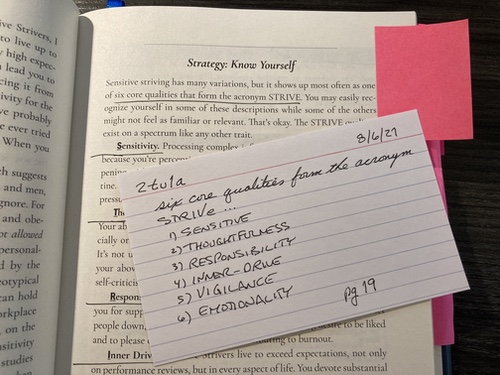
Finally, I go through all the spots I’ve identified and I do a little underlining. I jot the basics of the idea on a slip and address it. So for this example book, whose slip is addressed “2tu1”, this first of the summary slips goes “below” as “2tu1a.” Next summary slip would be, “2tu1b”, “2tu1c” etc.

ɕ

Opposing ideas

The test of a first-rate intelligence is the ability to hold two opposing ideas in mind at the same time and still retain the ability to function.

~ F. Scott Fitzgerald

slip:4a384.


Just create

But the unintended consequence of, what one might call, total brand and business control, is that it diverts attention away from the most essential part of any creative profession. You know, making great stuff.

It’s hard to do that under ideal circumstances; harder still when you’re tweeting or visualizing your next Instagram story or flying to some industry conference.

~ Ryan Holiday from, Your Work Is the Only Thing That Matters | by Ryan Holiday | Human Parts

slip:4umeyo1.

The only thing better than finding something worth sharing is not realizing who the author is until after deciding to share it. Holiday—I’ve just learned—also writes on Medium, and I didn’t recognize the site title, nor his style. But that’s not my main thrust today…

An artist’s job is to create masterpieces. Period.

~ as above

Usually I’m all like: My latest podcast episode isn’t downloaded a million times? “Nobody loves me.” Paltry likes on Instagram? “Nobody loves me.” My LinkedIn post gets ignored? “Nobody loves me.” No new weekly email list signups? “Nobody loves me.” …ahem.

But sometimes I manage to remember to just. do. the. work. And then all’s right as rain.

ɕ


Escalation

It’s fine if you didn’t, but last week you may have noticed this weekly missive put on a few extra pounds. (I just love the word, “missive,” don’t you?) This week’s missive is similarly embiggened. And for the foreseeable future, you can expect about 42.9% more puzzlement. What, pray tell, has happened?

Here’s how much care I put into this . . .

I write, and schedule, the it’s-just-a-quote posts as I find new quotes. At this moment, there are a few—202 to be specific—lined up in the wings awaiting their day in the sun. I had been scheduling them every third day. But you nimble-mathing people will realize that means I was scheduling them nearly two years out. (Relax. WordPress makes it easy to do.)

Worse, because I feed the quotes to my Little Box of Quotes podcast-turned-Little_Shop_of_Horrors-monster, I must accumulate at least one new quote every day, (on average.) Not only are the quotes stuck, like an epic fat-berg, in the pipeline of my blog, that ‘berg is quickly growing. What to do?

Well, I really don’t want to turn my blog into a quote-a-day web site. That’s the only real way to fix the pile-up. Instead, I rescheduled them to be every-other-day. (Relax. WordPress doesn’t make it easy, but I’m cuckoo, and fast.) I already felt that I was cheating 33.3% by only writing two blog posts between every-third-day’s quote— But there was no way I could bear to only write a blog post every-other-day. (Don’t misread that as: I couldn’t bear to cheat that much. No, the posts come out of my head faster than that, and I couldn’t bear to ignore them.) Which brings me to…

I’m going back to writing a blog post for every day, and you’re getting 3 or 4 quotes each week. Thus the jump from a regimented 7 items per week to an embiggened 10 or 11 items per week.

So I got that goin’ for me, which is nice.

ɕ


Half twist

Continual awareness of all time and space, of the size and life span of the things around us. A grape seed in infinite space. A half twist of a corkscrew against eternity.

~ Marcus Aurelius

slip:4a455.


Yes, relax

This is the training. Relax the narrative, loosen your view, and drop into the openness of the present moment. Breathe deeply, and relax your body. Relax the jaw, relax the muscles in your torso. Feel the openness in this moment.

~ Leo Babauta from, Training to Be Relaxed in Stressful Situations – Zen Habits Website

slip:4uzere2.

It took me a long time to understand that the only source of stress in my life is myself.

I’ve been in two car crashes where I’ve instantly gone from automobile operator to roller-coaster rider. I’ve been absolutely wiped out, in countless variations, in martial arts context. I’ve discovered mid-air that I’ve been launched off my mountain bike. I’ve been obliterated while skiing. I’ve had too many—I’m refusing to count—nearly serious automobile accidents where my driving skills, applied consciously with to-the-inch and to-the-split-second accuracy saved the day. I’ve had bones broken. I’ve been fallen upon, by a poor fellow who was saved from an 8-foot, head first, fall onto concrete… by the flex of my rib cage. I’ve been hit in the face with a max-power, line-drive, point-blank soccer ball penalty kick. I’ve been flattened by a skull-to-skull running-speed impact. Sucker-punched in the gut. T-boned into the sticker-bushes at high speed on a bicycle. Beaned by a 2×6 board. I once fell 12 feet from a tree with my head being the first thing to land… on a tree root. I’ve been clipped by a truck, and blown a bicycle tire at high speed, ending up happy to reach the ditch rather than the asphalt. I rear-ended a car at speed (on my bicycle.) I’ve been banged up, flipped over, slammed into, … but also yelled at, and put upon. I had someone angrily invoke the name of my dead father in an attempt to shame my actions. I’ve been laughed at, and picked last in gym class. I’ve run out of money and bummed rides to work. I’ve been chewed out by a boss. I’ve had my credit card declined while in public. I’ve been scammed by street hustlers, lied to by various people, and pre-judged in various dimensions.

…and I can now truthfuly say: The only source of stress in my life is myself.

ɕ


Spiritless men

Fires can’t be made with dead embers, nor can enthusiasm be stirred by spiritless men. Enthusiasm in our daily work lightens effort and turns even labor into pleasant tasks.

~ Baldwin

slip:4a732.


Quotations are difficult

Most of my blog posts are either a quotation which I leave to stand on its own, or a usually-longer-length pull-quote with a citation and my commentary. Things around here are very intentional. The freestanding quotations are meant to leave all the context and analysis to you, Dear Reader, without any of my thoughts coloring your thoughts. You may very well try to learn more about me based on my selections, but I’m trying to recreate—for your enjoyment—the experience of discovering the quotation. The pull-quotes both expose the seed of my reflections and try to lure you to something in the world I’d like to highlight.

Fires can’t be made with dead embers, nor can enthusiasm be stirred by spiritless men.

~ Baldwin

But there are the vanishing rare two-fer posts like today. There. Have a quote. And…

I discovered this quote in a book, (p17 of Get Together, 2019 Richardson et al if you must know.) I know this will surprise you, but I have a well-practiced process for “capturing” quotes. In this case, the vague attribution tickled a memory; “I’m pretty sure I have a quote from James Baldwin…” I checked, and I do. “I wonder if this quote is that Baldwin…”

What’s the simplest thing that could possibly work? Just type the quote, in quotes, into a search engine… and Quote Investigator has a page for it. (Going directly to Quote Investigator is step two, by the way, if the search fails. I search generally, first, because it often finds the phrase in the original source material right out of the gate.) It turns out that this quote has a second sentence!

Fires can’t be made with dead embers, nor can enthusiasm be stirred by spiritless men. Enthusiasm in our daily work lightens effort and turns even labor into pleasant tasks.

~ Baldwin

slip:4a732.

Oh, nice! I like that even more than the one I stumbled on. But who is this “Baldwin”… and then I read the Quote Investigator page. Their conclusion is ¯\_(ツ)_/¯ . It’s been attributed four different ways for nearly 90 years. And now I’m wondering if my James Baldwin quote— which is #380 in my collection of 700+ so it’s pretty old, although I think I recall where I got it, from Gaping Void . . . but don’t go there! It’s a wonderland rabbit hole of decades of cartoons. I digress. And I’m having images of the book authors doing this same rabbit hole deep dive.

Fine, executive decision: I’ll stick with “Baldwin.” But that makes for this wonky entry in my slipbox index of people… Now I have “Baldwin, James” and “Baldwin.” But you know what? I’m never going to forget about this now, if I ever look at that index slip again.

So now you know: When you see me casually drop a freestanding quote here, it’s not in truth casually.

ɕ


Audience with Tyler Williams

What are the differences and challenges in engaging an audience across live performances, studio recordings, and podcasts?

Crafting a consistent identity for a podcast requires balancing creative freedom and audience expectations.

I started out thinking every episode of my podcast needed three actionable tips, something concrete so that even a stranger would walk away with value. But then I realized I was having so much fun just talking to my musician friends—those natural conversations became the real heart of the show.

~ Tyler Williams (8:07)

The conversation explores the differences between live performances, studio recordings, and podcasting, particularly how they affect the performer’s ability to connect with an audience. Live performances demand real-time adaptability, like responding to unexpected disruptions, while studio recordings offer intimacy and control. Podcasting, on the other hand, presents unique challenges due to the absence of a visible audience, requiring conscious effort to maintain energy and engagement.

Another key topic is podcast structure and identity. The discussion touches on title choices, episode intros, and whether podcasts should always deliver specific value, such as tips or insights. The importance of consistency and balancing creativity with audience expectations is emphasized, particularly as podcast creators experiment with formats, such as solo episodes versus guest interviews.

The conversation also highlights audience surprises, such as unexpected feedback on edited episodes, and the role of accessibility. Strategies for improving audience reach, including artwork and search relevance, are considered, alongside concerns over licensing agreements with platforms like Spotify.

Takeaways

Live performance adaptability — Engaging a live audience requires real-time reactions to unexpected challenges, such as disruptions or mistakes.

Podcast intimacy — Studio recordings and podcasts offer a controlled, intimate setting to connect with the audience.

Audience engagement challenges — Podcasting lacks direct audience feedback, making it harder to gauge and maintain engagement during recording.

Podcast identity and structure — Balancing creativity with consistent value, like including tips or key insights, helps define a podcast’s identity.

Episode titles and artwork — Titles and visuals impact whether a potential listener clicks “play” on an episode.

Audience surprises — Listeners often respond unexpectedly to certain episodes, highlighting the subjective nature of audience preferences.

Podcast format flexibility — Mixing guest interviews with solo episodes provides creative freedom without creating separate shows.

Licensing and platform concerns — Understanding the implications of podcast licensing agreements, particularly with platforms like Spotify, is crucial.

Accessibility of older episodes — The longevity of podcast episodes allows them to surprise creators long after publication.

Introductions and summaries — Crafting episode intros or show notes can range from minimal to highly curated, depending on the podcast’s style.

Resources

Hear Me Pod — Tyler’s podcast

Tyler Williams Music

Mac Power Users Podcast — A podcast offering tips and insights on Apple devices and workflows.

The Working Musician Podcast — A podcast discussing the challenges and realities of working musicians.

Anchor by Spotify — A free podcasting platform discussed in relation to its push for advertising and licensing agreements.

(Written with help from Chat-GPT.)

ɕ


Journey with Steve Heatherington

What is the personal and professional journey of someone who engages deeply with podcasting and alpaca farming?

The challenge of helping alpaca owners led to building a community-driven podcast from scratch.

You’re onto a good thing when that happens—the resistance is an indicator and therefore you need to engage with that and find a way through it, round it, over it, whatever to get past it.

~ Steve Heatherington (8:59)

Craig and Steve engage in a conversation that spans podcasting, personal growth, and alpaca husbandry. They reflect on Steve’s podcasting journey, which begins with his intention to help his wife promote her book. Over time, this evolves into a deeper commitment to podcasting, leading to the creation of his show, Alpaca Tribe, and a role as a coach in podcasting workshops. Steve shares his experiences of learning the craft, overcoming challenges like imposter syndrome, and balancing different podcast formats such as solo episodes and interviews. The pair also discuss the significant time and effort required to develop a podcasting practice.

Steve’s passion for alpacas emerges as another key topic. He describes his life as an alpaca shepherd and shares how his podcast aims to help alpaca owners feel confident and fulfilled while caring for their animals. The discussion also delves into broader themes of creativity and growth, with Craig noting the similarities between podcasting and artistic endeavors like painting. They explore how both pursuits involve facing challenges and continuously improving. Steve emphasizes the importance of identifying a compelling problem to address, one that resonates deeply enough to sustain years of exploration and conversation.

Takeaways

Having a clear purpose — Revisiting “why” helps keep the podcast focused and aligned over time.

The power of curiosity — Sustained exploration and willingness to learn drive growth in podcasting.

Different podcast formats — Host-on-mic versus interviews create distinct challenges and require varied skill sets.

Imposter syndrome — Resistance often signals that you’re doing meaningful work worth pursuing.

Balancing storytelling with practicality — Melding stories with helpful information engages a broad audience.

The iterative process — Success comes from continuous refinement and revisiting foundational questions.

Starting small — Big ideas often begin as modest, practical experiments.

Resources

The Alpaca Tribe Podcast — A podcast aimed at helping alpaca owners feel confident and fulfilled.

The Pod Buffet — A curated platform featuring short, impactful podcast episodes.

Akimbo Podcasting Workshop — A workshop designed to teach podcasting skills and foster community collaboration.

Stephen Pressfield’s Blog — Mentioned in the context of overcoming resistance and creative challenges.

(Written with help from Chat-GPT.)

ɕ