The dirty little secret of the diet-heart hypothesis

This entry is part 7 of 12 in the series Stephan Guyenet's "Whole Health Source"

The diet-heart hypothesis is the idea that saturated fat, and in some versions cholesterol, raises blood cholesterol and contributes to the risk of having a heart attack. To test this hypothesis, scientists have been studying the relationship between saturated fat consumption and heart attack risk for more than half a century. What have these studies found?

~ Stephan Guyenet from, The Dirty Little Secret of the Diet-Heart Hypothesis

Elsewhere, this is 4ubodi2. — slipbox

ɕ


Life Return On Exercise Invested

This entry is part 59 of 72 in the series My Journey

Life Return On Exercise Invested – LROEI

Exercise has been show to correlate (caution, https://en.wikipedia.org/wiki/Correlation_does_not_imply_causation) with longevity; The people who exercise more are also the people who live longer:

«http://www.drbriffa.com/2009/03/06/taking-up-exercise-in-middle-age-appears-to-give-a-handsome-return-on-investment/»

Elsewhere, this is 4udita1. — slipbox

I had never thought about exercise in quite this way: If I’m going to exercise, and if the exact details of the exercise aren’t so important, WHICH exercise would I prefer to do?

Would I rather spend time indoors or outdoors?
…in a gym, or at a playground?
…alone, or with my friends?
…in a familiar place, or some place new?

There are many types of exercise. The way I’m pursuing exercise through Parkour ALSO happens to generate a greater LROEI.

ɕ


The body fat setpoint, Part II: Mechanisms of fat gain

This entry is part 6 of 12 in the series Stephan Guyenet's "Whole Health Source"

Body fat produces a hormone called leptin, which signals to the brain and other organs to decrease appetite, increase the metabolic rate and increase physical activity. More fat means more leptin, which then causes the extra fat to be burned. The little glitch is that some people become resistant to leptin, so that their brain doesn’t hear the fat tissue screaming that it’s already full. Leptin resistance nearly always accompanies obesity, because it’s a precondition of significant fat gain.

~ Stephan Guyenet from, The Body Fat Setpoint, Part II: Mechanisms of Fat Gain

Elsewhere, this is 4ubobo1. — slipbox

This part of his series is short and non-technical. But his whole series is, probably, the greatest explanation of why one gets fat which I have ever read.

ɕ


Is obesity all in the mind?

This entry is part 8 of 14 in the series John Briffa's "A Good Look at Good Health"

My position, and that of a growing number of researchers, is that there’s more to obesity than calorie balance, and that body weight and fat mass is regulated by a complex system that involves an array of hormones and feedback mechanisms.
In recent months I’ve become interested in the potential role of a hormone by the name of leptin in obesity.

~ John Briffa from, «http://www.drbriffa.com/2011/03/10/is-obesity-all-in-the-mind/»

Elsewhere, this is 4udiio1. — slipbox

It’s not “in the mind” in the sense that you can imagine your way to weight loss. But there’s definitely MORE to weight loss than the balance of calories. My experience is that the best way to lose weight is to simply reduce my calorie intakes slightly — no need to count everything and aim for a computed target intake. At the same time, include some strength training (a ton is not required, but walking/cardio is NOT what worked for me.)

ɕ


Instead of dumbing down

So that’s what I suggest as an alternative to dumbing down: See if you can care about your listeners or readers enough to understand why they should want to know this and what direction they can approach it from. Then work on your own understanding of the subject until you grasp it well enough to approach from that direction yourself. In the short term, that may not be as satisfying as ridiculing their stupidity, but in the long term I think it works better.

~ Doug Muder from, Instead of Dumbing Down | The Weekly Sift

Elsewhere, this is 4uweie1. — slipbox

ɕ


Animal models of atherosclerosis: LDL

This entry is part 5 of 12 in the series Stephan Guyenet's "Whole Health Source"

The bottom line is that experimental models of atherosclerosis appear to rely on overloading herbivorous species with dietary cholesterol that they are not equipped to clear. SFA does exacerbate the increase in LDL caused by cholesterol overload. But in the absence of excess cholesterol, it does not necessarily raise LDL even in species ill-equipped to digest these types of fats. Dietary cholesterol has a modest effect on LDL cholesterol in humans, and it has even less effect on LDL particle number, a more important measure. So there may not be a cholesterol overload for saturated fat to exacerbate in humans.

~ Stephan Guyenet from, Animal Models of Atherosclerosis: LDL

Elsewhere, this is 4uboai5. — slipbox

In the context of actual amounts that you can actually consume (animal studies feed cholesterol to herbivores as if you eat 20+ eggs EVERY day) there is no evidence (not in animal studies and certainly not in human studeis) that cholesterol and saturated fat cause atherosclerosis. If you think eating cholesterol or saturated fat is bad, I hope you’ll investigate where you obtained that knowledge, and look into the factual basis of that knowledge. If you’re avoiding cholesterol and saturated fat, what are you replacing it with?

ɕ


It looks like our ancient ancestors ate a low-carb diet

This entry is part 7 of 14 in the series John Briffa's "A Good Look at Good Health"

Official recommendations are normally that about 60 per cent of the calories we consume should come from carbohydrate. That’s actually higher than the most carbohydrate-rich hunter-gatherer diet of all, and about three times the average carbohydrate percentage in such diets. The authors of this study conclude, ‘…the range of energy intake from carbohydrates in the diets of most hunter-gatherer societies was markedly different (lower) from the amounts currently recommended for healthy humans.’

~ John Briffa from, «http://www.drbriffa.com/2011/10/11/it-looks-like-our-ancient-ancestors-ate-a-low-carb-diet/»

Elsewhere, this is 4udiio2. — slipbox

Not “low carb” as in some wacky, extremist diet. I’d prefer to call it a “normal carb diet” where you simply try to get your carbs from tubors, fruits and veggies, not from added sugars and refined grains.

ɕ


An overlooked factor in creating positive change

Find joy in every step. You’re not doing this to get to some great destination at the end. Each positive step can be a joy in itself, a place to smile and breathe and find gratitude. What a wonderful thing to be where you are!

~ Leo Babauta from, An Overlooked Factor in Creating Positive Change – Zen Habits Website

Elsewhere, this is 4uzetu1. — slipbox

ɕ


Modern diet-health epidemiology: A self-fulfilling prophecy?

This entry is part 4 of 12 in the series Stephan Guyenet's "Whole Health Source"

Do whole grains prevent smoking too? An alternative explanation is that the women who were eating whole grains were all-around more conscientious and concerned about their health than those eating refined grains. And why not? They “knew” from mainstream diet advice that whole grains are healthier than refined grains. When is the last time you saw someone smoking a cigarette while eating whole grain muesli with skim milk and half a grapefruit for breakfast? Is it easier to imagine someone smoking while eating a donut and sweetened coffee?

~ Stephan Guyenet from, Modern Diet-Health Epidemiology: a Self-Fulfilling Prophecy? Part II

Elsewhere, this is 4ubomo1. — slipbox

I recommend reading everything on the Whole Health Source blog; Very science-intensive, but you’re life will be imrpoved. And, the above piece is a great explanation of things like “correletion”, “confounding factors”, and more. But, there’s also a HUGELY useful take-away that he doesn’t explicitly state:

By being health-conscious — reading, learning, making small changes — you’re going to have a huge affect on your health. In the long run, you don’t need to learn every little scientific nuance (because who has time for that, right?) Instead, you learn a little each day and continuously work to make small improvements.

ɕ
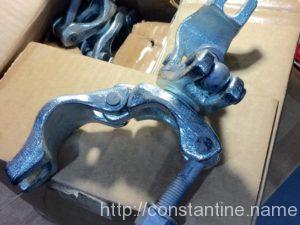

Scaf 101: A source for swivel clamps

This entry is part 13 of 13 in the series Scaf 101

Eventually, you will want to purchase swivel clamps. They can be quite expensive. But, I found this place, which sold them to me for an unpublishably, insane, low price: https://www.associated-scaffolding.com

ɕ