We think we’re working 70 or 80 hours a week, but we’re not. We think we’re not getting enough sleep, but often we are. We misjudge our own time use constantly, and it can lead us to misidentify problems and remain stuck and frustrated.
The man who is calm has his course in life clearly marked on his chart. His hand is ever on the helm. Storm, fog, night, tempest, danger, hidden reefs— he is ever prepared and ready for them. He is made calm and serene by the realization that in these crises of his voyage he needs a clear mind and a cool head; that he has naught to do but to do each day the best he can by the light he has; that he will never flinch nor falter for a moment; that, though he may have to tack and leave his course for a time, he will never drift, he will get back into the true channel, he will keep ever headed toward his harbor.
You may be sure that this refractory nature, which demands much toil, has been implanted in us. There are obstacles in our path; so let us fight, and call to our assistance some helpers. “Whom,” you say, “shall I call upon? Shall it be this man or that?” There is another choice also open to you; you may go to the ancients; for they have the time to help you. We can get assistance not only from the living, but from those of the past. Let us choose, however, from among the living, not men who pour forth their words with the greatest glibness, turning out commonplaces and holding. as it were, their own little private exhibitions, – not these, I say, but men who teach us by their lives, men who tell us what we ought to do and then prove it by practice, who show us what we should avoid, and then are never caught doing that which they have ordered us to avoid.
What insights can practices like Tai Chi, Qi Gong, and Parkour offer about balance, healing, and personal growth?
Thomas Droge discusses balance and falling, as well as the physical and mental implications of each. He unpacks his thoughts on recovery, body work, injury and eastern and western medicine. Thomas also shares about the book he’s writing, his goals, and finishes with his thoughts on the culture of parkour.
The amount of attention it takes to stay balanced allows you to obliterate all the other thoughts in your mind, and you get into this awake conscious state really fast. To be in any kind of balanced state—especially if it’s new—is incredibly valuable to bring you into this moment.
~ Thomas Droge (1:51)
The conversation explores the concept of balance as a dynamic and transformative process, contrasting it with the common misconception of balance as a static endpoint. Through discussions of practices like Tai Chi, Qi Gong, and Parkour, it highlights how engaging fully in the present moment enables heightened awareness and flow states. The dialogue also examines how physical balance mirrors emotional and interpersonal dynamics, such as communication and relationships.
Another key theme is healing and recovery, approached through the lens of Chinese medicine and bodywork. Thomas discusses the principles of Dit Da Jow and how traditional and modern approaches address injury and recovery. The conversation also touches on the iterative nature of personal goals, emphasizing the importance of collaboration, adaptability, and finding meaning through both small and grand ambitions.
Early on a brisk Saturday morning, I was struggling to find the motivation to put solid effort into a quadrapedie workout. During a break, I was talking to someone about how I’ve recently been dropping goals. I’ve always had a laundry-list of goals such as getting to a free-standing hand-stand, or a specific number of pull-ups. But I’m learning — slowly — that blindly chasing goals only leads me to injury and failure. Tenaciously refusing to let go of a goal can be counterproductive, even overtly unhealthy.
I find it’s easy to learn, and easy to get some new bit of knowledge stored in my mind. But it is difficult to get my instincts and feelings to change to align with that new knowledge. So it is with my processes and goals: I know it’s all about the process, but my instincts and habits are to create goal upon goal. I regularly get caught up chasing the goals, and lose sight of the process.
How far ahead can I see? How wisely can I set my goals? Do I chase them blindly causing my journey to veer off? Or do I have a broad spread of goals that firmly draw me in my desired direction towards the horizon, and ultimately, to the end of my journey?
The bulk of this series is about the various major changes I have made. In the big picture sense, it’s just a long list of posts with actionable ideas for you to consider. Unfortunately, accomplishing any of these changes requires you to be able to break old habits and create new ones.
There’s plenty of information available on habit change, so I’m leaving the psychology of habit change out of this series. Instead, I’m going to suggest one activity: Keep a habit journal. I started my habit journal, began by trying to fix my sleep, and slowly began my upward spiral.
For the rest of this series I won’t – I promise! – tell you the back story of how I discovered and explored each change I’ll be describing. Instead, I’ll compress each as much as I can, with as much actionable intel as possible. But for this “Strategy” part of the series, I want to tell you the story of how I discovered and started my habit journal.
This entire “Changes and Results” story begins with me realizing I needed to get more, quality sleep. It was a slow realization, and it sprang from some online articles I had stumbled upon. As I read more, I became curious about my sleep, and found I was often thinking about my sleep and how to improve it.
To make any change, new knowledge is required; What would the change look like? What are healthy sleep cycles, duration and times-of-day? What temperature, light and sound levels are conducive to good sleep? What room details (the bed, the colors, the room layout) and room uses (is the room multi-use or a space where I only sleep) are conducive to good sleep? It turns out that all of that knowledge is out there, and so I dug into it to varying degrees until I felt I had satisfactory answers to some of my questions.
But, all that new knowledge accomplishes nothing.
I had identified a problem, (“get better sleep”,) which gave me new questions. From there, my curiosity led me to new knowledge. At that point, I knew what I wanted to change, but right there is where I had always failed.
Enter, stage left, Benjamin Franklin.
One day, still frustrated and making no progress on improving my sleep, I read an article about Ben Franklin. Franklin had set out to improve himself over the course of several years. He came to the conclusion that there were too many different things to focus on for him to improve himself in one broad effort:
It was about this time I conceived the bold and arduous project of arriving at moral perfection. I wished to live without committing any fault at any time; I would conquer all that either natural inclination, custom, or company might lead me into. As I knew, or thought I knew, what was right and wrong, I did not see why I might not always do the one and avoid the other. But I soon found I had undertaken a task of more difficulty than I had imagined. While my care was employed in guarding against one fault, I was often surprised by another; Habit took the advantage of inattention; Inclination was sometimes too strong for reason.
I had reached the same conclusion, (but, alas, without the same eloquence,) when I was unable to change things by simply desiring them to change. Goals such as: sleep better, be less grumpy, and lose some weight, all failed to materialize.
Franklin went on to create a grid, with a row for each virtue and a column for each day of the week. At the end of each day, he put a mark if he felt he hadn’t lived up to that virtue on that day. The goal was then to have no marks on the grid at the end of the week. Each week he would focus particularly on one virtue (and he cycled through his 13 virtue goals.) He began each week by re-reading a small reminder he’d written about the week’s focus virtue (for example, “Humility: Be not Achilles; Imitate Socrates.”) He would then set about focusing on that virtue during the week. Franklin was working on a list of virtues such as Tranquility or Temperance, but his system works perfectly well for anything.
[O]n the whole, though I never arrived at the perfection I had been so ambitious of obtaining, but fell far short of it, yet I was, by the endeavor, a better and a happier man than I otherwise should have been if I had not attempted it.
Inspired by Franklin, I began my habit journal more than ten years ago. At the beginning of each month I create a table with the dates across the top, and a row for each thing I’d like to work on that month. Initially, I had a small notebook just for these monthly habit journal tables. I started with rows for 6, 7 or 8, hours of sleep and put a corresponding mark for each day. This created a rough graph running across the month. That visual graph really gave me a push: “Yesterday’s mark is 6.5 hours, if I go to bed right now, I can put tomorrow’s mark at 7.” (I’ll go into the details of my sleep changes in the next post.)
Eventually, if something becomes an ingrained habit, I remove it from the grid; If it becomes a problem again, I add it back and work on it again. Sometimes I don’t get around to filling in the table, and the next day, I’m thinking, “Not two days in a row! Fill it in!” Which serves to further reinforce my paying attention to my daily goals.
(When I travel, I usually leave the habit journal behind and track nothing. Generally, I don’t have the time and my schedule is changed, so filling it in or even sticking to the habit plans would be tough. But such trips — little breaks from the habit journal — serve as test runs with the training wheels off. A three-day weekend, for example, gives me a lot to think about when I pick up my habit journal upon returning home to my normal routine.)
The monthly habit journal tables grew in size and complexity as I added and tracked more things, and eventually tracked many things. But there’s no need to start with complexity. Start with columns for the days of the month, and make a row for that one thing you want to work on first. Next month, assess how you did, adjust as necessary, and add a row if you want to work on a second thing.
In the very beginning, I used a small, square-gridded, notebook, but my tables eventually outgrew the page size. Years later, I started journaling and I didn’t want to have both a habit journal and a “regular” journal. So I invested the time to copy all the historical grids into my journal so I’d always be able to refer to them.
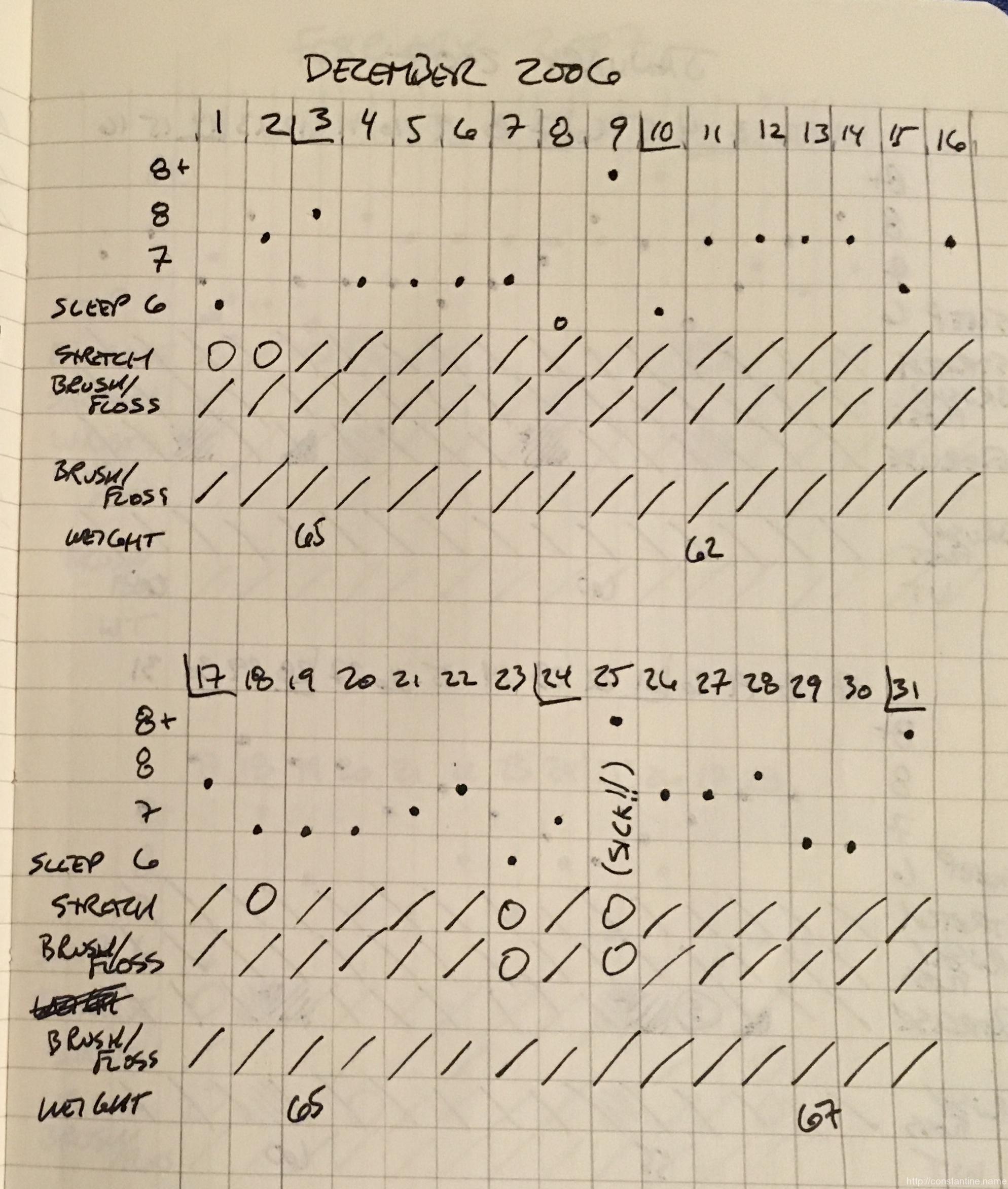
So what does this actually look like? Here’s my (recopied) habit journal table from the very first month, December 2006:
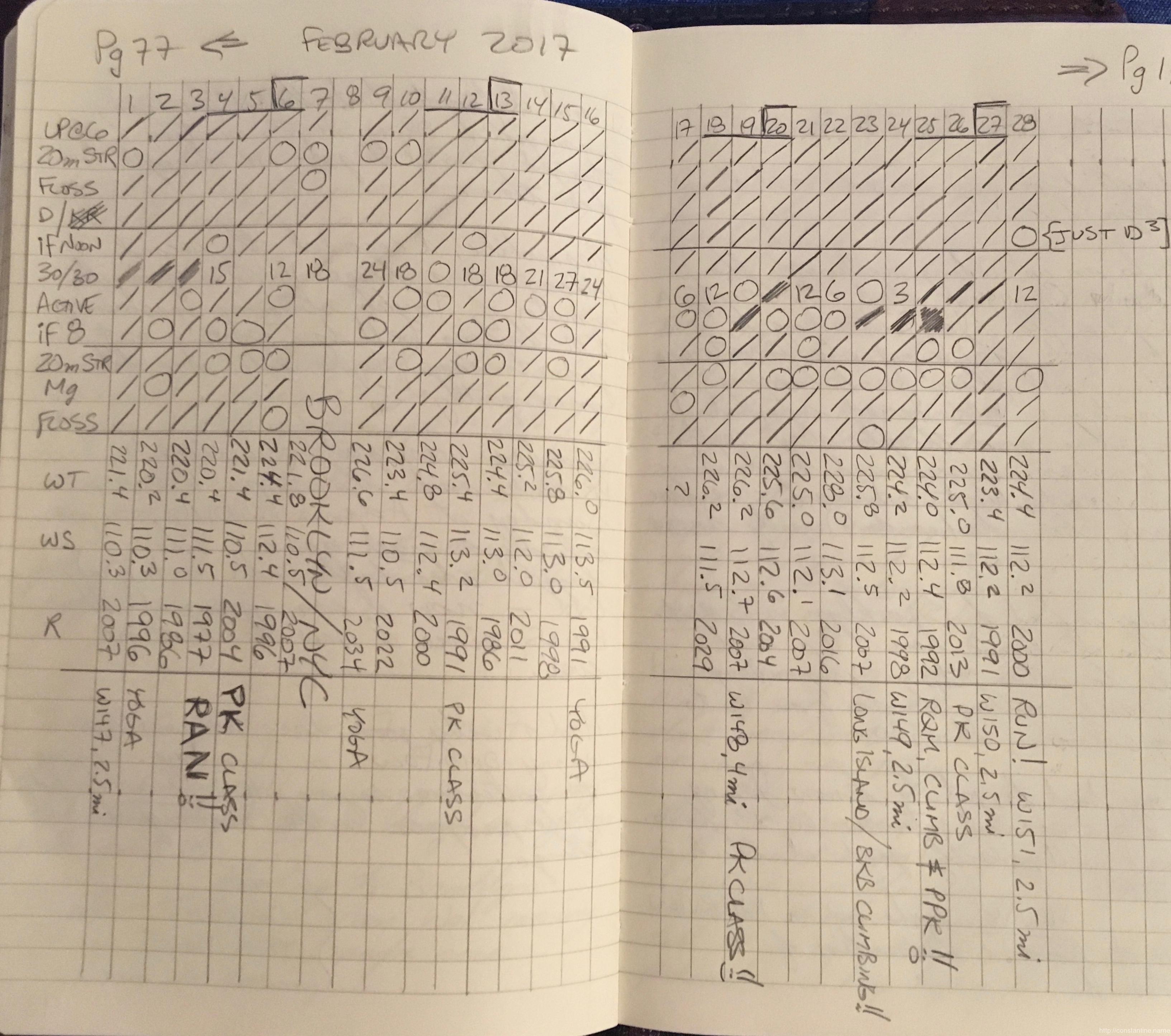
…and here is the table from, February 2017:
That’s really all there is to it. These little grids are the framework on which I hang whatever it is I’m trying to change.
ɕ
How our beliefs about what controls our weight may actually affect our weight →
Another finding of this recent research was that those who believed weight is primarily determined by activity generally ate more than those who believed diet is more important. I am wondering if this observation is, at least in part, a reflection of a belief some have that they can eat relatively freely as long as they ‘exercise it off’. For the reasons I’ve listed above, I’m not sure this strategy is likely to work out too well. And on top of this, sometimes the issue can be compounded by individuals ‘rewarding’ themselves after exercise with food or drink.
What role do community, creativity, and challenge play in connecting personal passions with physical disciplines?
Jonny Hart shares the role of parkour in his life, and how that fits in with his career as an artist. He explains the parkour and anatomy art classes that he helped develop, and discusses the joy he finds in coaching and teaching. Jonny finishes by unpacking his thoughts on breaking jumps, and shares the story of the first jump he ever broke.
I specifically make sure that there’s something in there that I have no idea how to do. And none of my skill set has prepared me for it.
~ Jonny Hart (15:30)
The conversation explores Jonny Hart’s journey from fine arts to becoming an advocate and teacher of Parkour, merging art with movement. He shares his early fascination with Parkour, describing its intensity and the unique community bonds it fosters. He reflects on how his artistic background influences his Parkour practice, providing insights into anatomy and movement, and how this cross-disciplinary knowledge enriches his teaching and personal growth.
The discussion also digs into fear and challenges, likening “breaking the jump” in Parkour to creative hurdles in art. Jonny emphasizes how facing uncertainty in both fields leads to personal breakthroughs and joy. His innovative teaching approach combines drawing, anatomy, and physical movement, aiming to make art and Parkour accessible and transformative for kids and others in the community.
This entry is part 61 of 72 in the series My Journey
My level of motivation varies tremendously, and it took me far too long to learn that it was cyclical. I used to think I had these huge swaths of motivated productivity with an occasional, unexplained crash. I used to think I just needed to figure out how to avoid those anomalous crashes, and I spent too much precious time fighting with myself in the down-turns. I now see that I was wrong; My motivation is inherently cyclical.
When I am highly motivated, it’s alluring to believe that I should spend my time working only on focused and directed things. I used to fall into the trap of trying to focus all of my time and energy on moving forward. I felt that if I wasn’t on-task, then I was wasting time, and that feeling fed into my sense of guilt.
Because I now expect the inevitable down-turns, I feel justified spending time on things which support my motivation in the long run. I work intermittently in two directions: I spend some of my time working on-task towards achieving my goals, and some time goofing-off cultivating my motivation and inspiration. In effect, I’m prolonging the motivational peaks by spreading them out wider. At the highest points, I may not be as motivated as I once was, but I maintain a productive level of motivation for a much longer time.
(To be fair, I have a pretty organized way of goofing-off. I read from a wide range of online sources and books, from health, wellness and exercise blogs to physiology text books. I constantly fiddle with new exercises to try, places to go, health tweaks, and habits. I make plans to travel near and far, where I can meet new people, and visit old friends. I even have no-thinking-required things — music playlists, and monotonous chores — which I can draw on when I need to be off-task.)
But eventually, I head into a down-turn. They vary from mild bouts of, “meh,” where I simply feel unmotivated to do any of the things I’ve set out for myself, to dark moods of depression. Regardless of the depth, when I’m heading into a motivational down-turn, my best tactic is to stop doing — to stop trying — and to simply be. It’s as if I’m at the crest of the first hill on a roller-coaster; I see what’s coming, and prepare for the inevitable ride.
At the bottom of that huge, thrill-less, depressing hill it is agonizing to lay in a puddle of “meh” and believe that this is exactly what I need to be doing right now. But that is the truth. After countless cycles of ebb and flow, I’ve learned to think: “Right now, laying in this puddle is exactly what I need.”
…and that is the key to my success.
I remind myself to roll with this down-turn, guilt-free. I try to avoid “should’ing” on myself. (I should stop this. I should do that.) I remind myself this down-turn is only one phase of a healthy cycle.
I rest.
I mope.
Maybe I watch a movie and have some popcorn. Maybe I nap. Maybe I nap in the hammock if it’s warm outside. Maybe I bask before the fire, or lay in the sun. I do whatever it is I feel like doing, which may well be absolutely nothing at all. I throw down the reigns which my executive-level mind normally holds with an iron grip. I set my thoughts and body free. They weren’t listening anyway.
And then I could write a long diatribe where I try to explain how it feels as if there’s this big, gloomy, moping, dog that sits around keeping me stuck in the down-turn. And eventually that dog gets bored and I can convince it to go away. And, honestly, it’s a stupid metaphor. Except for the fact that here I am, stuck writing some lousy metaphor, making me hate writing this, which — it turns out — is exactly the sort of perfect metaphor for feeling lousy when I’m stuck in a down-turn…
I’m going for a walk.
Just the tiniest little stroll.
But…
Walking invariably loosens up my mind. Sometimes it takes days of doing nothing interspersed with some walking before I see the light at the end of the tunnel. Soon, I find I have at least a few things on my mind that need to be unloaded. When I hear that quiet calling, I write whatever-it-is into my journal. Writing things down — moods, worries, plans, ideas — unjumbles my mind. So I record my thoughts as inspiration for future projects, and as reminders to expect future down-turns.
Eventually, I simply find the thought of working on something might actually be fun. At which point I realize I’m headed back towards the next up-turn.
When things go badly, relax; It will not last. When things go well, relax; It will not last.
It’s funny, I thought, if you could hear me, I could hang on, somehow. Silly me. Silly old Doctor. When you wake up, you’ll have a mum and dad, and you won’t even remember me. Well, you’ll remember me a little. I’ll be a story in your head. But that’s OK: we’re all stories, in the end. Just make it a good one, eh?
~ Doctor Who, in Doctor Who (“The Big Bang”), (s5e13, 2010 TV series)
I am not travelling in search of something. I am not travelling to escape. I am not travelling as a search for fulfillment. I am not lacking some key experience that I can only find by travelling.
What shall I find? …nothing in particular. And then I’m free to find everything.
Travel is fatal to prejudice, bigotry, and narrow-mindedness, and many of our people need it sorely on these accounts. Broad, wholesome, charitable views of men and things cannot be acquired by vegetating in one little corner of the earth all one’s lifetime.
I travel because I want to meet new people. I want to learn about their culture, their ideas, their hopes, dreams and passions, their way of thinking, their language, their ancestors, and their philosophy.
I travel because I want to see things. The world — all of it, near and far — is an amazing place. I want to see new vistas, new architecture, new mountains, new valleys, new weather, new plants, new animals, and new art.
I travel because, in the end, I am just a story. There’s no finish line, no definition of “having arrived”, “having suceeded”, or “having it all”. Hearses do not have luggage racks. I am not taking anything with me. I can spend my days sitting at home, collecting and counting and organizing my things, toiling to create a pocket of order in the chaos of the universe. Only, I remain absolutely certain that everything I collect, create, organize, build, and buy will not matter to me in the end.
In the end, I am just a story. And I’d very much like to enjoy the writing of it.