There’s no reason to have a plan B because it distracts from plan A.
~ Will Smith
Elsewhere, this is 4a257. — slipbox
There’s no reason to have a plan B because it distracts from plan A.
~ Will Smith
Elsewhere, this is 4a257. — slipbox
Humans are the most communicative species on the planet, but we’ve come increasingly to rely on the very cheapest signals: words. The problem with words is that they aren’t a scarce resource. Which is a more honest signal of your value to a company: when your boss says, “Great job!” or when she gives you a raise?
~ Kevin Simler from, Honesty and the Human Body
Elsewhere, this is 4umeho2. — slipbox
I’m not sure I have a take-away from this. I don’t mean, “I’m not sure I have a take-away to share“, I mean I’m not sure I have a take-away, for me personally.
I’m sure only that this made me think.
ɕ
Dom D’Agostino — The Power of the Ketogenic Diet (#172)
Elsewhere, this is 4utido1. — slipbox
This is a superlative question-and-answer session where Dr. Dagostino answers questions collected from Tim Ferris’s listeners.
It’s not so much a pitch about why you should do it (ketosis / the diet), but rather, it’s a deep discussion of all the details. What exactly is ketosis, how does it work, how do the systems in your body interact (at the various levels of organ, glands, hormones, cells, biochemics, and molecules.) Dr. Dagostino is obviously very much in favor of ketosis, but there’s a ton of useful information here.
ɕ
Elsewhere, this is 4c2ke1a. — slipbox
I always think back: We were in these small foraging groups of 30-to-50 people who were part of a larger tribe, who were part of a larger language group, and we were very connected to these people. We carved that 30-to-50 up, down to nuclear families, and we carved them up into neighborhoods, and now we’ve carved that up into even smaller units, and broken families, and now individuals, and everybody’s plugged into the internet with everybody, but they’re all alone.
~ Daniel Vitalis from, Eat Like A Centenarian: Culinary Genomics – Amanda Archibald #95
Elsewhere, this is 4udare2. — slipbox
Daniel’s guest, Amanda Archibald, discusses what Centenarians (persons 100 years of age and beyond) eat. It’s a fun and wiiiiiiide ranging discussion about food, human civilization and society.
ɕ
Masculinity-as-cultural-construct is one of those beliefs that sounds good in the abstract, perhaps. But I think most folks, men and women alike, feel deep in their gut that it isn’t so, isn’t desirable, and isn’t working. As someone who has examined the research and history of masculinity, I find the idea of it being wholly a cultural construct utterly untenable. It is a conclusion one can reach only by willfully ignoring large swaths of the data and the human experience.
~ Brett McKay from, The Dead End Roads to Manhood
Elsewhere, this is 4uaote4. — slipbox
Masculinity is not — not “entirely”, nor even “mostly” — a social construct. I believe one is free to attempt to take on whatever role one wishes. (I see that as one of the big benefits of our current level of human progress.) But if you attempt the role of a “Man”, you do not get to simply make up what you think a Man should be.
ɕ
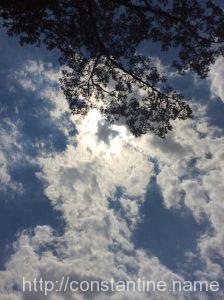
The mostly eclipsed solar disk is in the middle of this photo– just a bit above the center. Normally, at this stage of the eclipse, the partly exposed solar disk would cause retina damage if you look at it directly. But thanks to this cloud… ok, fine, yes, clouds don’t block UV light so looking at this is a BAD idea. I looked quickly. A few times. It was TOTALLY worth it. Here, you can look all you want, but you might need to zoom in a bit…
The entire eclipse was very “busy”. It was clear, then some clouds, then clear, a cloud… the viewing conditions changed second-by-second. Truly a rare event to see.
ɕ
But I still don’t see ads in my Instagram feed. Literally none. This might be because I don’t have a Facebook account, or might be because my Instagram account is flagged in some sort of hidden way because of my prominence from here at Daring Fireball, or might be a bug. This has been a years-long mystery to me (that I probably shouldn’t complain about).
~ John Gruber from, Instagram is turning into Facebook
Elsewhere, this is 4udali1. — slipbox
I understand why Instagram is adopting Facebook features: They work. But for years I logged into Instagram and enjoyed it more than Facebook. I fear a day when I wake up, open my phone and can no longer tell the difference between the two.
~ Katherine Bindley from, Instagram Is Turning Into Facebook, and That’s Bad
Reminder: On social media, YOU are the product being sold to the advertisers.
I recently deleted my Instaspam account entirely. I used to enjoy posting and viewing, but it’s just a useless stream now (like Bookface.)
Meanwhile, way back in the beginning, I had the foresight — knowing Instaspam would get eaten, monetized and rot into junk — I used a plugin on my site which kept all my photography: They are still locatable here, with one of my favorite tags: #Instaspam
ɕ
If you ask anyone who’s read [Fahrenheit 451], that hasn’t read it in like 20 years, “What do you remember of how that came to be in the book?” They’d say, “There’s this totalitarian government.” The truth is, it was the people. It was the people who decided that any dissenting opinions that would offend specific groups in society, ought to be burned. So it was self-inflicted. I think that’s what we are doing right now. We are slowly torching the first amendment and free speech by, basically, going on these witch hunts. I think it’s the most dangerous thing in the U.S. right now.
~ Tim Ferris from, Jamie Foxx Part 2 – Bringing the Thunder (#167)
Elsewhere, this is 4utija1. — slipbox
Normally, the Tim Ferris show is Tim interviewing his guests. But this episode is a rebroadcast of Jamie Foxx interviewing Tim.
First, great book. Second, I’m a huge believer of the marketplace of ideas. (That’s a significant part of the reason behind my Movers Mindset podcast project.)
ɕ
Elsewhere, this is 2fa1a. — slipbox
In Allen Ginsberg’s poem “Howl” (1955), Moloch is used as a metaphor for capitalism and industrial civilization, and for America more specifically. The word is repeated many times throughout Part II of the poem, and begins (as an exclamation of “Moloch!”) in all but the first and last five stanzas of the section.
~ from Moloch
Elsewhere, this is 4uwiwi2. — slipbox
I just recently, (in the scale of my life,) stumbled over an explicit reference to Moloch. I was all like, “Moloch? Who the what is that? *bookmark*”
I finally got around to reading the WikiPedia article and realized that there’s a huge amount of Moloch wriggled into and behind a ton of the classic fiction which I love.
ɕ
Decisions are made by those who show up.
~ Jennifer Pahlka
Elsewhere, this is 4a346. — slipbox