Taking an “anti-” stance is not a solution

Even from a seemingly unempowered starting point — a budget apartment in some forgettable corner of a society that has been designed to make you sick and impotent — these traits will do more for you than any “Anti” stance you can think of. Hating the system is a favorite American pastime. It feels good, is difficult to stop once you start, and gets you precisely nowhere, not unlike eating Doritos. This is not us against them, it’s us for us.

~ David Cain from, How to Make Trillions of Dollars

I don’t know about you. But it is definitely “me against me.” Not in the sense, “I need to conquer myself,” but in the sense, “I need to stop defeating myself.” What’s that old adage? …be kind for everyone you encounter is fighting a great battle? I need to learn that lesson, and I need to remember that the person I most often encounter is me.

ɕ


The frickin’ best sports writer on the planet

You get the job because you walk into the editor’s office and go, “Hi, I’m the best frickin’ sports writer on the planet.” And somehow the editor can tell you aren’t lying, either.

~ Jason Korman from, «https://www.gapingvoid.com/content/uploads/assets/Moveable_Type/archives/001070.html»

slip:4ugaco2.

It’s critical that you realize this works. It’s even more critical that you notice the “aren’t lying” caveat.

I’ve never liked the mantra, “fake it ’til you make it.” Don’t fake it! Just start working and start asking questions.

My favorite question is, “what would world-class look like?”

ɕ


Parkour floor

We forget that what we have is more than what we need. Obscenely more. I know it may sound perverse, but here in the future people often feel like they need more than they have.

~ David Cain, from A Day in the Future

There’s a sense of accomplishment in being prepared to sleep on the floor when traveling. There’s a sense of freedom in being able to carry a small backpack and live comfortably. I always knew this was at least partly due to knowing that I was prepared enough for important contingencies and free enough to roll with whatever comes up during the day.

But now I see that there’s a second dimension to why I enjoy it: The self-imposed hardship. Sometimes the floor is cold and drafty, sometimes there’s a cat (I’m allergic to cats), sometimes everyone stays up very late (I usually turn in around 9:30), sometimes I miss a meal, sometimes I don’t sleep much if there’s too much light, sometimes it’s noisy, … and so on. Still, I am invariably in a better mood than usual the morning after each of these choose-your-own-adventures-gone-bad. Cold, stiff, sneezy, tired … sure. But in a good mood. Well, that’s very interesting, now isn’t it?

I’m not making a call for you to take up Parkour-flooring. I’m only pointing out that when I occassionally reset my callibration by intentionally taking on some suffering, I’m invariably happier after.

ɕ


The devil always gets his due

Anyone can be an idealist. Anyone can be a cynic. The hard part lies somewhere in the middle i.e. being human.

~ Jason Korman, from «https://www.gapingvoid.com/content/uploads/assets/Moveable_Type/archives/001117.html»

slip:4ugaco3.

I’ve recently been on a run with posts about “balance” simply because that’s what I’m struggling with most these days. Confirmation bias then ensures I’m seeing things “about” balance everywhere.

realist: n., optimist with experience.

I’m not going to say the best place to be is always in the middle of a given spectrum. Actually, it’s not even perfectly clear to me that “idealist” and “cynic” are opposite ends of a spectrum; but I’ll run with that assumption for today. So given that acting from an entirely idealistic or cynical position is going to end badly… what can I take from that?

I think it’s pretty simple: Strive for the best, and plan for the worst. Running with that idea, I’ve been returning to my old, first step of my current journey: Self-awareness.

“Look, you’re freaking out. Simple fact.”

“Is this really the end of the world?”

“Is this maybe too far toward the cynical end of the spectrum?”

“Could I maybe do with a little less drama?”

“What if I turned around and looked back at what I’ve accomplished?”

“Would that at least bring me a little peace?”

ɕ


Deliberate way of living

Set intentions at the start. When you start your day, or any meaningful activity, check in with yourself and ask what your intentions are for the day or that activity. Do you want to be more present? Do you want to move your mission forward? Do you want to be compassionate with your loved ones? Do you want to practice with discomfort and not run to comfort? Set an intention (or three) and try to hold that intention as you move through the day or that meaningful activity.

~ Leo Babata, from A More Deliberate Way of Living

slip:4uzede1.

Long ago—maybe ten years?—this idea of setting intentions made a huge impact on my life. I’ve talked about first learning the twin skills of self-awareness and self-assessment as the first steps on my journey. Once I began developing those skills, I was able to begin setting intentions and that lead to the long period of growth I’ve recently been experiencing.

But there’s a problem, or at least there’s a problem for me. Once I started down the road of setting intentions I’ve fallen prey to a vicious cycle. Practicing continuous improvement by setting intentions and assessing progress makes me focus forward, treating my intentions at targets before me. I used to think the “focus forward” part of that was a good thing. After all, it clearly has led me on a long journey of improvement.

I set good intentions which force me out into my un-comfort zones and it turns out that I usually don’t quite reach the goals. If I do reach a goal, then I realize I could have set a better goal by stretching for a farther intention. In that way, every assessment ends up reporting that I fell short, didn’t make it, didn’t live up, didn’t achieve, didn’t succeed, didn’t, didn’t, didn’t, didn’t… and that leads to a dark place.

Recently I’ve been more intentional about what intentions I set.

(That’s a red flag right there; I’m still intentions based.)

None the less, I’ve been trying to set easier-to-achieve intentions so that I can check off more wins. I find this very hard to do since it feels like artificially lowering the bar so I can cheer-lead myself away from the dark place. Worse, this is still looking forward and assessing progress made towards goals.

I wonder what would happen if I could manage to turn around, make progress towards the goals, (they now being behind me,) while staring back at the INSANE MOUNTAIN OF AMAZING THINGS I HAVE ACCOMPLISHED?

Maybe I should try that for a while?

ɕ

One who acts naturally

One who tries to stand on tiptoe cannot stand still. One who stretches his legs too far cannot walk. One who advertises himself too much is ignored. One who is too insistent on his own view finds few to agree with him. One who claims too much credit does not get even what he deserves. One who is too proud is soon humiliated. These are condemned as extremes of greediness and self-destructive activity. Therefore, one who acts naturally avoids such extremems.

~ Book of Tao

slip:4a272.


Ten-years and About that “diet”…

This entry is part 69 of 72 in the series My Journey

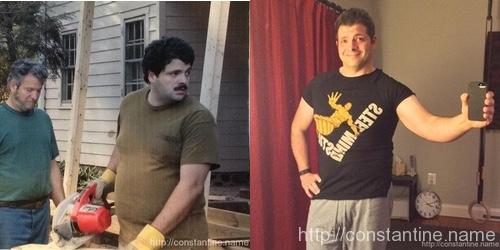
That photo? In the “before” photo (the left half) I am the unrecognizable person on the right. :)

Recently a friend of mine emailed me and asked, “Hey Craig, tell me about that diet you went on a few years ago.” He was referring to what I did from ~2008 to ~2016—the photos above were taken in 2008 and 2016. Below is my response and this just happens to all coincide with the “ten year challenge” currently all over social media.

(more…)

Thought experiment

We should apply the same ruthlessness to our own habits. In fact, we are studying philosophy precisely to break ourselves of rote behavior. Find what you do out of rote memory or routine. Ask yourself: Is this really the best way to do it? Know why you do what you do—do it for the right reasons.

~ Ryan Holiday, p24 The Daily Stoic

I sometimes imagine that the things I can choose to do can be placed on an aspirational spectrum. It’s not a linear, ordered list, but rather a thought experiment to do the pair-ordering; for any two things I could do right now, which is higher on the aspirational spectrum?

I could go even farther than just the pair-wise comparing and imagine all the things in my life might be orderable as…

a b c d e f g h i j k l m n o p q r s t u v w x y z

Fortunately—not a typo—the incessant work of ordering things to pick what to do next is exhausting. It forces me to notice that when I zoom out, I could imagine I’m doing things in the “j” through “q” range…

a b c d e f g h i ( j k l m n o p q ) r s t u v w x y z

I can make things better simply by making some space in my life. If I just drop that “j”-thing entirely I can be comfortable in knowing I’m improving, without having to actively micro-worry about everything all day. Dropping that “j”-thing leaves me with…

a b c d e f g h i j ( k l m n o p q ) r s t u v w x y z

Whereas before my average was between “m” and “n”, just by eliminating something from the lower side, my average moves up. Clearly I can improve my life appreciably by occassionally thinking about all the things I’m doing, and identifying a lower-end thing to drop.

Yes, of course things aren’t really this simple. But it took me a long time to learn the lesson that removing something can produce marked improvement. Some would say that removing is the very definition of how to approach perfection.

ɕ


The absurdity

We usually (though not always) recognize the absurdity in blaming animals, inanimate objects, or the weather for the annoyances they cause us. Shit happens, and most reasonable people can accept that. But somehow, if we can in any way pin the inconveniences in our lives on a failing of another human being, we are quick to do it.

~ David Cain, from Do You Make a Moral Issue Out of Being Inconvenienced?

slip:4urado1.

Replace every instance of we with I in the above quote and it once fit me perfectly. I sometime mention the fundamental attribution error and that is a significant part of what he’s talking about. But there’s more to it than just that error.

This is something I’ve managed to transform into a snide condescnesion; for example, when driving, I often think, “…aaaaaand, cut me off,” just before drivers do so. I recall how I used to get angry in such situations. Really angry. Fortunately, more than a decade ago, after a lot of meditation, I learned to first witness the anger, then to know when to expect it, and finally to not bother creating it.

Current project: Witness the condescention. Learn to expect the condescension.

ɕ


How to make life agreeable

You’ll feel much less of a need to control outcomes, which — in a brilliant instance of irony — frees your capacity to control your response, and create an outcome you like. If there is some action you want to take, you can take it with grace and cool-headedness instead of frustration and desperation.

~ David Cain from, How to Make Life Agreeable

slip:4uraho8.

This reminds me of my thought about enjoying standing in line at the post office.  Not in the sense of, “I’m great, I have this mastered.”  Rather in the sense that I recall what it has felt like and I recall the impatience and urge to get away from situations which I had decided were disagreeable.

Obviously I’ve not mastered this; there are still plenty of instances where I judge a situation unworthy and begin my squirming to escape.  But, I’m making progress.  I’d go so far as to say that I’m getting comfortable sitting in my inability to sit comfortably in situations I’d normally resist.

ɕ