Consider: Has a podcasting hiatus changed your perspective on the grind of production?

You didn’t plan for a hiatus—it just kind of happened. Stepping away from the routine of podcasting, has it changed the way you see the relentless pace of content creation? Do you feel more or less pressure to keep up with a schedule now? Has this break made you rethink what “consistency” really means for a podcaster?

~ Asked by the LLM(1)

Yes, it definitely changed how I look at everything about podcasting. I’ll unpack the reason for the hiatus, so that my take-aways make more sense.

First, in April 2024 we had an unexpected death in the family. Given the scale of things, it was a no-brainer to cancel the several guests who were scheduled for recording sessions. Unfortunately, I over-worked myself for a stretch of days, and that led to my being exhausted and getting sick. In those first days, as I sent “I’m really sorry, but…” messages to the guests, I was thinking about this in a very particular way: This is the right thing to do for these people who kindly set aside time for me.

The first take away from this experience is to be honest and realistic with myself. An unexpected death changed my daily priorities. I’m sick and my voice is crap. I need many weeks to recover, assess, and figure out what I can do in the coming months. In the past, I might have tried to work harder to try to keep juggling everything.

Then in May, a routine blood test returned results which one would prefer to never see. Through June and July, and then into August and September, I worked through a cancer diagnosis. This further “adjusted” my priorities and schedule for the rest of 2024.

The second take away is just having a conversation with anyone is a crazy-awesome gift. And (as I’m getting back to podcasting now, in Feb 2025) to be able to record and share them is just icing on the cake.

As for the grind, consistency, a schedule? No, not any of that. I hope I can hold on to this mindset:

I’m insanely lucky to get to do just one more episode, and it looks like I can do them for years to come. Grinding, being consistent, and sticking to a schedule are all forms of striving for something. (I am a professional even without any of those.) So, nope. No, thank you. I’m not signing up for that mindset again.

ɕ

(1) I’m working with an LLM instance which has access to everything I’ve written about podcasting, and all the episodes I’ve published. It prompts me by asking me these questions.
Archeology and music

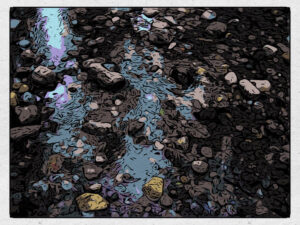
Simply sound-related things today: An image of a babbling brook and archeology…

It is possible that some 8,000 years ago, in this acoustically resonant haven, people not only hid from passing coastal thunderstorms, they may have used this place to commune with their dead—using music. That’s a possibility hinted at in the work of archaeologist Joshua Kumbani, of the University of the Witwatersrand in Johannesburg, and his colleagues.

~ Sarah Wild, from What Did the Stone Age Sound Like?

Elsewhere, this is 4usaaa2. — slipbox

Seems obvious that archeology would be interested in sound— but I’d never thought of that aspect of it before.

ɕ


Having a clear why

It’s become cliché to talk about finding our ‘why’. That’s a shame because it’s absolutely, still, critically important, to us as podcasters. I was recently reminded of this point…

Ask yourself, why am I podcasting as a host, or as a guest? You must have a clear why, and it should be bigger than just “me.”

~ Alex Sanfilippo

Tell me your ‘why’.

And if you just hesitated— If you don’t immediately have an answer— Then you do not actually know your ‘why’.

You don’t have to post it! But you better know exactly and clearly what it is. Posting it just puts it out there, ensuring it remains real for you.

Whether or not you post it, you absolutely must have a ready-to-mind answer for your ‘why’.

For the longest running of my shows, Movers Mindset, my why is…

Each conversation feeds my insatiable curiosity, but I share them to turn on a light for someone else, to inspire them, or to give them their next question.

When I started that show, I did not have a clear ‘why’. It wasn’t until I took the Akimbo podcasting course in 2019, that I took the time to reimagine a lot of the two-year-old Movers Mindset podcast, and prompting from the course material and the coaches turned me onto asking myself, “uh, yeah, why?!”

ɕ


Getting back to podcasting

Working with the garage door up, means I’m really just thinking out loud. I’m talking mostly to myself. It’s been a long time since I’ve done an episode for one of my own shows. Obviously the break was begun because of health issues in 2024. In the last couple of months though, I again do have the time. And I miss it. So I shall resume.

ɕ


Show the web some love

Web sites!

Our beloved podcasting is built upon technology from the free (as in freedom and money) World Wide Web. We’ve come to take it for granted, so we just call it the web without even a capital-W.

Every podcast creator talks about getting more listeners. There are billions of people using the web. Searching on the web has to lead to a web site.

My challenge to you is:

Type “Your Show Title podcast” into a few search engines…

(You could also search for the title, or some critical words, or a guest name, from a recent episode.)

What did you get?

How far down those results is it to something that you actually control?

Is there even anything you control, anywhere in the results?

The only thing you can actually control on the web, is your own domain name.

…go to https://hover.com/ and find a domain name that you like.

ɕ


Between a rock and a hard place

I really enjoyed Curtis Cates’s episode 14, Transformation can be fun…!.

Lately, I’ve been back to my regular walking, and I’ve started getting serious listening time in. I was delighted to get a chance to hear from Curtis.

(Yes, yes, I’m way waay behind on the Hansel & Gretel Code.)

Like you, my to-listen-to podcast cup runeth over! I’m regularly adding newly-released episodes. But I also have a way of systematically looking through shows’ entire back-catalog. So I’m also, regularly adding very-old episodes.

Yikes!

…and I heard one of Curtis’s sound-bites as I typed that.

Anyway, if you’re already familiar with Curtis’s work, drop back into ep14 of H&G, just for fun. If you’re going “Curtis who?” … start below. And, you’re welcome!

art is personal
and what qualifies or disqualifies something as art is all up to you

~ Curtis Cates, from Kristo.art

ɕ

PS: I don’t subscribe to shows; I add episodes one-by-one when I see interesting episodes via my daily RSS-feed reading.


How things feel

I have written about this before and it is something I wish to emphasize repeatedly: efficiency and clarity are necessary elements, but are not the goal. There needs to be space for how things feel. I wrote this as it relates to cooking and cars and onscreen buttons, and it is still something worth pursuing each and every time we create anything.

~ Nick Heer, from Delicious Wabi-Sabi

Elsewhere, this is 4upobo3. — slipbox

Yes, “efficiency and clarity are necessary elements, but are not the goal. There needs to be space for how things feel.” Hear! Hear!

There are at least three reasons to read Heer’s points. Retro-digital photography is really a thing; the Japanese concept of wabi-sabi (appreciating beauty that is imperfect, impermanent, and incomplete); A bit of hist wondering about software.

It’s the wabi-sabi that got me thinking about podcasting. I’m well-known for cutting the corner when it comes to editing the conversations I record. I’ve always looked at that as a necessity: If I tried to raise the level of quality by editing, I’d not be able to put the episodes out (or at least not as many.)

After reading Heer’s thoughts, now I’m wondering if I’m also—perhaps even more so?—drawn to the wabi-sabi of the conversations with all their blemishes, false-starts, uhm-and-ahs in place.

ɕ


Really, this book is worth reading

I mentioned this book previously (in, Driveway Moments). As I read more, it became clear this book is stuffed full of useful information for podcasters. At some point, I’ll get around to organizing some sort of “resources” something-or-other over on the Podcaster Community, and Sound Reporting will definitely go in the “must read” books list for podcasters.

Almost nothing in the book is directly usable… but there’s a ton of stuff—far too much for me to quote—that I found made me think.

To be honest, a lot of it felt like, “yes, I agree” and “yes, I learned that the hard way.” But there was also a lot of “that’s a good idea” and “yikes, now I know I don’t want to do that that way.”

These chapters were particularly fertile ground: Writing for Broadcast, Story Editing, Reading on the Air, Hosting, and Booking. They contains tons of information from the professionals.

ɕ


Where’s the scene?

Where is the space where you hang out with other people doing whatever it is you do? I’ve mentioned this idea before, for example, Setting and scene. This is something I come back to often because it is really important to me.

And by “space” I mean a physical space, like the proverbial 19th century café with writers talking and drinking coffee. Third places are clear candidates for our scene.

What about virtual third places? All of us know each other virtually, including through various video calls over the years. But a virtual space has to be very special to be a true “scene.” In fact, I’m not sure just how special, and I’m not sure what exactly the features it needs to have…

That’s what I’m thinking about this morning:

What are the special feature of a virtual space that make it into a scene?

Here’s a few I’ve come up with so far…

  • People :) obviously. We need to know others are there (I see “likes” or a head-count in the video call).
  • Engagement. We (me, you, the person seeking the scene) need to soak up energy from other people. Yes, even introverts need at least a little bit of interaction, particular in the realm of one’s creative endeavor.
  • Questions. Questions don’t have to be about getting an answer! “Revealing your questions in such a way points to the shape of the knowledge you are seeking.”
  • Mistakes. …not sure about this one. “Mistakes” isn’t quite the right word. I’m trying to point at the idea that seeing other people attempt things, and not succeed, shows that the scene is a space safe for experimentation and challenging ourselves.

What else comes to mind?

ɕ


Strategy questions

Seth Godin posted a selection of strategy questions a few weeks back, to coincide with his latest book’s release. I’ve found myself referring to these questions a few times, and wanted to post about it here to be sure everyone had a chance to notice them…

Where will I cause tension? What resistance should I anticipate from others (and myself)?

~ Seth Godin, from Strategy Questions

Elsewhere, this is 4usete18. — slipbox

…just to pick one to quote, to give you a taste.

I’ve been using this list as a primer when I want to think about some project. I’ve found it works in my own head, as well as with other people.

As always, his asking really good questions is a gift; A tremendously empowering gift.

Is there a question in that list which scares you?

ɕ