What lessons and insights can be drawn from personal experiences in Parkour and community development?
Exploring how personal growth intertwines with professional experiences in Parkour and community development.
Getting things out there, 85, 90% done, and then there maybe being a few little fixes you do, is actually harmless compared to making people wait or never getting to the end of a project.
~ Chris Grant (15:49)
The conversation explores the evolution of roles and responsibilities within the Parkour community. Chris discusses his transition from being a coach to a development manager at Parkour UK, emphasizing the value of building systems that support practitioners. He reflects on how stepping back from Parkour full-time provided him with a broader perspective and transferable skills, which he now applies to help others in the community.
The discussion also touches on practical advice for those navigating entrepreneurial endeavors in niche fields. Topics include the importance of financial stability, embracing imperfection in projects, and the benefits of setting boundaries to avoid burnout. Chris highlights the need for humility and openness to new learning opportunities, even after years of experience in a field.
How does one balance pursuing multiple creative and physical endeavors while maintaining long-term growth and curiosity?
Practical insights into climbing, gymnastics, and writing illuminate the shared themes of persistence and adaptability.
My real goal is to get people thinking about how to apply all these different kinds of steps to their own training or injuries or whatever they are working on and be able to do things for themselves.
~ Steven Low (15:59)
This conversation weaves through the journey of pursuing physical and creative challenges, reflecting on how to balance growth and curiosity over time. Topics range from the iterative process of writing deeply informative books to the physical and mental intricacies of climbing and gymnastics. The discussion emphasizes the importance of problem-solving and adapting methods based on personal experiences and new scientific insights.
Personal anecdotes highlight the interplay of curiosity, physical limitations, and the satisfaction derived from mastering difficult tasks. The conversation touches on teaching as a vehicle for personal fulfillment, drawing parallels between activities such as rock climbing and whitewater rafting in terms of their unique ability to offer new perspectives and foster resilience.
What role does curiosity play in shaping movement, interactions, and personal growth?
The nuanced relationship between uncertainty and opportunity defines how we engage with challenges.
If you protect yourself from all uncertainty, maybe you are protecting yourself from falling down a well or getting eaten by a bear, but you’re also protecting yourself from love.
~ Flynn Disney (8:05)
The conversation begins with an exploration of curiosity as a driving force behind personal growth and movement practices. Curiosity is described as a positive sense of uncertainty, where individuals embrace the unknown with hope rather than fear. This attitude ties directly to embodied experiences, where physical movement reflects the mental and emotional processes involved in navigating uncertainty.
The discussion touches on boundaries, games, and goals, emphasizing their roles in learning and engagement. A notable insight is the idea that boundaries create meaning in challenges, as seen in activities like parkour and games. The interplay of failure and success, described as the resolution of uncertainty, is vital for developing curiosity and staying motivated. Personal anecdotes, such as training dogs and solving puzzles, highlight how curiosity manifests across diverse contexts.
What unique insights and challenges arise from participating in World Chase Tag and how do they intersect with the broader culture and practices of parkour?
This discussion explores the tension between preserving authenticity and adapting for mainstream appeal in parkour competitions.
Being playful, goofing around, is part of keeping your head in the game. And if you lose that playfulness, that’s when I get really worried that I won’t be able to perform.
~ Olof Wood (15:20)
The conversation examines World Chase Tag as a competitive extension of parkour, highlighting its demands on reflexes and decision-making. The interplay of flow states and logical strategies is emphasized as central to mastering the sport. Its unique blend of simplicity and complexity offers accessibility to audiences and athletes while retaining its competitive edge.
Discussions also touch upon social media’s influence on parkour practitioners. By choosing to disengage from traditional platforms, Olof reflects on authenticity and how parkour communities could benefit from self-owned platforms. The broader implications for personal evolution within parkour are also explored, with insights into adapting practices to life’s changing demands.
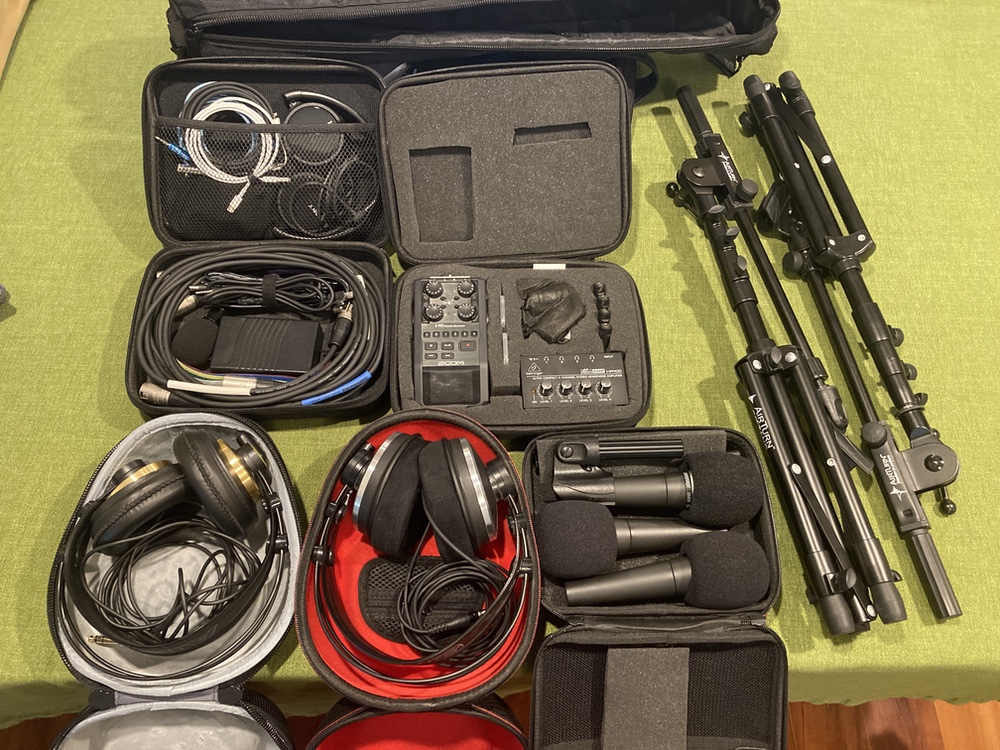
As I mentioned last week, I was recently on a rather long road trip doing some recording for the Movers Mindset project. I took a lot of stuff on the trip, but here’s the two bags which comprised the complete podcast setup—everything I need to press record is in these two bags. The rectangular bag is a proper, no-cheating, most-stingy-airline carry-on size.
And here’s what’s inside: Two full-size (albeit lightweight) mic stands, 2 sets of full-size headphones, and 3 containers of all the podcast recording and listening electronics. (And it’s all battery powered to boot.)
I’ve talked previously about simplicity. In particular, the idea that imformed simplicity, following from a beginner’s mind which has moved through understanding the complexity of a topic, is the hallmark of mastery practice. But forced simplicity is an entirely different animal.
Occassionally, I really need to stretch out and tear into some hard work. This week I did 8, long-form recordings in 5 days. Driving, sometimes eating, more driving, arrive, set up, record, drive, sleep, and on and on. At night I’m trying to quickly come up with a plan for the next day; I have to be where, when? …drive time? …traffic? And before I can be comfortable I have the next day under control, I need to get to sleep. Small bits of online work need to be done here and there—
I’m literally sitting by a campfire. My Mac is wifi’d to my iPhone’s cell service. I’m uploading a 90mb audio file to Movers Mindset’s project management system, as I type this blog post.
—then it’s time to sleep. Then jump up and leap into the next day. Organize the van. Is there time to shower today? (This is a real decision, and the answer was not always, ‘yes.’) Can I do my journaling? …not this week? My usual reading? …not this week. Everything I did for 6+ days was laser focused on what happens between when I press “record” and “stop.” Arrive at the location and bring my A-game. Under- or over-caffeinated, sleepy, prepared or not, … game. on.
Forced simplicity can be brutal. But, I got the good tape.
What insights and experiences are shared about balancing personal life, professional commitments, and community involvement in Parkour and humanitarian work?
The journey from Washington, DC, to sabbatical in Scotland highlights the value of rest and self-reflection.
You don’t need to earn a break; you’re allowed to just take time off and breathe and enjoy your life a little bit.
~ Adrienne Toumayan (4:59)
The conversation begins with reflections on taking a sabbatical and the challenges of prioritizing rest and recovery. Insights are shared on overcoming self-doubt and embracing the freedom to recharge. Adrienne discusses their unique journey, transitioning between a demanding career in humanitarian aid and their deep involvement in Parkour, where she has contributed to events like the North American Women’s Parkour Gathering.
The dialogue also explores the Adrienne’s contributions to Parkour Earth, emphasizing the importance of foundational work in creating a transparent and inclusive global organization. Additionally, she shares her passion for storytelling through blogs and Instagram, using these platforms to connect with others and inspire engagement with their adventures. The beauty of the Scottish Highlands is also highlighted as a source of inspiration and joy during her sabbatical.
I’ve been on a road trip this week recording podcasts for Movers Mindset. One thing I wanted to experiment with was trying to record “short” form podcasts for Movers Mindset while on the road. Adrienne Toumayan joined me for a recording titled, Balance.
For as long as I’ve been recording podcasts I’ve wanted to figure out how to learn more, and retain more, from the conversations. An audio recording of a good conversation can be a good experience for the listener; It can be good experiential learning. But the conversations contain so much more—facts sure, but also connections to other people, projects, stories, new perspectives, insights—which I know I’m missing. If something prompts my memory, I can recall the experience of the conversation, but everything else is either never learned, or if it was, I’ve subsequently lost it.
I’m reminded of…
If you remember what an author says, you have learned something from reading him. If what he says is true, you have even learned something about the world. But whether it is a fact about the book or a fact about the world that you have learned, you have gained nothing but information if you have exercised only your memory. You have not been enlightened. Enlightenment is achieved only when, in addition to knowing what an author says, you know what he means and why he says it.
There are multiple levels of understanding and learning, contained in each conversation. At the root of my feeling that I’m missing out is the knowledge that I’m only retaining the most-superficial level of the experience.
Who’s it for?
It’s obviously for me. But by doing the writing in public everyone who finds a specific episode interesting would be able to capture and retain more of those “levels of experience” for themselves.
What makes bike racing a unique and transformative experience for individuals and communities?
Bike racing is Joan Hanscom’s life; from racing for fun, to professionally organizing races, to running an entire bike racing organization, Joan has done it all. She talks about all things bike racing; from how she got started, to organizing, to the challenges facing women in the sport. Joan discusses her work at the Valley Preferred Cycling Center, and the importance of outreach and the larger picture. She shares her insights on passion, training, podcasting, and what a career in the sport means to her.
As a person who’s had a career in bike racing since 2002, I was well versed in knowing what the velodrome was, and it was sort of an honor to be tasked with this role. If there’s one thing that I want the velodrome to be is, it’s fun, because that matters. But I also want it to be a place where little kids Pee Wee Pedalers, Squirts and Weebles Wobbles, all the way up to master’s racers, and everybody in between, elite or not, can come and have fun. To me, it’s a place where we can cultivate this lifelong enjoyment of the bike.
~ Joan Hanscom (20:53)
Joan Hanscom is a cyclist, podcast host, and the Executive Director at Valley Preferred Cycling Center. Her love of the sport helped her build a unique career in race promotion and production, working with organizations such as the US Gran Prix of Cyclocross, Cyclocross World Championships, and USA Cycling. Currently, Joan is the Executive Director of the Valley Preferred Cycling center in Trexlertown, Pa, and hosts the Talk of the T-Town podcast.
It’s the process. It’s the process, no matter what your pursuit is. If you are pursuing excellence in the ballet, it is repetition. It is absolutely repetition. The process of the ballet is every day, there’s a bar, there’s plies, there’s grand plies. There’s jete. It’s a repetition and it’s a process of perfection. Maybe ballet is skewed a little bit more towards perfection than other sports, but it is definitely a repetition and a process and a refinement that you do daily.
~ Joan Hanscom (42:50)
This conversation centers on the multifaceted world of cycling, highlighting its unique sensory and communal experiences. A core theme is the immersive nature of bike racing, from the visceral sounds and sights at the velodrome to the inclusive, community-focused atmosphere it fosters. Joan reflects on her lifelong passion for cycling, tracing it back to her childhood and describing how the sport bridges personal enjoyment and professional achievement. She shares her experiences in organizing races, engaging the local cycling community, and her work at the Valley Preferred Cycling Center, aiming to create an inclusive space for all cyclists, from children to elite athletes.
Another key discussion point is the systemic challenges in the sport, especially regarding women’s participation. Joan outlines how structural gaps, like fewer racing categories and opportunities for women, make progression difficult. She emphasizes the need for investment in underserved groups, stressing that fostering diversity and inclusion can strengthen the sport and grow its community. Alongside these insights, Joan connects cycling to broader values of process, repetition, and community building, drawing parallels to other disciplines like ballet and movement practices.