Slip boxes aka zettelkasten

Zettelkasten is usually mentioned as a note-taking method. However, the end goal of Zettelkasten is not gathering and collecting notes, but rather creating a competent and knowledgeable communication partner. The main interaction with the slip-box is not when we are writing and adding new notes, because the slip-box is not there to be an archive of our memory and knowledge. Slip-box is there to be an apparatus with which we think. Therefore, the main interaction is when we communicate with the slip-box by confronting ourselves and our thinking with our prior knowledge.

~ Eva Thomas from, Understanding Zettelkasten — What does it mean to communicate with the slip-box

slip:4umeeo1.

This appears to be part four of a series: On knowledge systems, Push and pull, and Commonplace notebooks. Depending where you are on your personal journey you may have been sitting back, chuckling, waiting for me to “discover” zettelkasten. …to which I reply, “y u no email me about zettelkasten?!”

Now this idea I definitely have seen before. I can recall stumbling on the idea very early in my personal productivity and self-awareness journey. Without looking, I’ll bet I found it first on 43 Folders. I had the distinct pleasure of following along through Merlin Mann’s journey—trying to keep up, but not succeeding at the time. (Posts on that site run from 2004, through 2011.) If you just went, “43 Folders? …what’s that?” You need to go look at 43 Folders.

…oh sorry, I was off on a tangent there. I just realized Mann has a podcast that’s on episode . Shit. Another thing I probably need to listen too. I’ll just say: My web site serialize tool can drip podcast show notes pages at me too, so I’ll drip all those so I can skim the show notes, and I’ll just listen to the few that are “must listen” [in my opinion of course.]

*shudder* I’m all over the map today. Zettelkasten, right.

When I first encountered it, I got stuck on the idea that it’s “notes” in “boxes.” Why would anyone want to do that, now that we have (back then) web sites where you can tag stuff, search, edit, etc.? Now I see this part—trimming my lead quote down—is the neat part:

The end goal of Zettelkasten is creating a competent and knowledgeable communication partner. The slip-box is there to be an apparatus with which we think. Therefore, the main interaction is when we communicate with the slip-box by confronting ourselves and our thinking with our prior knowledge.

Do you see it now? The slip-box system can be slips of paper, digital notes/files, or many other implementations. The original slip-boxes (physical things, pre-Internet… actually, pre-electricity,) were used by one person. Using modern technology we can implement one that allows people to collaborate too. (If we wanted. Not saying I necessarily want that.)

Oh, and guess what I built four years ago. A very complicated, (that’s not a compliment,) system for weaving together references, summaries, and articles on a site called Hilbert’s Library. It was literally my first attempt to build a knowledge management system. I’m now thinking it’s over-designed—I mean yes, sure… I over-think and over-design everything. But I mean that now I see why the design I built into it actually gets in the way of it being maximally useful as a knowledge management system.

What? Oh, yes, people have built lots of ways to implement slip-boxes. Notably, Emvi does that (among other things, because zettelkasten can be confusing so they pitch it in various use cases.)

ɕ

slip:1b1


Commonplace notebooks

Continuing my train of thought from On knowledge systems and Push and pull, today I want to dive into something called a commonplace book. (For the third time: no denouement today.) In line with more modern language usage, I’m going to prefer commonplace notebook; books are today commonplace, and we use the word “notebook” for the ones we create privately.

Settle in, this is about to get tangential.

I first encountered this idea at 8am, November 13th, 2020. Literally. I’ve never heard of the idea of a “commonplace book” previously. And here I am in the midst of finally pulling on a thread which I’ve been calling a quest for a knowledge system… trying to solve a problem which is as yet ill formed. I’ve been reading through the entire https://fs.blog web site; it’s like 5,000 non-trivial web pages skimming a few every day for well over a year. This November 13th a little before 8am I happen to reach, John Locke’s Method of Organizing Common Place Books. Which, probably is not worth clicking through. First off, “common” modifies “place” so we can drop “common” without fundamentally changing the meaning—so sayeth grammar. Therefore Locke’s method is for organizing books about places. I very nearly didn’t even skim it. But I did. And realized it’s his method for organizing commonplace books. Oh my god Becky, that’s completely different. Wait, what’s a commonplace book? (There’s a link in that post about Locke’s method.) POW!

Commonplace books are personal knowledge libraries; notebooks full of collected ideas and bits of wisdom all mixed up together. Here, we take a look at their history and benefits.

~ from Commonplace Books: Networked Knowledge and Combinatorial Creativity

slip:4ufone1.

Am I on Candid Camera? This is so apropos of my recent thinking, it’s H.P. Lovecraft level eery.

Zooming out…

The knowledge system I’m seeking is not simply a repository into which I want to toss everything. For example, Evernote is not a solution that will work. It’s too easy to put things in. (Likewise for any home-grown version I might cook up with documents or cloud storage.) Sure, Evernote and other solutions are eminently searchable—that’s a good thing. But I continue to avoid such tools because… well, because I don’t want simply a giant collection of everything. I don’t want to simply amass everything I’ve ever been exposed to. (We already have an Internet. We don’t need Craig’s Internet assembled within the other.) But, I’ll call these desirables the “power” features.

I’m intrigued by the commonplace notebook solution as it requires a good bit of effort to add things. Effort is required to evaluate each new idea to be added. Effort is required to see how it “hangs together with” the rest of what I know, at the time when I encounter the new thing. This suggests individual, manual and mental labor, [meaning I have to do everything, possibly even including manually writing things down on paper] is also a desirable feature.

Some combination of those “power” and “manual” features feels like a sweet spot.

ɕ


Push and pull

Aside: Like yesterday, there’s no conclusion here today.

A large part of books’ allure is that they never interrupt. They sit inert, exactly where you leave them, (physically or digitally,) and respond the instant you decide you want to engage. You are in total control. Eons ago, I saw the difference between books and the Internet described, overly simplistically, as “pull” versus “push” modes of information flow. That’s true for a book; a book is completely pull oriented. However, the Internet can be used in either mode. It can both “push” information at you and enable you to “pull” information towards yourself.

I became convinced that I needed to pull information towards me and ruthlessly prevent any pushing. This was a simple continuation of my love of books and reading. Reading exposed me to so many new ideas, so I expanded the trawling into the Internet, and to make room for the new things I was finding I squelched things that were being pushed at me. Over many years I began to read trade publications slowly learning which ones were just advertising vehicles and which ones contained real ideas. I joined professional organizations and read their publications. I found web sites that were things I wanted to read and dutifully kept up with them, (either by visiting regularly or by following their RSS feeds.)

I was eventually in complete control of what information I was exposed to. Nothing was being pushed at me against my will, but this became far too much to keep up with. And once the pulling becomes a habit, it’s effectively pushing. I burnt out and crashed hard. I rage-quit a number of things I had been keeping up with, and stopped visiting a swath of great web sites. I began reading physical books more, but this it was only a sort of reset. It left me back at the beginning; I’d learned a lot about how to manage my exposure to information but I was once again starved for new information. These days, I’ve renewed interested in some sort of “knowledge system” and in addition to points I made yesterday it’s also a way to manage this pull-versus-push problem.

More than half a century before blogging, Instagramming, tweeting, and the rest of today’s ever-lowering barriers of entry for publishing content, Bush laments the unmanageable scale of the recorded human experience.

~ Maria Popova from, As We May Think: Vannevar Bush’s Prescient 1945 Vision for the Information Age, the Power of “Curation,” and the Need for Open-Access Science

slip:4ubaae2.

After a bit of cool perspective from history, it gets around to talking about the importance of not just categorizing and compressing information for storage—think “library” or “internet”—but the ultimate importance of being able to use the information. Spot on this topic I’ve been slowly trying to unpack.

So, thinking about a knowledge system in the context of pulling information: I currently have a lot of fresh information that I pull; I could say I’m regularly exposed to many new ends of thread. However, I also want to be able to pick a thread, (or two or three,) and to be able to continuously pull on it. My knowledge system should enable that.

ɕ


*click*

The power of preserving silence is the very first requisite to all who wish to shine, or even please in discourse; and those who cannot preserve it, have really no business to speak. … The silence that, without any deferential air, listens with polite attention, is more flattering than compliments, and more frequently broken for the purpose of encouraging others to speak, than to display the listener’s own powers. This is the really eloquent silence. It requires great genius—more perhaps than speaking—and few are gifted with the talent …

~ Arthur Martine from, The Art of Ordinary Conversation

slip:4ufote1.

Months ago, I presume, I had marked this Parrish article for later reading because it’s stuffed full of wonderful insight about conversation. That’s something about which I happen to be passionate, you know? Today I was giving it a thorough, leisurely read and the bit I quoted above screamed at me to be the lead quote of a post. I’d wager it caught my eye when I months-ago marked it for later reading. Turns out I have the book containing the original source, Martine, A. (1866), Martine’s Hand-Book of Etiquette, and Guide to True Politeness, pp 8-9, librarything.com/work/1885064/book/101201787

I read the book a decade (or more?) ago when I obtained it. But now I’m inspired to re-read a few of its chapters now that I’ve become reacquainted with conversation as an art in itself.

“Okay, Craig, get to the point.”

Sometimes bricks of thinking and action click perfectly into place. In this case: A web page from 2013 which I’m only just reading in 2020, a different web page I read a decade ago, an author working just after our Civil War, my personal journey, my interest in conversations and podcasting. I quite often worry about all the things I regularly jam into my brain; they’re good things, but they are so numerous that my brain sometimes feels overstuffed! And then, click. It’s all worth it.

Do you have ways of regularly exposing your self to… well… whatever it is you need to feed your mind?

ɕ


Tell me if this sounds crazy

All of our books have a small dot on their spine.

It’s one thing to try to keep your books physically under control. It’s another task for Sisyphus to keep track of your books in general. Here’s how I do it:

  • Create a free account over on LibraryThing. Set up three collections: One for the books currently in our possession; “Library.” A second for books we’d love to have join us; “Wishlist.” A third for books that have passed through; “Previous.”
  • Get some small stickers, (1/4″ round ChromaLabels work great,) and some sticky notes.
  • Add each book to your “Library” collection in LT and put a sticky note inside the cover marked “LT”. I also track digital books, so I tag all the books in LT with “physical” or “digital”. Then put a dot on the spine so you don’t have open the book to check if there’s a sticky note inside.
  • Why both? Some books can’t accept the spine sticker, and sometimes the dot falls off. So the sticky inside the cover is the definitive mark that a book is in LT.
  • New book arrives? Add it to LT’s “Library” collection, tagged as “physical”, insert sticky note in the front, and add a dot to spine.
  • Book leaving my possession? Remove the dot and sticky note, and shift the book to the “Previous” collection in LT.

As you come across books you might want to read, add them to your Wishlist collection in LT. My Wishlist contains hundreds of books. (That’s not a brag, that’s a confession.) LT has a notes field and I often leave a clue about where/why I’m adding the book. When I later—having forgotten all about that book—go into LT to add it, only to discover it’s already there… “Hmmm, that’s twice now I’ve ‘discovered’ this book. Maybe I should read this book sooner than ‘some day’?” Such books I then tag, “priority.” I’ve about ~20 books tagged priority at the moment.

Yet another reason this is useful is that you can search via the LT website, or the mobile app, to see if you have/have-had any book. You can even wander through a bookstore, and know that your Wishlist is always in your pocket.

Does that sound crazy? Dammnit, that does sound crazy now that I typed it all out.

ɕ


Blindingly obvious

A few weeks ago I had a rapid sequence of ideas related to reading books. All of these are blindingly obvious in hindsight:

One can gang books together when reading. Grab Aurelius’s Meditations, Frankl’s, Man’s Search for Meaning, Seneca’s Letters, and Epictetus’s Discourses, Handbook and Fragments—and read a little from each of them in each sitting. Or grab the Constitution of the United States, The Federalist Papers, the Anti-Federalist Papers, and Stevens’s Six Amendments. (What “gang” of books springs to mind for you?)

One is permitted to place multiple bookmarks in the same book. Yes I’ve long advocated adding sticky notes to mark various things in a book as I go along. But the idea of reading in multiple places simultaneously in the same book hadn’t really occurred to me.

One can make their own bookmarks from 1/4″ satin ribbon! I have all sorts of bookmarks; things which slide onto the edge like a paper-clip, printed cards (“Remain calm. I’m the Doctor.” for example) with the usual string or ribbon from the end, 3×5 cards stuffed in randomly, and large sticky notes. But it’s way cooler to cut a length of ribbon and drape it through the book… just like really cool and expensive books which arrive with a bookmark sewn into their binding.

If you’re cutting ribbon to make bookmarks, you can easily attach it into the book just like the fancy books’ marks. Cut it long enough to: lay one end between the last two pages of the book, tight in against the binding, with the end near the top of the page, and the ribbon laying down the page. Flip a few pages on top of it to hold it in place, and lay the ribbon back up across the entire book again tight in against the binding. Now you have a bookmark that feels like it’s sewn into the binding when you grab the lower portion sticking out of the book as your mark.

My final thought in that recent cascade was of course: Okay, wow, I really have a book problem.

ɕ


Books

I read now for the same reasons I read then — to feel less alone. But I read for more than that: Reading teaches me the answers to problems I haven’t had yet, or to problems I didn’t even know how to describe. And when I feel less alone with what troubles me, it is easier to find solutions. A book to me is like a friend, a shelter, advice, an argument with someone who cares enough to argue with me for a better answer than the one we both already have. Books aren’t just a door to another world — each book is part of a door to the whole world, a door that always has more behind it. Which is why I still can’t think of anything I’d rather do more than read.

~ Alexander Chee, from A Velocity of Being, which I found via, Alexander Chee’s Lovely Letter to Children About How Books Save Us – The Marginalian

slip:4ubaae3.

I’ve mentioned elsewhere that growing up, it was a 20-minute drive to anything. A true bookstore, or even a public library, was farther still.

But I do distinctly remember the feeling of being among books. At a book store, at my high school’s library, at the closest [small] city’s public library, and eventually at my university’s two libraries. To be honest, I don’t know when last I thought of that feeling, until it bubbled up, just now as I write. The lighting. The sound-scape. The smells. The furtniture. And of course the books. Knowledge and experiences and surprises and questions beyond belief.

(Woa! I just remembered the huge amount of time I spent thinking about one day having a proper study. My own personal library, meets workspace, meets inner sanctum. And I’m reminded that I’m currently obsessed with finding a good chair for reading.)

But it’s all about the books.

Carl Sagan captured it best when we said, “Humans work magic.

ɕ


Frugal

On the other hand, if you dump your trash in the forest to avoid paying the city’s garbage fees, or haggle endlessly with the manager at big-box store to get things for free, you’re not helping anyone but yourself. Canceling TV service and taking up the more productive hobby of reading library books is Frugal. Saving the same amount of money by voting down property tax funding for your local school system is Cheap.

~ Peter Adeney from, Frugal vs. Cheap

slip:4umofu1.

Even my title.

ɕ


Vonnegut in rare form

When I taught in Iowa, University of Iowa, I had a writers workshop… Is I’d tell my students to go to the public library there in Iowa City and take out a novel that hadn’t been taken out for twenty years… And geezers they found some knockouts. It doesn’t surprise me at all.

~ Kurt Vonnegut from, Kurt Vonnegut Live in Second Life on NPR’s “The Infinite Mind.” – YouTube

…and when I say “in rare form,” I mean that literally. This is a YouTube video, of a live interview in Second Life on NPR’s “The Infinite Mind.” The video is of two avatars, (in front of a live audience of avatars,) having a virtual, live interview… and it’s all Vonnegut gold.

ɕ


Bethlehem serenity garden

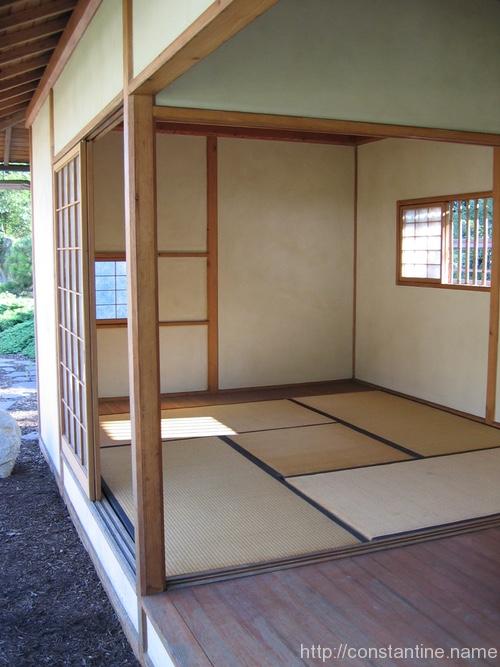
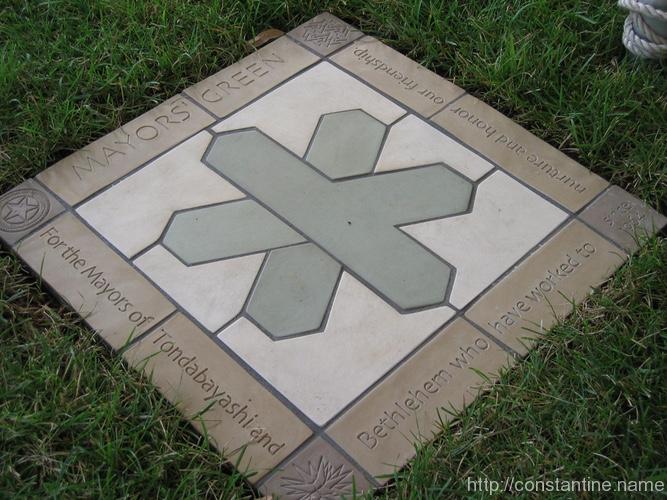
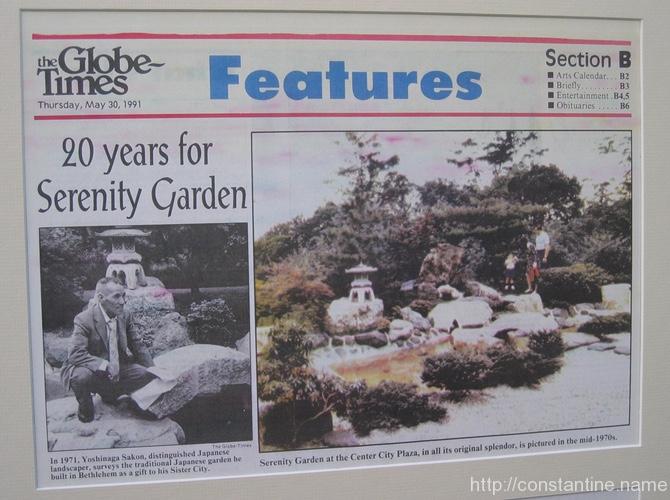
Adjacent to Bethlehem’s public library is a Japanese serenity garden. It was a gift from Bethlehem’s sister city Tondabayashi Japan. In 1971, Tondabayashi sent all the materials and the workmen to build this as a gift to the people of Bethlehem. If you live in the Lehigh Valley, this is a great place to visit; it’s just a short walk from Main Street on the north side of the city. These photos are from a dedication of a new “Mayors’ Green” that is located just in front of the garden.

ɕ