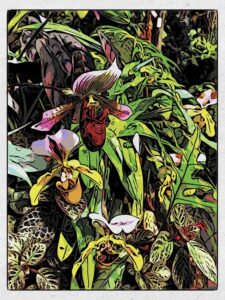
The artist-child

Spending time in solitude with your artist child is essential to self-nurturing. A long country walk, a solitary expedition to the beach for a sunrise or sunset, a sortie out to strange church to hear gospel music, to an ethnic neighborhood to taste foreign sights and sounds—your artist might enjoy any of these. Or your artist might like bowling.

~ Julia Cameron

slip:4a1499.


A creative life

To live a creative life, we must lose our fear of being wrong.

~ Joseph Chilton Pearce

slip:4a1498.


How things feel

I have written about this before and it is something I wish to emphasize repeatedly: efficiency and clarity are necessary elements, but are not the goal. There needs to be space for how things feel. I wrote this as it relates to cooking and cars and onscreen buttons, and it is still something worth pursuing each and every time we create anything.

~ Nick Heer, from Delicious Wabi-Sabi

slip:4upobo3.

Yes, “efficiency and clarity are necessary elements, but are not the goal. There needs to be space for how things feel.” Hear! Hear!

There are at least three reasons to read Heer’s points. Retro-digital photography is really a thing; the Japanese concept of wabi-sabi (appreciating beauty that is imperfect, impermanent, and incomplete); A bit of hist wondering about software.

It’s the wabi-sabi that got me thinking about podcasting. I’m well-known for cutting the corner when it comes to editing the conversations I record. I’ve always looked at that as a necessity: If I tried to raise the level of quality by editing, I’d not be able to put the episodes out (or at least not as many.)

After reading Heer’s thoughts, now I’m wondering if I’m also—perhaps even more so?—drawn to the wabi-sabi of the conversations with all their blemishes, false-starts, uhm-and-ahs in place.

ɕ


Potent muse

The most potent muse of all is our own inner child.

~ Stephen Nachmanovitch

slip:4a1493.


Universality

Creativity is harnessing universality and making it flow through your eyes.

~ Peter Koestenbaum

slip:4a1489.


The warrior and the artist

[…] fear doesn’t go away. The warrior and the artist live by the same code of necessity, which dictates that the battle must be fought anew every day.

~ Steven Pressfield

slip:4a1487.


Don’t look at that part

We all struggle with this. No matter what our art is, there are always those bits that everyone sees and those bits that are covered up. And we face the question of how much effort to put into these various parts. It’s easy enough if it’s a hobby and you have all the time in the world. But you need to ship if you’re making a living off your art.

~ David Sparks, from Lessons From an Ancient Craftsman

slip:4umabo5.

It’s always good when, as above, I can get any sense of commiseration with other creatives. I had a hard time ever coming to understand I am a creative, and the imposter syndrome for me is eternal. (Also, apparently a shared experience.) Great piece from Sparks about exactly what that quote suggests.

Meanwhile, I’m reminded of something I say often, which comes from my paternal grandfather: When asked his opinion on something, (ala, “How’s that look?”) he’d reply, “A blind man in Idaho would be happy to see it.” This makes no sense, in several dimensions. I have no idea where he got that from. The Idaho bit in particular always made me wonder. He and I were generally in Pennsylvania, so Idaho is a long way away, but oddly specific, while still oddly vague. Where in Idaho? And why Idaho? Maybe Idaho was some Depression-era fake-magical place pushed by con-men and became a stand in for “anyone in Idaho must be really well off.” Because the whole point of the joke is that a blind person would be delighted to see anything. I dunno… maybe it’s a humorous construct because the Idaho part is so extraneous, it feels like it must be important? Really, does that reply mean it looks good, or it’s bad and I don’t want to tell you? I mean, the reply literally does nothing but dodge the question. Or, maybe I’ve just over thought this… for 40 years?

ɕ


Which reminds me of…

The sud­den flash­es of insight we have in states of med­i­ta­tive distraction—showering, pulling weeds in the gar­den, dri­ving home from work—often elude our con­scious mind pre­cise­ly because they require its dis­en­gage­ment. When we’re too active­ly engaged in con­scious thought—exercising our intel­li­gence, so to speak—our cre­ativ­i­ty and inspi­ra­tion suf­fer. “The great Tao fades away.”

~ Josh Jones, from Why You Do Your Best Thinking In The Shower

slip:4uoewy1.

I really dislike Open Culture’s web site—modal dialogs, moving thinguses, distracting whatsits… but then, that’s what Reader Mode is for. :) Meanwhile, this was an interesting read just for the nugget of: It’s the distraction, stupid. As I read the bits about the Tao, I realized that—if I had read the Tao—I would not have read into the Tao sufficiently to get this point. (And of course, I’m presuming that Jones’s interpretation—or his reporting thereof, at least—is correct.)

ɕ


To make, as in: Creation

The most important work we do is to make decisions. Decisions don’t seem effortful (turn left or right, say yes or no) but the apparent risk and emotional labor is real. Hard decisions are hard because of the story we tell ourselves about repercussions and responsibility.

~ Seth Godin, from Decisions as effort

slip:4usede1.

To make a decision is an act of creation.

I’m not sure when I fully integrated the idea that making decisions is a creative act. But it definitely is a creative act. Making a decision is not simply choosing among options. Making a decision is not simply saying ‘yes’ to something. (And I’m not referring to the obvious corollary that a ‘yes’ to something is a ‘no’ to other things.) Making a decision creates a connection between the before and the after. Those were two things, and through our decision we create a connection; We create something greater than the simple sum of those two “parts.” The connection itself is something wholly new.

ɕ


Listening

Sit at your desk and listen.

~ Franz Kafka

slip:4a1460.