If the FBI, and CNN, and NBC, and the New York Post, and the Atlanta Journal Constitution, and All Of Us, could get the Atlanta bombing so tragically wrong in 1996, they, and we, can do it today. In the days to come, it would behoove All Of Us to take what the FBI, and CNN, and NBC, and the New York Post, and their ilk, have to say about suspects and motives with a grain of salt.
What if someone invented a service where, instead of having to check all your important blogs, instead of having to check Twitter and Tumblr a million times a day, you could get all the updates in one place? Great idea!
Free is so prevalent in our industry not because everyone’s irresponsible, but because it works. … In other industries, this is called predatory pricing, and many forms of it are illegal because they’re so destructive to healthy businesses and the welfare of an economy. But the tech industry is far less regulated, younger, and faster-moving than most industries. We celebrate our ability to do things that are illegal or economically infeasible in other markets with productive-sounding words like “disruption”.
Here’s an interesting form of murder we’ve come up with: assassination. You know what’s interesting about assassination? Well, not only does it change those popularity polls in a big fucking hurry, but it’s also interesting to notice who it is we assassinate. D’you ever notice who it is; stop to think who it is we kill? It’s always people who’ve told us to to live together in harmony and try to love one another. Jesus, Gandhi, Lincoln, John Kennedy, Bobby Kennedy, Martin Luther King, Medgar Evers, Malcolm X, John Lennon. They all said “Try to live together peacefully.” BAM! Right in the fuckin’ head. Apparently, we’re not ready for that.
This entry is part 2 of 72 in the series My Journey
If you want to repeat that little jump at an angle to a moss covered wall all day until you can do it with your eyes closed… well my friend, you are not alone. I want to repeat that jump with you. But let’s do 50, just to be sure. And one more for the others who can’t join us. That’ll do us both more good than that big roof gap whilst you hold the camera.
By now, all of my friends know I practice parkour with Lehigh Valley Parkour. I’m pushing 42, with graying hair and the BMI calculator says 34.9, (which is “obesity.”) So when people first find out, they raise an eyebrow and say, “You’re a brave soul!” or “Huh? The jumping from roof-top to roof-top thing?!”. …my answer is ‘no’ to both of those.
Please do not go to TouYube and look up parkour; Total waste of your time. This is one of those Catch-22 things where the people who believe — quietly, to themselves — that they “get it”… well, those people aren’t posting spectacular videos on TouYube. So you don’t notice their point of view on the whole thing.
I am not saying, “those people over there have it wrong.” I am not saying, “parkour is the One True Path(tm)”. I am not saying, “these ideas are to be found only through parkour.”
I am saying parkour is…
…a journey composed of tiny steps so easy that failure is impossible.
…the grueling, deconstructing, work of self-improvement.
…that well-earned sense of accomplishment.
…the joie-de-vivre that I hadn’t noticed I let slip away.
Playfulness.
Freedom.
…and one more for the others who can’t join us. :*)
I respect kindness in human beings first of all, and kindness to animals. I don’t respect the law; I have a total irreverence for anything connected with society except that which makes the roads safer, the beer stronger, the food cheaper and the old men and old women warmer in the winter and happier in the summer.
For 57 words, that does a pretty good job of summing it up. “Kindness” covers all of my political beliefs. No need to spell them out. I believe that if, at the end of it all, according to our abilities, we have done something to make others a little happier, and something to make ourselves a little happier, that is about the best we can do. To make others less happy is a crime. To make ourselves unhappy is where all crime starts. We must try to contribute joy to the world. That is true no matter what our problems, our health, our circumstances. We must try. I didn’t always know this, and am happy I lived long enough to find it out.
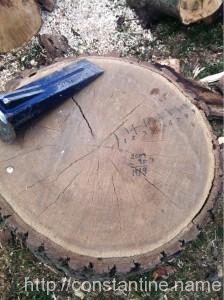
Red Oak round. Part of a standing-dead tree felled by my father in 2009.
It’s a beautiful Spring day — perhaps a little too breezy for the 50-something temperature — in the cute little neighborhood where we live. Laid out in the ’50s, our lots are about 60 feet wide and organized into neat rows of little 2- and 3-bedroom homes. From the back patio, I can see directly into the yards of at least a dozen of my neighbors.
We have a wood stove. It’s a magnificently efficient, modern marvel that fills our living room with the distinct glow and flicker of a one hundred thousand year-old technology. The little stove remains cold on the back, gets inconceivably hot on the front, and can heat the entire 1,400 square feet of our little ranch in the dead of winter. It does all that while consuming one big-ass piece of firewood every 90 minutes or so.
In other words, I’m polluting the world. I’m also releasing carbon-dioxide and a host of other truly hazardous chemicals into the neighborhood. (For example, read this revelation of horrors.) In my defense, this is Pennsylvania, the slopes of a wooded mountain start a block from our house, and every house in our neighborhood heats with oil or wood because natural gas is not available.
I digress.
I grew up in a house on a wooded lot, where loss of electric power was not uncommon in the winter. Every Spring, my father, (and later, my father and I,) set about laying up firewood. When he was younger and I was indefatigable, we would cut our own trees, or cut and remove trees for neighbors. The cut rounds would then be laboriously split by hand with wedges and sledge, (no fancy-schmancy log splitters for my dad,) over the course of weeks and months until we had a season’s worth of firewood. Each year we’d burn the wood we’d layed-up two Springs back.
I possess a swirled mass of happy memories related to a deafening chain saw — a kick-ass early ’70s “Mac10” (yes I still have it, no it’s not for sale) — huge bow saws, splittin’ wedges, mauls, worn work gloves, wood chips in all your clothing and socks. I distinctly remember being deemed too young to be allowed to swing the sledge, and being relegated to wedge-starting duty working with a four pound maul. I also distinctly remember my dad wincing as I quickly wrecked the hickory handle of his sledge hammer once I was deemed old enough.
Split your own firewood; It will warm you twice.
They’ve stopped already??
See, I started writing this piece because “the young kids” two yards over were splitting firewood, and I just noticed they have already stopped some time ago. ha! Kids these days.
We’ve a section of shadow box fencing on the side of our yard, so I could only see them in glimpses through the slits. But I could hear the whootin’ and a-hollerin’, and the not-as-rhythmic-as-it-should-be banging and whacking, and also the missin’ and cussin’ and the sound of a sledge handle hitting things.
I could see they were swinging the sledge the way one would swing a tennis racket for an overhand serve. They were hurrying the swings, instead of making each strike count. They were excited when the wood split, rather than being excited by the process of producing firewood with their own hands.
You see, to split with a sledge, you draw the handle back by sliding it through your top hand until your hand nears the head of the sledge. Then you send the head straight up, pushing with your lower hand that is at the end of the handle and sliding your top hand down to meet your bottom hand. As your hands meet, the head of the sledge is up in the clouds. Then — all together — bend your knees slightly, lower your whole body, pull down your arms, and bring everything to focus on the top of that wedge. If you’ve done it correctly, the sledge strikes with a solid BAM! and stays on the wedge with a succinct “da-tink”-sounding hop. When a log splits clean, the wedge sings out, “PLING!”
Last spring I split firewood for hours on end. Carefully. Methodically. For the long haul. While thinking of my father.
BAM-da-tink. BAM-da-tink. PLING!
Splitting firewood as a metaphor for life
Choose the right work.
It’s not enough to choose to do the splitting. You have to split the right wood, at the right time of year. You need a place to do the splitting. You need a place to stack the wood so your labors are ultimately useful. You also need family or friends with which to share the warm glow of the fire as the fruits of your labor.
Use the right tools.
A mechanized log splitter is fine for commercial firewood sellers. But humans splitting their own firewood use hand tools. You need the correct tools; No more, no less. Your pride in your work shall show in the maintenance of your tools.
Strike decisively.
Aim. Strike. Strike correctly. Strike hard enough, but no harder. Strike so that you can strike again and again and again, until your work is well and truly done.
Around the corner I have a friend, In this great city that has no end, Yet the days go by and weeks rush on, And before I know it, a year is gone.
And I never see my old friends face, For life is a swift and terrible race, He knows I like him just as well, As in the days when I rang his bell.
And he rang mine but we were younger then, And now we are busy, tired men. Tired of playing a foolish game, Tired of trying to make a name.
“Tomorrow” I say! “I will call on Jim Just to show that I’m thinking of him”, But tomorrow comes and tomorrow goes, And distance between us grows and grows.
Around the corner, yet miles away, “Here’s a telegram sir,” “Jim died today.” And that’s what we get and deserve in the end. Around the corner, a vanished friend.
Let’s re-read the statement: “This supports the idea to take humans out of the loop (because they are unreliable and inefficient) and replace them with automated processes.”…which are designed by humans, who are assumed to be unrelia…oh, wait.