I can’t read it, but I know what to do with it! (rum. must. not. drink. before. noon.) Thanks E&A!
ɕ

I can’t read it, but I know what to do with it! (rum. must. not. drink. before. noon.) Thanks E&A!
ɕ
The Lehigh Valley and surrounding areas are a wonderful place to live and work. Because of the density of people, tech companies and professional opportunities, I think there is a real opportunity for a community of network and systems administrators to develop.
In hindsight, I see that I’ve now spent over 18 years doing network and systems administration. Along the way, I’ve mostly had no idea what I was doing; I simply had a desire to build things and the will to figure things out. I’ve worked with fantastic people, have accomplished much, and had an insane amount of fun along the way.
This open letter is not trumpeting a grand vision.
This is not a rallying cry.
This is not a call to organize into any sort of formal structure.
I think it would be amazing for like-minded individuals to get together, to share knowledge and experiences, to create inroads to employment for those just starting out, to create opportunities for internship and mentoring, and much more.
Interested?
Update May 2014
After more than a year of talking to people – and I mean a lot of people – I was unable to find a single person who was interested in helping me organize the group. So the only way it was going to happen was if I did all the work of finding a location, finding sponsors, coordinating meetings and speakers, etc.
…and that’s just too much for me to do alone. :^( But definitely reach out to me if you’re interested in starting something. I’m still interested.
ɕ
“As a 6th kyu, I have spent very little time, and have very little skill at sensing the timing of a coming attack. Though my teacher has worked on this with us, I find I am slow at learning to ‘read’ my attacker, and rely on knowing what is coming and the very slow attacks of training. Have you any specific techniques for this?”
~ name withheld
I do have specific things you can practice. But first, I’m going to wander very far afield…
An aside for those not well-versed on Aikido: ‘6th kyu’ is the first rank one reaches in Aikido. “A minimum of 40 hours” of practice time is commonly seen as a baseline requirement in the various styles of Aikido. A 6th kyu student is definitely a beginner, but also definitely someone dedicated enough to have stuck with their training through their first real test.
Martial arts are mentally and physically difficult. Everyone is their own worst critic. When students express frustration with something, (a technique, a principle, etc) I often say, “that is why it is called ‘practice’.” My best advice is to simply practice. I assert that such advice is not trite!
“If you want to go east, go east. If you want to go west, go west.”
This is a handed-down quote which Sensei Wirth attributes to Sensei Koichi Tohei. It is clearly echoed in one of Sensei Wirth’s phrases, immortalized on some of our t-shirts years ago: “No this. No that. No delay.” So whatever is being practiced, do that thing, the whole thing, and nothing but the thing. Do not entertain some mental storyline about how, “this is a great opportunity to work on sensing,” nor “this is particularly hard so I need to pay special attention here.”
Physically, do only what must be done. Do not flail, twitch, wind-up in preparation, shuffle before starting, speak, nor any other of countless things. Practice being physically calm; Act calm until you are calm. Simply move. Move simply. Go east. Go west. Practice this physical aspect always and everywhere.
Mentally do only what must be done. Don’t have a running mental commentary. Do not think, “I did that one wrong”, “I did that one better”, “that one was horrible”, “my partner does this so much better than I”, nor any other of countless thoughts. Observe your thoughts, but do not add one iota of energy to them. Thinking, “I am thinking useless thoughts”, is a useless thought! If you were handed a large bucket of sloshing and disturbed water and told to calm the water, you should simply set the bucket down and wait for the water to calm. You would definitely NOT shake the bucket in an attempt to convince the water to calm down. You cannot think your way to sensing an attack; You can only NOT think, whereupon you will discover your senses work rather well.
Here are several other sources of information which I think are apropos…
O’Sensei mentions a ‘mountain echo’ in at least one place. The best source I see is AikiNews (AN), later known as Aikido Journal. Refer to issue 46 from March 1982 wherein Seiseki Abe Sensei — who was O’Sensei’s caligraphy instructor in addition to being an Aikido student — granted permission, under the supervision of then-doshu Kisshomaru Ueshiba, for AN to publish a selection of O’Sensei’s ‘Doka’. (Alternatively, ‘Poems’. But ‘poem’ is not a perfect word to describe what O’Sensei was writing, so you’ll need to read the entire AN article to get more context.)
The article contains these two doka among many others:
(#48)
Blend with ki-musubi the
Universe of Heaven and Earth (tenchi)
Stand in the center (of all)
In your heart take up the stance
Of “The Way of the Mountain Echo”(#68)
The cold expanse (samuhara) of the Great Vast Sea
Which is foaming in the world of kotodama
Is “the Way of the Mountain Echo”.
I am by no means qualified to analyze O’Sensei’s writings. I only present these two particular doka so as not to pull “the Way of the Mountain Echo” completely out of context from O’Sensei original writing. You will need to pick up AN #46 to learn more; There is much more in the article than the little bit I’m presenting here. Abe Sensei provided a number of explanatory footnotes for the doka. Here is the footnote for “the Way of the Mountain Echo”. Bear in mind that “today”, although it’s not completely clear, is certainly no later than circa 1982.
“This is a difficult image to define clearly, especially since it is rarely used today by the present teachers of Aikido. A mountain echo repeats back to the caller the same thing that was originally shouted. In O’Sensei’s “Way of the Mountain Echo” the images seem to be something akin to the concept of Aiki, in the sense of responding to or adapting to whatever it may be that your partner delivers and dealing with each encounter as if it were a completely new and fresh event. Associated with this may be the image of the emptiness of the echo before anyone calls out to it, the fact that an echo makes no distinction between two different callers and recognizes no differences in languages, or content of the message. It may also involve the idea of the purposefulness of the echo’s calling back although it never fails to do so whenever called upon and to do so with all its effort. Another possible interpretation or nuance could be the fact that the echo’s answering call always brings pleasure to the caller.”
~Seiseki Abe Sensei, from AN #46 March 1982, footnotes to selections of O’Sensei’s Doka
Next I would like to draw your attention to an article published more recently on the Aikido Journal (AJ) web site. The article is, I believe, publicly accessible. (However, any serious Aikido student should join AJ as a supporting member.) You should read the whole article. The sections “Beyond ‘Sensen no Sen'”, “Up, Down, To and Fro” and “Leading and Directing” are apropos, and this paragraph introducing ‘Takemusu Aiki’ is particularly poignant:
“This is a high-level ideal that is attainable only through long years of training to develop a heightened sensitivity to people and happenings in one’s surroundings. It further involves developing a set of spontaneous skills consisting of physio-psychological responses suited to any conceivable kind of human interaction. The Founder described this state as ‘Takemusu Aiki’ — the highest level of aikido where one is capable of spontaneously executing perfect techniques in response to any circumstance.”
~ Stanley Pranin, Aikido Journal web site
The article is Exploring the Founder’s Aikido by Stanley Pranin.
Another article I recommend is simply titled “Irimi.” It too is posted on the AJ web site, but is written by Ellis Amdur, (who is not directly related to AJ.) There’s so much in this article that is apropos, I couldn’t select a reasonable amount to quote, so go there and read the entire thing.
This second article is Irimi by Ellis Amdur.
Having wandered very far afield, I’ll now circle back to some nuts-and-bolts things you can practice. Only the most die-hard of Aikido students will still be reading at this point. The first two suggestions below are internal/mental things to do and the later two are external/physical things to do.
1) work on not “missing frames” of the movie.
If what you see of uke were actually a movie, would you be seeing all the frames of the movie? Does is seem, in hindsight, that they teleported from their starting position to somewhere mid-attack? Repeat the practice and pay attention to when (which frame?) you first notice they have attacked. Continue practicing, focusing your senses on noticing the gap in your observations. The gap will necessarily grow smaller the more you practice this.
2) stay “pressed against the glass”
A metaphor I probably lean on too often. Consider driving in a car at a break-neck speed. Don’t lean back in your seat cowering in fear of whatever it is you’re going to encounter. (And which, at break-neck speed you could not hope to avoid and would therefore crash into.) LEAN FORWARD. Press your face against the windshield as if somehow getting a few feet closer to the oncoming destruction would somehow buy you enough time to avert the collision. This is a metaphor! Don’t physically lean perilously forward. Move your attention and your curiosity forward. Strain to reach forward with your senses.
3) practice entering into a swinging-jo-staff
Have uke hold a staff by the very end and swing it menacingly through a full range of arc; so the staff goes from behind on the right, around the front to behind on the left. You should have a good “whoosh whoosh” going on with the swing. If you get hit with the end of the stick, you’ll need smelling salts or a cast. Stand safely outside the staff’s swinging range and move as close as is possible remaining perfectly safe. “whoosh whoosh whoosh”. When the time is right, move briskly right up to uke without getting whacked.
4) practice atemi
The atemi should be the “affect uke’s attention and balance” variety, not the “crush uke and end the interaction” variety. Begin by finding (no small task, ask your Sensei) the atemi options for whatever uke is doing. Then work on noticing — actually thinking, atemi there, atemi there, atemi over there — several (all?) of the possibilities in each attack. Then practice actually implementing one or two (or more!) of the atemis.
ɕ
 I was home sitting at my desk when I first noticed the news of Mr. Armstrong’s passing. It seemed to me, that I had just experienced one of those defining moments; My parents’ generation has the infamous, “where were you when Kennedy was shot?”, or apropos here, “where were you when they landed on the moon?” At a deep level, I suddenly felt I would always know exactly where I was when I found out that Mr. Armstrong had died.
In the statement released by the family of Neil Armstrong following his death, they said, “For those who may ask what they can do to honor Neil, we have a simple request. Honor his example of service, accomplishment and modesty, and the next time you walk outside on a clear night and see the Moon smiling down at you, think of Neil Armstrong and give him a wink.”
ɕ
“With the publication of Fahrenheit 451, you were hailed as a visionary. What would you warn us about today? Our education system has gone to hell. It’s my idea from now on to stop spending money educating children who are sixteen years old. We should put all that money down into kindergarten. Young children have to be taught how to read and write.”
From the Spring 2010 issue of the Paris Review:
slip:4uteie12.
INTERVIEWER
With the publication of Fahrenheit 451 , you were hailed as a visionary. What would you warn us about today?BRADBURY
Our education system has gone to hell. It’s my idea from now on to stop spending money educating children who are sixteen years old. We should put all that money down into kindergarten. Young children have to be taught how to read and write. If children went into the first grade knowing how to read and write, we’d be set for the future, wouldn’t we? We must not let them go into the fourth and fifth grades not knowing how to read. So we must put out books with educational pictures, or use comics to teach children how to read. When I was five years old, my aunt gave me a copy of a book of wonderful fairy tales called Once Upon a Time , and the first fairy tale in the book is “Beauty and the Beast.” That one story taught me how to read and write because I looked at the picture of that beautiful beast, but I so desperately wanted to read about him too. By the time I was six years old, I had learned how to read and write.We should forget about teaching children mathematics. They’re not going to use it ever in their lives. Give them simple arithmetic—one plus one is two, and how to divide, and how to subtract. Those are simple things that can be taught quickly. But no mathematics because they are never going to use it, never in their lives, unless they are going to be scientists, and then they can simply learn it later. My brother, for example, didn’t do well in school, but when he was in his twenties, he needed a job with the Bureau of Power and Light. He got a book about mathematics and electricity and he read it and educated himself and got the job. If you are bright, you will learn how to educate yourself with mathematics if you need it. But the average child never will. So it must be reading and writing. Those are the important things. And by the time children are six, they are completely educated and then they can educate themselves. The library will be the place where they grow up.
What if there was a way for parents to obtain age-appropriate reading material for their children at a very affordable cost?
Suppose we nationally produced different series of books — picture books, alphabet books, then word books, early readers etc. Certainly, it would be difficult to decide at a national level what should be in the books, but common ground could be reached. Our existing elementary educators would know what would best merge with our education systems already in place. We’d have a massive economy of scale producing these materials, and they could be distributed through the schools.
This seems like it wins in several ways: Easier for the parents, more children exposed to reading and exposed sooner, and more parent involvement with their child’s education. Furthermore, the private sector could produce side tracks (which would be available through retail, not through the schools); This would be similar material but perhaps in additional languages; Or there could be cultural and heritage specific tracks that parents could purchase if they wish.
ɕ
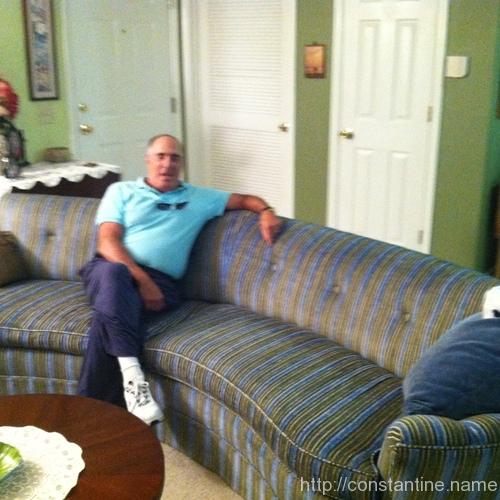
1953, custom made sofa… has been through four families in our larger family tree… if it could talk.
ɕ
Koichi Tohei (藤平光一, Tōhei Kōichi) (born January 1920, died May 2011) was a 10th Dan aikidoka and founder of the Ki Society and its style of aikido, officially Shin Shin Toitsu Aikido (literally “aikido with mind and body unified”), but commonly known as Ki-Aikido.
Our friends over at the Bryn Mawr dojo of Kinokawa Aikido have an article providing a survey of the basic information about Sensei Tohei.
Unfortunately, I never saw Sensei Tohei in person. Today, the closest one can get is any of the myriad of videos which remain. One can find a great deal on YouTube. However, a much better place to go is to Aikido Journal (AJ). If you’re an aikidoka, you should go over to AJ immediately and join. There is an enormous amount of information available in general, and about Sensei Tohei in particular.
In particular from AJ, you can find books, DVDs and ebooks for download that are specifically about, or written by, Sensei Tohei. Log into the members site and search for ‘koichi tohei’. You’ll find interviews of Sensei Tohei conducted by Stanley Pranin, details of Sensei Tohei’s split from the Aikikai (including his resignation letter), and much more.
As for Kinokawa’s relation to Sensei Tohei, remembering his soft and flowing style is something to which we continuously pay attention. Sensei Wirth provides some more details related to Kinokawa’s history:
The grace and power I witnessed in those first few hours at the Dojo drew me into the way of Aikido.
In those early days we spoke little and trained very hard. There were only a few students who endured for long.
Maruyama Sensei was a student of Koichi Tohei Sensei and O’Sensei. By 1971, two years after O’Sensei’s death, divisions of viewpoint regarding who was to lead Aikido and how it was to be conveyed and directed lead to a split between Tohei and Kisshomaru Ueshiba, the Founder’s son. Maruyama Sensei aligned himself with Sensei Tohei, and so it was that our practice in the 1970’s reflected both the early style and training of O’Sensei as preserved and conveyed by Aikikai and the flowing late life Aikido of O’Sensei presented by Tohei.
~ Sensei Wirth, from ‘A History of Kinokawa ryu Aikido’
ɕ
Since 1998 I have been continuously and vigorously studying and practicing a martial art called Aikido. Over the years my responsibilities have gradually increased to the point where I am now straight-up teaching Aikido. I was having a terrific time exploring Aikido while trailing in the footsteps of many senior people. I’m now surprised to find that a bunch of people have appeared behind me asking questions.
What is this I don’t even…
I am currently teaching at the Kinokawa Aikido LV dojo, and I study under Sensei Michael Wirth at Main Line Budo.
ɕ
 cc1315 was my InterNIC handle.
What’s an Internic handle?
Back in the mid-90s, there was only one place to register a domain name. (See Network Solutions.) To register a domain, or to make changes, one sent a specially formatted email message to a special email address at Network Solutions. On the receiving side, a program would read the message and follow the instructions. To verify the request was valid, the program checked the message for a valid InterNic handle.
To obtain a handle one would register with the Internic by sending a formatted email message containing your name, address, and other contact information. The InterNic software would then create a globally unique handle in response. Some program back in 1994 saw my initials and added 1315 — cc1315.
I never managed to figure out the source of the 1315. If memory serves, the handles were always two initials and three or four digits. So my best guess has always been that the digits were the local time-of-day when my registration was received.
ɕ
You gain strength, courage and confidence by every experience in which you really stop to look fear in the face. You are able to say to yourself, “I have lived through this horror. I can take the next thing that comes along.” … You must do the thing you think you cannot do.
~ Eleanor Roosevelt
slip:4a267.