The connection between the cerebellum and movement has been known since the 19th century. Patients suffering trauma to the brain region had obvious difficulties with balance and movement, leaving no doubt that it was critical for coordinating motion. Over the decades, neuroscientists developed a detailed understanding of how the cerebellum’s unique neural circuitry controls motor function. The explanation of how the cerebellum worked seemed watertight.
[But ultimately acting makes you happy?] Yeah, I think. It is also about balance and finding the balance between the very cerebral part of your brain and the much more impulsive creativity that can come from chaos. So for me it is very much about that balance. The cerebral part of acting and the perfectionism can be exhausting, but the spontaneity can be very joyful. So it’s about managing these two sides of the experience. But yes it’s fun. I mean, there is no point in doing a movie if you’re not having fun.
What defines a deep conversation, and how can one recognize or evaluate its depth?
Is the depth of a conversation defined by content or the experience?
I feel like it only can be deep if it if it was deep for both of us. Like can you have a conversation— I guess anything’s possible. [But,] does it seem realistic to have a conversation where one person thought it was deep? Because I’m saying to myself, yeah, obviously it’s possible. But what happens if both people thought it was deep versus [only] one person thought it was deep?
~ Craig Constantine (4:18)
Craig Constantine and Jesse Danger explore the nature of deep conversations, focusing on the distinction between superficial and meaningful exchanges. Jesse begins by considering what makes a conversation real, emphasizing the unique contributions of each participant and the specific moment. Craig reflects on the term “deep” and questions whether it might sometimes be the wrong word, as some people avoid deep conversations due to discomfort. They both ponder if a deep conversation is characterized by newness or if it can occur without discussing novel topics.
I share experiences with people, I think that people are having the same experience as me. And I’ve come to realize that that’s not the case, I think I can have a deep and profound moment that doesn’t strike the other person as poignantly. I do an exercise with myself, and I’ve done it with my wife, where we write down the moments that struck us most deeply. There are different moments. And you remember, like, oh, yeah, I was there, it’s there. It didn’t strike me. But now, I’m starting to understand that that was really an important moment for you.
~ Jesse Danger (7:02)
They discuss the concept of depth as an emergent feature of a conversation, suggesting that depth arises from a shared experience rather than just content. Craig wonders if a conversation can be considered deep if only one participant feels it is, while Jesse shares his experience of recognizing that people often have different perceptions of the same moment.
They also touch on the idea that profound moments can occur upon revisiting familiar topics, and that the willingness to be known is essential for achieving depth in a conversation. The discussion highlights the importance of co-creation, presence, and the conditions that foster profound exchanges.
Takeaways
The nature of deep conversations — discussed as moving past superficiality and involving unique contributions from each participant.
The difference between superficial and real — explored in terms of what is uniquely shared in a meaningful conversation.
Discomfort in deep conversations — mentioned as a reason some people avoid such exchanges, differentiating between depth and inappropriateness.
Depth as an emergent feature — suggested that depth arises from shared experience rather than merely the content of the conversation.
Newness versus familiarity — debated whether a deep conversation always involves new topics or can occur with familiar subjects.
Shared profundity — questioned whether a conversation can be deep if only one participant perceives it as such.
Different perceptions of the same moment — highlighted through personal experiences, recognizing that not everyone experiences depth in the same way.
Revisiting familiar topics — noted that profound moments can still occur upon revisiting familiar conversations or books.
Willingness to be known — identified as essential for achieving depth in a conversation, implying vulnerability and openness.
Co-creation in conversations — emphasized as an important aspect of achieving depth, with both participants contributing meaningfully.
Presence and awareness — discussed as crucial for recognizing and experiencing the depth of a conversation in the moment.
Conditions for profundity — suggested that certain conditions must be present for a deep conversation to occur, such as openness and receptivity.
One of the principles I come back to over and over is adrienne maree brown’s invitation to move at the speed of trust. That is, whenever attempting any effort with other people, prioritize building trust and respect for each other over and above any other goal. The trust forms the foundation from which the work can grow.
I bump against this in podcasting often: How do I get to the “good” part of this conversation as quickly as possible? And I sometimes focus on the “quickly” part, when in reality the best way is to focus on the trust part. The “good” part of the conversation just falls out after that.
How can we know if an idea is a good one? This time on Out on the Wire, we investigate how to refine story ideas using the focus sentence and the X/Y story formula. Plus, Ira Glass recounts a reporting trip gone sideways and Jay Allison’s takedown of formulaic storytelling.
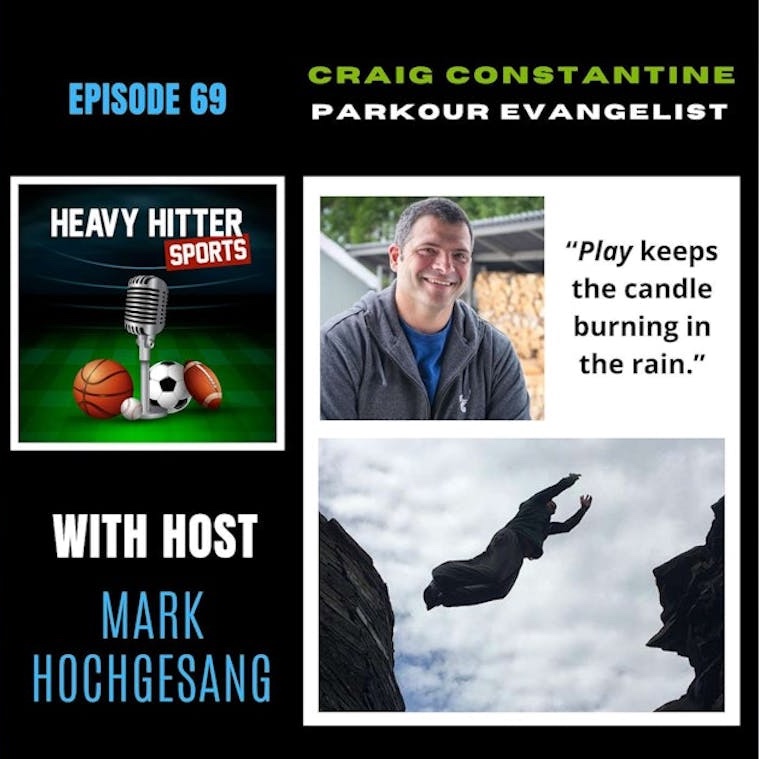
My good friend Mark Hochgesang recently invited me to be on his Heavy Hitter Sports. I have heavy imposter syndrome when it comes to talking about movement. None the less, here’s the episode…
Craig Constantine, the host of the Movers Mindset podcast, shares the wonders of parkour with host Mark Hochgesang. Craig highlights the physical & mental challenges & rewards of this one-of-a-kind sport birthed from the Paris suburbs. Parkour newcomers & veterans alike will be entertained & enlightened by Craig’s engaging storytelling.
Listeners, please subscribe to Heavy Hitter Sports wherever you listen to podcasts so that you don’t miss any future episodes. Ideally, please also rate and review the show. And share this episode with a coworker, friend or family member who it might benefit.
Feel free to reach out if you have suggestions re future episode guests or topics. Mark’s contact info is noted below. Many thanks.
But what really made Vinge the father of the Singularity was his fiction. His 1981 novella “True Names” created many of the tropes about artificial intelligence and virtual worlds that have now become standard. It’s such a tour de force that top computer scientists felt compelled to write a series of essays exploring its ideas, and it’s often considered the founding work of the entire cyberpunk genre.