Long was I Marcellinus!

This entry is part 33 of 72 in the series My Journey

Nevertheless I shall brave this danger and be bold enough to show [Marcellinus] his faults. He will act in his usual way; he will have recourse to his wit, – the wit that can call forth smiles even from mourners. He will turn the jest, first against himself, and then against me. He will forestall every word which I am about to utter.

~ Seneca, from Letters From A Stoic: Letter 29

slip:4ulele2.

Many of Seneca’s letters are pretty obtuse after all this time. But this one… this one jumped out at me as being really apropos of modern life. And, uh, painfully on point for myself.

ɕ


§3 – The rose that grew from concrete

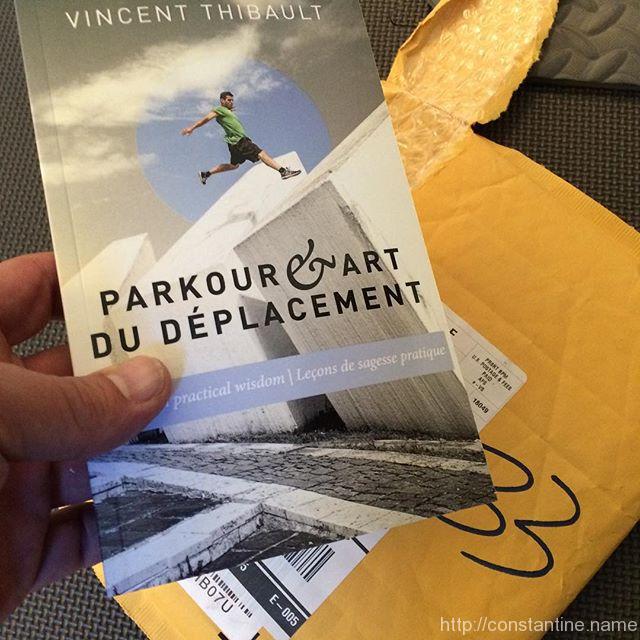
This entry is part 9 of 37 in the series Study inspired by Pakour & Art du Déplacement by V. Thibault

Resilience.

Why does Parkour so effectively teach resilience? Because your regular world and your regular life are DESIGNED for your interaction. Stairs are a certain height, walking surfaces are smooth and even, door knobs are convenient, chairs, air conditioning, trains and autos; Everything you interact with is designed for human interaction. In a very real sense, that’s what “civilized” means.

Have you ever stopped to consider something as simple and common as doorways? What would life like, if – just for some historic reason – every doorway was only 4 feet high? Life would be much better simply because everyone would have to bend over regularly!

What if stairs were the norm? What if walking was the norm?

When you begin exploring your world through the lens of Parkour, you are told to intentionally seek out challenges. In Parkour practice, you’re exposing yourself to a hard choice: Bend your mind and body to the challenge, or face pain and injury. A good coach sets you up for success, but you’re still told to go under that railing, climb over that wall, and put your hands on that rough concrete. You have to teach your mind and body how to be resilient so that you can rediscover the ways already within yourself to interact with an environment that is, at best, indifferent to your wellbeing.

Once you see things differently, you can start interacting with things that were specifically designed for some reason other than human interaction. You start by looking at your world this way as part of a specific practice; “I’m going to class and the instructor makes us do this”. Eventually, the mindset becomes comfortable on its own without prompting, and you begin to automatically practice a mindful resilience in your daily life.

How could I get to that place over there without using that obvious pedestrian route? How would I get down there, or up there? Why am I eating inside when it’s so nice outside? What would I do if an emergency happened right now?

Once you are well and truly comfortable with the resilient mindset, your body relaxes and the physical uncertainty, or even fear, that you were unconsciously feeling goes away. In it’s place wells up good old natural Human Curiosity. Your mind says, “Sure, let’s go this other way,” and, “Let’s take this road less travelled.” It really does make all the difference.

I shall be telling this with a sigh
Somewhere ages and ages hence:
Two roads diverged in a wood, and I—
I took the one less traveled by,
And that has made all the difference.

~ Robert Frost, from The Road Not Taken

ɕ


Resilience?

This entry is part 32 of 72 in the series My Journey

Resilience also requires downtime for recovery. Changing up my scaf routine today to take advantage of the lingering awesome weather.

ɕ


You can be good

…and now that you don’t have to be perfect, you can be good.

~ John Steinbeck

slip:4a131.


10,000 repetitions

This entry is part 2 of 36 in the series 10,000 Reps Project

Today (Friday, Sept 25) was day number 66, and without realizing it, I did pushup number 999.

Way back in June, I read about someone who was going to “celebrate” their 30th birthday with a year-long challenge: They were going to try to complete 30,000 pushups in one year.

That would be 82.19 pushups per day, every day. (81.97 if it’s a leap year.) That’s crazy. That’s crazy like repetitive-stress-injury crazy. Especially since their point was that they were out of shape and wanted to get into shape.

Celebrate: n., to torture oneself?

I chuckled, and sipped my coffee. But the wheels were turning. With my 44th birthday approaching, I briefly considered 44,000 as a goal. Briefly. Very briefly. But then I was thinking: …well, I can do 10 pushups, easy. So doing just 30 per day wouldn’t be too crazy, and that should get me to about 10,000 in a year. (Calculator’ing happens.) Actually, about 27 pushups per day would get me to a nice round 10k in a year.

And over the next few weeks the idea grew.

It seemed clear that completing 10,000 pushups would be eminently possible without injury. Maybe I should try doing 10,000 repetitions of something I currently suck at? That would force me to get from “I can do zero of these,” to a competent 30-or-so per day. This started to sound more interesting and useful. It would be like a race, but a long-term race with me pitted against the calendar.

(It also fits very well with my Oath.)

Eventually I settled on five exercises which would be a serious challenge, AND would yield major improvements:

1. pushups
2. squats
3. pullups
4. bar-to-bar precisions
5. handstands (10k seconds in a handstand)

I’m not going to describe the exercises in detail. I’m not going to brag about how great I’ve gotten at them. (Which is, “not very.” But I’m still working on them.)

I decided up front that I would do whatever it took to reach the goal. To me, that means, doing enough to get stronger, but not hurting myself. It means continuously thinking about the form of the exercise and striving to do them well. But I do NOT fixate on perfection. Build it. Refine it. Lather. Rinse. Repeat.

What I really want to share is HOW MUCH FUN THIS IS!

Every time I do one of the exercises I am acutely aware of how much I’ve improved. Early on, I had little variations to everything to make it possible; I’d do 3 crappy, negative versions of a pull-up (climb up, and fight the fall for as long as possible) and happily mark “3” completed in my spreadsheet. Now I do sets of three reasonably good pull-ups and I think, “boo-YEAH! Pull-ups! Who’s ‘da man?!” I can’t wait to see what it’s like to crank out a clean set of 10 in a row.

Did you say spreadsheet?

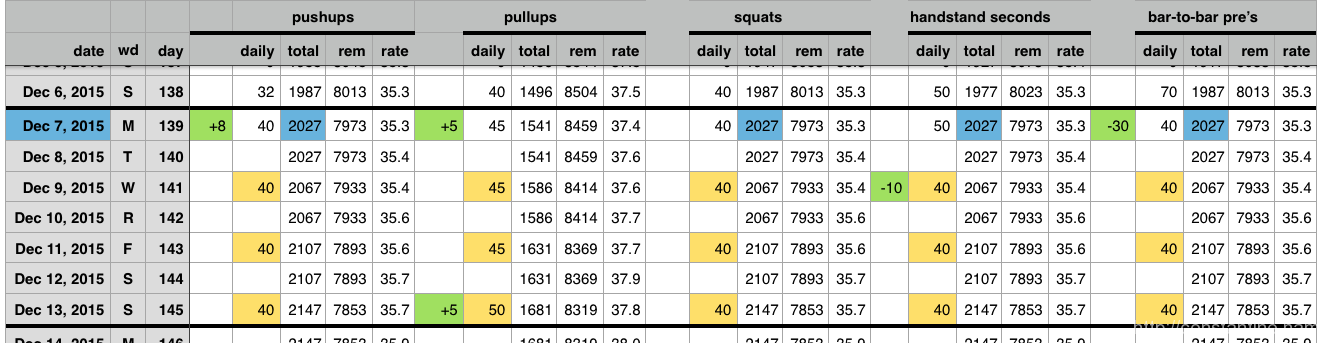
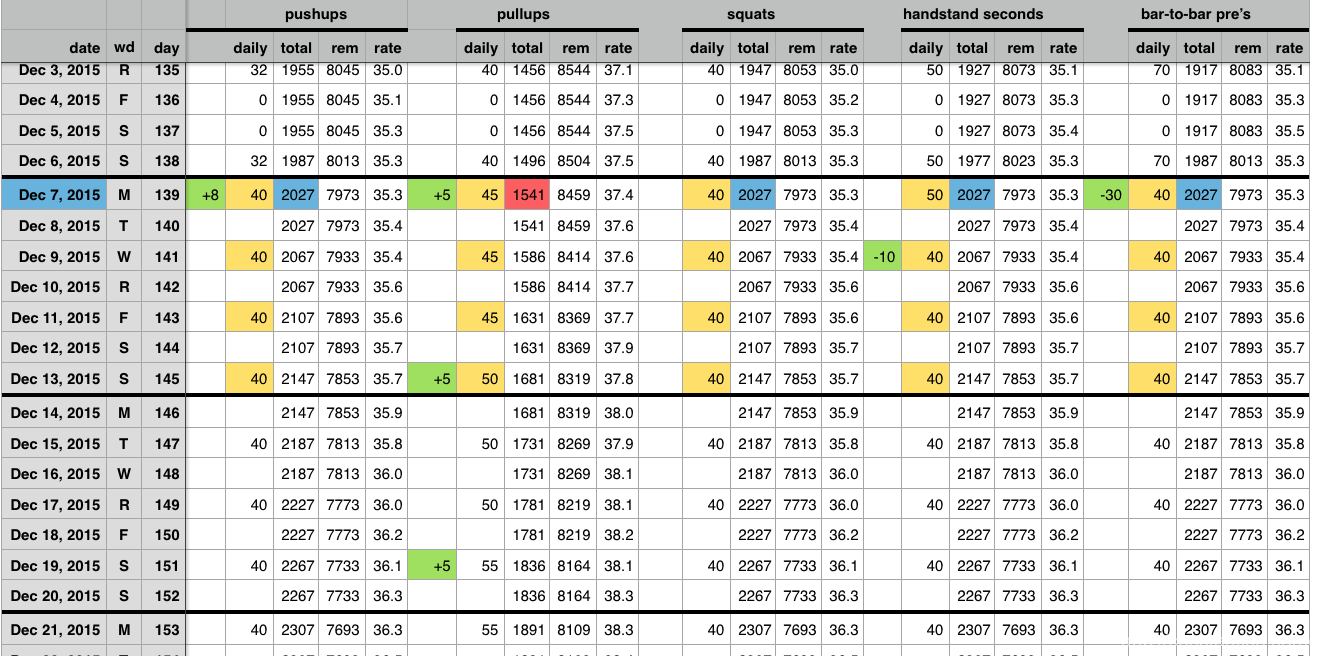
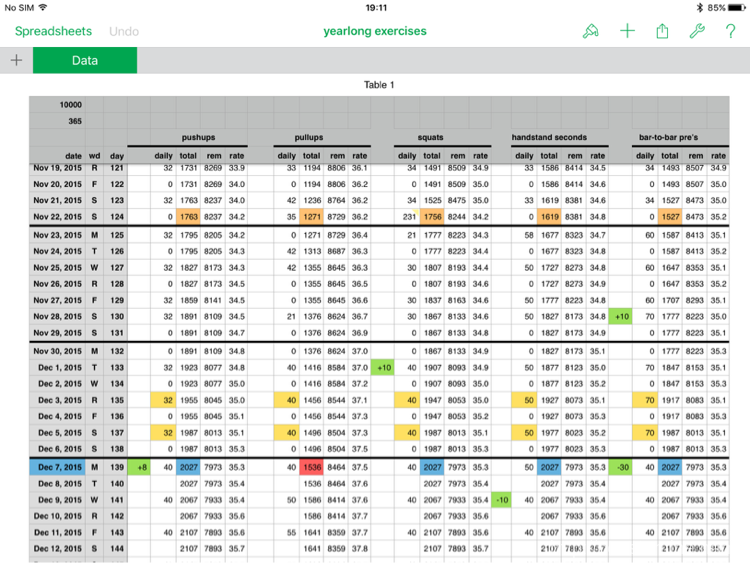
Yes I did. Of course I went to the trouble of making a full-geek spreadsheet. It has a row for all 365 days. I enter the reps completed and it has columns for the cumulative number completed, the number remaining to reach the goal, and it does the math to tell me the rate-per-day that I’d have to continue at to reach the goal. (So if I do 10 pull-ups and it says the required rate is 27 per day, I know I’m digging a hole. If I do 40 pushups and it says the rate is 30, I know I just banked 10 for a day off.)

Well, here’s what day 66 looks like. I entered 42 under pushups and 999 popped out. What a neat surprise! :D

10k-reps-spreadsheet

ɕ


Paeonia Japonica

ɕ


Alternative paths

This entry is part 8 of 37 in the series Study inspired by Pakour & Art du Déplacement by V. Thibault

Post class thoughts? Not many. Class is usually pretty visceral, (as one would expect,) and there’s not much time for an internal dialog of philosophical thinking. There were of course various opportunities to come up with relatively creative solutions to physical movements and challenges. But nothing particularly interesting in the context of this discussion. I think the primary reason this “alternate paths” section didn’t stand out in class was that everyone there already thinks this way. Almost everyone in class is already applying this section’s ideas — at least applying it in the physical context.

And so, I hadn’t bothered to put up a “nothing to report” report. Until I happened to read:

As you begin to learn something, notice when you feel frustrated with sucking. It might be really difficult, confusing, full of failure. You’re out of your comfort zone, and you want to go back into it.

Now turn to this feeling of frustration, or whatever difficult feeling you’re having: confusion, impatience, boredom, feeling bad about yourself, wanting to quit.

Turn to the feeling, and instead of trying to stop it or avoid it … try sitting with it (or running with it). Just be there with it. Let it be in you, give it space.

~ Leo Babauta, from The Gentle Art of Trying Something & Sucking at It – Zen Habits Website

slip:4uzesu2.

I’m pulling disparate threads together here of course. But this is the feeling! I look at something really sketchy, challenging or downright scary, and my mind flees to the easy path. Took a lot of work to get my body to NOT flee to the easy path, which eventually gave my mind a bit of time to look at the “I don’t think so…” path and give it some consideration. In hindsight, I think it’s what Babauta describes so succinctly.

So, uh, yeah. What Thibault said. And also what Babauta said. :*)

ɕ


Have something to say

Wise men talk because they have something to say;
Fools, because they have to say something.

~ Plato

slip:4a266.


§2 – One thousand ways to read a book

This entry is part 7 of 37 in the series Study inspired by Pakour & Art du Déplacement by V. Thibault

Here Thibault draws an analogy from how one reads a book. The obvious way is to read straight through from front to back. But he points out, just as there are alternatives with a book, there are alternatives with how we view and interact with our environment.

I’ve said many times – this isn’t my idea but I’ve forgotten where I picked it up – that one aspect of Parkour is realizing that the obstacle IS the path. Things in the environment which once were “obstacles” become “options.” Things which others would never consider interacting with draw my attention and suggest ways to interact. As my curiosity developed, I literally began to see my environment differently.

Aside: One of my favorite Parkour jokes is that I’ve converted my ADD from “Attention Deficit Disorded” to “Art Du Déplacement”. (That’s the French name for what we call Parkour.) But I’ve subsequently been diagnosed with late onset “Obstacle Attraction Disorder” (OAD).

Here, there is a railing. Why, really, may I not walk upon it? Many of the reasons for staying off are internal: I may fall; I have poor balance; I’m afraid. The rest of the reasons are based on other people’s internal fears projected out into the environment: People think, “I may fall, therefore you may fall.” And so we encounter people yelling, “Get down from there you’ll hurt yourself!”

Aside: Here’s my opinion on liability issues. Railings, as an example, are clearly not intended to be walked on. So I’m implicitly accepting the risk of my falling off the railing. Further, I’m also implicitly accepting the responsibility to repair the railing if I break it.

Through Parkour, I slowly discovered all of these internal reasons which I’d never noticed, let alone attempted to address, which were holding me back! Not simply holding me back in the context of some particular obstacle. (After all, I could simply walk around that wall!) But rather, all those internal reasons were holding me back in the context of my entire life. I realized that climbing stairs was no longer trivial. Touching my toes was no longer trivial. Climb a tree? …no more. Live a full life, sleep well, run? Nope, nope, nope. As a human being, I have a birthright to move (with a hat tip to Ido Portal), and to interact physically with my environment.

(Spoiler: I also have a birthright to interact physically with my fellow humans, but that’s another section in Thibault’s book.)

So Thibault’s section 2 seems trivial at first glance, but actually speaks to a very deep, and fundamentally important idea.

ɕ


Epimedium

ɕ