When the ‘me’ is obliterated →

This entry is part 52 of 72 in the series My Journey

When the ‘me’ is obliterated by fear or the demands of immediate survival, action is no longer constrained by social forces, and the individual is left with a sense of self-determination. […] Behavior in edgework appears to the individual as an innate response arising from sources deep within the individual, untouched by socializing influences”

~ Stephen Lyng from, Edgework, 2004

A couple years ago I tried to write something explaining what exactly it is about practicing parkour that I like so much. It turns out others are way WAY ahead of me. Julie Angel (you have read Cinè Parkour, right?) talks a bit about “edgework”; The idea of negotiating the “edges” between things like consciousness/unconsciousness, sanity/insanity, and life/death. Others (H.S. Thompson and Lyng) have talked about “edgework” in depth.

And I agree. My experience is that being in the parkour practice — even just the visceral edges where I’m pushing my physical limits while exposing myself to only manageable levels of risk — just totally strips away all the context of my work-a-day life. Everything — all the way down to my thoughts — everything falls away.

My martial arts teacher has a great phrase related to edgework: No this. No that. No delay.

ɕ

Introduction →

This entry is part 1 of 5 in the series Parkour Travel

I’m putting down my thoughts on “Parkour travel” for two reasons: First, I’ve found it immensely fun and rewarding, and so I hope to encourage others to travel. Second, I’ve seen enough things first-hand (as a host and as a guest), and heard enough stories, that make it clear that some bits of helpful knowledge are not universal. In this second area, I can only hope to raise some awareness.

This series will necessarily cover a wide range of ideas which I’ll try to cram into a few broad categories. Eventually, I’ll share my thoughts on all of the following (and more): Why travel at all? What do I mean by ‘Parkour travel’? How to be a good guest? Where to go?

This series is not about the nuts and bolts of traveling lightly and enjoying the experience. Although that’s a closely related topic, it’s an entirely separate series.

ɕ


Arizona →

ɕ


Perfection →

Perfection is achieved, not when there is nothing left to add, but when there is nothing left to take away.

~ Antoine de Saint-Exupéry

Elsewhere, this is 4a197. — slipbox


Ocean’s Gate NJ →

Much movement later, I’m sure. …but first some “lion time”

ɕ


What the Haig?! →

So my best pal from back when we waz youngins… brought a bottle of Scotch from the 40’s. Original packaging and all. Let’s see… 70 year old Scotch… 7am run/qm… yeup, OPEN THE SCOTCH!!

ɕ


Embrace Challenge →

This entry is part 33 of 36 in the series 10,000 Reps Project

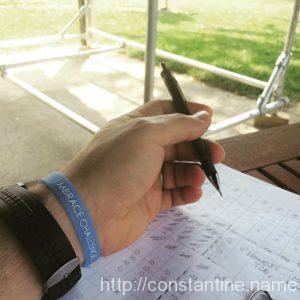
Not sure where this is going; no way I can reach 10,000 by the one year deadline… but I’m not quitting!

ɕ


Flowering moss →

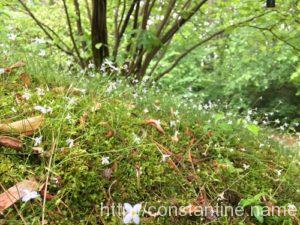
Macro-photography of some flowering moss, from the Sarah P. Duke gardens in Durham, NC.

ɕ


§6 – I Choose To Fall! →

This entry is part 18 of 37 in the series Study inspired by Pakour & Art du Déplacement by V. Thibault

I’ve now read the entire book several times, and Chapter 6 never ceases to inspire!

Three thoughts:

I may not be the strongest. I may not be the fastest. But I’ll be damned if I’m not trying my hardest.

~ unknown

It ofttimes requires heroic courage to face fruitless effort, to take up the broken strands of a life-work, to look bravely toward the future, and proceed undaunted on our way. But what, to our eyes, may seem hopeless failure is often but the dawning of a greater success. It may contain in its debris the foundation material of a mighty purpose, or the revelation of new and higher possibilities.
…
Failure is often the turning-point, the pivot of circumstance that swings us to higher levels. It may not be financial success, it may not be fame; it may be new draughts of spiritual, moral or mental inspiration that will change us for all the later years of our life. Life is not really what comes to us, but what we get from it.

~ Chapter 14, “Failure as a Success”, from Self Control, Its Kingship and Majesty, by William George Jordan, 1907

The application in the Ways is to falls in life. To be able to take a disaster or a great failure, with the whole personality, without shrinking back from it, like the big smack with which the judo man hits the ground. Then to rise at once.

Not to be appalled at a moral fall. Yet it is not that it does not matter. The judo man tries by every means not to be thrown, but when he is thrown it does not hurt him and in a sense it does not matter. It matters immensely, and yet it does not matter.

‘Falling seven times, and getting up eight.’

~ “Falling”, from Zen and the Ways, by Trevor Leggett, 1978

ɕ


By example →

The world is changed by your example, not by your opinion.

~ Paulo Coelho

Elsewhere, this is 4a558. — slipbox