Instead of letting your head dangle forward when you’ve logged on, put some strength in your swipe and use a little muscle in your upper back to hold your head and spine up.
Over in the Movers Mindset project, Bowman is someone who has long been on my to-talk-to list. Some day!
Until then, you’ll just have to read everything she writes. It’s terrific. Large amounts of actionable stuff around bare feet. This article is about what you are doing to yourself through your habitual phone use—uh, it’s horrific. But then, maybe if you were empowered with some knowledge, then you’d change? (I know that worked for me!)
Your intellectual appetites might include knowing the answer to a mathematics problem; the satisfaction of receiving a text from someone you have a crush on; or getting a coveted job offer. These things won’t necessarily cause physical pleasure. They might spill over into physical enjoyment, but they are not dependent on it. Rather, the pleasure is primarily intellectual.
[…] But, for most people, such joy is fleeting. There is always something else to strive for – and this keeps most of us in a constant, sometimes painful, state of never-satisfied striving. And that striving for something that we do not yet possess is called desire. Desire doesn’t bring us joy because it is, by definition, always for something we feel we lack. Understanding the mechanism by which desires take shape, though, can help us avoid living our lives in an endless merry-go-round of desire.
Although I won’t be sharing specifics, I have stellar care and support, from my family, and from a huge team of the best healthcare professionals. My prognosis is excellent. If one must get cancer, you want to have the experience I’m having.
You may have noticed that I’ve not published a podcast episode since something like May. That’s when I started working through my diagnosis, and that’s when I intentionally pressed the pause-button on some of my current projects. I’ve been a guest on a couple of podcasts this year, and that has kept alive a warm ember of my passion for this wonderful art-form.
This is perhaps the greatest conundrum of our current technological era: the desperate need to connect with one another, because it is our only hope of survival; combined with the fact that nearly all the means of connection available to us are deeply—possibly irredeemably—fucked. Syndication, as I am currently experimenting with it, is then an effort to try and navigate that terrain, to find some productive way to play in the outskirts, to let the work out into the world while (hopefully) minimizing the misery that is reflected back.
Yes, to everything from Brown (and not just this particular piece.) Beautiful thoughts therein around why one should “publish own site, syndicate elsewhere (POSSE)”—my methodology since the beginning.
Unfortunately, the Internet went from “publishing your own stuff is difficult”, straight to “it’s easy to publish on platforms other people control.” To this day, it is still quite difficult to get your own domain name and begin publishing in a way that you control your own content. Worse, we went from people discovered and read your stuff (back in the “publishing your own stuff is difficult” era) to the now where no one can find or read your stuff regardless where you publish it (unless you pay money to the platform brunch-lords.)
Fortunately, if you have a little bit of time and a little bit of curiosity, you can still find everything that people are publishing.
Or another way of putting it, machines are very good at solving PROBLEMS, but not very good for solving THE PROBLEM.
THE PROBLEM of being alive. The problem of being conscious in the universe. That is what art is for. That is what connection is for. That is what leadership is for.
The future belongs to the people who can actually tell the difference.
That’s really the point. I keep saying we don’t yet have artificial intelligence. The things we have definitely lack agency—that’s a requisite. We already know of non-human intelligences such as other mammals and cephalopods. We’re just spoiled because they’re inferior in at least one dimension (such as “that intelligence lacks our level of language”). But one day, sooner rather than never, there will exist non-human, human-level-and-beyond, intelligence. We won’t call that AI. We’ll call it whatever it prefers; He, She, Them, Finkelstein, Bob… whatever. And Bob will be an artist, or a writer, or a philosopher— or all those things and more. And it will have curiosity and questions, just like you and I.
With great power, comes great responsibility. Large language models (LLM) like Chat-GPT are powerful tools. How do I use it responsibly?
I want to find and present great quotations from guests on my podcast episodes. What happens when I try to get Chat-GPT to do it? Following is a really deep dive into exactly what happens, along with my best efforts to work with this power tool in a way which accurately represents what my guests say, while showing them in the best possible lighting.
The transcripts the LLM works from
For this to make any sense, you need to know that I start from a machine-generated transcript. I get them from the recording service, or from another service where I upload audio (for older episodes before machine-generated-from-the-service was available.)
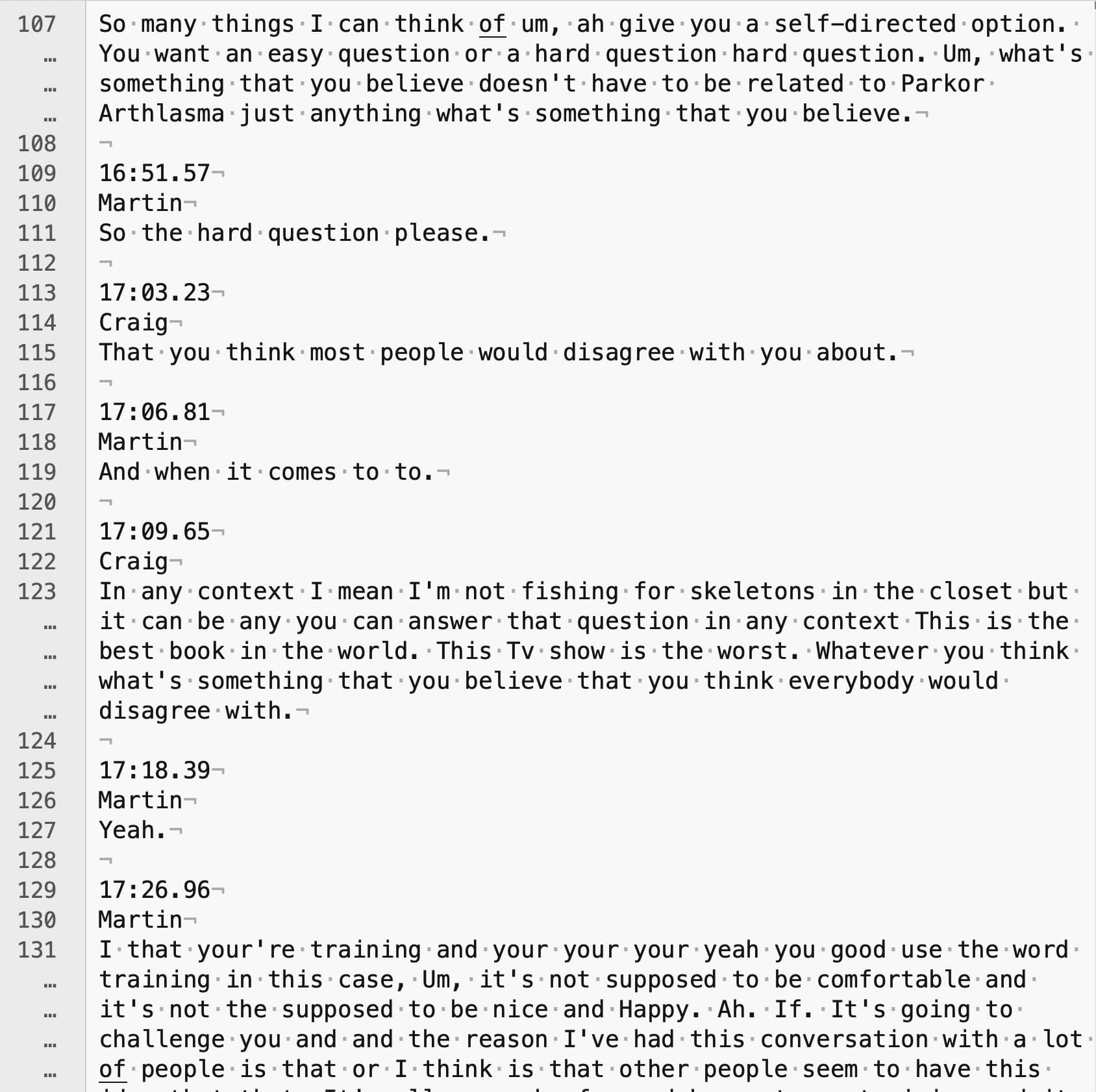
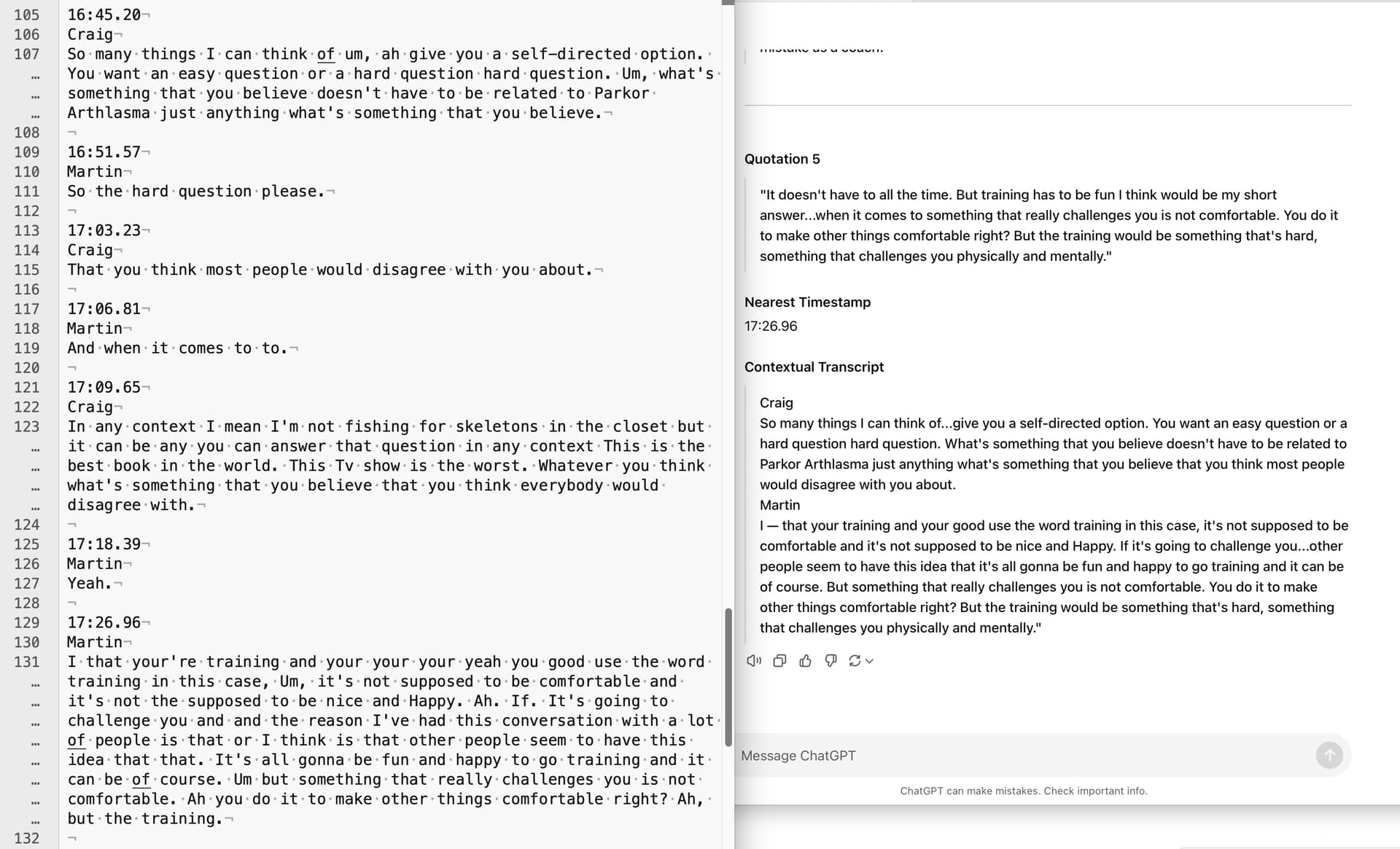
Below is a screenshot.
In the left-margin are line numbers. Line 107 and 123 are too long to fit, so my text editor has visually, “soft” wrapped them for ease of reading.
The files have time codes in them (the format does vary somewhat too). They have silly amounts of precision: 16:51.57 is 16 minutes and 51.57 seconds. Hours appear in the front as another number with another colon.
The LLM understands which person is the guest, because it understands who introduces the show, and introduces the other person.
I break the very long transcript text file into chunks, because there’s a maximum amount of text you can paste into the LLM interface. The screenshot above is from the 2nd or three chunks from my conversation with Martin. The whole chunk is 144 lines and about 8,000 characters.
Imagine having to read through the whole transcript to find the best part to quote. That’s very hard for me to do (nevermind I don’t have the time to do it), but the LLM can do it in a blink. LLMs are tireless and patient.
The prompt
There’s much discussion about “prompt engineering.” It’s an art. The best clues I can give you are: Explain it to a 5-year-old. And, the 5-year-old does not get confused by ordered lists, even if you nest them.
I give the LLM all the transcript chunks. Then I give it this prompt:
Select 5 direct quotations (not from Craig) from the conversation. I prefer longer quotations which include more context. For each quotation you select, do three things: First, show me your selected quotation. Do not rewrite the quotations. You may remove verbal tics such as “ah”, “yeah” and “um”. You must leave the speaker’s false-starts and restarts in place, ending those with an em-dash and a space. Second, show the nearest time from before the selected quotation. Show that time exactly as it appears in the original transcript. Third, show the exact original transcript from which you selected the quotation. For context, show several lines of the original, unedited transcript before and where you selected the quotation.
Oh! Reviewing this post, I even found a problem in the prompt above. Can you see it? Below, you’ll see a complaint about the LLM response. Now I think it’s not an LLM error, but an error in my prompt above. :slight_smile:
(This entire post about quotations is actually just part 2 of a much larger prompt which starts with, “Perform the following 5 tasks. Include a numbered heading before your response for each of these tasks:”)
It spits the result out in one long stream of text. I’ll break it apart…
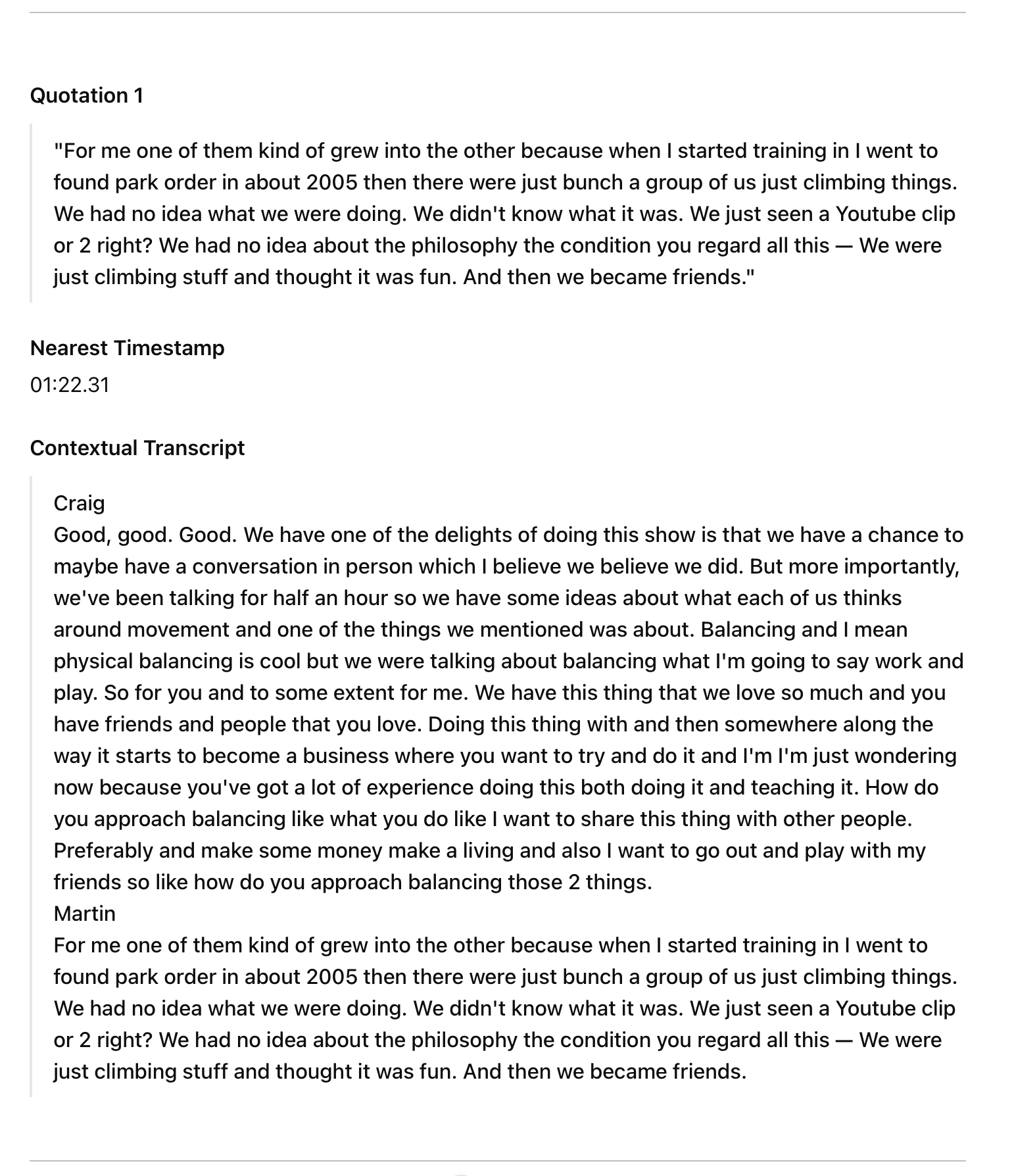
Quote 1
There are many things that I have to consider as I look at that:
Is it really a good quote, based on what I remember of that conversation? Meh, it’s okay. But that’s why I as it for 5 selections.
I don’t love that it refuses to give me context after the part where it selected the quote. I’ve tried, but after hours of work, I’m done prompt engineering and want to start this post. (As I mentioned above, I think this is because there’s an error, above, in my prompt.)
In this particular conversation, Martin talks a lot about “parkour”—thus “park order” (and many other variations I see a lot)—is just an error in the raw transcript. Ignore that for today.
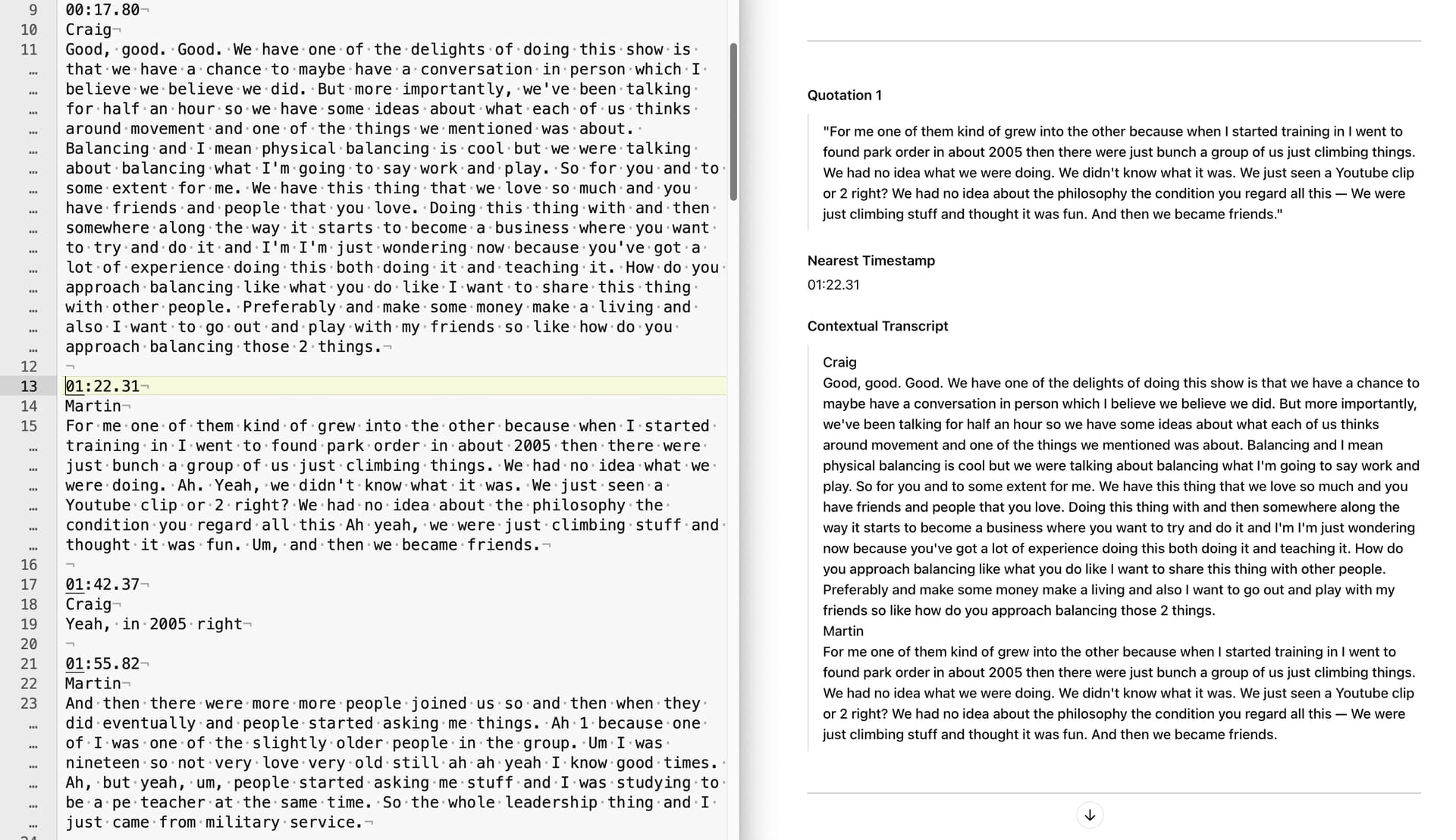
Most importantly: Is it hallucinating?? Well, it’s easy to use that timestamp. 1 minute 22 seconds is definitely in the 1st chunk… a moment of scrolling…
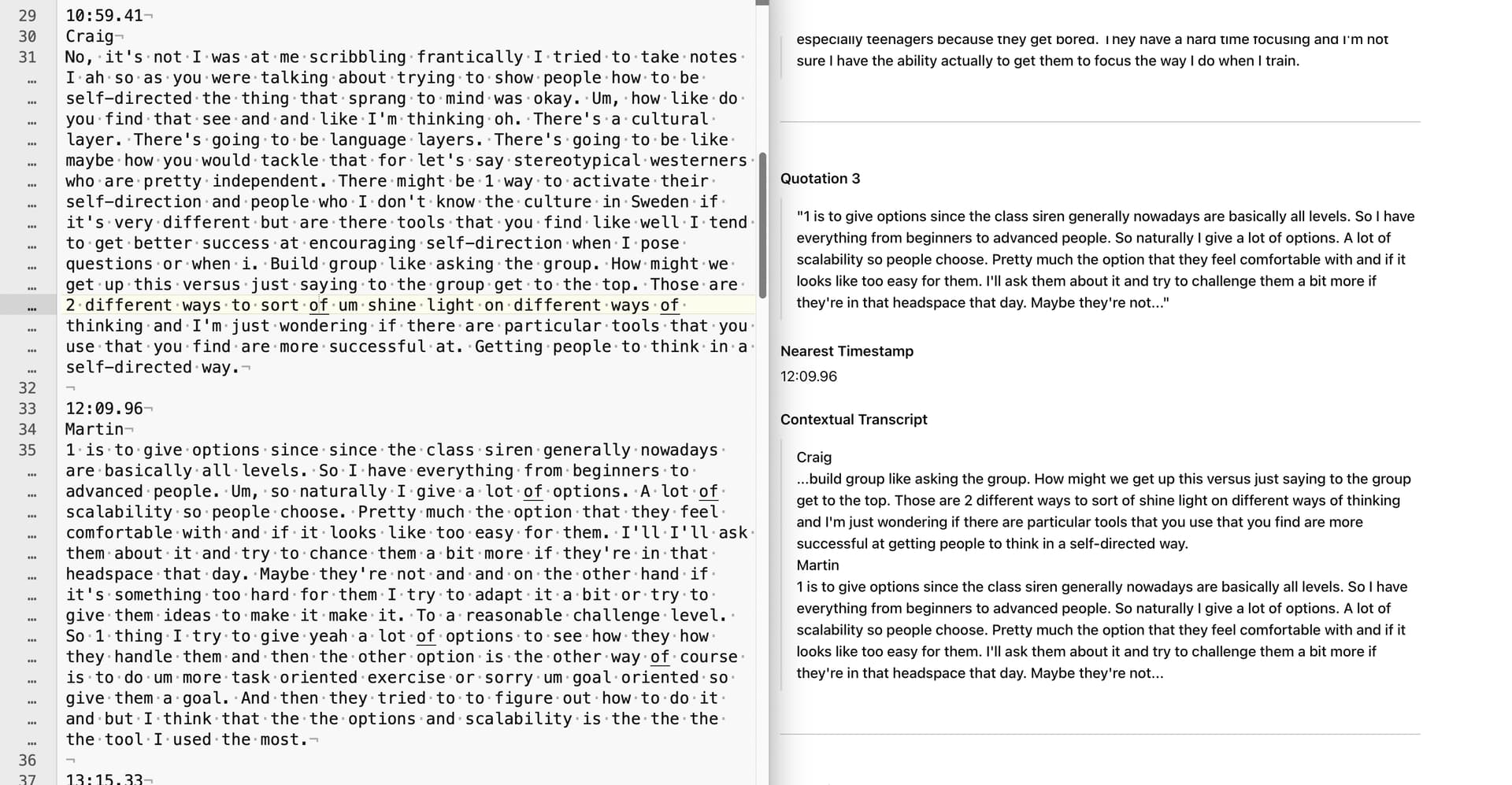
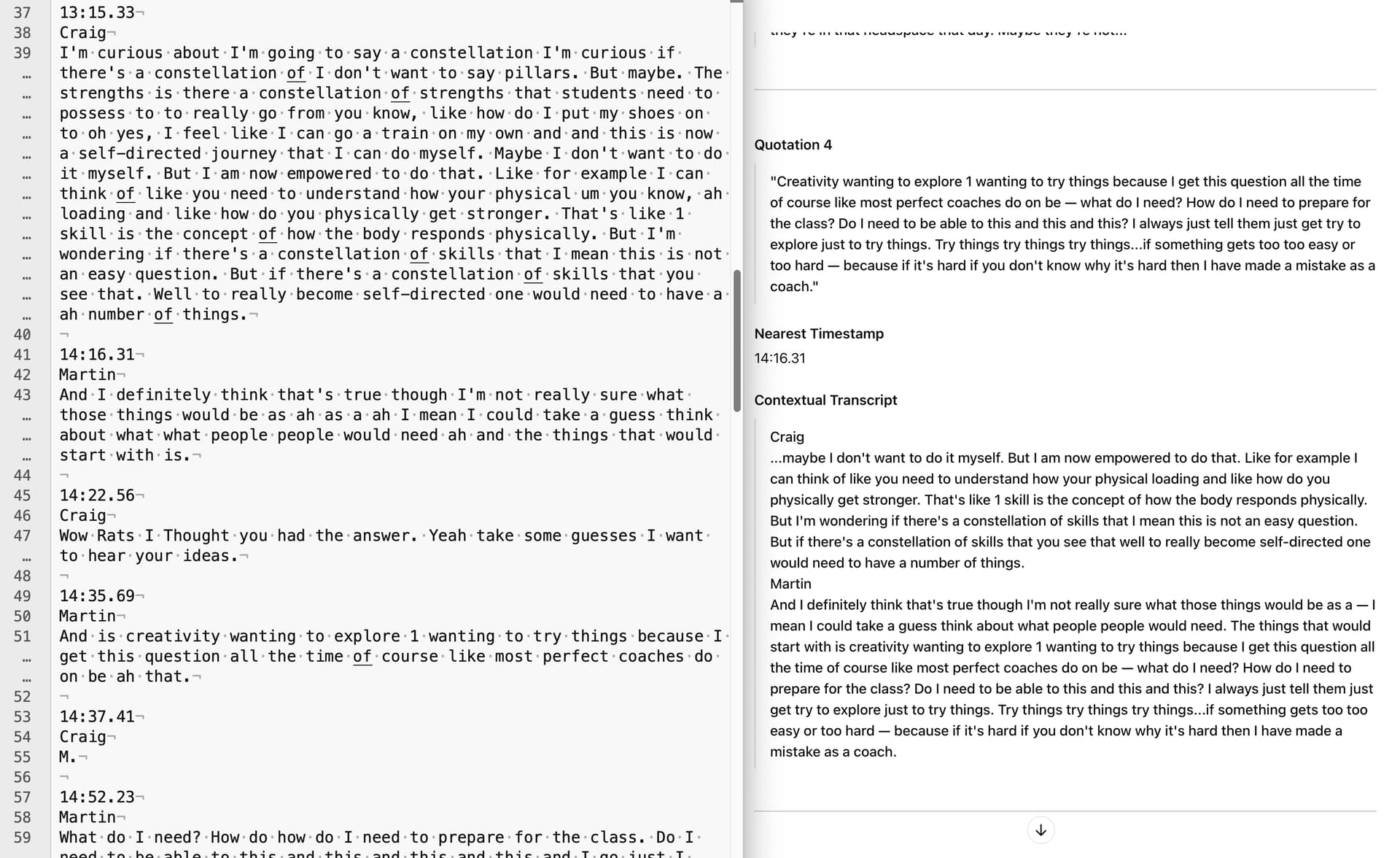
Here’s the actual, original chunk I uploaded, and the LLM’s output side by side…
Okay, that’s sane. If I was going to pick this quotation, I’d have to work some form of my question into that quote, so his quote has some context…
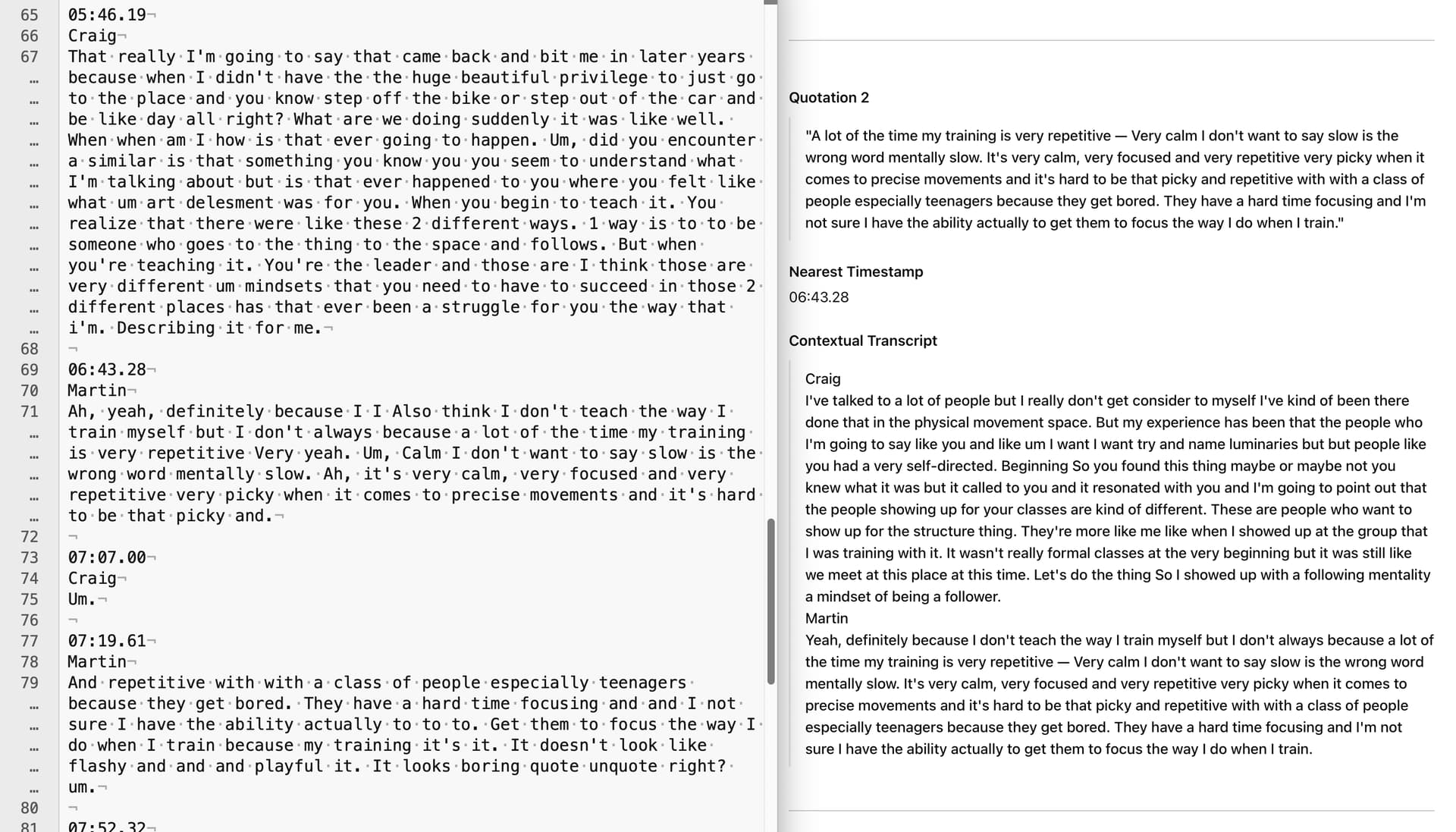
Moving on, I’m just going to give you the screenshots for each.
Quote 2
Quote 3
Quote 4
Quote 5
Closing thoughts
I use LLMs to write my show notes. Getting a quote or two is just one part of that.
“Write show notes” is not “the work only I can do” (as Seth would say.) And, I simply do not have the time to do show notes from scratch.
Yes, I’ve spent hours today on prompt engineering, but I have 319 more podcast episodes from 2022 and earlier (!) that I want to have show notes for. Those episodes would be better with show notes. A few hours spent here, enable me to copy-and-paste… wait a few minutes (the LLM is not instantaneous) and I have a really good starting point for show notes.
But, all things considered, this became more and more obviously the right move for me, despite the headaches it would cause in execution. So to hopefully save you the same pain and give you a little look behind the scenes, I wanted to share how I came to this conclusion and executed the rebrand.
The article above is a deep dive into one person’s thinking and efforts as part of re-brand. (Although, it has nothing to do with podcasting specifically.)
There are good points in there too about what, exactly, is a brand.
Seriously? A whole day each week without work? Sitting in the orientation that day, I could not imagine pulling it off. I had spent a decade of my professional life running from event to event, fighting for the time to read and write and reflect.
I’d like to suggest a layer of nuance be added: One can only achieve a certain “width” of change for that one day each week. You cannot have a completely relaxed day if the other six are maximally frenetic. If you live with the chaos and noise turned up to 11, you cannot turn it down to 2 on a particular day. By “width” I mean you can really only turn it down somewhat; If you’re normally living at an 11, you can only expect to get down to, perhaps, a 7 on your sabbath. If you really want to have a relaxing day of rest, that’s probably down around like a zero on the chaos and noise knob.
So, Sabbath? Certainly. And work regularly—every day—to turn that chaos and noise knob. Live life at 2, and then your day off can be a sublime zero of rest and recovery.
There are a bunch of insights in this little conversation with Ira Glass:
I’m ambitious! I want the stories to be special and I want the interviews to be special. The nervousness is my fear that they won’t be, and my awakeness to how hard it might be to get it to work. If you have any ambition, you march into the interview with a battle plan. You have this theory about what’s going to happen with this other person but you really have not the best idea if it’s going to work. Interviewing is an art form that so depends on the soul of the other person and also on how the two of you interact.
I particularly like that one about nervousness as a sign that we are doing something right as podcast creators. What’s the hard work? What’s the part that makes us a little nervous? Exactly.