Even more calm than a sand timer

I tell anyone who will listen about using physical sand timers for managing individual sessions of work. They are the perfect example of calm technology. I like to work with about 40 to 45 minutes of sand time.

Today I took a half an hour to have Claude build me a digital one. Often, I’m not within reach of my favorite sand timer and I’ve wanted to try building a digital one, which behaved exactly like a physical one. A digital one which was exactly as calm as a physical one.

A sand timer permits a constant flow rate through the neck. I didn’t bother modeling that.

In my descriptions and prompting I steered Claude to build a trivially simple approximation: The upper “sand pile” is a perfect triangle and it “drains” by having single-pixel rows removed from its top. The lower “sand pile” grows by adding lines to its top. This is NOT how a sand timer (which approximates fluid flow) actually behaves: It means the height drops at a constant rate, not an accelerating one.

When it was all working, I realized it was actually even more calm than a sand timer.

When you view a sand timer, the height of the sand changes at an increasing rate. In the beginning the height changes very slowly, and right near the end, the height runs down much more quickly.

But my digital sand timer is so calm, it even remains unhurried as it nears its end.

ɕ


I’m done with diet apps that guilt me when I miss a day

I’ve tried the apps. The ones that want you to log every meal. The ones with streaks you’re terrified to break. The ones that send notifications when you haven’t checked in, like a needy friend who keeps score.

They work for a while. Then I miss a day, or a week, and the guilt piles up until I delete the app entirely. I end up feeling worse than before I started.

Streaks. Badges. Red notification bubbles. I can’t sustain a relationship with an app that demands daily proof of my commitment.

What if it didn’t demand anything?

Most things built to help people eat better demand attention. They want you to log meals, hit streaks, earn badges, check dashboards. They need you to need them.

I built something quiet instead. One email. Once a day. No tracking. No streaks. No notifications. Just a question—a small thing to notice about how you actually eat.

If you open it, good. If you don’t, it doesn’t guilt you. There’s no streak to break. Tomorrow, another one arrives, same as today.

I think this matters because attention is finite and food is forever. I can’t sustain a relationship with an app that demands daily proof of my commitment. The prompts ask almost nothing. They just show up.

365 Changes: A daily prompt about eating — https://365changes.com/

ɕ


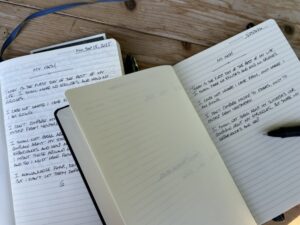
One Notebook. Not Two. Not Three. One.

The decision about where to write something is friction. Friction is the enemy.

You want zero decisions between “I should write this down” and actually writing it down.

I know it’s tempting: one notebook for work, one for personal, one for that side project. That’s three decisions you have to make every time you want to write something down. Three opportunities to just… not write it down.

What actually matters is having something you can write in without thinking about whether this thought “belongs” in this particular notebook.

One notebook. Everything goes in it.

Work stuff, personal stuff, ideas, questions, whatever. It’s all part of figuring out what you’re trying to do. The notebook doesn’t care about categories. Neither should you—at least not at the moment of capture.

Organization can come later. Capture has to happen now, or it doesn’t happen at all.

ɕ

This is part of a series about Hand-Write. Think Better.—a method for using paper to think more clearly. Get the book → or grab the free quick reference →


Why willpower doesn’t work for eating — and what does

I’ve tried relying on willpower. Everybody has. You decide you’re going to eat better, and for a while you do—until you don’t. Then you blame yourself for not being disciplined enough.

But here’s what I’ve come to understand: My body is the result of thousands of small decisions made over years. Most weren’t really decisions at all. They were defaults—things I did without thinking because that’s what I do. Open the pantry, grab what’s at eye level. Finish what’s on the plate because it’s on the plate.

The problem with “eating better”

The problem with trying to “eat better” is that it frames eating as a series of choices. But by the time I’m choosing, the default has already voted. Willpower shows up late, tired, and outnumbered.

By the time I’m choosing what to eat, my defaults have already voted. Willpower shows up late, tired, and outnumbered.

So I stopped trying to have more willpower. I started trying to change my defaults.

Defaults are built from accumulated ideas—things I believe without examining. If I want different defaults, I need different ideas taking up residence. Not all at once. One thought at a time, repeated until it becomes part of how I see things.

That’s why I built something that puts a single thought in front of me each morning—not to motivate me, but to slowly reshape what “normal” feels like.

365 Changes: A daily prompt about eating — https://365changes.com/

ɕ


Bifocals

I’ve come to realize I have a kind of bifocal attention – solving today’s problem while simultaneously noticing the friction, which I can’t leave alone. I’ll stop in the middle of the task to write the script, the alias, the doc, the template. Not because I’m procrastinating the real work, but because to me this is the real work – the specific task is just today’s instance of a pattern I’ll hit again.

The instinct has a cost: it’s slower in the moment. The payoff is cumulative and mostly invisible – unless someone else sees my environment and how I work. That’s where the “wizardry” appears; One gesture suddenly seems to perform magic. Except it’s not magic, it’s just a lot of bifocal attention.

It’s an acquired taste to know when the improvement is worth the interruption.

ɕ


Undertake a journey

I took [Judith Wright’s] reply to mean that for certain kinds of knowledge you have to undertake a journey. It isn’t like pouring water into a bucket—a process by which neither water nor bucket is much changed—It seemed that if I took this journey I would be utterly changed. And before setting out, I couldn’t predict what that change would be.

~ John Tarrant, from Bring Me the Rhinoceros

slip:4a1566.


I understand nutrition. I still can’t stop overeating.

I know about macros. I understand glycemic index, the difference between whole and processed foods, why protein keeps you full longer. I’ve read the books. I can explain insulin resistance while reaching for a second slice of cake.

If you’re like me, you’ve wondered why knowing all of this doesn’t seem to help. The information is there. The behavior doesn’t follow.

I used to think I needed more information—better information, presented more compellingly. It doesn’t work that way. The problem isn’t what I know. The problem is when I know it.

The problem isn’t information. It’s when and how the right thought arrives.

When the thought arrives matters

The prompts I built aren’t information delivery. They’re interruptions.

One thought arrives each morning—before I’m hungry, before I’m standing in front of the fridge negotiating with myself. Before the defaults kick in. That timing is the whole thing.

If you could read all the prompts in an afternoon, nod along, close the tab—nothing would change. The email works differently. It just shows up, early, when there’s a small window for a thought to land.

That’s what I built 365 Changes around—not more nutrition facts, but a single question arriving before my day fills in, when there’s still room for it to matter.

365 Changes: A daily prompt about eating — https://365changes.com/

ɕ


Kessler, 1978

Do you know what Kessler Syndrome is? You should.

ɕ


Simply a moment captured

Simply a moment captured

Sometimes I see a moment that’s worth capturing.

ɕ


Extraction

This is a rich conversation around validation vs. reassurance, which I recently revisited. Go listen. (Seth Godin and Brian Koppelman, 7/7/2015, from The Moment podcast—from over 10 years ago, back catalog for the win!)

I recently re-listened. Then I took the audio file, had a transcript generated (from otter.ai), passed it to Claude.ai who wrote me a magnificent list of takeaways. I’ve been reading over them, thinking about them, and weaving the ideas into my thinking.

But I’m not publishing those takeaways because that would be devaluing Koppelman’s and Godin’s work. AI is a power tool which I use for various things. (For example, I use it to help me write show notes for my podcast episodes, which I do publish in full.) But I blog here to help my thinking (and in this case to encourage others to listen to a great podcast episode.)

I’m not trying to give you all the gems all polished up from something someone else created. If you want the gems, go listen; Find your way to get the gems. Because the gems are only valuable if you dig them out and polish them yourself.

ɕ