The artist belongs to his work, not the work to the artist.
~ Novalis
Elsewhere, this is 4a1572. — slipbox
A small marked enclosure where a different kind of attention is kept.
A temenos, in ancient Greek, was a piece of ground set apart from ordinary use — bounded, dedicated to something larger than daily life, and respected as such. Not a temple, necessarily; just a marked enclosure where a different kind of attention was kept. People went there to do something they couldn’t quite do anywhere else — pay attention to what was hard to see in the noise of regular life. The marker around the place mattered as much as anything that happened inside it.
Temenos.place is an instance of one. A small daily instance. Each day, one thing appears on a page behind this one — a sentence, a question, a quote. Anyone who’s joined can sit with it. They can leave a short reply, where the others can see it but no one responds to it. Tomorrow the post is gone, the replies are gone, a new one is there. Nothing accumulates; there’s no archive, no body of work being built, no count of anything. People can show up today, or not, and either is fine. There is nothing to fall behind on.
The thing worth taking from this page is the temenos itself, which is yours to mark out wherever you are. A notebook, a chair, a corner of a morning, a daily walk — anywhere you decide that a particular kind of attention will be kept. If reading this gives you the word for something you’ve been doing already, or the permission to start, that’s enough.
ɕ
It’s important for us to remember in our own journey to self-improvement: one never arrives. The sage—the perfect Stoic who behaves perfectly in every situation—is an ideal, not an end.
~ Ryan Holiday
For me, the first glimmer of my own access to a temenos (the ancient name and clarity of the place’s meaning and utility came much later) was when I took up a daily reading practice. At first, I selected a physical book designed to be a daily devotional, and later I’ve bent all my daily reading into digital formats. The key point being: I needed to anchor my daily habit in an analog context, away from all the digital addictions I had developed. Later, once the habit was the thing I enjoyed more than the digital distraction, I was able to bend digital tools to my use.
As opposed to how digital tools normally (by their creators’ designs) bend you to their use.
ɕ
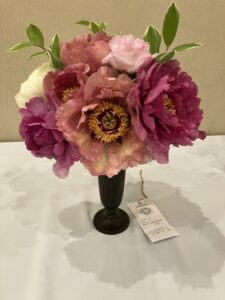
These blooms (and the greenery) were snipped by Tracy to create an entry for the American Peony Society’s annual convention. It’s WAY more complicated than I made it sound. Her hobby is hybridizing Peonies, and that means there are more than 100 tree- and herbaceous Peonies around our house. o_O
ɕ
Revert to what Epictetus described as our “chief task in life”—getting real clear about what’s up to us and what isn’t. Our actions, our thoughts, our feelings—these are up to us. Other people, the weather, external events, these are not. But here’s the thing: our responses to other people, the weather, external events are in our control. To reset your life, the best place to start is with making this distinction and then choosing to focus on the things that are in your control. If only because it concentrates your resources in the places where they matter.
~ Ryan Holiday, from You Slipped Up […]
Bryan Ward wrote a great article How The Hammer Fails You and reading his metaphor about the hammer versus the crowbar was a pivotal moment for me. Later, I realized that Epictetus’s counsel feels like the seed for Ward’s metaphor.
Am I applying my mental or physical effort in the correct place?
Until my answer was consistently coming up yes, that was the most useful question I kept asking.
ɕ
Perhaps further outside the clear connections, it also reminded me of the Eudaimonia machine, which I’ve previously written about here and here. It’s “a multipart floor plan that effectively funnels employees[, workers, creators, thinkers] through various spaces with the intention of triggering different mental states. The layout consists of an entry gallery, a social salon, a multi-person office, an archival library, and the chamber—a site for deep work.” One can easily think of the cloister as one more space in such a setup.
~ Patrick Tanguay, from The Cloister & The Starship
I’ve long been an admirer of subtly curated spaces. Sentiers itself is one such space. There, I keep staring at the juxtaposition of a starship and a cloister. There’s just something special about a wide range of experiences. For example, listening to meditative music streamed across the Internet—an incredible tech stack just to make some quiet sounds—while sitting in an ancient meditation posture listening to water gurgle in a downspout. We each contain multitudes, as it were.
ɕ
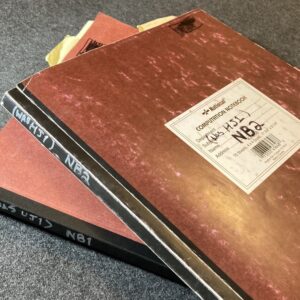
You could write in anything. Why do I specifically recommend lab notebooks?
Because they’re designed to solve a specific problem: how do you keep track of what you’re figuring out when you don’t yet know what matters?
Scientists use lab notebooks because experiments don’t always work. Most of the time you’re trying things that might fail. You need a record of what you tried, what happened, and what you thought about it—even the stuff that didn’t work. Especially the stuff that didn’t work, because that’s often where the actual learning is.
Your work is the same way. You’re trying things. Some succeed, some don’t. You’re figuring things out as you go.
Here’s what makes lab notebooks work:
Chronological order. Everything goes in date order. You don’t have to decide where something “belongs.”
Numbered pages. You can reference things later. “See p47” is useful. “That thing I wrote somewhere” is not.
Permanent record. Bound notebooks mean you can’t rip out pages or reorganize. This sounds like a limitation, but it’s a feature. You can write messy thoughts without worrying about making it pretty later.
There is no “later.” There’s just what you wrote and what you write next.
ɕ
This is part of a series about Hand-Write. Think Better.—a method for people who feel overwhelmed to start simply writing more on paper. Get the book →
[…] I just stumbled across [koans] in a book. They looked to be a kind of Chinese poetry. It was at a time when managing my mind had come to seem like a really good idea. And I needed a method. I knew immediately that koans might help. It was as if I held out my hand to see if it was raining and a yellow ball fell into my palm.
~ John Tarrant
Elsewhere, this is 4a1571. — slipbox
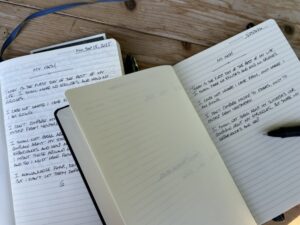
I remember when I started journaling. It began as a way to capture memories from trips—classic trip journaling. And then I started trying to bootstrap personal changes… which requires review… which requires something to review… which requires getting in the habit of…
The other day I was starting a new journal. It’s a process of unwrapping, labeling, and making my own pen-holder for the side…
But my favorite part is copying my personal oath into the front. Every one of these volumes feels like a reminder that every day can be a fresh start.
ɕ
I have a long Aikido background before coming to Art du Déplacement in my forties. I’m in my fifties now. The age of air, this stretch has been called — after roots, fire and water. Things that used to take effort don’t. Things that didn’t take effort do. The practice that carried me here doesn’t fit anymore, and I’m still figuring out what I’m going to do about that.
This thread is a path through pieces I’ve written and conversations I’ve had with others, sequenced for someone who’s wondering what their practice is asking of them next. None of it answers the question! But, I’m hoping it makes the question easier for you to explore yourself.
(more…)