When you want to visit a web site, you do not need to search for it in a central directory of web sites. Your web browser simply goes into the DNS system and finds the address to connect to.
Today, podcasts are managed inside a huge directory. But they do not need to be in a directory!
Meet the Open Podcast Directory
If you want to find the podcast for example.com why doesn’t your podcast player simply go find that podcast by looking it up in DNS?
What are the inherent challenges of growing and monetizing a Parkour community without losing its core values and spirit?
35 episodes and 2 years later, Adam McClellan returns to Movers Mindset. Adam deserves a large measure of credit because he was willing to be the original guinea pig for this crazy experiment. Our first interview was a simple Q&A style but in this episode we have an in depth conversation about the cycles a community goes through, the nature of parkour, and the type of people who are drawn to it. Adam explores the intersection of parkour and business, and how the two coexist, before discussing the nuances of coaching children. He opens up about his knee injury and recovery, his thoughts on normalizing parkour to the public, and different ways to design a parkour gym.
One of the things we value about Parkour is there isn’t that hierarchy and structure in place. It’s just you and me, and we’re hanging out, you don’t have to call me anything— There’s no assumed authority, right? We’re just training together.
~ Adam McClellan (21:40)
This conversation explores the growth and evolution of a Parkour community as it transitions from informal outdoor training to a structured business model. The discussion highlights the shifts in community dynamics when money and formal structures are introduced, drawing parallels between martial arts schools and Parkour. Adam reflects on how scaling up often leads to a loss of intimacy and core values, raising questions about whether Parkour can retain its spirit as it grows.
Key topics include the role of leadership in shaping community culture, the unavoidable influence of business practices on Parkour, and the challenge of teaching children while preserving the deeper philosophical aspects of the discipline. There is also a focus on personal injuries, their impact on training, and how physical setbacks shape the journey of a Parkour practitioner.
This post is from some quick notes I made in August 2018. I’m only just getting around to publishing it now, 8 months later, as part of this series. Today, at ~230 pounds, 215 seems like a dream.
—
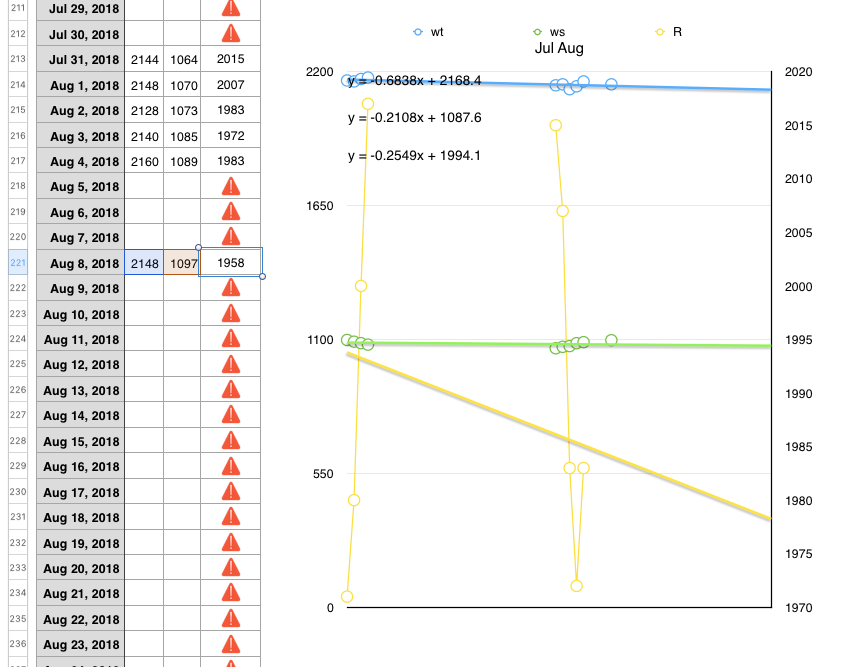
I’m recently back from traveling to Denmark and France to attend two Parkour events back-to-back. As usual when I’m traveling, I don’t attempt to keep up my normal routines so there’s no data recorded for most of July 2018.
I’m happy to return still around 215 as I try to get back to my routine of “chaining together” my mornings. Compared to July, I’m not as active, but I’m trying to AVOID the, “let’s be super active and try the 100-days-of-activity challenge,” mistake I made in 2017 when I came home from the same events all excited about movement.
Anyway, what about that ratio of 1958? …it’s so low that it’s not even on the graph! This reminds me of two things I believe I’ve noticed:
The ratio lags behind when I’m actively losing weight. My guess is that the different components (water, subcutaneous fat, visceral fat, and muscle) change at different rates. So when losing fat from calorie deficit, the peripheral/subcutaneous is liberated first—which aligns with my recollection that visceral fat is more tenacious.
The best ratio is very hard to find—to actually see it in the measurements. I have to lose weight gradually, and then stay at the new weight for many weeks to see the ratio rebound to above 2000. (Reminder, the ratio is in wacky units of “tenths of pounds per millimeter midriff circumference” because of how I record the numbers. The numerical value of the ratio is of no concern; It’s only useful for trending.)
Weak as I am, I carry on the war to the last moment, I get a hundred pike thrusts, I return two hundred and I laugh. I see near my door Geneva on fire with quarrels over nothing, and I laugh again; And, thank god, I can look upon the world as a farce even when it becomes as tragic as it sometimes does. All comes out even at the end of the day, and all comes out still more even when all the days are over.
I experimented by letting go of goals for a while and just going with the flow, but that produced even worse results. I know some people are fans of that style, but it hasn’t worked well for me. I make much better progress — and I’m generally happier and more fulfilled — when I wield greater conscious control over the direction of my life.
“Letting go” of my structures and goals is good for short-term health. I do this when I’m traveling, or when something unusual happens, (such as having a house guest for a weekend.) Letting go enables me to see if my default habits have changed, as I’m often working on some goal or project that involves habit change. Letting go creates space for serendipity.
But letting go does not get things done. My mind is meant to have ideas, not to hold them. Systems (a grocery list, a todo list, plans for projects, and so on) are how my mind creates the changes I want to see in the world.
Letting go certainly recharges me. It’s the restorative yin to my personality’s default yan.
This article got out of hand, and is 3,000 words. I encourage you to skip around; There’s more discussion of specific tools and how-to material in the last third.
In the beginning
In the beginning, podcasts were simply audio files which people shared directly either by emailing them to each other, or by providing download links on their web sites.
RSS technology has been around for a while and provided a way for a web site to publish a “here’s what’s new” feed. It was soon realized that RSS could be used to provide a feed specifically of podcasts. Software able to retrieve and understand a podcast feed, could then automatically download the podcast files, and alert you of new episodes. Sharing a new show with friends then meant simply giving them the “feed URL” which one would “subscribe to” by adding it to your feed reader.
Exercise builds physical ability and mental health.
For me, it began when I fell in love– with a bicycle.
The story of a boy and his bicycle
Long after college, way down in my downward death spiral, I bought a cheap mountain bicycle. Today, I don’t recall what possessed me to even want to buy a bike. I guess it just reminded me of the freedom I’d discovered when as a kid I first set out on a bicycle.
At the time, we were living in an apartment a short ride from a long park that followed a meandering creek. The park has long trails—some asphalt, some packed gravel—that follow the creek, and it has a few, short, side trails that almost resemble mountain biking.
What impact can parkour have on recovery and personal growth after a serious health challenge?
Nancy Lorentz opens up about her experience fighting cancer, and the role that parkour played in her recovery. She unpacks how her recovery inspired the idea of PK Move, and shares her ‘parkour origin story.’ Nancy discusses her thoughts on parkour’s growth and spirit, PK Move’s current goals, and finishes with her insights on how to attract older individuals to parkour.
[A]t the time of the diagnosis and going forward from there, I was not thinking about how parkour was part of this until afterward. I think once you are in that situation, you’re just going through the steps and getting through the treatment and what you have to do— the surgery or whatever. The fact is that, it did occur to me afterward— I thought, oh my gosh, [yes.] I really do say that parkour saved my life.
~ Nancy Lorentz (5:13)
Nancy Lorenz shares her personal journey of surviving cancer and how parkour became a crucial part of her recovery. She describes how the physical and mental resilience built through parkour helped her endure treatment and how this experience inspired her to co-found PK Move, a nonprofit organization dedicated to bringing parkour to underserved communities. The conversation covers her introduction to parkour, the challenges she faced during and after her illness, and how the supportive community around her played a significant role in her healing process.
The discussion highlights the mission and vision of PK Move, which focuses on providing adaptive parkour training to individuals who may face barriers to participating in traditional gym environments. Nancy details how PK Move brings parkour directly to people in their own communities, particularly targeting older adults and cancer survivors. Additionally, she reflects on the broader impact of parkour and the importance of preserving its core philosophy as it expands into mainstream fitness spaces.
One day I’ll be a filmmaker! One day I’ll be a famous artist! One day I’ll be a CEO! One day I’ll be a Creative Director! One day I’ll be a Venture Capitalist! And so forth.
Then you get to a certain age and you realize that the time for “One Day” is over. You’re either doing it, or you’re not. And if you’re not, a feeling of bitter disappointment starts hitting you deep into the marrow. Which explains why we all know so many people in their 30s and 40s having mid-life crisis’.
Whether I’m different, or have already passed through that, I know not. What I can tell you is that my problem is not at all a feeling of not doing what I want to do.
My problem is the feeling that I am doing too many different things. All things I’ve chosen. All things which I’m passionate about. All things which are cool, rewarding, meaningful and make the world a better place.