Can’t remember the last time I had a beer—not that I quit specifically, and I’d be surprised if it’s been more than a year, but at one time beer was a thing… and now, not so much. I’m not sure if that’s because my life went to shit and I feel I never have time to relax, or if I’m simply no longer interested in beer. Anyway. Also: Mustache.
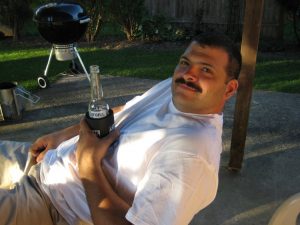
A few years ago →
Expectations →
All outcomes are manifestations of forces that are at work to produce them, so whenever looking at specific outcomes, think about the forces that are behind them. Constantly ask yourself, “What is this symptomatic of?”
~ Ray Dalio from, 17 Management Lessons from Ray Dalio
Elsewhere, this is 4ufoma1. — slipbox
This is pretty much the zero-th rule of being a rational agent. (But that doesn’t mean it doesn’t bear repeating.) The post from Parrish is simply a long list of quotes from Dalio. It’s a great list, and it’s assembled in the context of leadership skills. This one, (quoted above,) in particular speaks to me; speaks to me like a drill sergeant. “What is your dysfunction?!” Anyway.
Once I started practicing being rational—yes, emotions are real, they are important, they get their due… But once I started intentionally practicing using rationality as a tool I made huge strides in self-improvement.
ɕ
Commitment →
People who are interested in doing something will do it when it’s convenient. People who are committed will do it no matter what.
~ Bob Proctor
Elsewhere, this is 4a399. — slipbox
Adam McClellan, Caitlin Pontrella, & Alan Tran | Art of Retreat 2019 Recap →
On Castbox.fm — Adam McClellan, Caitlin Pontrella, & Alan Tran | Art of Retreat 2019 Recap
How can events like retreats foster personal growth, collaboration, and community-building in specialized fields?
Discover how open schedules and shared creative spaces redefine the meaning of collaboration and innovation at events.
Something new that we did this year was open schedule […] an open forum where anyone could add a session or workshop or something informal, to the schedule during our blocks of open time, which was really well received.
~ Caitlin Pontrella (0:54)
This discussion revolves around the role of retreats in fostering personal growth, community-building, and collaboration. Adam, Caitlin and Alan describe the unique atmosphere of the retreat, emphasizing the importance of an open schedule that allows participants to contribute sessions spontaneously. This format lowers barriers to participation, inspiring individuals to step into leadership roles and share their expertise. Additionally, the conversation highlights the retreat’s design, which fosters vulnerability, connection, and a sense of belonging through shared meals, cozy settings, and creative activities.
The group also explores the challenges and opportunities of organizing international retreats. Topics include reducing economic barriers for attendees, creating cross-cultural connections, and leveraging sponsorships to enhance inclusivity. They stress the significance of helping participants take the retreat’s transformative energy back to their local communities, translating it into actionable insights and long-lasting impact. A key theme is the interplay between deliberate planning and organic participant-driven creation, which collectively define the retreat’s unique success.
Takeaways
Creating space for spontaneous sessions — This fosters inclusivity and encourages new voices to emerge as potential future leaders.
The role of environment — A retreat’s physical setting significantly contributes to its emotional and social impact, enhancing connection and memory.
Barriers to accessibility — Efforts to reduce economic, geographic, and social barriers ensure more diverse participation.
The power of shared meals — Communal meals are designed to build intimacy and create a warm, homelike atmosphere.
Cultural exchange in international retreats — Cross-cultural understanding and shared learnings enhance the global community’s impact.
Emphasis on personal agency — Participants are encouraged to take ownership of their experience, tailoring it to their needs.
Connection beyond the retreat — A focus on enabling participants to take back ideas, skills, and inspiration to their communities.
The hero’s journey framework — The retreat experience is framed as a journey of personal growth and transformation.
Resources
Art of Retreat — Official website for the retreat, offering event details and registration.
Parkour Visions — A partner organization supporting the retreat.
Parkour Generations Americas — A key partner in organizing and supporting the event.
Zen Planner — A sponsor providing resources for event management.
(Written with help from Chat-GPT.)
ɕ
Dawning of moral progress →
One of the signs of the dawning of moral progress is the gradual extinguishing of blame. We see the futility of finger-pointing. The more we examine our attitudes and work on ourselves, the less we are apt to be swept away by stormy emotional reactions in which we seek easy explanations for unbidden events.
~ Epictetus
Elsewhere, this is 4a162. — slipbox
What do you do while on the bench? →
She didn’t recognize there was a bench in her life — and because she didn’t recognize the bench, she didn’t focus on the game playing out around her. In baseball there’s a location shift, from a player being on the field to a player being on the bench in the dugout.
~ Callie Oettinger from, What It Takes: How to Pitch: Get in the Game
Elsewhere, this is 4useho2. — slipbox
I don’t personally think of my life as if I’m sitting on “the bench” waiting to be tapped to go out and play in the game—but it’s a good enough metaphor, so I’m running with it today.
The question is simply: What do you do while you are sitting on the bench?
There are many other ways this has been phrased…
What are you doing, each day, to build an asset that will be useful to you later?
Or if you are in a creative arena…
What’s on your web site that shows me the work you’ve done?
What’s in your portfolio?
Who can’t stop talking about you?
ɕ
P.S.: This question is part of my personal list of daily reminders.
Baseball →
If I stick with it, however, my mind eventually downshifts — quieting the noisy neuronal clamoring for easy entertainment, and leaving instead an unencumbered attention of a type that I often seek in my work.
~ Cal Newport from, Deep Habits: Listen to Baseball on the Radio – Cal Newport
Elsewhere, this is 4ucabo6. — slipbox
Once or thrice I’ve heard a baseball game on the radio. This would have been back in the 80’s when with some neighborhood friends—brothers, whose father was a plumber—we’d occasionally ride to a baseball game. The kind of game where we were playing as kids; semi-organized little league games at random churches’ baseball fields scattered around the Pennsylvania rolling hills. A homerun into left-field was in the graveyard and into right-field was in the corn field. I can’t convey in writing what it sounded like riding in the truck with the radio on; some combination of a monotonous announcer with a touch of crowd noise, a big ‘ol truck engine—this was the plumbing truck full of plumbing supplies in the back—a 5-speed manual floor shift and 3 rowdy kids with the windows rolled down and the smell of fields and manure and baseball gloves.
I think I had something else to say about baseball and focus when I started typing. But I forget what it was.
ɕ

Dam! →
If memory serves, this was shot from the new-ish highway bridge that carries the interstate above the canyon. I love the complexity of how everything is all jammed down into the canyon.
ɕ
Let’s grab a kayak →
Let’s grab a kayak to Quincy or Nyack
~ Lyrics by Tom Adair
Let’s get away from it all
The secret to life, of course, is to first get away from it all, then grab that kayak. Because wherever I go, there I find myself. The things that one wants to “get away from” are all things over which you exclusively have control. That stack of papers that should be filed… This mountain of debt… That broken air conditioning… Even really hard things like mortgages, needy pets, frenemies, toxic family members… you are in control of how you act and how you assess those things.
Have you truly and honestly examined the things in your life which are weighing on your mind?
You have? Great! That’s the easy part.
The hard part? Let go. Toss things out of your life. Realize the hearse has no luggage rack. 15,000 years from now nothing you did or worried about will matter at all. You have exactly this one lifetime. Apprehend why each thing is in your life and appreciate it, right now. Build things up. Help people. Create. …we humans are creatures meant for social interaction, of course. But no regrets. No could’a should’a would’a.
ɕ