There’s a lot of conventional wisdom in podcasting—things like “You have to publish weekly” or “Shorter episodes are better.” But not all common advice applies to everyone. What’s something you’ve found doesn’t actually work or that people should rethink?
~ Asked by the LLM(1)
Don’t go alone.
I don’t think people do well trying to do their podcast entirely by themselves. I think this is really a point about creating art in general.
Yes, one definitely should do the work for the work’s sake. (What is referred to as autotelic.) Yes, don’t depend on external motivation and reward. But it is not easy to do that entirely alone.
The easy way is to find others who share your passion. You don’t need to directly collaborate on your work. But you absolutely will be happier if you have others who speak your jargon, do the thing, and face the same struggles.
ɕ
(1) I’m working with an LLM instance which has access to everything I’ve written about podcasting, and all the episodes I’ve published. It prompts me by asking me these questions.
Being quiet and slowly building mastery and expertise doesn’t pay off much at first. So many creatives must make a calculation: Do I want the short term, could-go-viral-at-any-second thrill of being a vocal expert in my field? Or am I more content playing the long game? More people are incentivized to choose the former — and it’s getting crowded in here.
This is closely related to the bit the other day from Offerman. In fact, it’s closely related to anyone’s journey of self-discovery. It is directly related, and critically important, for creatives to understand the trap of the idea of there being a possible short-term payoff. There is no short-term payoff. It exists, in the same sense that car accidents exist: Yes, but we don’t hope for that. We don’t set out trying for that.
But if you only paid attention to television and social media, you would think that all we’re supposed to do is make as much money as possible, and buy as many retail goods as possible. I’ve found that making a life with one’s hands and spending your time with loved ones pays less dollars but makes your life much more rich. I feel like the American Dream has been a bit hijacked by consumerism… And I learned the hard way that that’s actually quite empty and depressing as a lifestyle.
Maybe don’t follow Offerman’s path. But I think it’s worth following his advice. Yes, it’s difficult to balance exploring what makes me unique, with simply doing what everyone is doing. The balance you choose is part of the journey of self-creation. That’s a feature, not a flaw.
What makes parkour jam spaces unique, and how do they shape the experience of movement, community, and accessibility?
A church, a jam space, and a parkour gym—what do they have in common, and why does it matter?
The empowerment, and the kind of liberation to not care what other people think, does have a limit for some folk, I guess. I love it. I think for me, it’s been great and really powerful. I really like not caring anymore about being bad at stuff in particular— that’s so freeing.
~ Nina Ballantyne (14:00)
The conversation explores the concept of parkour jam spaces, emphasizing how they lack defined boundaries, making them more accessible in theory but sometimes intimidating in practice. The discussion touches on the contrast between structured athletic environments and the open, fluid nature of parkour, where new participants must navigate unspoken social norms rather than physical barriers. The conversation also highlights the paradox of accessibility—while jam spaces remove formal entry requirements, social and cultural factors can still create obstacles, especially for marginalized individuals.
The discussion transitions into broader themes of public space, inclusivity, and the intersection of parkour with community projects. A significant portion focuses on an initiative to purchase a historic church in Edinburgh and transform it into a community space. The conversation reflects on how physical spaces carry different meanings based on personal and cultural perspectives. The comparison between parkour jam spaces and community-driven spaces like the church highlights the broader theme of reclaiming and redefining public areas for collective benefit.
Takeaways
Jam spaces and accessibility — The absence of a physical boundary in a jam space doesn’t mean it’s truly open to everyone, as social and psychological barriers still exist.
The role of unstructured environments — Unlike traditional sports with defined spaces and rules, parkour operates in public spaces, leading to unique challenges in inclusivity and belonging.
Marginalized groups in public spaces — Individuals who are already scrutinized in society, whether due to gender, race, or body type, may experience additional barriers when engaging in parkour.
The impact of early experiences — Many practitioners come into parkour without formal athletic backgrounds, which shapes their approach to movement and learning.
Cultural norms within parkour — Different communities have their own customs, such as specific greetings or approaches to training, which can be both welcoming and exclusionary.
Reclaiming public space — Parkour’s ability to redefine urban spaces extends beyond movement, influencing broader discussions about who has access to and control over public areas.
Indoor vs. outdoor training — While some practitioners prefer the spontaneity of outdoor training, indoor spaces provide a structured environment that can be more accessible to beginners or marginalized groups.
The intersection of parkour and community work — The discussion about repurposing a church into a community space parallels parkour’s ethos of adapting and reclaiming environments.
The perception of churches as public spaces — Depending on cultural background, a church can be seen as either a welcoming community hub or an exclusive, imposing institution.
The role of storytelling in community building — Sharing experiences and narratives within parkour fosters a sense of shared culture and belonging.
The importance of understanding different motivations — Some practitioners seek challenge, while others prioritize playfulness, relaxation, or self-expression.
The limits of parkour’s inclusivity — While parkour prides itself on being an open and adaptable discipline, social realities can still make participation difficult for some individuals.
Resources
Access Parkour — A parkour organization in Scotland that provides training opportunities and works on community-focused projects.
Leith St Andrews Trust — The charitable organization working to purchase and repurpose a church in Edinburgh as a community space.
Coach Europe — A parkour coaching conference that brings together practitioners to discuss teaching methodologies and movement philosophy.
Richard Marshall — A parkour practitioner and speaker who discusses the importance of play in movement training.
(Written with help from Chat-GPT.)
ɕ
What is one counterintuitive truth about podcasting that most people don’t realize? →
Many podcasters start out assuming success looks like big audience numbers, sponsorships, or industry recognition. But in your experience, what’s something that actually matters way more than people think—or something people chase that turns out to be irrelevant?
~ Asked by the LLM(1)
All advice is useless until you first figure out why you are creating your podcast. There, that’s counterintuitive and contentious.
I’m not saying you must have a deeply considered, philosophical reason. But you must start with some reason for your podcasting. It can be any reason at all that you can imagine.
Because any useful advice must take your reason for podcasting into consideration. What’s the best mic? Should I publish on a schedule? Does the quality of the audio matter? What about show-length? …format? …social media? Even, what’s something that actually matters way more than people think? It depends.
All advice is going to be wrong if it doesn’t take your reasons into consideration. This applies to everything in life. Get up early? Stay up late? Avoid gluten? Read more? It depends.
Certainly you can change and refine your reasons. When you do that you can get real power from all that advice. If you get advice towards one course of action, but you don’t want to do that, then you need to dig into your reason, or you need to dig into that advice. One of them needs to be updated.
ɕ
(1) I’m working with an LLM instance which has access to everything I’ve written about podcasting, and all the episodes I’ve published. It prompts me by asking me these questions.
You just have to use what you have, and have great cohorts. I have people that I’ve played with a very long time. We are connected by our common understanding of what we’re doing, all the experiences we’ve had over the years… And most of all, there’s a friendship between us which allows us to do it without having to explain everything with a huge long manifesto. It has a lot to do with the trust I’m able to place in them to do our work.
Time after time I hear creatives talk about that. How they have an inside circle of peers. Of people who are also friends. Creatives need to have a group of people which somehow form a scene; They have access to a place where others like them freely associate.
When it comes, this will be the fourth message received from Alsafi in my lifetime. Few have timed their career so fortuitously. The first came when I was a child. The second came just weeks after I joined the Intercivilizational Observatory’s San Francisco office, and I wormed my way onto the analysis team. The third came the year I met Cassio, and I was doubly lovestruck. Still, I was reading responses to questions another generation had asked. But now, a full 39-year round-trip after I began, I’ll finally get answers to my questions. Ones from my youth, maybe, but they’ll be mine. After all this time, I’ll finally be In Conversation.
This piece of fiction is one of those things I start skimming, thinking “should I mark this for later reading?” and then read it all the way through. So of course I recommend you do too.
I find tremendous value in considered conversation. Usually, a conversation about the weather isn’t such a valuable opportunity. But this conversation about “weather” is really about what are the limits of what can be considered a conversation… is understanding required for it to be a conversation? Or is simply trying to understand, enough?
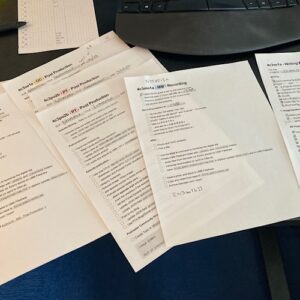
Writing issues of 7 for Sunday has become familiar (not to be confused with “easy”). I have a checklist which I use when I’m writing each issue. It’s as much for scratch-paper thinking, as it is for ticking off completed steps. Originally, the checklist had a lot of notes about formatting, what goes where, how to typeset the specific parts, image sizing, etc. all nuts-and-bolts stuff. As I’ve modified it, it’s now mostly signposts and I use it to celebrate each phase of the issue’s development.
Today, I was down to just a couple of these checklists and I hit print. How many copies? Without hesitation I printed 20—because that would be checklists through issue 150. It simply struck me as interesting that I’ve moved beyond “should I continue” and even beyond “can I continue” for this neat little weekly missive that I enjoy putting together.
ɕ
Consider: If you were starting a brand-new podcast today, what would you do differently? →
With everything you’ve learned from running multiple shows, what are the biggest mistakes or inefficiencies you’d avoid if you were launching a new podcast from scratch? Would you approach production, audience growth, or personal mindset differently?
~ Asked by the LLM(1)
Picture me smiling and chuckling nervously because, for more than a year, I have been trying to restart one of my shows. Certainly a big part of my 2024 was reallocated for health reasons, but my attempted restart of the Open + Curious podcast has had many months available to me before, and since. Still, there’s no new show. It’s all about the mindset, for me. I have a too-grand vision of what it should be. I can’t stop seeing all the things it could possibly become, and fixating on getting everything right (my vision of what it should be) from launch day.
However, the best wisdom that I have here for others, is just a repackaging of Heraclitus’s “no one steps in the same river twice” (the flowing water implies the river is different, and the person is also different.)
If someone is actually starting their first show: Once you understand how to do a podcast (it takes perhaps 10 minutes to learn that?) then do not spend more time asking people about starting. That’s hiding from the work. Rather, start. The experience of the doing is what you are actually seeking.
ɕ
(1) I’m working with an LLM instance which has access to everything I’ve written about podcasting, and all the episodes I’ve published. It prompts me by asking me these questions.