Zeal, dogmatism and idealism exist only because we are forever committing intellectual sins. We sin by attributing concrete significance to meaningless pseudo-knowledge; We sin in being too lazy to think in terms of multiple causation and indulging instead in over-simplification, over-generalization and over-abstraction; And we sin by cherishing the false but agreeable notion that conceptual knowledge and, above all, conceptual pseudo-knowledge are the same as understanding.
As I headed out of Asheville, North Carolina it occurred to me to wonder why I was heading north on Interstate 26. It was clearly labeled “North,” I was currently pointed north, and as far as I could tell—glancing at the dashboard’s big bright display while negotiating the swerving and undulating roadway—it was going to take me very-much northward. None the less, even-numbered Interstates are usually east-west routes. Also odd: The signage in North Carolina said “future” I-26, but it looked pretty in-existence to me.
North Carolina’s license plates say, “from sea to mountains.” Or something like that. Asheville and surrounds take that seriously. Lots and lots of hills and mountains and valleys for my little 4-cyclinder van to lumber up and down. Dang pretty though. Lots of evergreens, but enough deciduous trees that I bet the fall foliage is a spectacle.
At which point Siri announced: “Welcome to Tennessee!” Wait, wat?
I really should look over the map route before I start driving. I was expecting to go straight from North Carolina into Virginia. In hindsight, I see that was an option if I’d gone east from Asheville and northward from, like, Charlotte. And so I got an extremely brief glimpse of an extremely beautiful part of Tennessee.
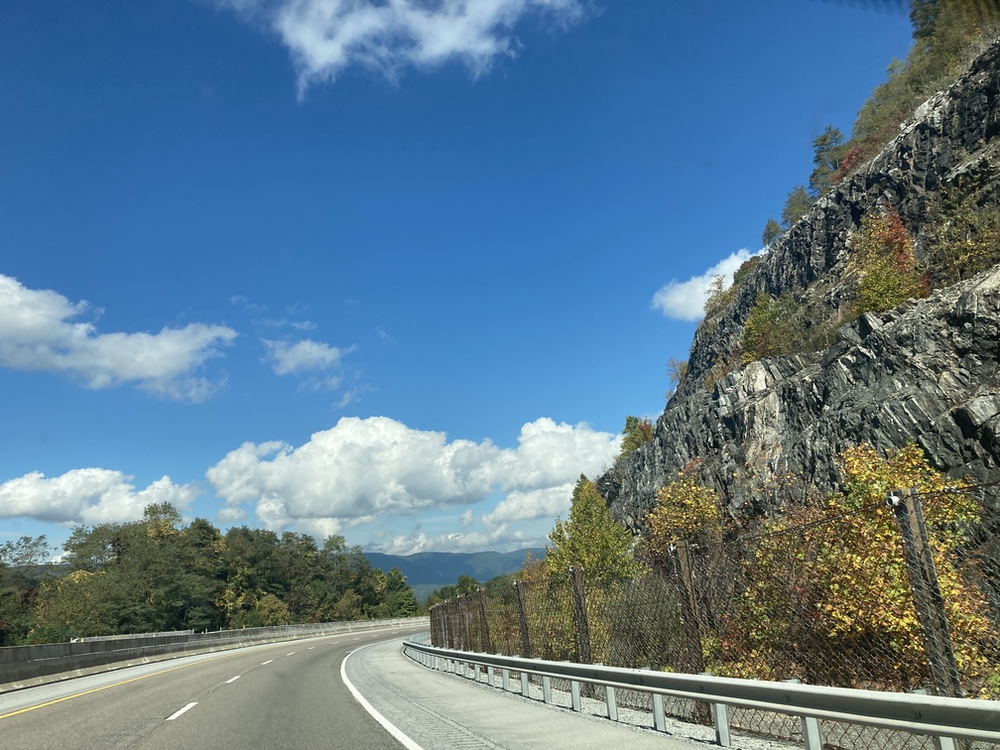
But first, I drove up and down 42 steep hills like this one:
Somewhere along the way I saw a sign for the almost-was-a-State of Franklin. I’d read about that years ago, and—serendipity!—here I was driving through it. (The entire far-eastern pointy bit of Tennessee was once almost-sort-of Franklin.) Anyway.
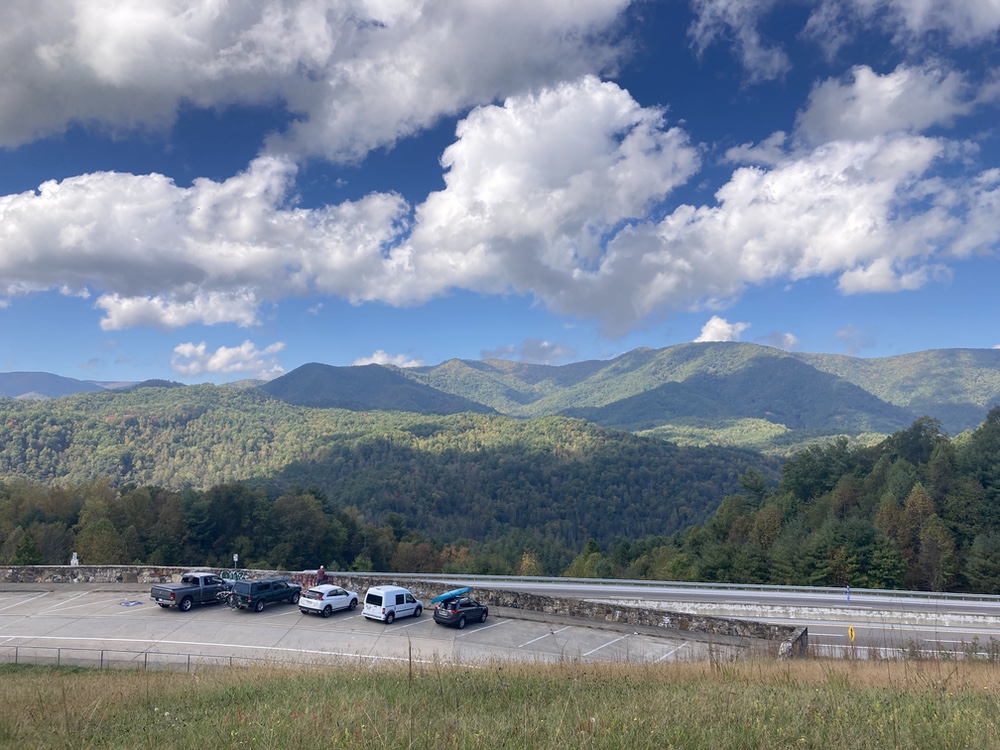
Eventually I reached that quintessential American experience: The scenic overlook. I parked here:
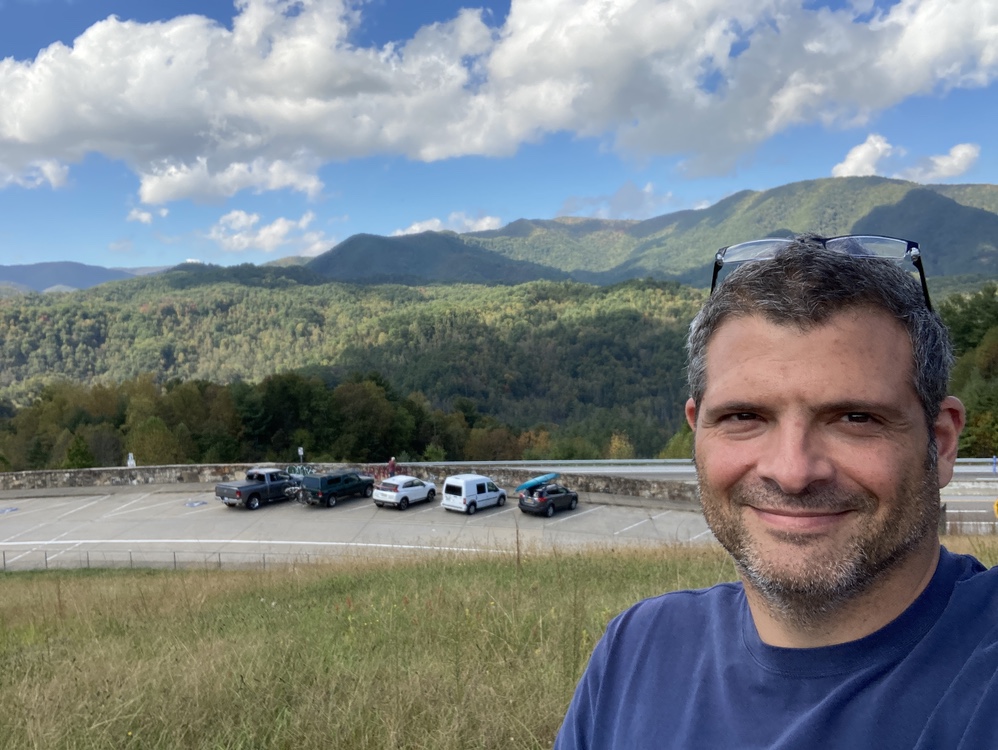
I can tell when I’ve been sitting too long, riding in a car for days… I get the urge to bound up the stairs, one might even say the urge to run. Same shot, selfie-mode:
Two tricks to better selfies: Look at the camera lense, not the screen, as you trip the shutter, and intentionally lower the shoulder of the arm holding the camera. The one shoulder scrunched up is the dead-giveaway in selfies. Also, dude, get a hair cut and shave.
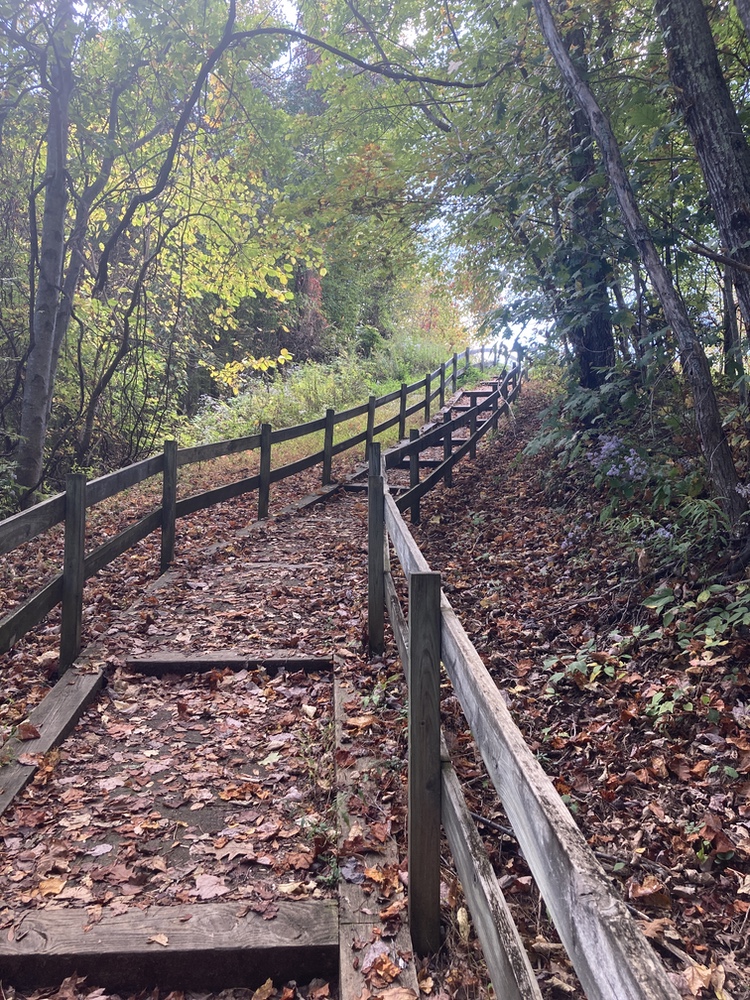
As I was strolling away, I realized there was a side trail. It mentioned 800 feet, and 150 feet vertical. I didn’t “run” up. I briskly walked up while thinking, “oooooh max heart-rate cardio… didn’t see that coming either.” But it was worth it:
During my recent road trip my finely-tuned pattern of sleep was annihilated. It’s one thing to have simplicity forced upon you; That has some benefits. But once my sleep was off the rails, everything fell apart. It wasn’t quite Escape-from-New-York-level chaos. It was close though. On one day, I wasted an hour, driving all the way to an entirely wrong address because, the night before I didn’t feel I had 2 minutes to spare to doublecheck.
I’m often viciously critical of myself if I’m still up even a few minutes beyond my desired go-to-bed time, or if I’m still in bed after my get-up time. None the less, for the 10 days of my trip, my sleep times were all over the map. On the one hand, I didn’t die and things got done. On the other hand, it was reminiscent of the old days before I got my sleep sorted out.
Sleep, (when, quantity, and quality,) and daily planning, (what am I doing, when and where,) are related. Back in the day, I cut the Gordian knot by setting a consistent sleep schedule. In a return to Primary School days, I gave myself clear and unchanging go-to-bed and get-up times. Then, arranged around those times I can schedule a specific “plan the day” session. (I’ve tried both “plan for tomorrow” just before bed, and “plan for today” fairly soon after getting up.) With improved sleep and some basic daily planning—which can be literally to simply sit on the beach all day—my life took a serious turn for the better.
But after my recent experience I’ve given this another prolonged bout of thinking and I’ve had a new [to me only, I’m sure] idea: Sleep and planning are not just related, they are circularly dependent on each other.
Here’s a sample pass around the circle: Today’s been busy, and I’ve some things I’d like to finish before sleeping. What time should I go to sleep? What time do I stand up and excuse myself from the current goings on? I need to know how much sleep I’d get if did that at different times. So what time do I have to get up tomorrow? I don’t know. What am I doing tomorrow? I need to spend some time planning for tomorrow, but that’s best done as part of my “alone time” as I’m winding down to sleep… And I cannot simply leave it to luck tomorrow morning. If I have to drive an hour, be some where at a certain time, a shower would be smart too…
Living amphibiously, half in fact and half in words, half in immediate experience and half in abstract notions, we contrive most of the time to make the worst of both worlds. We use language so badly that we became the slaves of our clichés and are turned either into conforming Babbits or into fanatics and doctrinairs. And we use immediate experience so badly that we become blind to the realities of our own nature and insensitive to the universe around us. The abstract knowledge which words bring us is paid for by concrete ignorance.
What is the fruit of these teachings? Only the most beautiful and proper harvest of the truly educated—tranquility, fearlessness, and freedom. We should not trust the masses who say that only the free can be educated, but rather the lovers of wisdom who say that only the educated are free.
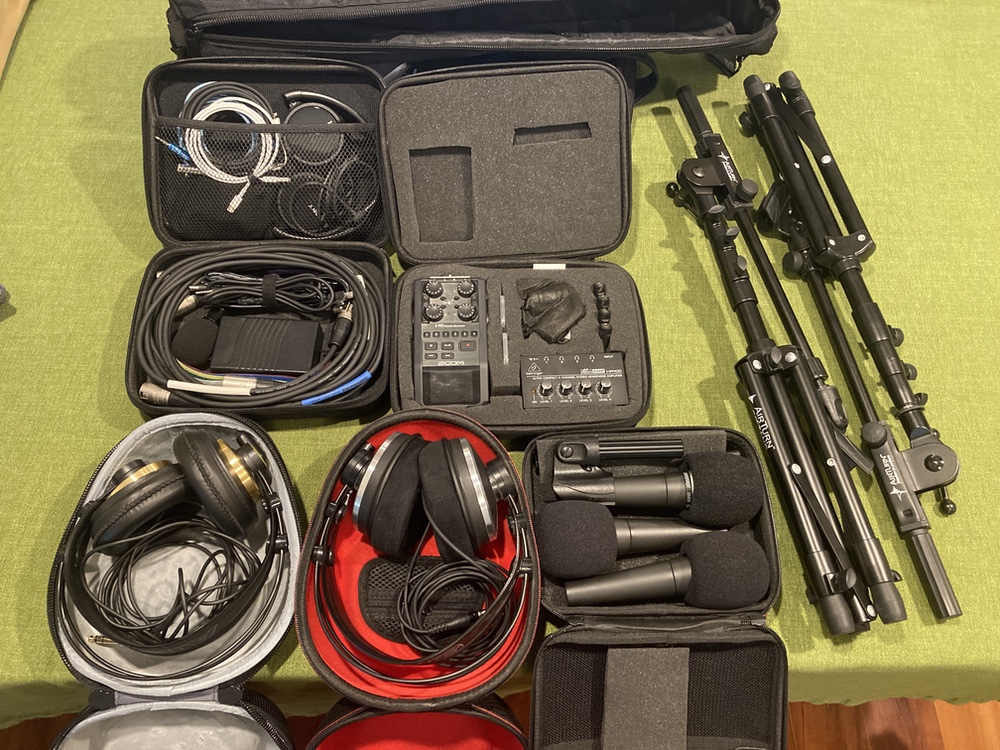
As I mentioned last week, I was recently on a rather long road trip doing some recording for the Movers Mindset project. I took a lot of stuff on the trip, but here’s the two bags which comprised the complete podcast setup—everything I need to press record is in these two bags. The rectangular bag is a proper, no-cheating, most-stingy-airline carry-on size.
And here’s what’s inside: Two full-size (albeit lightweight) mic stands, 2 sets of full-size headphones, and 3 containers of all the podcast recording and listening electronics. (And it’s all battery powered to boot.)
I’ve talked previously about simplicity. In particular, the idea that imformed simplicity, following from a beginner’s mind which has moved through understanding the complexity of a topic, is the hallmark of mastery practice. But forced simplicity is an entirely different animal.
Occassionally, I really need to stretch out and tear into some hard work. This week I did 8, long-form recordings in 5 days. Driving, sometimes eating, more driving, arrive, set up, record, drive, sleep, and on and on. At night I’m trying to quickly come up with a plan for the next day; I have to be where, when? …drive time? …traffic? And before I can be comfortable I have the next day under control, I need to get to sleep. Small bits of online work need to be done here and there—
I’m literally sitting by a campfire. My Mac is wifi’d to my iPhone’s cell service. I’m uploading a 90mb audio file to Movers Mindset’s project management system, as I type this blog post.
—then it’s time to sleep. Then jump up and leap into the next day. Organize the van. Is there time to shower today? (This is a real decision, and the answer was not always, ‘yes.’) Can I do my journaling? …not this week? My usual reading? …not this week. Everything I did for 6+ days was laser focused on what happens between when I press “record” and “stop.” Arrive at the location and bring my A-game. Under- or over-caffeinated, sleepy, prepared or not, … game. on.
Forced simplicity can be brutal. But, I got the good tape.
If [the gods] had made philosophic knowledge also a common attribute and we were all born wise, then wisdom would have forfeited its principal quality, which is that it is not fortuitous. What is precious and magnificent about it is that it does not merely happen to people but that the individual is himself responsible for it and cannot obtain it from others.