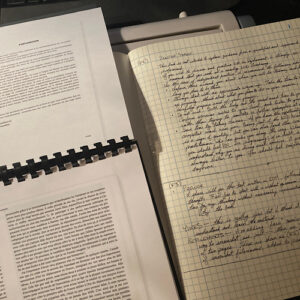
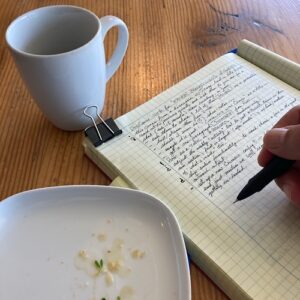
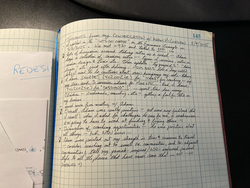
Stany Foucher recently wrote a book, Art du Déplacement: Au delà du saut. I’ve been working on translating it for my own reading. I can read the French language at an “advanced beginner” level. From the epub version of the book (which I printed so I can write on it), I’m working in a notebook… writing things out longhand is part of the learning process. I don’t simply want to read this book, but rather I want to apprehend this book.
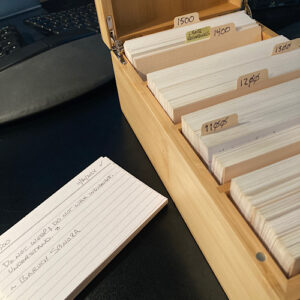
This morning I was working on adding some quotes to the ‘ol collection. I have a little box with the most-recent quotes, blank 3×5 cards and other little office-supply-ish things. Every now and then I pick up a bunch of those new quotes and move them back into these boxes. Today I realized, the second of these boxes is now nearly full—it seems like only yesterday that I moved the first few inches of cards (like ~400) into the first box. Time to order more of these storage boxes!
I’ve been thinking about ways to get participants to engage after the session. I talked to a few experienced coaches about this, and there doesn’t seem to be a way that works well. Sure, after any session a few students might ask questions. But cultivating engagement beyond that is a big question—everyone I talked to said to tell them how to do it if I figure it out.
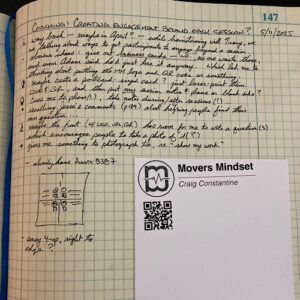
My first thought was to imagine something people could take a picture of. (Giving people things like business cards would be silly and wasteful.) Coaching in the context of Movers Mindset, I imagined a printed card with MM logo/name and QR to MM’s web site and lots of room for me to write. I imagined I could write a question on it; thinking it could be interesting enough to entice people to take a photo of it.
But further thinking led me to create this little card. It’s printed on some 4x postcard stock from Avery, where a full sheet is perforated to tear apart. In the phot you can see a little sketch showing how the printed parts are all arranged in the center of the full sheet, enabling printing very close to the final cards’ edges on the two sides that aren’t the actual printing margins.
My idea is that I’ll use these little cards for my notes as I’m preparing for a session. Then, any changes, problems, questions, etc. that come up are easily captured. This way I can close my personal loop of wanting to reflect afterwards into my more permanent notebooks.
And anyone who notices the card I’m holding, (referring to, writing on, stuffing in my pocket…) may want a photo of it. There we go! There’s no “please take a photo of this” pressure. Instead, if someone is interested, I have the perfect thing for them with some notes and details about the session and a QR to reach me. (The MM site has an email list and a contact form to reach me.)
What does it really mean to be an effective podcast host?
Good podcasts succeed by focusing on engagement, not biography.
[…] everybody loves podcasting and talks about their podcast constantly, and yet never talks about hosting— how can I be a better host?
~ Vince Quinn (2:00)
This conversation with Vince Quinn focuses on the role of hosting in podcasting, emphasizing that many podcasters neglect to develop hosting as a craft. The discussion contrasts how people obsess over gear or downloads but rarely consider how to become better hosts. A strong host is seen as fundamental to a good show—someone who prepares, guides the conversation, and stays aware of pacing, clarity, and energy. The act of listening back to one’s own show is framed as a vital method of improving, not just through passive review but through strategic reflection on structure, tone, and listener engagement.
Vince and Craig also discuss common pet peeves in podcasting, such as hosts who aren’t prepared or who rely on generic question lists. They stress that shows should begin with engaging topics, not guest biographies, and that silence and space are useful tools for dynamic audio. Another significant topic is the use of LinkedIn and other platforms not just for promotion but for building real, reciprocal connections. The conversation closes with reflections on using podcasts as core drivers of content strategy for small businesses, suggesting that most podcasters follow flawed blueprints and should instead focus on clarity of purpose and realistic goals.
How can older adults reclaim movement as a joyful, empowering part of life despite pervasive cultural narratives about aging?
Letting go of perfectionism opens the door to playfulness and self-compassion.
If I can be more compassionate toward myself, I can let go of this addiction to competence and just let myself try, and suck. So yeah, I have come to embrace the idea that if a thing is worth doing, it is worth doing badly and playfully.
~ David Wilson (48:45)
This conversation with David Wilson explores how movement intersects with aging, self-perception, and cultural narratives. David begins by addressing how deeply internalized ageist beliefs affect people’s willingness to move, take up space, and try new things. The discussion challenges the idea that aging necessitates physical decline, emphasizing instead that variety in movement and awareness of personal stories can lead to growth and transformation at any age. David also critiques societal pressures that promote fear-based motivation, and he encourages a shift toward framing movement as a present-moment gift.
The conversation moves through practical barriers and misconceptions that keep people inactive, such as rigid goals, perfectionism, and the belief that certain types of exercise are required. It emphasizes meeting oneself where one is, using personal values rather than fixed goals as guides. The importance of self-compassion, playfulness, and the willingness to “do things badly” is highlighted as a more sustainable path toward movement. There’s also a critique of mainstream fitness messaging, which often excludes older populations by failing to address their actual lived experiences.
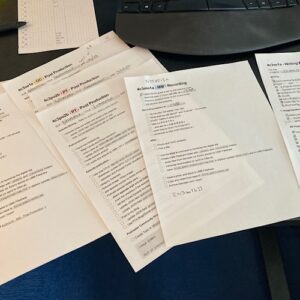
The first 90% of anything is vastly easier than the second 90%. Beginning something (an issue of 7 for Sunday, a new podcast episode for any of my 3 different shows) is so much easier if I know that all I have to do is go through these steps—look, it fits on one sheet, how hard could it be? I can totally do this…
Well, many of those tiny steps are big parts like “write the thing”. But by having all the little paper cuts listed out, I know that I won’t lose the entire kingdom for want of one horseshoe nail at the very end.
What happens when podcasters leave the safety of their studios to record in front of a live audience?
A physical space changes how podcasters, guests, and audiences engage with the medium.
You could actually just get out of your comfort zone, do this thing that you do in your house— do it live at a park and just see what happens.
~ Jeff Revilla (33:02)
This conversation with Jeff Revilla centers on the creation and impact of a physical podcasting theater, which offers independent podcasters the opportunity to record in front of live audiences. We explore how the controlled, familiar environment of home studios contrasts with the dynamic, unpredictable energy of live performance. The discussion covers how live podcasting challenges hosts to let go of production control and embrace spontaneity, leading to new experiences both for them and their listeners.
The logistics of creating the theater space are discussed in detail, including sourcing materials on a budget and designing the space to be flexible and immersive. The benefits of such live recordings are explored from multiple angles: audience feedback, performance energy, and personal growth for podcasters. The conversation also touches on the potential for this model to spread to other cities, encouraging podcasters to seek out or create similar spaces using resources like parks, coffee shops, and libraries.
I have tons of ideas. That’s the source of my greatest challenge: trying to decide what not to do. The first step is to fully think through an idea.
This one is about an idea for little bonus videos for the supporting members in the Podcaster Community. It’s been simmering in my head for a few weeks. This morning, walked in the glorious weather, to my fave little cafe. An hour of thinking to paper powered by coffee and a sandwich. :)
Now… should I do it? …or leave it in my notebook? 🤔
I always fade out from the process. I think the reason is that I’m not necessarily doing something related to podcasting every day. (Which is fine.) Without a strong habit of podcast-specific work (for example, “I do podcast stuff at 9am every day”) I don’t get in the habit of doing the extra little bit of work to capture something showing my work…
I’m convinced, my work would be better—and it would help others too—if I showed my work more. But I can’t seem to crack this nut.
Zooming out, away from podcasting . . .
I keep thinking: I don’t have a clear, single thing that is “my work” — it’s not podcasting, it’s not blog writing, it’s not community building [here], … For example: Here’s some notes I took, over the course of an hour thinking about coaching movement, based on a long conversation I had with a coach I respect. We had a coffee meeting where I wanted to pick his brain…
I post all sorts of things here, on the ‘ol blog. In recent years, my posting grew, become a weekly thing which I cleaved off to be the 7 for Sunday weekly email. Here I continue to post new quotes from my collection, copies of all the podcast episodes I do [all shows, anywhere], and a lot of “this is interesting” links that I find.
This morning, I’m thinking: My blog has long been the place where I work with the garage door up. Maybe I should lean into that?
…develop the habit of showing something (anything, from any project I’m working on) there on my blog. 🤔