I spend far too much time “working” inside the virtual world. When I get a chance (as I just did) to go do stuff entirely in the real-world, with scarcely a moment to check in online, I end up with piles of backlogged “work.” It’s at this point that I try to pare things down. I’d love to do zero computer work—but that’s not happening while my faculties hold out. Until then, I’ll continue to trim and optimize.
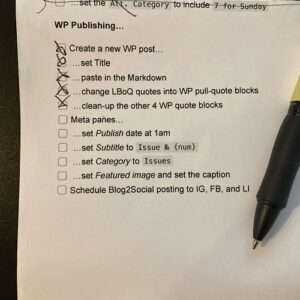
As I’m getting ready for a road trip, I’m finishing up as many things as I can. I always say I want to spend less time at my computer. That will definitely be the case for the next five days. Yes, please.
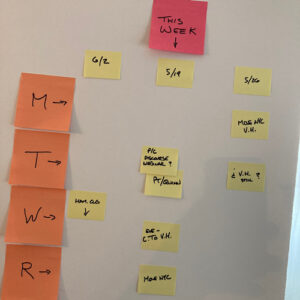
I keep a board with sticky-notes. Right at eye level, right next to my most-common workspace. What’s the simplest thing that could possibly work? In this case it’s rows for day-of-the week, and date at the top. Then I just stick notes for rocks where they need to be. (The metaphor is that of putting rocks and sand into a glass jar… put big rocks in first. Also sometimes phrased as, “Eat the toad first.”)
This really works well for me. Every time I see the board I think: Am I actually doing the right thing?
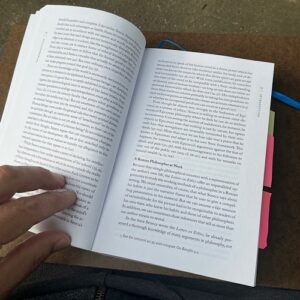
I spend a lot of time reading—frankly, as much time as I can sequester for it. I’ve read several of Seneca’s letters, randomly over the years. A while back I bought this delightful edition from Chicago Press and I’m beginning at the beginning. (There are marks in the book where I’ve already used it for referring to some of the letters.) What knowledge are you putting into your mind?
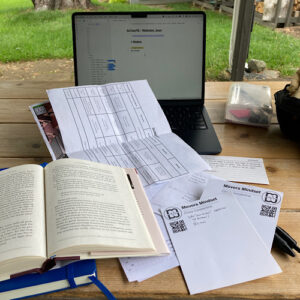
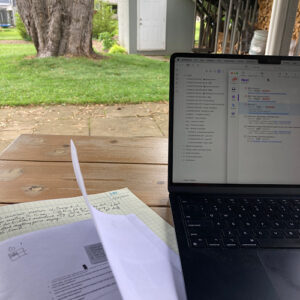
The view, when I’m doing my work is quite often a notebook and a computer. I try to make it be outside as much as I can too. Show-your-work photos are booooooring, I know. But capturing and gestating my thoughts, and then tapping on a keyboard. That’s mostly what I do.
In the most-recent Podcaster Community campfire we got to talking about what tools and services are we currently paying for as part of podcasting. So today I put up a simple post in a few places to ask just that.
It’s one thing to talk about what we prefer, it’s another for us to have voted with our dollars. Me?
Hindenburg Pro
Zencastr (for recording podcasts)
Zoom (for everything except recording podcasts)
Vimeo (for hosting streaming video for the Podcaster Community)
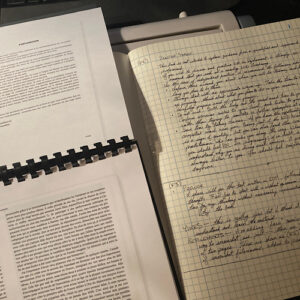
Stany Foucher recently wrote a book, Art du Déplacement: Au delà du saut. I’ve been working on translating it for my own reading. I can read the French language at an “advanced beginner” level. From the epub version of the book (which I printed so I can write on it), I’m working in a notebook… writing things out longhand is part of the learning process. I don’t simply want to read this book, but rather I want to apprehend this book.
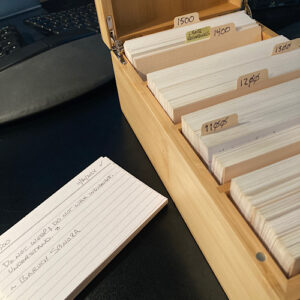
This morning I was working on adding some quotes to the ‘ol collection. I have a little box with the most-recent quotes, blank 3×5 cards and other little office-supply-ish things. Every now and then I pick up a bunch of those new quotes and move them back into these boxes. Today I realized, the second of these boxes is now nearly full—it seems like only yesterday that I moved the first few inches of cards (like ~400) into the first box. Time to order more of these storage boxes!
I’ve been thinking about ways to get participants to engage after the session. I talked to a few experienced coaches about this, and there doesn’t seem to be a way that works well. Sure, after any session a few students might ask questions. But cultivating engagement beyond that is a big question—everyone I talked to said to tell them how to do it if I figure it out.
My first thought was to imagine something people could take a picture of. (Giving people things like business cards would be silly and wasteful.) Coaching in the context of Movers Mindset, I imagined a printed card with MM logo/name and QR to MM’s web site and lots of room for me to write. I imagined I could write a question on it; thinking it could be interesting enough to entice people to take a photo of it.
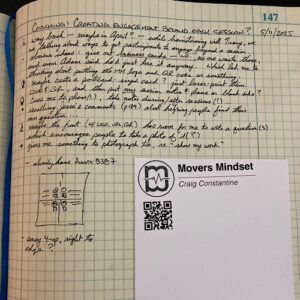
But further thinking led me to create this little card. It’s printed on some 4x postcard stock from Avery, where a full sheet is perforated to tear apart. In the phot you can see a little sketch showing how the printed parts are all arranged in the center of the full sheet, enabling printing very close to the final cards’ edges on the two sides that aren’t the actual printing margins.
My idea is that I’ll use these little cards for my notes as I’m preparing for a session. Then, any changes, problems, questions, etc. that come up are easily captured. This way I can close my personal loop of wanting to reflect afterwards into my more permanent notebooks.
And anyone who notices the card I’m holding, (referring to, writing on, stuffing in my pocket…) may want a photo of it. There we go! There’s no “please take a photo of this” pressure. Instead, if someone is interested, I have the perfect thing for them with some notes and details about the session and a QR to reach me. (The MM site has an email list and a contact form to reach me.)