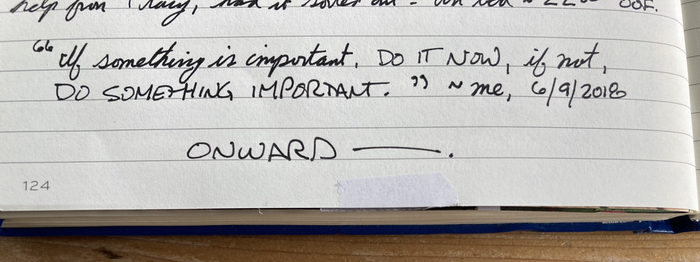
Wait wat

After ending on a startlingly inconclusive note in 1991, Twin Peaks returned in 2017 to extend the story for one more season. Yet audiences who’d hoped for a traditional ending were again denied one. Again, Lynch seemed to be imploring them to stop seeking clarity and embrace the moments whose overarching connections are far less obvious. What mattered to him, it appears, was the experience itself: the feelings they evoked, the uncanny images whose significance were difficult to parse yet impossible to forget. David Lynch didn’t want to leave his viewers with an interpretation, but with something more visceral—like the taste of cherry pie and a cup of hot coffee, black as midnight on a moonless night.

~ Emma Stefansky, from David Lynch Captured the Appeal of the Unknown

slip:4utecu2.

I watched Twin Peaks in real time on ‘ol broadcast TV. It bent my brain in the best way possible. But . . . there’s another season?! Shut up and take my money— I was reading this, thinking it was simply interesting. Until I got to this line… excuse me while I run to whatever streaming service it takes . . .

ɕ


Potent paper and pen

Paper is good. Somehow, a blank page and a pen makes the universe open up before you. Why paper has this unique power is a mystery to me, but I think we should all stop trying to resist this reality and just accept it.

~ “Dynomight,” from Paper

slip:4udypa2.

Paper is good is a colossal understatement. The magic of writing comes from being forced to slow down; One has to hold on to a single-sentence sized thought long enough to write it. You’ve never held one thought, clearly in mind, for 10 seconds… unless you were writing it down.

ɕ


Slow down

[I]t’s important to have a sense of urgency. But there’s a difference between urgency and rushing, hurrying, going quickly for the sole sake of speed. There is an old Latin expression that I think captures the balance here nicely: Festina Lente, which means, Make haste slowly. A sense of urgency…with a purpose. Energy plus moderation. Measured exertion. Eagerness, with control. It is about getting things done, properly and consistently. They like to say in the military that slow is smooth and smooth is fast.

~ Ryan Holiday, from These Are Leadership Ideas I Try To Apply Every Day

slip:4uryte5.

This is just one, from a long list of great ideas. I’ve been thinking and mentioning festina lente ever since I first learned about it.

ɕ


Consider: How do you handle the tension between quality and consistency?

We’re told to “just ship it,” but also to “make it great.” Where do you draw the line? When do you prioritize polish, and when do you hit publish?

I had to learn—the way you learn to ride a bicycle: do it over and over, the “principle” of the thing doesn’t help you do the thing—that the tension is a good sign. Now when I feel the tension between quality and consistency I know I’m in the correct place.

This morning, I’m thinking about a rowing metaphor: One oar is quality and the other is consistency. Pull evenly and the boat goes straight-ish. Also, if you try to row too hard, you get exhausted. The best way to make long-term progress is to row these two things, in balance, at a sustainable pace.

ɕ


First, balance

Well, I trust that if I’ve got a night’s sleep, if possible, and have had something to eat, and have worked on the part, I can kind of just show up. It’s of course a case-by-case basis, depending on the part and the scene. But just put some attention and some good honest effort into trying to solve the puzzles of the scene and it will work out, without overly trying to inflate my condition, my inner thinking and feeling — without overly abusing myself.

~ Jeff Goldblum, from Jeff Goldblum – The Talks

slip:4uteie50.

I do love that the first item on that list is sleep. But yes, absolutely, there’s magic in preparing, and then letting go of that preparation. In thinking: I’m prepared, smiling, and looking forward to this adventure.

ɕ


On the other hand

Along the way, over years of practice, I lost faith that awareness was always curative, that resolving childhood trauma would liberate us all, that truly feeling the feelings would allow them to dissipate, in a complex feedback loop of theory and practice.

~ Niklas Serning, from I am a better therapist since I let go of therapeutic theory

slip:4uaeea41.

I read somewhere that what likely makes any therapy work is the effort one puts into creating the relationship with the therapist. Striving to be a better person seems to lead to—wait for it—slowly becoming a better person. To that end, I recommend deploying tools like discovery and reflection to attempt to ground your self-assessment in reality, and to give yourself a force multiplier for the incremental insights.

ɕ


Difficult is not easy

When companies face real competitors, then some enshittificatory gambits are unprofitable, because they’ll drive your users to competing platforms. That’s why Zuckerberg bought Instagram: he had been turning the screws on Facebook users, and when Instagram came along, millions of those users decided that they hated Zuck more than they loved their friends and so they swallowed the switching costs and defected to Instagram. In an ill-advised middle-of-the-night memo to his CFO, Zuck defended spending $1b on Instagram on the grounds that it would recapture those Facebook escapees.

~ Cory Doctorow, from Pluralistic: Enshittification isn’t caused by venture capital (20 Jan 2025)

slip:4upuca1.

There’s a lot of value in being able to just hop onto some platform and do what you need or want to do: easily organize a group of friends, say, while not having everyone know where your baby shower will be. It turns out that building complex systems is difficult, not easy. Any time you find something is easy to do (using some piece of technology) first, marvel at that. Because doing the difficult work of building that whatever-it-is enables the other things you want to do to seem to be easy.

And the second thing should do it think about why would anyone want to do all that difficult work and perhaps you should (at least sometimes) just directly do that difficult work yourself.

ɕ


Immersive

You stand back and in a way, the reason it’s interesting is because it stands out, it doesn’t fit in, it doesn’t look like anything you’ve seen. But this is not really my position — generally. There might be moments where such a performance is necessary but we like to find a stronger relationship between the familiar and the unfamiliar. My feeling is that when a building is too self-referential, the audience is distanced; architecture becomes something that you look at. [Like in a cathedral or a monument?] Right, it’s a spectacle — whereas I think for 99% of the time, architecture is something that you should be inside and absorbed by. It’s something which convinces you by experience more than impresses you by image.

~ David Chipperfield, from David Chipperfield – The Talks

I think that tension exists in any creative endeavor. Perhaps, the existence of that tension is what defines something as being creative?

ɕ


Scheduling is the important thing

Set a recurring date on your calendar to get together. And then stick to it.

Some people might find this tactic a little soulless and formal, the same way that some couples deride the idea of scheduling sex. Yet when your life is ruled by your phone and nothing gets done unless it ends up on a to-do list, booking repeat friend dates is practical—a way to carve out real time not just for errands and work, but also for engaging with the people you love.

~ Serena Dai, from The Easiest Way to Keep Your Friends

slip:4utefa7.

I once had a long-running dinner with a few of my cousins and our spouses. We all liked to have dinner in, rather than out… but we couldn’t settle on a strict schedule. So instead, we made sure to start each gathering by having the “when do we next meet” discussion? :) Sure it took time to do that, but it has the advantage that everyone is in the room. We’d end up planning 4 or more weeks out, but it got on the calendar every time. And yes, we stopped because the last time we met up, we didn’t plan the next time.

ɕ


Not sorry

Sorry — too little time left.

~ Richard Avedon, from Creative People Say No

slip:4umeke1.

Well, there’s someone who has it figured out.

ɕ