Pain is inevitable. Suffering is optional. Say you’re running and you think, “man, this hurts, I can’t take it anymore.” The “hurt” part is an unavoidable reality, but whether or not you can stand anymore is up to the runner himself.
The same way having a diversity of traits within a population is optimal (yet uncomfortable) in nature, and having a diversity of personalities/beliefs/backgrounds is optimal (yet uncomfortable) in society, I would argue that possessing a diversity of values, perspectives, and inclinations as an individual is optimal (yet uncomfortable) for our psychology.
In certain circles there are some oft-posed rhetorical questions: What’s the work only you can do? What, if you ceased doing it, would people miss? …because there’s a lot of other stuff you could choose to do. Stuff which is easy, and which can be done by anyone. And then there’s the other stuff: The stuff that requires us to balance competing priorities, to resolve conflicting requirements, and to choose among exclusive options.
When’s the last time you made a sub-optimal decision knowing that doing so was better than doing nothing?
[F]ear is not a sign of personal weakness, but rather a natural state of discomfort that occurs whenever you’re out of your comfort zone. It’s there not to sabotage you, but to help you come alive, be more focused, and put you into the present moment and a heightened state of excitement and awareness. If you push the fear away, the only version of fear available to you will be its crazy, irrational, or contorted version. If you’re willing to feel it, and merge with it, its energy and wisdom will appear.
What strategies can help individuals manage personal challenges, including emotional and creative struggles, while maintaining growth and resilience?
A conversation navigating the complexities of identity, mental health, and artistic expression.
What I’ve realized is that, for me, I’m trying to just honestly recognize how I feel, when I feel it, and acknowledge it. [The] history of old-school Parkour, art school, and then doing stunts for film, kind of made me very good at ignoring how I feel and powering through it anyway.
~ Brian A. Prince (4:40)
The conversation examines personal challenges and strategies for resilience, emphasizing self-awareness and self-care. The discussion explores how external events, such as the pandemic and sociopolitical movements, prompted introspection and adjustments in mental health approaches. Techniques for recognizing and managing emotional states are shared, with a focus on therapy and understanding triggers.
Creativity and career balance are recurring themes, highlighting how transitioning creative pursuits into professional roles can lead to burnout. Brian reflects on finding sustainable ways to maintain artistic passion and adapting their career to preserve personal expression. Self-awareness, communication, and the need for support systems are underscored as critical to navigating these experiences.
What strategies can podcasters use to manage the complexities of content creation and sustain their passion over time?
The conversation explores how podcasters balance creative ambitions with practical constraints.
I think what would be a nice way to wrap it— would be, to create some kind of an ebook, or something like that, to condense a lot of the learnings into something.
~ James Fricker (12:24)
The conversation discusses the challenges podcasters face in managing their creative ambitions alongside time and resource constraints. Strategies for prioritizing tasks, such as focusing on specific platforms and using tools to repurpose content efficiently, are explored. The discussion also touches on how podcasters can manage information overload and set boundaries to maintain sustainability.
Career growth and the role of podcasting as a learning tool are significant themes. The potential for podcasting to foster connections within organizations is considered, with an example of private podcasts enhancing workplace culture. Inspirations like Tim Ferriss demonstrate the importance of preparation and structure in creating impactful episodes. The idea of consolidating podcast learnings into formats like ebooks is presented as a way to conclude a series thoughtfully.
The player of the inner game comes to value the art of relaxed concentration above all other skills; He discovers the true basis for self-confidence; And he learns that the secret to winning any game lies in not trying too hard.
I love the proverb: If there’s somewhere you need to be, you need to start walking. And the only place where I can start walking? …is right where I am now.
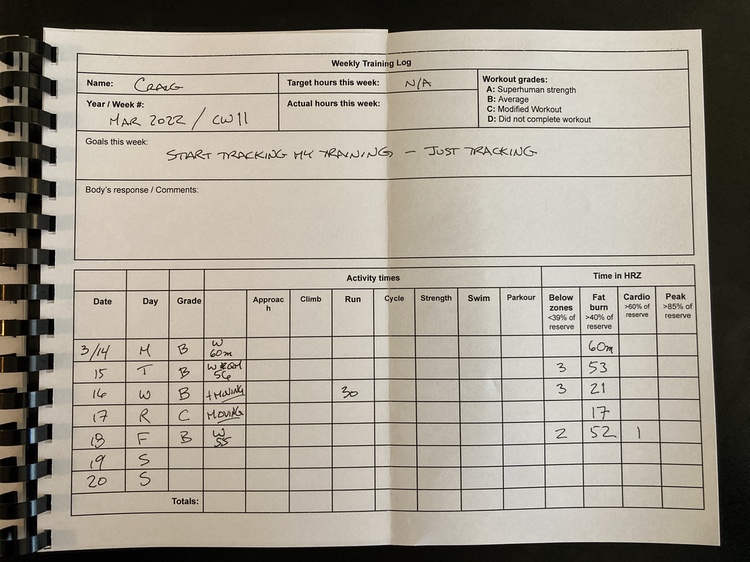
I’ve written a smattering of stuff about my training over the years. Once, in college, (age: 20) I was briefly in shape thanks to several semesters’ of effort put into Taekwondo. But in all that time since, I’ve always done well when someone else tells me what to do. “Do this today at this class. Come back for more.” I’ve also done well following the pack. There was an epoch where I was riding my mountain bike excessively, but I really got in shape when I started meeting up with others and trying to keep-in-sight people much better than me.
Last year, as the sun disappeared in a Pennsylvania grey winter, I began plotting a way to take what I had experienced when a seriously dedicated friend of mine had been planning my training, and turn it into something I could use in a self-directed fashion. I’m not a professional athlete and I don’t want to train like one. And on the other hand, simply “living my life” being active when I find those opportunities arising is not enough. I need some planning. So I’m working on that. Today, I’m just talking about the first piece of my plan: Tracking activity.
I have an older FitBit. It works fine, it’s not fancy-schmancy… but critically, I refuse to pay them monthly for extra bells-n-whistles. So this tracking sheet lets me take some notes about what I did each day, and to simply copy down the totals of time from the 4 zones that that FitBit tracks. Simply having the tracking system encourages me to be more mindful about activity—for example, it’s rather nice today, and I’ve a run in mind for later this afternoon.
The next piece of the puzzle is to begin working in activities that are more strenght-training in nature. A QM session, (there is one there on Tuesday,) some simple free-weight exercises, some bouldering, etc..
When viewed through an evolutionary or naturalistic lens, to walk, run and move barefoot is, of course, the default human condition. Any alteration of this is an alteration of not just millions of years of bipedal hominid function, but hundreds of millions of years of natural selection’s honing and refining of foot structure.
This is a stupendous deep-dive into our feet. I love the clarity of, “[a]ny alteration of this”. Am I barefoot? (At this instant, yes. With my feet on very rough, old, worn concrete, on my patio, in 50°F weather.) If I am not barefoot, I want that to always have been a conscious choice—some specific reason for why I’ve chosen to alter the function of my feet.