We live in an economic world. Economic models that were developed years ago were created based on observations of how the economy seemed to work at the time. As time goes on, it is becoming clear that early economists missed important connections. The most important of these is the role of energy and its connection to the economy. It takes energy to make anything, from a piece of steel to a loaf of bread. It takes energy to transport anything. Humans need energy in the form of food to continue to live. Clearly, energy should have a place in economic models.
I find this stuff fascinating; It’s this giant, emergent phenomenon. Billions of individual people going about their daily lives create such a whirl of activity and action. But the ultimate result is what… an “economy”? A path to “enlightenment” for humankind? Meaningless in total, but meaningful at the individual’s level of experience? Perhaps it’s simply [on the whole] incomprehensible. If you study a little chaos theory, you learn: The butterfly’s beating wings have ZERO affect on the weather. Instead, the fully understood system, (“stochastic”) is truly unpredictable.
I do NOT recommend using these plans to build a vault box. I’m putting this up for a historical record of what we did (so I don’t have to remember.) I’m already writing another article explaining a better way to build a vault box.
Really. Don’t build vault boxes using these plans.
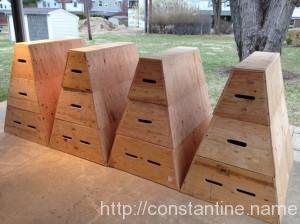
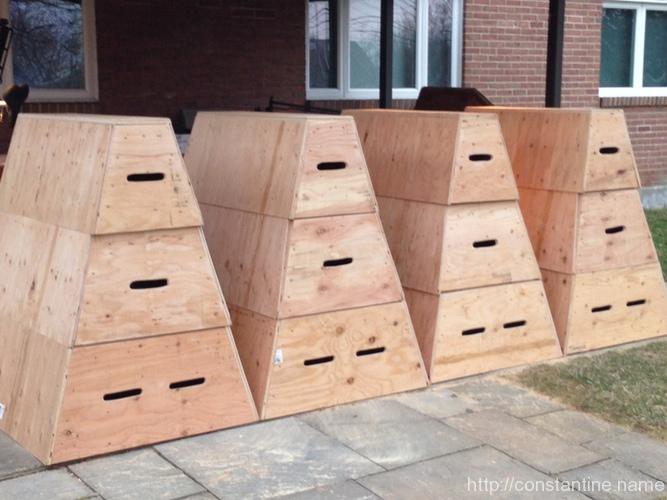
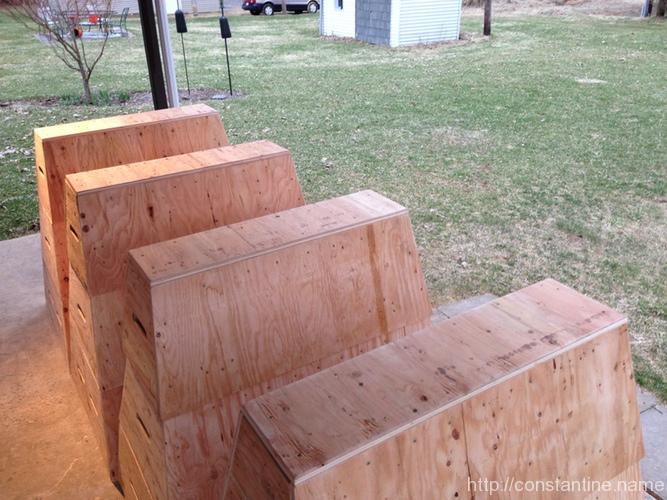
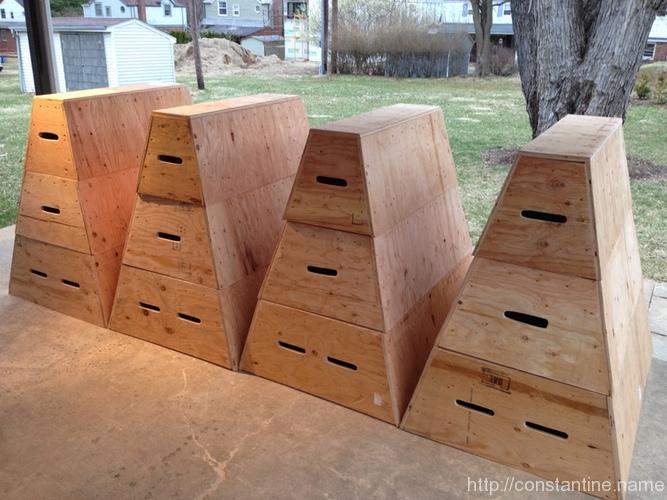
We, (Lehigh Valley Parkour) built 8 of these vault boxes. They are rock-solid, portable, stackable, etc. They’re great! …but you can do better. So I’m creating another set of plans from a slightly modified second design.
What we did that went right
The “small” top-box from eight vault boxes.
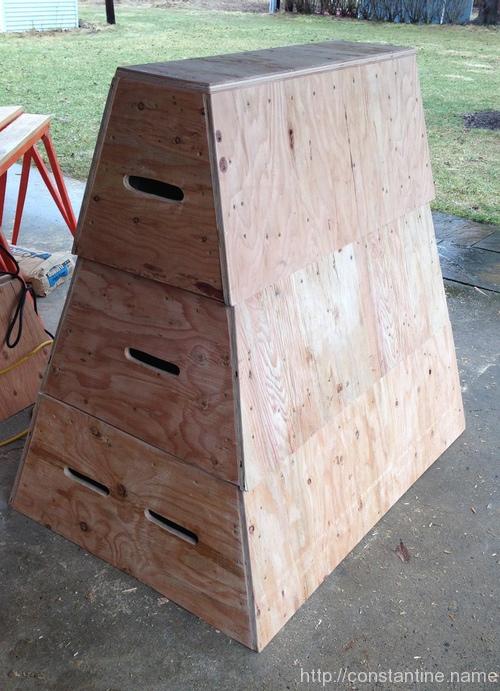
One completed box. Notice it’s not perfect. Not shown: the ratchet strap you have to put on it before trying to use it.
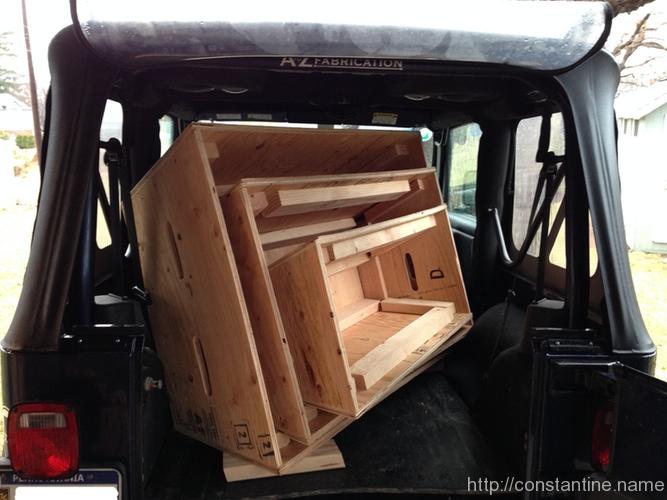
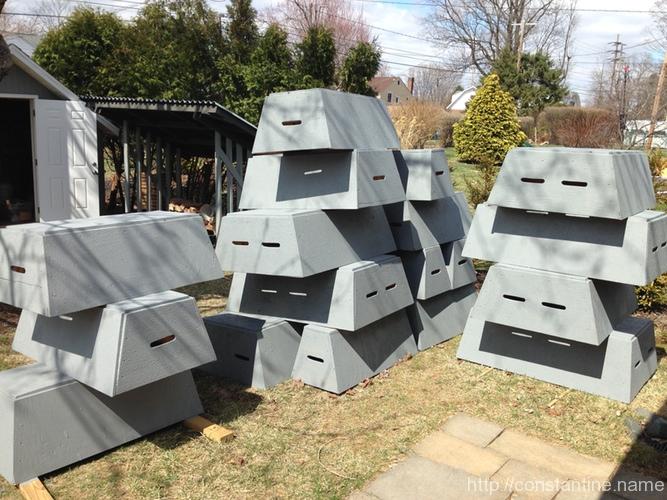
Here’s one box nest-stacked in a Jeep.
You can get the materials for less than $100 per finished box. We collected $100 from everyone, up front and bought everything together in one go.
We built 8 of these. We started by building one box from start to finish. It was the worst box, but we learned a lot. Most importantly, you need one person who understands how the whole box should go together so you can make sure it goes correctly.
We had so much material, we rented a cargo van, (it was winter and we didn’t want to deal with unexpected bad weather messing up our scheduled “buy everything” date) to haul the 1,000+ pounds of lumber and plywood to where we were going to build. We had four people on the “buying night”, and then several 6-hour DAYS of 4, 6 and even 8 (on one day) people working on building these.
We had all the right tools. This is a lot of cutting and screw driving… circular saws are dangerous, second only to chain saws. We had people with safety glasses, ear plugs, work gloves. One guy working the circular saw with two helpers moving plywood. Other people with a battery drill to drill pilot holes, another person with a corded drill driving deck screws. People with orbital sanders and files, someone drilling the large holes and cutting the hand-hold slots. It was crazy.
What goes wrong
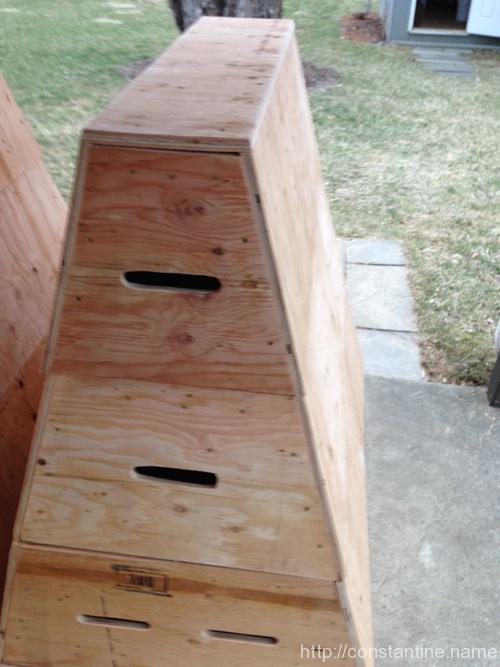
The root of the problem is that the design is sloped in both directions; There is a 15° lean from vertical on the “fronts”, (the bigger faces you’ll approach most often) and 7.5° on the “sides”, (the more narrow faces where the hand-holes for lifting are located.) This is simply too difficult to get it to work out correctly with rough lumber and basic building skills.
This box isn’t screwed together, it’s just leaning. But you can see how all the parts have to be perfect for this to work out.
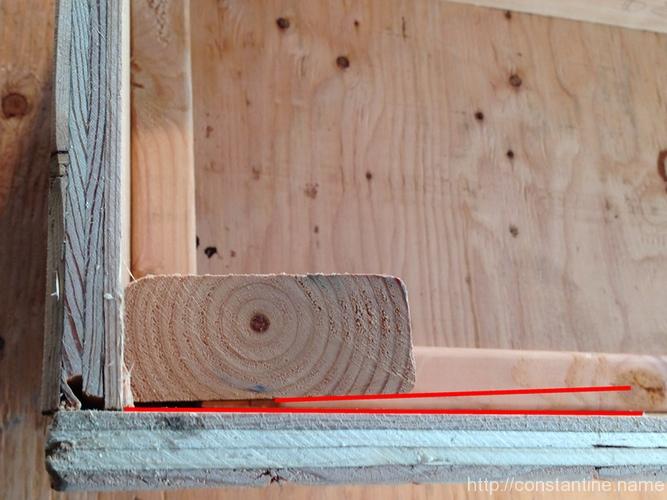
The left face of that 2×4 should be angled about 2°. Then the 2×4 would correctly sit in the corner.
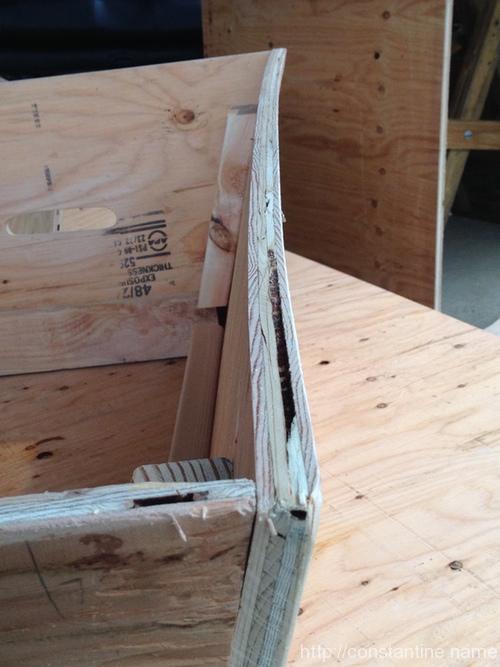
…instead, the deck screws pull the plywood in that 2°. :*(
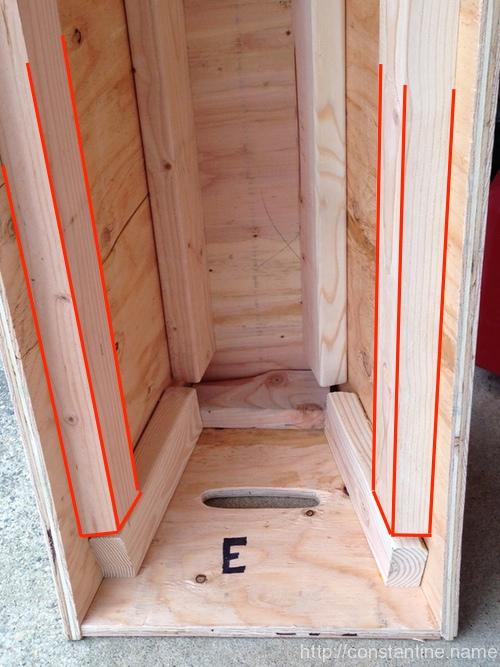
The biggest problem is that the corners are compound miters. In each corner there is a piece of 2×4. When you put a 90° angle (the corner of a 2×4) into the compound miter at the 15°/7.5° corner, you find out that you really need about a 93° corner on the 2×4. It almost works. The 2×4 goes in, but when you screw the faces together, it “pulls” the big face inward, making the plywood bow concave. That messes up the bottom of the box’s fit onto the next box below. I ended up adding some additional 2×4 strips near the bottom of the box front to straighten the faces… but it’s fiddly to get it to come out right.
These extra braces are NOT mentioned anywhere in the plans.
When I was coming up with this design, I tried combinations of different angles and eventually settled on 15°/7.5° because:
These angles make the finished boxes nest when you stack them in reverse order.
When you stack them up, you won’t knock the pile over using the box.
15° and 7.5° are reasonable bevels to cut on plywood edges with a circular saw.
You can measure convenient lengths of “2 inches” and “4 inches” and cut diagonally across the plywood strips for the box faces to get almost exactly the angles you need.
I also spent a lot of time adjusting dimensions to make the box as large as possible from only two sheets of plywood. There is very little scrap material left over.
When building, getting the box to work out right is difficult; If anything is off by even ONE-QUARTER of an inch, then the box isn’t perfect. If anything is off by HALF an inch, you may not be able to get the box together at all. Every cut on the plywood has to be perfectly straight, which means you have to use a clamped straight edge to guide the saw on every cut and you must always get the bevel correctly arranged. So sometimes you have to cut “backwards”, (the opposite way from the normal, safe way you’d cut with a circular saw.)
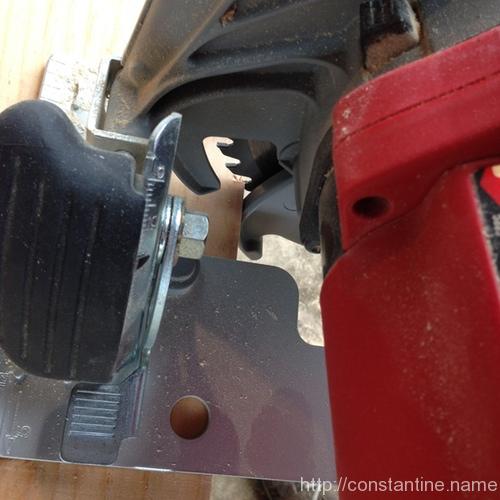
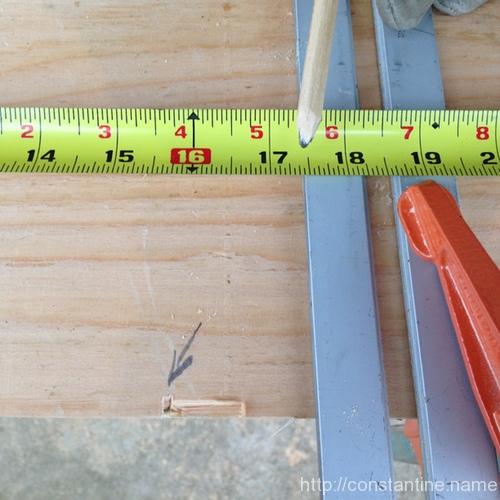
Measure (here, from the edge off the bottom of the photo) then nick the plywood, and do not move the saw.
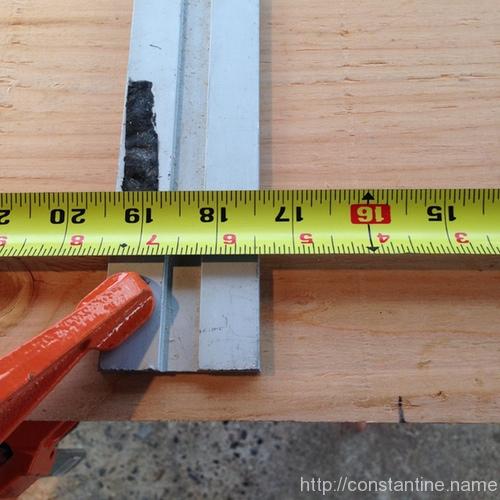
Set the straight edge against the saw’s shoe and clamp. Measure from the edge to the guide…
…set the other end of the guide. (pencil mark just shows you where the saw will really cut.)
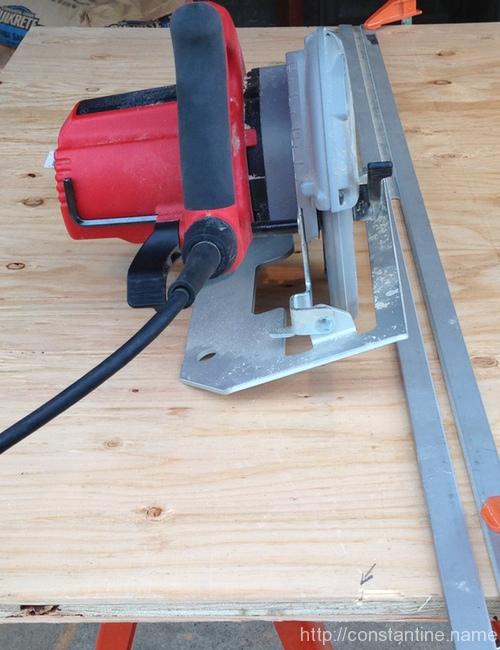
Cut along the guide. This is an example of cutting “backwards”. (Because the bevel has to be in this orientation.)
Also, near the end of the plans it describes a little about how to put the top-piece of plywood on each box. It works fine for the top/smallest box. But for the middle and bottom, the way to do it is: measure the opening of the box above, then cut the plywood sheet and screw it to the box. It might not look perfect, but if you put the plywood on so it fits nice, the box above isn’t likely to fit correctly over it.
Finally, the plans, (in the notes near the back of the PDF) show how to figure out how much paint you need to paint them. We used a grey outdoor deck/porch paint, and we mixed in fine sand to give the box some traction. If you’re making artificial obstacles, may as well make them friendly too.
Specific notes
The PDF document above has notes added in red pencil:
Pages 1 and 2:
We added hand-holes for lifting. They’re not shown on these sketches.
“Bevel” means set the bevel angle on the circular saw, i.e., make the saw blade lean. Saws only bevel in one direction, so every cut in the plans has an arrow on end showing you which way to cut; This determines the orientation of the “under bite” made by the saw. { The saw we used is “right handed”, (as are most saws) the blade tips to the right, and the blade bites under to the left. Some of the cuts are difficult because the “easy” cut direction, (with the saw on the bigger part of the piece, dropping the cutoff away to the right) would produce the wrong bevel on the work. }
For cuts number ‘2’, ‘3’ (which you do twice) and ‘4’: The arrows point the wrong way; They should point to the right on the diagram so you have 3 cuts that are easy/the-right-way, and just the last one is “in the wrong direction”, against normal saw usage.
This column shows you the materials you’re using up as you go along. It just helps you keep track of everything.
Page 2:
Don’t bother stacking. Just measure, mark and cut each (‘A’, ‘B’ and then ‘C’) strip as shown.
Yes, all the strips’ edges have a 7.5° bevel on them. Yes, it really does not matter which way you have the bevel when you cut the end-angles.
Page 3:
Cut ALL of these cuts the other way. It’s easier. Cut ‘1’ just trims the sheet to put the bevel on, cut ‘2’ (5 times) drops strips off neatly. Then you turn the piece around and cut it the “wrong way”; “wrong” in terms of how you normally rest the saw and cut “off” the smaller part.
Nothing to see here.
Page 4:
This is the view of the end of the 2×4. Just run the saw along the right edge of the 2×4 steering generally straight.
Page 5:
At least 3/4″, more is fine.
Pages 10 etc:
These are just some notes from figuring out how many boxes of screws we needed. (We didn’t put the exact number of screws in. We just went with “that’s probably enough”. And we ended up using only half the deck screws.) Also some calculations of how much paint we needed to buy.
Copyright
"Vault box design 1, sloped sides"
Copyright (C) 2014 Craig J Constantine

This information is free; you can redistribute it and/or
modify it under the terms of the GNU General Public License
as published by the Free Software Foundation; either version
2 of the License, or (at your option) any later version.

This work is distributed in the hope that it will be useful,
but WITHOUT ANY WARRANTY; without even the implied warranty
of MERCHANTABILITY or FITNESS FOR A PARTICULAR PURPOSE. See
the GNU General Public License for more details.

You should have received a copy of the GNU General Public
License along with this work; if not, write to the Free
Software Foundation, Inc., 51 Franklin Street, Fifth Floor,
Boston, MA 02110-1301, USA.
The new research, recently reported in PLOS ONE, builds on previous Oxford University research showing that elephants call ‘bee-ware’ and run away from the sound of angry bees. Whilst the ‘bee’ and ‘human’ rumbling alarm calls might sound similar to our ears there are important differences at low (infrasonic) frequencies that elephants can hear but humans can’t.
Seems pretty logical to me that elephants would have different sounds for alerting to different threats. The big question, for me, is how much of a threat do they perceive humans to be; Do they actually understand how dangerous humans are/can-be?
Update:
And someone emailed me to point out, that yes, elephants can distinguish a lot about humans; from, Elephants recognise human voices.
Consider a hypothetical scenario. Suppose you knew that although you yourself would live a long life and die peacefully in your sleep, the earth and all its inhabitants would be destroyed 30 days after your death in a collision with a giant asteroid. How would this knowledge affect you?
Over time, the ideal of craftsmanship was cordoned off to just the technical arts. Physicians and legislators no longer thought of themselves as craftsmen, but as philosophers and natural scientists who were more concerned with the theoretical as opposed to the practical. Such a shift is a shame, for the principles of craftsmanship truly do apply to every man, whether he makes furniture or crunches numbers. Below we take a look at how these overarching principles of the traditional craftsman can apply to all areas of your life, no matter your profession.
Everything is harder, or rather, I should say everything is more complex. The result is that I learn how to tolerate stress, both mental and physical, and how to adapt to make something work despite the fact that the environment is not cooperating. I deal with it or fail. When I’m out there, it doesn’t matter that I can deadlift 3x my bodyweight on a bar, because that doesn’t change the fact that a rock is completely off-balance and seems to be actively trying to roll onto my toes. And that doesn’t change the fact that I’m picking it up and carrying it up the mountain anyway.
Relaxation alone—even a specialized form of it—is not aikidō, however. If this internal power is a foundational skill—one largely abandoned today—the techniques of aikidō are its delivery system. Even with remarkable power, without a delivery system, one is no more able to fight than a power lifter is able to win in a boxing ring, just because he can bench press six hundred pounds.
Clearly, there is a moral principle at work in the actions of the leakers, whistle-blowers and hacktivists and those who support them. I would also argue that that moral principle has been clearly articulated, and it may just save us from a dystopian future.
…and I would argue that four, (number of examples he presents) is not a number which can be reasonably extrapolated to describe “the millennial generation.” The millenials I know are currently the “me” generation. Currently, meaning that for NOW, they’re focused on themselves. They are not going to buy into the national health care rigamarole, they are not going to buy life insurance, they are not going to carefully lay out their course with a moral compass.
Just like me, (and the members of my generation) when we were the age the millenials are currently. Also see: Generations.
Strauss and Howe argue that the last five centuries of Anglo-American history can be explained by the existence of four generational archetypes that repeat sequentially in a fixed pattern every 80-100 years, the length of a long human life, or what the ancients called a “saeculum.” These generational archetypes are: Prophet, Nomad, Hero, and Artist. Each generation consists of those born during a roughly 20 year period. As each generation moves up the ladder of age and takes a different place in society, the mood of the culture greatly changes.
The thing is, the DNA of dogs and wolves are over 99 percent similar. … So while they do have physical differences, …what’s there to stop a dog from attacking the same herd it is supposed to guard? It’s breeding and training. In the human counterpart, it’s attitude, ethos and goals. Predators and protectors are totally different kinds of people, although they share many different traits. The sharing of traits, however, is the danger zone for protectors.
Or, as one friend in self-defense training joked about it to me, “The closest thing to criminals are cops. Both like to drive around in cars all day scoping out the joints, both carry guns, boss people around, and drink a lot of coffee.”
It’s definitely worth thinking through the “sharing of traits” being discussed. That whole attitude/goals thing is critical for you to turn out a decent human being after a few years of your martial arts training. If you haven’t thought about your attitude/goals, you are on the good-intentions-paved road to Bad Times. If you haven’t made conscious choices about what you want to internalize, you are careening along without intentionally steering.