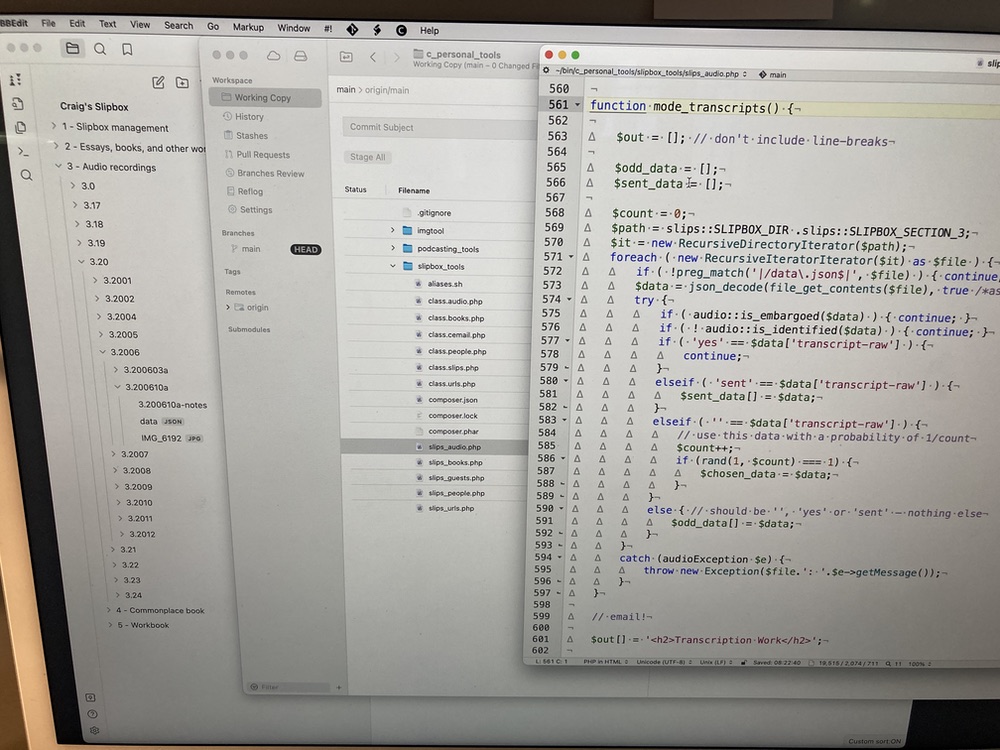
Currently in my personal knowledge system I have notes on ~400 audio recordings. (Raw recordings I’ve done, podcasts of my own I’ve published, other shows I’ve been on, etc.) That can be my episode notes and writing, but also program-readable meta information. Today, I spent time writing some new tooling to help me sort out transcripts (which recordings have them, which have been sent out, etc.)
Building tools →
Noses →
Have you ever tried to read Gray’s Anatomy? I tried to read a modern printing of a 1901 edition that was given to me. It’s 1,200+ pages in a perfect-bound book! That might have been 30 years ago and I’m not sure if anything from that adventure stuck… and yet, I bet a huge amount of knowledge has stuck. I recall it was an endless succession of interesting rabbit holes.
Nasal congestion, I’ve learned in all this, is far weirder than I ever thought. For starters, the nose is actually two noses, which work in an alternating cycle that is somehow connected to our armpits.
~ Sarah Zhang from, Everything I Thought I Knew About Nasal Congestion Is Wrong
slip:4utehe2.
I’m struggling to resist the urge to see what Gray’s has to say about the nose. I do know that even the most fleeting search of the ‘ol Internet turns up a huge amount of material around this topic. I will also say that I’ve long known that lying on one’s side tends to open the opposing nostril’s nasal whatsit-stuff. Which I know only because I have a long history of sinus and allergy problems and have necessarily tried to sleep with a plugged schnozz, leading to creativity and experimentation.
ɕ
Hand rolled →
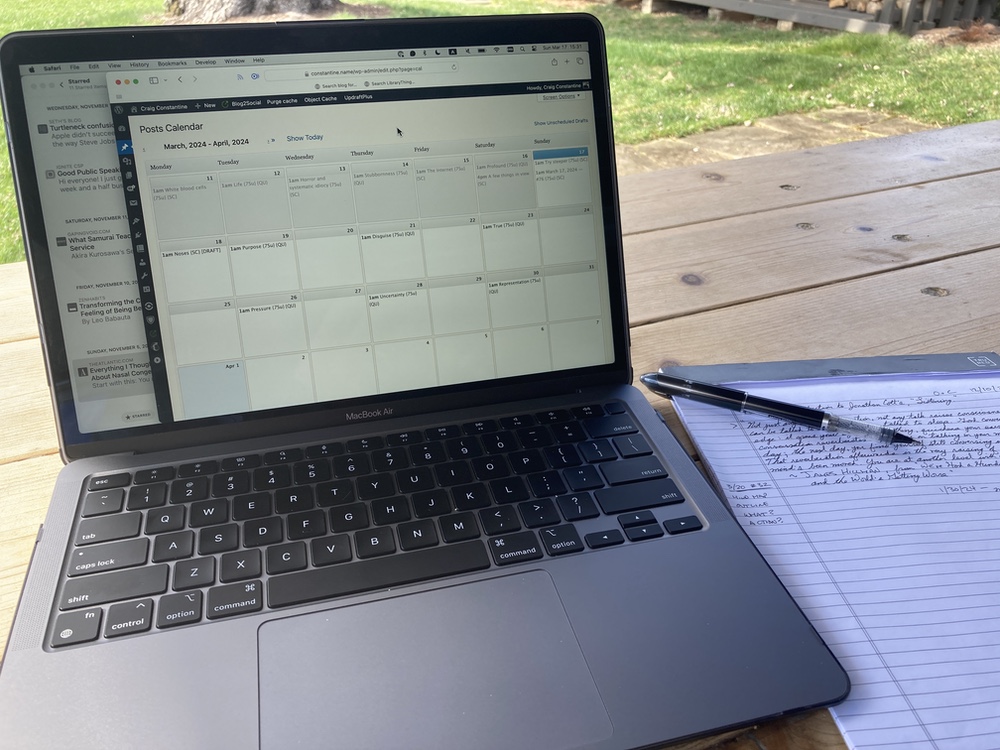
I describe my weekly email, 7 for Sunday, as “Hand-rolled and algorithm-free.” I’m using some custom code in WordPress to assemble separate posts into a single “thing” which then goes out via email. It’s definitely a lot of “hand-rolling”. A lot of hand writing my notes and mind-maps for each post, typing the posts, the quotes, ordering and organizing everything, handling links and images and… zoinks, it’s a lot. I love it.
March 17, 2024 — #76 →
Reading time: About 6 minutes, 1200 words
Get 7 for Sunday in your inbox. → Subscribe here.
This issue is https://7forsunday.com/76
Try steeper →
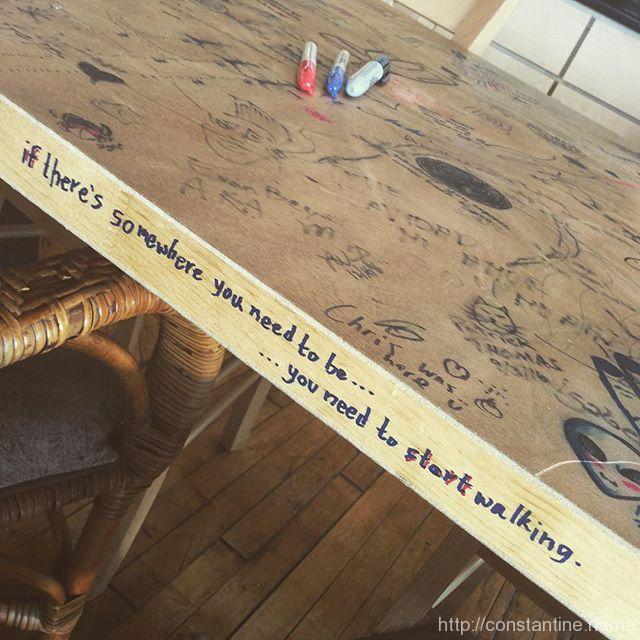
“The obstacle is the way” is not a phrase from Art du Déplacement. It’s a two-thousand-year-old comment from a Stoic (writing in a personal journal to himself.) In a similar vein, he also wrote that, “nature turns all things to its own purpose.” Likewise the more modern “Rust never sleeps,” is equally pithy.
The real lesson is of course that there’s a season for everything. Sometimes more challenge is the key to progress, and sometimes simply being is the key. (Which is also something thoroughly covered in the Stoic philosophy. And please: Stoicism is not at all about suppressing one’s feelings.) I think I learned that seasons lesson early on from bicycling. I’m from Pennsylvania, from an area of rolling, often wooded, hills. Every bike ride ever was an endless repetition of “down a hill, ’round a corner, up a hill, round a corner, down a hill, …” In a very real sense, all parts of that were equally fun.
In a comfortable, prosperous country like ours, some of the built in tendencies of Human nature tend to work against us, saying, “Hey – I’ve noticed we have plenty of food and reasonable shelter and that’s good enough. So let’s just double down on the Netflix, comfort foods, and occasional luxury purchases and that will keep us safe.” Instead, I want you to set your life treadmill to just a bit of a steeper, healthier incline setting.
~ Peter Adeney from, The Arizona Experiment!
slip:4umomo1.
I’d like to mention that “Culdesac” in that linked URL is a town’s name; You can go read that article either for the life advice, or to learn about one of several towns in the U.S. now which are being built as people-first. (As opposed to basically every other town and city which is built as cars-first.)
ɕ
A few things in view →
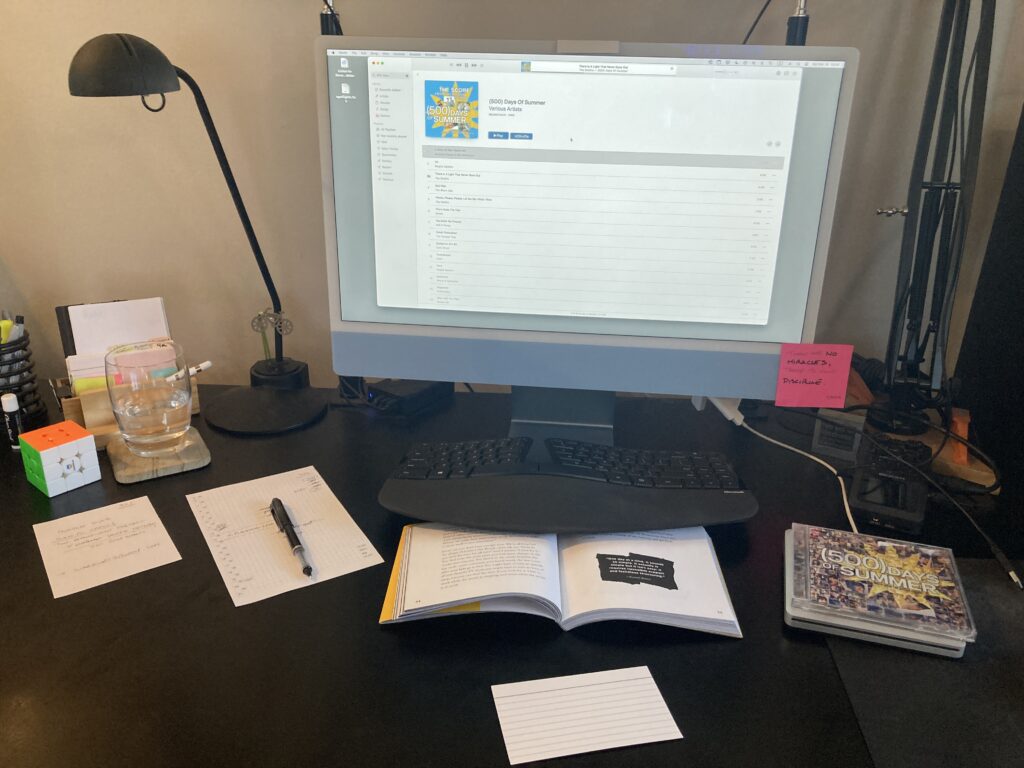
Taking a fresh look at Austin Kleon’s Show Your Work. Book is smashed open to a quote from Russell Brand—with a notecard where I’m about to add this quote to my collection. I’m a bit of an audio nerd—I don’t stream from services, rather stream from the countless CDs that I keep in the ‘ol digital library. I like to start from a movie soundtrack, and then spread out into all the artists. Rubik’s cube, glass of water. Pink postit reminds me: “There are no miracles, there is only discipline“
Profound →
The opposite of a true statement is a false statement. But the opposite of a profound truth may be another profound truth.
~ Niels Bohr
slip:4a1386.
The Internet →
When I started really fiddling with the Internet in 1989 it was a twisting mazy of branching passages. It was entirely technical details and arcane (not to be confused with difficult to master) knowledge. It was fun and rewarding to figure things out—all I had to do was simply read and experiment. It was also very much social! There were people, both in-person and remote (as in, I don’t think I’ve ever met them in person), who I got to know through working on things and exploring and building. But at no point did I ever even wonder if what I was doing and building was going to change society. “This is interesting” and “I wonder if…” were my guiding philosophy.
Such prophesies might be dismissed as the prattle of overindulged rich guys, but for one thing: they’ve shaped public opinion. By spreading a utopian view of technology, a view that defines progress as essentially technological, they’ve encouraged people to switch off their critical faculties and give Silicon Valley entrepreneurs and financiers free rein in remaking culture to fit their commercial interests. If, after all, the technologists are creating a world of superabundance, a world without work or want, their interests must be indistinguishable from society’s. To stand in their way, or even to question their motives and tactics, would be self-defeating. It would serve only to delay the wonderful inevitable.
~ Nicholas Carr from, The world wide cage
slip:4uaeea9.
But an equally great quote is: “Technology promised to set us free. Instead it has trained us to withdraw from the world into distraction and dependency.”
Anyway. Looking back, I don’t see how I could actually have done anything differently. Looking back, I can clearly see how we—the world, society at large—got where we are.
ɕ
Stubbornness →
To someone who asked Newton how he had managed to construct his theory, he could reply: ‘By thinking about it all the time.’ There is no greatness without a little stubbornness.
~ Albert Camus
slip:4a1385.
Horror and systematic idiocy →
Have you ever looked at your own writing and wondered: What author’s work might it resemble? And if you haven’t, I hope I didn’t just break writing for you.
All I can remember of these once indispensable arts is the intense boredom by which the practice of them was accompanied. Even today the sight of Dr. Smith’s Shorter Latin Dictionary, or of Liddell’s and Scott’s Greek Lexicon, has power to recall that ancient ennui. What dreary hours I have spent frantically turning those pages in search of a word for “cow” that could be scanned as a dactyl, or to make sure that my memory of the irregular verbs and the Greek accents was not at fault! I hate to think of all that wasted time. And yet, in view of the fact that most human beings are destined to pass most of their lives at jobs in which it is impossible for them to take the slightest interest, this old-fashioned training with the dictionary may have been extremely salutary. At least it taught one to know and expect the worst of life. Whereas the pupil in a progressive school, where everything is made to seem entertaining and significant, lives in a fool’s paradise. As a preparation for life, not as it ought to be, but as it actually is, the horrors of Greek grammar and the systematic idiocy of Latin verses were perfectly appropriate. On the other hand, it must be admitted that they tended to leave their victims with a quite irrational distaste for poor dear Dr. Smith.
~ Aldous Huxley from his essay, Doodles in a Dictionary from, Tomorrow and Tomorrow and Tomorrow and Other Essays
Lest you think that’s an overly long quote, I’ll point out it’s still only about half of the paragraph. Huxley can really unspool a sentence. Some of the writing in that book—Huxley’s, omg no not Smith’s dictionary—are overwrought. But some of them have a delicious tinkling of structure and grammar with an occasional punctuation of solid snark.
ɕ