It’s also about what’s missing

The richness and meaning arises in part from choosing it at the expense of all other places you could be and things you could be doing. Accepting a place’s shortcomings, the things it lacks, and its imperfections is essential to appreciating everything it does have to offer.

Rosie Spinks, from Does where you live matter?

Striving is—in my opinion of course—my biggest flaw. I’ve never had the striving for place, the urge to move to a new location.

I’ve long enjoyed travel. I enjoy the anticipation, and the looking back (via my journals and selected photography), as much as the in-the-moment experience. Certainly, I spend more actual time in anticipation and in review, than I ever do actually during any trip. So here too, not striving.

Elsewhere? Oh, striving very much.

ɕ


Stop and really look

Stop and really look

On a recent trip I found myself with some spare time one morning. I used it to slowly wander through the little hotel’s sitting area. There I found a collection of board games and a couple dozen coffee-table books scattered about. I took the time to thumb through each of them for just a few moments.

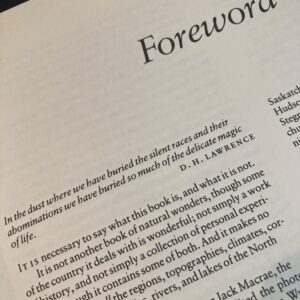
This book still held my interest after a few moments and so I applied my page 88 test. When I realized that page 88 was somewhere within a long series of color plates—all of which were interesting to me—I flipped to the Foreword. And then I took a photo of the cover so that I could later snag a copy.

Today, here I am with a copy of the book (bought for $4.95 from AbeBooks). Beyond all of the above and the contents of the book itself, the book is now also imbued with the ambiance of that little hotel and cues up all the memories of that little trip.

ɕ


Shifting perspective

No one doubts human beings are special—indeed unique. After all, people are (to our knowledge) the only ones pondering evolution, not to mention creating symphonies and skyscrapers. Still, that is not saying much: All species are unique, or else they would not be distinct species in their own right. Each species can do things humans only dream of, whether flying or diving deep under the sea.

~ Alexander Werth from, The Problems of Evolution as a “March of Progress”

slip:4usabi2.

Anthropocentrism is one perspective. There are many others worth considering too because the more one learns, the better one is able to make moral choices.

ɕ


What nature requires

What nature requires is close by and easy to obtain. All that sweat is for superfluities. We wear out our fine clothes, grow old in army tents, hurl ourselves against foreign shores, and for what? Everything we need is already at hand. Anyone who is on good terms with poverty is rich.

~ Seneca, letter 4:10-11

slip:4a1559.


It matters that you notice

Whether you’re a binge-watcher or a doomscroller or some other type of time-bider, the following is probably true for most people reading this: There are things you want to do with your life that you’re not doing. You know these things are worthwhile. You know these things are possible.

~ David Cain, from How to Start Doing the Things You Daydream About

slip:4uraho22.

Cain draws our attention (often in his writing) to the noticing part. That is the really difficult part. If you’re not noticing that there’s a tension in your life, then you’ll surely never change.

Beyond noticing comes relaxing into the feeling. Then deciding whether the tension and the feeling represent something to allow to bloom. And deciding what to let go of to make room for that new growth.

ɕ


Reality

In this modern age, very little remains that is real. Night has been banished, so have the cold, the wind and the stars. They have all been neutralized: The rhythm of life itself is obscured. Everything goes so fast and makes so much noise, and men hurry by without heeding the grass by the roadside, its colour, its smell and the way it shimmers when the wind caresses it. What a strange encounter then is that between man and the high places of his planet!

~ Gaston Rébuffat

slip:4a1550.


Acceptance

My happiness grows in direct proportion to my acceptance, and in inverse proportion to my expectations.

~ Michael J. Fox

slip:4a1519.


Perspective

Maybe it’s the nature of the binary times that we’re in that makes it very, very difficult to applaud one thing without condemning another. I think we’re afraid to take a victory lap, and maybe we should be. Maybe that’s just a bit premature or arrogant.

~ Nick Gillespie, from Mike Rowe on Patriotism, Paul Harvey, and American Progress

slip:4uremi1.

The same question (can we applaud one thing without condeming other things?) arises with eulogies. I say we can. The key is to know and understand the broader context that we’re—just for a little while—ignoring.

ɕ


The definition of done

What you realise, the moment you ask “what would it mean to be done for the day?”, is that the answer can’t possibly involve doing all the things that need doing – even though that’s the subconscious goal with which many of us approach life, driving ourselves crazy in the process. If there are a thousand things that need doing, you’re going to need to arrive at some definition of “finished” that doesn’t encompass them all.

~ Oliver Burkeman, from What would it mean to be done for the day?

slip:4ucabu1.

And defining “done” for the day is just the first step. How can I be done at the end of this week? …month? I need to keep pulling back to larger timeframes to imagine: How do I ever stop having a, “the next thing I should do is…”?

ɕ


First priority

Make your own recovery the first priority in your life.

~ Robin Norwood

slip:4a1508.