Law of sacrifice

Society today tries to deny the law of sacrifice at every turn, promising people that they can fulfill their desires without having to forsake anything at all. “Lose weight without giving up your favorite foods!” “Get ripped without long workouts!” “Get rich without having to work hard!” The denial of the law of sacrifice is at the heart of things like our soaring credit card debt (US citizens currently hold $886 billion of it), not to mention our national debt. The fantasy that you can have whatever you’d like without ever paying for it is an incredibly seductive fantasy.

But it is only a fantasy. There is always a price to pay.

~ Brett McKay from, The Law of Sacrifice

slip:4uaote3.

“What does it cost?”

Over the years, I have talked to hundreds of prospective students who have walked into the dojo and asked about Aikido. One quickly learns that anyone who walks in, has some level of interest. So these are not cold sales calls where you need fast paced, hard hitting, sales tactics. People simply have some specific questions that need answering before the conversation continues to more general topics.

Some people are concerned about the monetary cost. That is important, and money should be discussed. But they should be much more concerned about the time cost of the commitment.

My explanation usually goes like this…

The cost of committing

One class per week is not often enough, and few people can withstand training more than three. So let’s say you’d like to come to class twice per week.

How much time is that? For each class you need at least one hour of padding — pack your bag, drive to the dojo, change before/after class, drive home, unpack, etc. Then the actual class time is about 2 hours per class. So three hours per class, twice per week: We’re talking about, six hours every week.

Now think about your life, and tell me about the six hours every week when you are alone, doing absolutely nothing.

So the real question is: What are you willing to give up from your current life to create those six free hours?

There’s no going back

Once you realize that your time is the limiting resource in your life, you’ll look at everything differently.

How much time do you spend watching TV? Is that time entertainment, family bonding, or what? Do you value anything more than entertainment?

How much time do you spend commuting to work? You clearly value something more than your time. (2 hours a day? 14 hours a week? . . .) What is it that you value so highly you’re willing to commute? …is it your children’s school district? …the size of your paycheck? …your career path?

Do you mow your own lawn? Do you pay someone to mow your lawn? Might you spend time mowing your lawn if it was mentally relaxing? …or if you push-mowed (sans motor) your lawn, and it was a means of exercise?

Do you get enough sleep at night? If not, why not? …are you spending time in the evening/night doing — what? Why do you value that activity more than sleep?

ɕ


The Cat’s Out of the Bag

This entry is part 2 of 72 in the series My Journey

If you want to repeat that little jump at an angle to a moss covered wall all day until you can do it with your eyes closed… well my friend, you are not alone. I want to repeat that jump with you. But let’s do 50, just to be sure. And one more for the others who can’t join us. That’ll do us both more good than that big roof gap whilst you hold the camera.

~ Chris ‘Blane’ Rowat from, «http://www.parkourgenerations.com/article/call-arms»

By now, all of my friends know I practice parkour with Lehigh Valley Parkour. I’m pushing 42, with graying hair and the BMI calculator says 34.9, (which is “obesity.”) So when people first find out, they raise an eyebrow and say, “You’re a brave soul!” or “Huh? The jumping from roof-top to roof-top thing?!”. …my answer is ‘no’ to both of those.

Please do not go to TouYube and look up parkour; Total waste of your time. This is one of those Catch-22 things where the people who believe — quietly, to themselves — that they “get it”… well, those people aren’t posting spectacular videos on TouYube. So you don’t notice their point of view on the whole thing.

I am not saying, “those people over there have it wrong.” I am not saying, “parkour is the One True Path(tm)”. I am not saying, “these ideas are to be found only through parkour.”

I am saying parkour is…

…a journey composed of tiny steps so easy that failure is impossible.

…the grueling, deconstructing, work of self-improvement.

…that well-earned sense of accomplishment.

…the joie-de-vivre that I hadn’t noticed I let slip away.

Playfulness.

Freedom.

…and one more for the others who can’t join us. :*)

ɕ


Splitting Firewood

red oak round

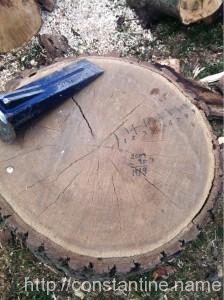
Red Oak round. Part of a standing-dead tree felled by my father in 2009.

It’s a beautiful Spring day — perhaps a little too breezy for the 50-something temperature — in the cute little neighborhood where we live. Laid out in the ’50s, our lots are about 60 feet wide and organized into neat rows of little 2- and 3-bedroom homes. From the back patio, I can see directly into the yards of at least a dozen of my neighbors.

We have a wood stove. It’s a magnificently efficient, modern marvel that fills our living room with the distinct glow and flicker of a one hundred thousand year-old technology. The little stove remains cold on the back, gets inconceivably hot on the front, and can heat the entire 1,400 square feet of our little ranch in the dead of winter. It does all that while consuming one big-ass piece of firewood every 90 minutes or so.

In other words, I’m polluting the world. I’m also releasing carbon-dioxide and a host of other truly hazardous chemicals into the neighborhood. (For example, read this revelation of horrors.) In my defense, this is Pennsylvania, the slopes of a wooded mountain start a block from our house, and every house in our neighborhood heats with oil or wood because natural gas is not available.

I digress.

I grew up in a house on a wooded lot, where loss of electric power was not uncommon in the winter. Every Spring, my father, (and later, my father and I,) set about laying up firewood. When he was younger and I was indefatigable, we would cut our own trees, or cut and remove trees for neighbors. The cut rounds would then be laboriously split by hand with wedges and sledge, (no fancy-schmancy log splitters for my dad,) over the course of weeks and months until we had a season’s worth of firewood. Each year we’d burn the wood we’d layed-up two Springs back.

I possess a swirled mass of happy memories related to a deafening chain saw — a kick-ass early ’70s “Mac10” (yes I still have it, no it’s not for sale) — huge bow saws, splittin’ wedges, mauls, worn work gloves, wood chips in all your clothing and socks. I distinctly remember being deemed too young to be allowed to swing the sledge, and being relegated to wedge-starting duty working with a four pound maul. I also distinctly remember my dad wincing as I quickly wrecked the hickory handle of his sledge hammer once I was deemed old enough.

Split your own firewood; It will warm you twice.

They’ve stopped already??

See, I started writing this piece because “the young kids” two yards over were splitting firewood, and I just noticed they have already stopped some time ago. ha! Kids these days.

We’ve a section of shadow box fencing on the side of our yard, so I could only see them in glimpses through the slits. But I could hear the whootin’ and a-hollerin’, and the not-as-rhythmic-as-it-should-be banging and whacking, and also the missin’ and cussin’ and the sound of a sledge handle hitting things.

I could see they were swinging the sledge the way one would swing a tennis racket for an overhand serve. They were hurrying the swings, instead of making each strike count. They were excited when the wood split, rather than being excited by the process of producing firewood with their own hands.

You see, to split with a sledge, you draw the handle back by sliding it through your top hand until your hand nears the head of the sledge. Then you send the head straight up, pushing with your lower hand that is at the end of the handle and sliding your top hand down to meet your bottom hand. As your hands meet, the head of the sledge is up in the clouds. Then — all together — bend your knees slightly, lower your whole body, pull down your arms, and bring everything to focus on the top of that wedge. If you’ve done it correctly, the sledge strikes with a solid BAM! and stays on the wedge with a succinct “da-tink”-sounding hop. When a log splits clean, the wedge sings out, “PLING!”

Last spring I split firewood for hours on end. Carefully. Methodically. For the long haul. While thinking of my father.

BAM-da-tink. BAM-da-tink. PLING!

Splitting firewood as a metaphor for life

Choose the right work.

It’s not enough to choose to do the splitting. You have to split the right wood, at the right time of year. You need a place to do the splitting. You need a place to stack the wood so your labors are ultimately useful. You also need family or friends with which to share the warm glow of the fire as the fruits of your labor.

Use the right tools.

A mechanized log splitter is fine for commercial firewood sellers. But humans splitting their own firewood use hand tools. You need the correct tools; No more, no less. Your pride in your work shall show in the maintenance of your tools.

Strike decisively.

Aim. Strike. Strike correctly. Strike hard enough, but no harder. Strike so that you can strike again and again and again, until your work is well and truly done.

See, this here our fathers wrought for us.

ɕ


Our profession has a long way to go

old_timey_sysadmins

Here is the 2013 Super Bowl Dodge Commercial, “God Made a Farmer.”

https://youtube.com/watch?v=GdR5TOhHJGM

Here is the recent spoof, “God Made a Sysadmin.”

There are important differences.

Obviously the ‘farmer’ video is a commercial. It intends to stir up empathy and appreciation for hard work, solid work ethics, traditional American values, (and perhaps some spirit of ‘rally around the under-dog,’) and then the corporation hopes everyone will associate those positive characteristics with their product. (This is also known as, ‘Intro to Marketing.’)

The ‘sysadmin’ video is a spoof. It engenders a healthy dose of pride, enables those who work in the profession to smile at the references, and to have a bit of winsome fun.

There are also important similarities.

Both professions entail difficult work, (the type of difficulty is of course different,) and have clear work ethics. Without the farmers, or without the sysadmins, life as everyone knows it would end rather quickly.

But, here’s the rub:

The average person will understand all of the things which the farmers are said to do, but will understand almost none of those things which the sysadmins are said to do.

Sysadmins like to think, and I’ve said this myself, that they are part of a profession with a “long” history. In reality, computers and the profession are in their infancy. We have just 70-ish years of history if we measure from Alan Turing’s ideas, and we have just three different generations of people who have worked in our profession.

If we want to be treated as professionals, if we want to be individually granted a measure of respect based on our chosen profession the way farmers, doctors, and (some) lawyers are, then we must continue to work hard as we have done for 70-ish years.

We also need to work hard to raise awareness of our profession. We need to work together more, as a community of people, rather than an archipelago of individuals. We need to take better care of ourselves; We must not sacrifice our own physical and mental health at the alter of short-term advancement. We need to work to solve the larger problems — the ones which aren’t even system administration problems, but which are organizational, societal and philosophical problems — which put many of our fellows into untenable situations.

Our profession has a long way to go.

ɕ


No this. No that. No delay.

“As a 6th kyu, I have spent very little time, and have very little skill at sensing the timing of a coming attack. Though my teacher has worked on this with us, I find I am slow at learning to ‘read’ my attacker, and rely on knowing what is coming and the very slow attacks of training. Have you any specific techniques for this?”

~ name withheld

I do have specific things you can practice. But first, I’m going to wander very far afield…

An aside for those not well-versed on Aikido: ‘6th kyu’ is the first rank one reaches in Aikido. “A minimum of 40 hours” of practice time is commonly seen as a baseline requirement in the various styles of Aikido. A 6th kyu student is definitely a beginner, but also definitely someone dedicated enough to have stuck with their training through their first real test.

Martial arts are mentally and physically difficult. Everyone is their own worst critic. When students express frustration with something, (a technique, a principle, etc) I often say, “that is why it is called ‘practice’.” My best advice is to simply practice. I assert that such advice is not trite!

“If you want to go east, go east. If you want to go west, go west.”

This is a handed-down quote which Sensei Wirth attributes to Sensei Koichi Tohei. It is clearly echoed in one of Sensei Wirth’s phrases, immortalized on some of our t-shirts years ago: “No this. No that. No delay.” So whatever is being practiced, do that thing, the whole thing, and nothing but the thing. Do not entertain some mental storyline about how, “this is a great opportunity to work on sensing,” nor “this is particularly hard so I need to pay special attention here.”

Simply practice

Physically, do only what must be done. Do not flail, twitch, wind-up in preparation, shuffle before starting, speak, nor any other of countless things. Practice being physically calm; Act calm until you are calm. Simply move. Move simply. Go east. Go west. Practice this physical aspect always and everywhere.

Mentally do only what must be done. Don’t have a running mental commentary. Do not think, “I did that one wrong”, “I did that one better”, “that one was horrible”, “my partner does this so much better than I”, nor any other of countless thoughts. Observe your thoughts, but do not add one iota of energy to them. Thinking, “I am thinking useless thoughts”, is a useless thought! If you were handed a large bucket of sloshing and disturbed water and told to calm the water, you should simply set the bucket down and wait for the water to calm. You would definitely NOT shake the bucket in an attempt to convince the water to calm down. You cannot think your way to sensing an attack; You can only NOT think, whereupon you will discover your senses work rather well.

Further reading

Here are several other sources of information which I think are apropos…

O’Sensei mentions a ‘mountain echo’ in at least one place. The best source I see is AikiNews (AN), later known as Aikido Journal. Refer to issue 46 from March 1982 wherein Seiseki Abe Sensei — who was O’Sensei’s caligraphy instructor in addition to being an Aikido student — granted permission, under the supervision of then-doshu Kisshomaru Ueshiba, for AN to publish a selection of O’Sensei’s ‘Doka’. (Alternatively, ‘Poems’. But ‘poem’ is not a perfect word to describe what O’Sensei was writing, so you’ll need to read the entire AN article to get more context.)

The article contains these two doka among many others:

(#48)
Blend with ki-musubi the
Universe of Heaven and Earth (tenchi)
Stand in the center (of all)
In your heart take up the stance
Of “The Way of the Mountain Echo”

(#68)
The cold expanse (samuhara) of the Great Vast Sea
Which is foaming in the world of kotodama
Is “the Way of the Mountain Echo”.

I am by no means qualified to analyze O’Sensei’s writings. I only present these two particular doka so as not to pull “the Way of the Mountain Echo” completely out of context from O’Sensei original writing. You will need to pick up AN #46 to learn more; There is much more in the article than the little bit I’m presenting here. Abe Sensei provided a number of explanatory footnotes for the doka. Here is the footnote for “the Way of the Mountain Echo”. Bear in mind that “today”, although it’s not completely clear, is certainly no later than circa 1982.

“This is a difficult image to define clearly, especially since it is rarely used today by the present teachers of Aikido. A mountain echo repeats back to the caller the same thing that was originally shouted. In O’Sensei’s “Way of the Mountain Echo” the images seem to be something akin to the concept of Aiki, in the sense of responding to or adapting to whatever it may be that your partner delivers and dealing with each encounter as if it were a completely new and fresh event. Associated with this may be the image of the emptiness of the echo before anyone calls out to it, the fact that an echo makes no distinction between two different callers and recognizes no differences in languages, or content of the message. It may also involve the idea of the purposefulness of the echo’s calling back although it never fails to do so whenever called upon and to do so with all its effort. Another possible interpretation or nuance could be the fact that the echo’s answering call always brings pleasure to the caller.”

~Seiseki Abe Sensei, from AN #46 March 1982, footnotes to selections of O’Sensei’s Doka

Next I would like to draw your attention to an article published more recently on the Aikido Journal (AJ) web site. The article is, I believe, publicly accessible. (However, any serious Aikido student should join AJ as a supporting member.) You should read the whole article. The sections “Beyond ‘Sensen no Sen'”, “Up, Down, To and Fro” and “Leading and Directing” are apropos, and this paragraph introducing ‘Takemusu Aiki’ is particularly poignant:

“This is a high-level ideal that is attainable only through long years of training to develop a heightened sensitivity to people and happenings in one’s surroundings. It further involves developing a set of spontaneous skills consisting of physio-psychological responses suited to any conceivable kind of human interaction. The Founder described this state as ‘Takemusu Aiki’ — the highest level of aikido where one is capable of spontaneously executing perfect techniques in response to any circumstance.”

~ Stanley Pranin, Aikido Journal web site

The article is Exploring the Founder’s Aikido by Stanley Pranin.

Another article I recommend is simply titled “Irimi.” It too is posted on the AJ web site, but is written by Ellis Amdur, (who is not directly related to AJ.) There’s so much in this article that is apropos, I couldn’t select a reasonable amount to quote, so go there and read the entire thing.

This second article is Irimi by Ellis Amdur.

Having wandered very far afield, I’ll now circle back to some nuts-and-bolts things you can practice. Only the most die-hard of Aikido students will still be reading at this point. The first two suggestions below are internal/mental things to do and the later two are external/physical things to do.

Things to practice

1) work on not “missing frames” of the movie.

If what you see of uke were actually a movie, would you be seeing all the frames of the movie? Does is seem, in hindsight, that they teleported from their starting position to somewhere mid-attack? Repeat the practice and pay attention to when (which frame?) you first notice they have attacked. Continue practicing, focusing your senses on noticing the gap in your observations. The gap will necessarily grow smaller the more you practice this.

2) stay “pressed against the glass”

A metaphor I probably lean on too often. Consider driving in a car at a break-neck speed. Don’t lean back in your seat cowering in fear of whatever it is you’re going to encounter. (And which, at break-neck speed you could not hope to avoid and would therefore crash into.) LEAN FORWARD. Press your face against the windshield as if somehow getting a few feet closer to the oncoming destruction would somehow buy you enough time to avert the collision. This is a metaphor! Don’t physically lean perilously forward. Move your attention and your curiosity forward. Strain to reach forward with your senses.

3) practice entering into a swinging-jo-staff

Have uke hold a staff by the very end and swing it menacingly through a full range of arc; so the staff goes from behind on the right, around the front to behind on the left. You should have a good “whoosh whoosh” going on with the swing. If you get hit with the end of the stick, you’ll need smelling salts or a cast. Stand safely outside the staff’s swinging range and move as close as is possible remaining perfectly safe. “whoosh whoosh whoosh”. When the time is right, move briskly right up to uke without getting whacked.

4) practice atemi

The atemi should be the “affect uke’s attention and balance” variety, not the “crush uke and end the interaction” variety. Begin by finding (no small task, ask your Sensei) the atemi options for whatever uke is doing. Then work on noticing — actually thinking, atemi there, atemi there, atemi over there — several (all?) of the possibilities in each attack. Then practice actually implementing one or two (or more!) of the atemis.

ɕ

Pardon me?

I lobbied for a new idea: Let’s stop talking to each other from different rooms. Let’s take the time to find the other person, and to wait until they are ready to listen before we begin speaking. I hoped this would eliminate the hearing-related false starts. But to be fair, we agreed this should be a two-way street; We would both work to try this new idea.

Everyone who knows me, knows my hearing is failing. Recently, I realized just how much of the communication at our house was frought with false starts. If my attention wasn’t focused on the speaker, we started most conversations with, “Mumble mumble mumble?” “Pardon me?” “I said, …”

I lobbied for a new idea: Let’s stop talking to each other from different rooms. Let’s take the time to find the other person, and to wait until they are ready to listen before we begin speaking. I hoped this would eliminate the hearing-related false starts. But to be fair, we agreed this should be a two-way street; We would both work to try this new idea.

It turns out, that it’s amazing how much this changes. As the listener, you have time to finish your thoughts. Instead of the speaker demanding your instant attention, you shift your attention when you are ready to listen. As the speaker, you place increased value on the other’s time. You have to invest your time to locate them, and then you have to wait for them to be ready to listen.

People are dubious when I explain this idea. It sounds exactly like the sort of hair-brained, overly pedantic, arrangement people expect me to invent. After all, it is hair-brained and pedantic. And it is life-changing. Try it. Go ahead, I’ll wait.

ɕ