Fragmentation

What if I don’t know how to take something apart? One option is to apply excessive force and break the thing open. That works, but obviously sacrifices the thing; this is particularly useless if I wanted to take something apart because I need to fix it, or understand it. Generally, the smash method always works, but is almost never useful.

Yet thought also goes wrong somehow, and produces destruction. This arises from a certain way of thinking, i.e., fragmentation. This is to break things up into bits, as if they were independent. It’s not merely making divisions, but it is breaking things up which are not really spearate. It’s like taking a watch and smashing it into fragments, rather than taking it apart and finding its parts. The parts are parts of a whole, but the fragments are just arbitrarily broken off from each other. Things which really fit, and belong together, are treated as if they do not. That’s one of the features of thought that’s going wrong.

~ David Bohm from, On Dialogue p56

I’m perpetually on a journey of self-awareness. I’m quite often applying my mind to understand things. This idea from Bohm about fragmentation, and in particular fragmentation being bad because it misses out on the relationships and inherent properties of the natural parts (in the sense of disassembled-watch parts versus smashed-watch bits). This idea of fragmentation is a warning against my running with the first way I manage to understand something; just because I’ve found one way to understand (smash) something into understandable pieces, doesn’t mean that’s the best way.

ɕ
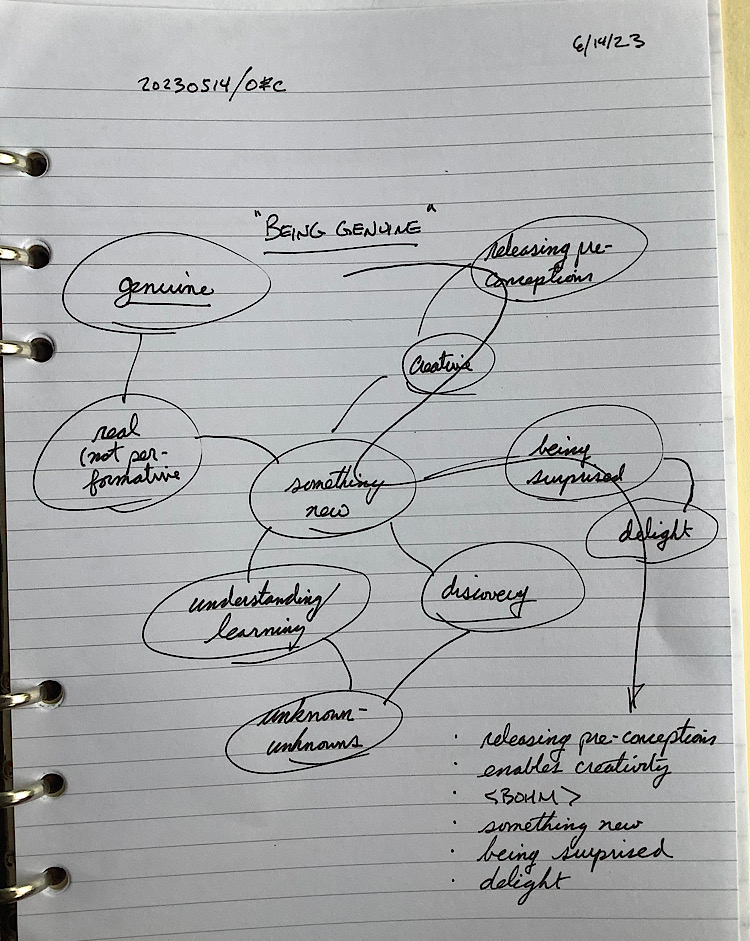

Maybe try a map?

First a hat tip to Austin Kleon. His most-recent post, Do you have a nemesis? included a mind map, which is the most-recent of the countless times I’ve encountered mind mapping. I’m a fan of Kleon for many reasons, not least of which is that he, like me, flouts the usual guidelines for the capitalization of one’s titles.

I’ve tried mind mapping a few times. (What’s that? Did I overdo it with software and processes? …yes, of course!) Today, I was feeling unmotivated to write for Open + Curious. I thought, “Just start. JUST START!” But I simply didn’t want to face the blank screen of the digital document.

Instead, I opened my idea garden wherein I capture interesting nuggets to be seeds for future writing. In my garden, I rarely (I first wrote “never,” but I don’t want to jinx myself) have trouble finding a nugget to write about. I grabbed my favorite pen, and flipped to a blank sheet in the little binder I keep. So much action! I felt like I was already writing. /s

On that mind map I wrote the “something new” at the center. It’s not a meaningless bit of meta; it’s the central idea from a captured nugget. At this point, staring at the paper with my pen in hand felt great, versus facing a digital document which always feels too structured for me to think in. (ref. Sönke Ahrens.) In just a few minutes of thinking and scribbling I had all those bubbles. Then I had a title. …then a route. …an outline. And from there the writing felt doable.

ɕ


Thank you I. Asimov

Over in my Open + Curious project, I’ve been working intentionally to improve my writing. For Open + Curious the more recent articles all begin with a clear posit (a statement which is made on the assumption that it will prove to be true) and then go on to explain why I believe that to be true; that’s their finished form. I was generally writing each piece, editing it to find and hone a single line of thinking, and then finishing up by crafting the leading posit. Yes, I know, “Craig discovers the essay.”

I’m reading I. Asimov and this advice leapt off the page:

What I do now is think up a problem and a resolution to that problem. I then begin the story, making it up as I go along, having all the excitement of finding out what will happen to the characters and how they will get out of their scrapes, but working steadily toward the known resolution so that I don’t get lost en route.

When asked for advice by beginners, I always stress that. Know your ending, I say, or the river of your story may finally sink into the desert sands and never reach the sea.

~ Isaac Asimov

slip:4a1193.

I’ve now written thousands of posts where I’ve led with a quotation from something. I’m forever writing some observation about what I’ve quoted, and then trying to pivot to what I actually want to say. Unfortunately, this style has begun to feel constraining.

Going forward, I’m going to see what happens if I think of what I’m quoting as giving me a direction. This piece starts with my thoughts about my writing for Open + Curious, and then looking “in the direction” of Asimov’s quoted contribution, beyond that I “see” this gibberish about my writing process. Sorry, maybe that’s all too meta? It’s noisy in my head.

ɕ