…and now that you don’t have to be perfect, you can be good.
~ John Steinbeck
slip:4a131.
…and now that you don’t have to be perfect, you can be good.
~ John Steinbeck
slip:4a131.
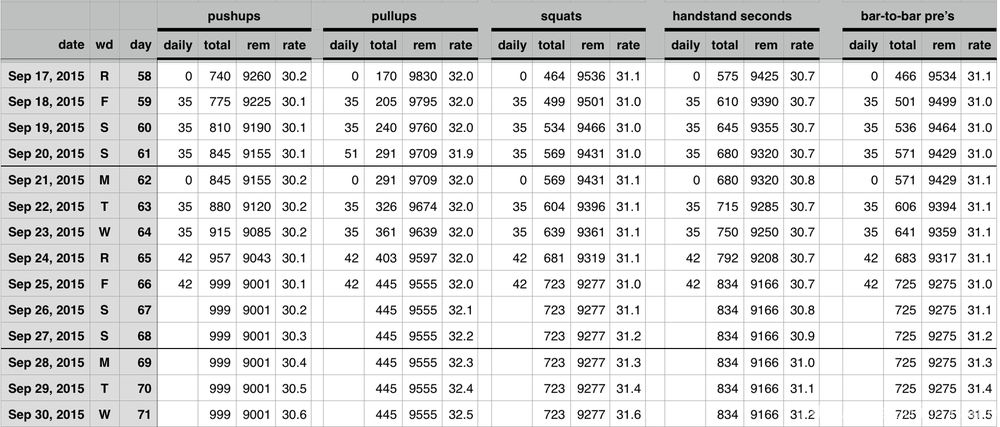
Today (Friday, Sept 25) was day number 66, and without realizing it, I did pushup number 999.
Way back in June, I read about someone who was going to “celebrate” their 30th birthday with a year-long challenge: They were going to try to complete 30,000 pushups in one year.
That would be 82.19 pushups per day, every day. (81.97 if it’s a leap year.) That’s crazy. That’s crazy like repetitive-stress-injury crazy. Especially since their point was that they were out of shape and wanted to get into shape.
Celebrate: n., to torture oneself?
I chuckled, and sipped my coffee. But the wheels were turning. With my 44th birthday approaching, I briefly considered 44,000 as a goal. Briefly. Very briefly. But then I was thinking: …well, I can do 10 pushups, easy. So doing just 30 per day wouldn’t be too crazy, and that should get me to about 10,000 in a year. (Calculator’ing happens.) Actually, about 27 pushups per day would get me to a nice round 10k in a year.
And over the next few weeks the idea grew.
It seemed clear that completing 10,000 pushups would be eminently possible without injury. Maybe I should try doing 10,000 repetitions of something I currently suck at? That would force me to get from “I can do zero of these,” to a competent 30-or-so per day. This started to sound more interesting and useful. It would be like a race, but a long-term race with me pitted against the calendar.
(It also fits very well with my Oath.)
Eventually I settled on five exercises which would be a serious challenge, AND would yield major improvements:
1. pushups
2. squats
3. pullups
4. bar-to-bar precisions
5. handstands (10k seconds in a handstand)
I’m not going to describe the exercises in detail. I’m not going to brag about how great I’ve gotten at them. (Which is, “not very.” But I’m still working on them.)
I decided up front that I would do whatever it took to reach the goal. To me, that means, doing enough to get stronger, but not hurting myself. It means continuously thinking about the form of the exercise and striving to do them well. But I do NOT fixate on perfection. Build it. Refine it. Lather. Rinse. Repeat.
What I really want to share is HOW MUCH FUN THIS IS!
Every time I do one of the exercises I am acutely aware of how much I’ve improved. Early on, I had little variations to everything to make it possible; I’d do 3 crappy, negative versions of a pull-up (climb up, and fight the fall for as long as possible) and happily mark “3” completed in my spreadsheet. Now I do sets of three reasonably good pull-ups and I think, “boo-YEAH! Pull-ups! Who’s ‘da man?!” I can’t wait to see what it’s like to crank out a clean set of 10 in a row.
Did you say spreadsheet?
Yes I did. Of course I went to the trouble of making a full-geek spreadsheet. It has a row for all 365 days. I enter the reps completed and it has columns for the cumulative number completed, the number remaining to reach the goal, and it does the math to tell me the rate-per-day that I’d have to continue at to reach the goal. (So if I do 10 pull-ups and it says the required rate is 27 per day, I know I’m digging a hole. If I do 40 pushups and it says the rate is 30, I know I just banked 10 for a day off.)
Well, here’s what day 66 looks like. I entered 42 under pushups and 999 popped out. What a neat surprise! :D
ɕ

ɕ
Post class thoughts? Not many. Class is usually pretty visceral, (as one would expect,) and there’s not much time for an internal dialog of philosophical thinking. There were of course various opportunities to come up with relatively creative solutions to physical movements and challenges. But nothing particularly interesting in the context of this discussion. I think the primary reason this “alternate paths” section didn’t stand out in class was that everyone there already thinks this way. Almost everyone in class is already applying this section’s ideas — at least applying it in the physical context.
And so, I hadn’t bothered to put up a “nothing to report” report. Until I happened to read:
As you begin to learn something, notice when you feel frustrated with sucking. It might be really difficult, confusing, full of failure. You’re out of your comfort zone, and you want to go back into it.
Now turn to this feeling of frustration, or whatever difficult feeling you’re having: confusion, impatience, boredom, feeling bad about yourself, wanting to quit.
Turn to the feeling, and instead of trying to stop it or avoid it … try sitting with it (or running with it). Just be there with it. Let it be in you, give it space.
~ Leo Babauta, from The Gentle Art of Trying Something & Sucking at It – Zen Habits Website
slip:4uzesu2.
I’m pulling disparate threads together here of course. But this is the feeling! I look at something really sketchy, challenging or downright scary, and my mind flees to the easy path. Took a lot of work to get my body to NOT flee to the easy path, which eventually gave my mind a bit of time to look at the “I don’t think so…” path and give it some consideration. In hindsight, I think it’s what Babauta describes so succinctly.
So, uh, yeah. What Thibault said. And also what Babauta said. :*)
ɕ
Wise men talk because they have something to say;
~ Plato
Fools, because they have to say something.
slip:4a266.
Here Thibault draws an analogy from how one reads a book. The obvious way is to read straight through from front to back. But he points out, just as there are alternatives with a book, there are alternatives with how we view and interact with our environment.
I’ve said many times – this isn’t my idea but I’ve forgotten where I picked it up – that one aspect of Parkour is realizing that the obstacle IS the path. Things in the environment which once were “obstacles” become “options.” Things which others would never consider interacting with draw my attention and suggest ways to interact. As my curiosity developed, I literally began to see my environment differently.
Aside: One of my favorite Parkour jokes is that I’ve converted my ADD from “Attention Deficit Disorded” to “Art Du Déplacement”. (That’s the French name for what we call Parkour.) But I’ve subsequently been diagnosed with late onset “Obstacle Attraction Disorder” (OAD).
Here, there is a railing. Why, really, may I not walk upon it? Many of the reasons for staying off are internal: I may fall; I have poor balance; I’m afraid. The rest of the reasons are based on other people’s internal fears projected out into the environment: People think, “I may fall, therefore you may fall.” And so we encounter people yelling, “Get down from there you’ll hurt yourself!”
Aside: Here’s my opinion on liability issues. Railings, as an example, are clearly not intended to be walked on. So I’m implicitly accepting the risk of my falling off the railing. Further, I’m also implicitly accepting the responsibility to repair the railing if I break it.
Through Parkour, I slowly discovered all of these internal reasons which I’d never noticed, let alone attempted to address, which were holding me back! Not simply holding me back in the context of some particular obstacle. (After all, I could simply walk around that wall!) But rather, all those internal reasons were holding me back in the context of my entire life. I realized that climbing stairs was no longer trivial. Touching my toes was no longer trivial. Climb a tree? …no more. Live a full life, sleep well, run? Nope, nope, nope. As a human being, I have a birthright to move (with a hat tip to Ido Portal), and to interact physically with my environment.
(Spoiler: I also have a birthright to interact physically with my fellow humans, but that’s another section in Thibault’s book.)
So Thibault’s section 2 seems trivial at first glance, but actually speaks to a very deep, and fundamentally important idea.
ɕ

ɕ
Once you have your goals firmly in your head, think of a food, any food.
Now ask yourself “Will this food move me closer to my goals or farther away from my goals?”. If you believe it will help you move closer to your goal, then eat it.
If you believe it will actually move you away from your goals, then don’t eat it, or at least eat it moderately and in very small portions.
~ Brad Pilon from, The Two Types of Food – Brad Pilon’s ‘Eat Blog Eat’
slip:4ubawe7.
ɕ
Finally, going forward, let’s practice tossing out our expectations of how we’re going to do today (and in life in general), and instead adopt an attitude of curiosity. We don’t know how we’re going to do at work, or in our relationships, or with our personal habits. We can’t know. So let’s find out: what will today be like? How will it go?
~ Leo Babauta from, A Guide to Dealing with Frustration & Disappointment in Yourself – Zen Habits Website
slip:4uzedi2.
Another something that jumped out at me as part of my regular, ongoing reading. Leo talks a lot about “mindfulness” and related practices. If you’re digging Vincent’s section 1, I think you’ll like this too.
ɕ
As I expected, I pretty much forgot about this project once I was on my way to class. So this is just my looking back at my experiences in class through the lens of this first section of the book. (I’m betting this is what’s going to happen another 89 times.)
I’m not going to pick apart every moment from class; I’ll just go over a few that come immediately to mind:
Balancing at height – We started practicing purposely bailing off a low rail and worked up to some climb-over tasks in a playground. Eventually we worked up to a “find something that’s high enough to be moderately uncomfortable” level of individual balancing. I headed for a 7-foot high long bar (like where swings would hang. sorta.) and struggled my way up onto the bar — that was a challenge in and of itself. So I definitely went straight at something that was challenging — falling from standing on a 7-foot bar is not trivial. I down-graded though after falling, because climbing up multiple times wasn’t worth the little bit of balancing I was managing.
Balancing on a rail – We were working with partners. We ended up mostly taking turns challenging each other. Try this, try this variation, etc making it increasingly difficult. At one point, I quietly headed off to the side for a rail to work on a sequence of variations. (Off to the side so as not to be a distracting, apparent-show-off.) So again here, definitely operating in the mind set where “the obstacle is the path”.
QM exercise – We ended with a laps challenge. For me, 3 laps of QM around a small-ish basketball court, followed by a running lap around the school. I pushed this really hard and it was here that I think the mind set really paid off . . .
In a discussion with Tracy after class, I came up with the idea that I seem to be using this mind set as a “razor”; An immediate yes/no testing tool. Your mind is busy with a stream of thoughts as you grind you way through hard work. In hindsight, I realize I was fast-processing everything with this combination of the mindset and a dash of stoicism. “Caution, quad nearly cramping,” is something I can affect; pause and unload that leg, or stretch it, or slow down. “Ow, stone in my hand,” shake it off when next I lift that hand. “I want to quit,” what? no, that’s not going to move me forward towards my goal. “How is [other student] still going so fast,” ignore that I cannot affect that. So it seems to have been just this long (long LONG) series of thoughts. Sometimes I’m certain I wasn’t finished with one thought before another preempted it; Which is fine, the really important stuff will preempt silly thoughts about a cool drink of water.
So it was nice to come away believing that I’m already applying this mind set in a big way.
Light bulb
But wait a second, here’s a new [for me] thought: This mind set also means there’s a difference between “stopping” and “quiting”, even though outwardly they look identical to an observer. I can STOP for the RIGHT reason, or QUIT for the WRONG reason. Stop before an actual cramp, verus quit because I’m demoralized. That’s another facet of using this mind set as a “razor”.
ɕ