I understand nutrition. I still can’t stop overeating.

I know about macros. I understand glycemic index, the difference between whole and processed foods, why protein keeps you full longer. I’ve read the books. I can explain insulin resistance while reaching for a second slice of cake.

If you’re like me, you’ve wondered why knowing all of this doesn’t seem to help. The information is there. The behavior doesn’t follow.

I used to think I needed more information—better information, presented more compellingly. It doesn’t work that way. The problem isn’t what I know. The problem is when I know it.

The problem isn’t information. It’s when and how the right thought arrives.

When the thought arrives matters

The prompts I built aren’t information delivery. They’re interruptions.

One thought arrives each morning—before I’m hungry, before I’m standing in front of the fridge negotiating with myself. Before the defaults kick in. That timing is the whole thing.

If you could read all the prompts in an afternoon, nod along, close the tab—nothing would change. The email works differently. It just shows up, early, when there’s a small window for a thought to land.

That’s what I built 365 Changes around—not more nutrition facts, but a single question arriving before my day fills in, when there’s still room for it to matter.

365 Changes: A daily prompt about eating — https://365changes.com/

ɕ


Kessler, 1978

Do you know what Kessler Syndrome is? You should.

ɕ


Simply a moment captured

Simply a moment captured

Sometimes I see a moment that’s worth capturing.

ɕ


Extraction

This is a rich conversation around validation vs. reassurance, which I recently revisited. Go listen. (Seth Godin and Brian Koppelman, 7/7/2015, from The Moment podcast—from over 10 years ago, back catalog for the win!)

I recently re-listened. Then I took the audio file, had a transcript generated (from otter.ai), passed it to Claude.ai who wrote me a magnificent list of takeaways. I’ve been reading over them, thinking about them, and weaving the ideas into my thinking.

But I’m not publishing those takeaways because that would be devaluing Koppelman’s and Godin’s work. AI is a power tool which I use for various things. (For example, I use it to help me write show notes for my podcast episodes, which I do publish in full.) But I blog here to help my thinking (and in this case to encourage others to listen to a great podcast episode.)

I’m not trying to give you all the gems all polished up from something someone else created. If you want the gems, go listen; Find your way to get the gems. Because the gems are only valuable if you dig them out and polish them yourself.

ɕ


Why you can’t link to a podcast episode

The other morning I was spun off on a tangent. I was writing a blog post about a Godin/Koppelman podcast episode. I know full well you cannot link to episodes, so I just said the usual “go search…”

I sometimes give my blog post drafts to Claude.ai for critique. For this piece, it pointed out I should just link to the episode… cue my frustration. It’s a valid critique, and I don’t fault that Claude instance for not understanding the reality . . .

So we talked about it until it did understand. Then I told it to write me a prompt (because I didn’t want my writing critic going farther afield) for a Claude-code instance. It took Claude-code about 10 minutes to do the work, which I posted publicly for discussion:

Why you can’t link to a podcast episode

I particularly LOVE its list of sources; There’s so much great reading in there.

Its analysis actually surprised me. I had assumed this was a technical problem. It’s not.

There was a time when I’d make a web site, email people (eg James Cridland), and start trying to rally people into fixing something. But those days need to be behind me, I simply cannot take on another new thing.

My hope? Someone somewhere sees that topic over on the Podtalk Community. Learns something about the problem and gets energized to do something about it.

I love podcasting, but this isn’t a fight I can lead.

Maybe you can?

ɕ


2026

This year’s cynosure is “Temperance.”

There was a great deal of journaling and conversation with Claude.ai about selecting 2026’s cynosure. Many times I thought about writing a blog post about the process of choosing…

As I watched December move along, I realized that if it’s going to be temperance, then it’s temperance in all things. Particularly in blog posts.

ɕ


The Backwards Productivity Hack

Here’s what sounds wrong but turns out to be true: writing more actually creates less work.

When you feel overwhelmed, the last thing you want to do is add another task. Writing things down feels like more work piled on top of everything else you’re already not getting done.

But here’s what actually happens when you don’t write things down: You think about the same problem multiple times. You have the same realization three different times and forget it twice. You start working on something, realize you don’t know the next step, stop, and come back to it later only to re-figure out where you were.

That’s exhausting. And it’s way more work than writing things down.

Writing is slower than thinking. That’s actually the point. When you write, you can only hold one thought at a time. You have to finish the sentence before you start the next one. This forced slowness makes you think more clearly about what you’re actually trying to say.

And once it’s written down, you don’t have to hold it in your head anymore.

More writing = clearer thinking = less total effort.

It sounds backwards until you try it.

ɕ

This is the first in a series of posts about Hand-Write. Think Better.—a method for people who feel overwhelmed to start simply writing more on paper. Get the book →

Not ready for the book? Grab the free one-page quick reference—it covers the entire method on a single sheet. Download the PDF →


It’s also about what’s missing

The richness and meaning arises in part from choosing it at the expense of all other places you could be and things you could be doing. Accepting a place’s shortcomings, the things it lacks, and its imperfections is essential to appreciating everything it does have to offer.

Rosie Spinks, from Does where you live matter?

Striving is—in my opinion of course—my biggest flaw. I’ve never had the striving for place, the urge to move to a new location.

I’ve long enjoyed travel. I enjoy the anticipation, and the looking back (via my journals and selected photography), as much as the in-the-moment experience. Certainly, I spend more actual time in anticipation and in review, than I ever do actually during any trip. So here too, not striving.

Elsewhere? Oh, striving very much.

ɕ


Closer. Closer. Close enough.

Closer. Closer. Close enough.

Sometimes I spot a pollinator in a place where I can get close. Despite it being a chilly day, this guy was very active.

Closer…

Closer…

—crap, I think that’s a Yellow Jacket? (Which are mean and aggressive this time of year when good food gets scarce.) Too close. Too close!

ɕ


Podcasting anniversary

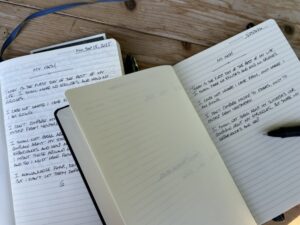
I hope you have some way of sitting down and looking back on what you’ve actually accomplished. If you don’t, you’ll never notice what you’ve done; Instead you’ll only be able to stare at your imagined yet-to-do list.

I have a habit of looking back through my old journals to see what I’d written on the same date, years past. That’s the only way I can actually notice how much I’ve done, and how far I’ve come.

December 9, 2016 was the first time I recorded something, which led me directly into podcasting. It was a Skype call—yikes, dated memory—which I recorded for the purpose of getting a transcript.

At the time, I was trying to build a website where I was asking people to answer questions from a set list. But of course, writing is hard and it was a real struggle to get people to engage with doing it. So my friend Nick (who eventually appeared on the Movers Mindset podcast in, Play with Nick Anastasia, in 2022) said, let’s just record a Skype call and I’ll try writing something [answers to my movement related questions] from that. At the time, I tried to do some transcribing, gave up and sent it to rev.com for (I think it was) a $1/minute for human transcription. Yow, time and technology fly. And the rest is history.

ɕ