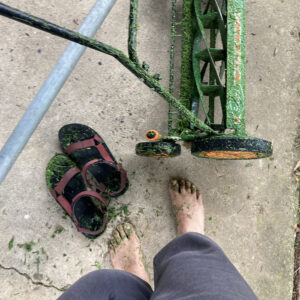
never in a hurry never worried never desperate never stopping short
As Epictetus once summarized his entire philosophy: Persist and resist. Persist in your efforts. Resist giving in to distraction, discouragement, or disorder.
This is just one of countless times I’ve strolled this connector-trail. It’s different every time. This time, I was literally arrested mid-stride to snap this.
A man’s job is to make the world a better place to live in, so far as he is able—always remembering the results will be infinitesimal—and to attend to his own soul.
How does a podcast serving millions still make each listener feel personally connected?
Discover why “connection, not perfection” became the north star for one of the world’s most-listened-to language shows.
[Do you ever freak-out thinking about 200,000 people listening?] I think that our vision of the human connection is still so strong inside me, that I think about that. I think about that listener who might feel isolated right now because of language. They’re either living in the US and they’re struggling to get connected in their community, or they’re on a call from Japan to New York and they’re cringing because they think they just said the wrong thing and they’re not building the business relationship.
~ Lindsay McMahon (19:00)
This conversation with Lindsay McMahon explores the strategic structure and guiding values behind one of the most successful podcasts for English language learners. Lindsay discusses how the show’s consistency in structure, length, and tone builds trust and supports learning. The format was intentionally designed from the beginning, and every episode follows a clear template. The recurring message, “connection, not perfection,” drives the brand and resonates deeply with listeners around the world. The show targets global English learners, particularly professionals, and publishes five days a week, delivering a sense of reliability and approachability.
Lindsay shares her team-building strategy, including how co-hosts are hired, trained, and retained. She emphasizes treating podcasting as a business (for example, offering benefits like 401(k) matching), which contributes to long-term team cohesion. The show’s monetization model is also discussed, covering courses, sponsorships, licensing, and Apple+ subscriptions. The team uses lead magnets (like quizzes), and consistent calls to action are embedded in every episode. Additional topics include burnout, managing production buffers, and ambitions to expand into live events and podcast coaching.
Reading my previous journal entries (as I do every morning) I was surprised to find it’s been only a year since I move my 7 for Sunday weekly email off to its own site. (If you like reading my blog posts, you’ll love reading my weekly email. ;)
It was quite a lot of work, although I’d completely forgotten all about it. What a gift it was to my today-self; yes, the work to move the project making it even better, but more so the delight of being reminded to look back and appreciate the project now.
Things were quiet the morning after coaching and volunteering at the 2025 Move NYC event. Coffee. Chill morning air. Sun rising through the trees. A snapshot to remind myself that sometimes I do get the rare privilege to be able to literally address the sun with sun salutations. And although I can stare at anything while meditating, when I find moss-covered balanced stones also in the direction of the rising sun… sublime. Thanks Ruby and Jesse!
What happens when faith, logic, and vulnerability collide in a personal search for truth?
Cassian Bellino has turned personal doubt into a public quest for answers interviewing scholars about Christianity.
I think just, over time, you really understand that God invites these questions because He doesn’t want us to live blindly or have blind faith.
~ Cassian Bellino (36:55)
The conversation explores the origin and evolution of Cassian’s podcast, Biblically Speaking, focused on asking scholars direct, often difficult questions about Christianity. It begins with her internal conflict—wanting to live as a Christian while not fully understanding or agreeing with the faith—and follows her decision to start a podcast to resolve those doubts through dialogue. Cassian’s podcast is a place for intellectual exploration, built from personal curiosity and a desire for logical clarity rather than blind faith.
The discussion touches on content strategy, emotional challenges, and the mechanics of sustaining a solo creative endeavor. Cassian recounts her journey through building community platforms, hiring coaches, learning software systems, and dealing with burnout. Marketing, guest outreach, and pre-call preparation processes are shared in detail, alongside reflections on episodes that felt like failures but later proved meaningful to listeners. Throughout, the conversation centers on the power of asking questions and trusting intuition to guide the creative process.