Routine, in an intelligent man, is a sign of ambition.
~ W. H. Auden
Elsewhere, this is 4a875. — slipbox
Routine, in an intelligent man, is a sign of ambition.
~ W. H. Auden
Elsewhere, this is 4a875. — slipbox
The end for self-discipline is personal improvement; the end for discipline lies beyond the self. This distinction helps explain why individuals can be incredibly self-disciplined and yet see very little external achievement as a result. Sure, they never miss a day writing in their journal and never lose their temper, but those displays of self-mastery don’t automatically lead to outward success.
~ Brett McKay from, Are You Disciplined or Just Self-Disciplined?
Elsewhere, this is 4uaoca9. — slipbox
There are lots of ways to talk about this distinction; the particular way described by McKay comes from an author he’s interviewed. I’d never thought about is as “discipline” versus “self-discipline.” I’d always thought of discipline as a thing, and then the “self-” prefix in “self-discipline” means that thing done to myself. And I’m not going to change how I use the words, “discipline,” and “self-discipline.” I see why they’re using “discipline” and “self-discipline.” I think I’d prefer to use, “inward-directed,” and, “outward-directed,” discipline. Everything I do to myself is self-discipline, but when my goal is to change myself, then it’s “inward-directed,” and when my goal is to change the world, then it’s “outward-directed.”
But the point of the distinction is very interesting. Do I actually have goals which are the, “why?” behind my self-discipline? Are those goals an appropriate mixture of inward- and outward-directed?
ɕ
What insights can a photographer share about the collaborative process of capturing movement, particularly when working with athletes?
Discover the intersection of art and athleticism through the lens of a movement-focused photographer.
Having been around so many different athletes, I think what’s really fascinating to me is the process, where you get a front-row seat to the process of them breaking a jump. And working through the challenges. And I can’t get enough of that. That is— I find that so amazing, where someone just gets in a zone. And then they can do this thing.
~ Ben Franke (16:11)
The conversation highlights the intricate collaboration involved in capturing dynamic movement in photography. Ben shares his approach to working closely with athletes, emphasizing the importance of understanding the movement art they practice. This partnership allows him to create compelling images while respecting the athletes’ physical limits. The interaction between artist and subject enriches the process, enabling both to come away with something meaningful.
A significant portion of the discussion revolves around the creative process, from compositional choices made in the moment to post-processing decisions. Ben also reflects on the evolution of their practice, highlighting a preference for collaborative and thoughtful work over impersonal or candid photography. Practical advice is offered to aspiring photographers, encouraging experimentation and active exploration as a path to discovering personal style.
(more…)What motivates and challenges individuals when starting and developing a podcast?
Posting a daily question for years transforms a personal habit into a creative legacy.
I am a creator, like— I have this creative— …how did I do this? I just— …just made a decision one day.
~ Ken Kaus (28:35)
The conversation explores the challenges and motivations behind starting a podcast. It begins with reflections on technical aspects such as editing, which surprisingly becomes manageable for Ken due to previous experience with audio software. Imposter syndrome and self-doubt are discussed as significant obstacles to creativity, alongside strategies for pushing through discomfort, like publishing imperfect episodes and focusing on growth rather than perfection.
Another theme revolves around self-expression and communication. Ken reveals how podcasting helps clarify their thoughts and improve everyday communication. He share his practice of posting daily questions as a way to cultivate creativity and build a consistent habit, which now informs his identity as a creator. Both Craig and Ken agree that small steps and persistence are crucial in creative pursuits, offering listeners insights into overcoming personal and professional barriers.
(more…)I read and hear a lot about how excessive “screen time” is bad. But there’s a distinction that has to be made: Is the “screen time” tool-use to accomplish something meaningful? …because tool-use is not bad for you. We don’t begrudge the time a mechanic spends wielding his tools; we call that “working.”
Today I spent nearly every waking minute in front of one of four different computer screens. For reasons of sanity and physical health, sometimes I was sitting, sometimes standing, sometimes indoors and outdoors for long stretches too. I also take intentional “vision breaks” to allow my eye muscles to relax—literally relax to infinite focusing distance, which they would otherwise never do facing a screen, or anywhere indoors.
What did I do? I did an enormous number of things. Here are a few examples from today: I submitted a presenter application for an in-person event in September. I worked on my presentation notes for a different, in-person event in 2 weeks. I researched and experimented with exporting the contents of a WordPress site, and then read and interpreted the massive data which was output, to verify that I could later write a program to parse it. I then planned out the work needed to disassemble the project, of which that WordPress site is but one piece. I estimate I spent three hours reading text articles I’d previously queued up to read later. I helped a member of a community sort out a problem they were having.
I, truly, don’t know about you. I however, am an excellent mechanic, with the finest tools, and there remain far more things worth doing than I can ever get done. My problem is not, “screen time.”
ɕ
How can movement professionals inspire hope, encourage personal growth, and create spaces that foster inclusivity and collaboration?
‘Peanut butter and chocolate’ perfectly describes Dani Almeyda and Tim Anderson’s working relationship, and why they’ve successfully built a business together. They discuss Original Strength, what it takes to work with someone for 10 years, and why they remain passionate about their work. Dani unpacks her work with the Women’s Movement Collaborative, and Tim shares his process and influences. They explain their beginnings as OS, how they’ve grown, and what motivates each of them personally.
If you walk into our studio on the wall, it says: ‘I am awesomely and wonderfully made.’ That’s the message we want people to get when they come in to learn about themselves.
~ Tim Anderson (22:23)
Tim Anderson is an experienced fitness professional, writer, speaker, and former fire fighter. He has over 20 years of experience as a personal trainer, and is the co-creator of the Original Strength System and Original Strength Institute. In addition to fitness, he has authored and co-authored over 5 books. Tim’s methodology is centered on one key principle; we are meant to feel good and be strong throughout our lives.
Our whole goal has always just been to get people to move— to move and to get back to the very basics and the foundations. And the heart of that has always been that we wanted people to feel the hope that movement can bring into life, and to understand that moving heals the body.
~ Dani Almeyda (23:18)
Danielle Almeyda is a fitness professional with over a decade of experience in the industry. She is a the co-creator of the Original Strength System as well as the Original Strength Institute, and the founder of the Women’s Movement Collaborative. Dani’s passion lies in helping people reclaim their movement and their hope.
The conversation explores the transformative power of movement, highlighting its potential to heal the body and inspire hope. It delves into the foundational principles of the Original Strength system, emphasizing simplicity and accessibility in helping individuals reclaim their innate ability to move well. The speakers discuss their mission to create safe, inclusive spaces where movement becomes a tool for empowerment and personal growth, transcending the traditional fitness lens. They describe their unique partnership, which blends complementary strengths to innovate within the movement education field.
A significant part of the discussion focuses on building connections and fostering collaboration. The speakers share insights from their experiences with the Women’s Movement Collaborative, an initiative designed to create a supportive environment for women to explore movement and build confidence. They reflect on the challenges of maintaining authenticity while scaling their efforts and the importance of being relatable to foster meaningful connections with clients and collaborators. Their shared belief in the power of movement to positively impact lives resonates throughout the dialogue.
(more…)Out on the edge you see all kinds of things you can’t see from the center. Big, undreamed-of things—the people on the edge see them first.
~ Kurt Vonnegut
Elsewhere, this is 4a870. — slipbox
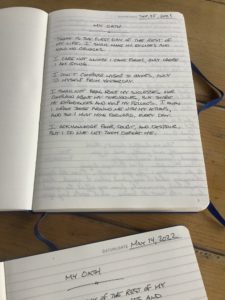
And quite often, I’m not using screens at all. My journal writing recently rolled-over into volume 18, and in recent years I’ve been copying my oath into the front of each new volume.
ɕ
The specific outcome is not the primary driver of our practice. […] We can begin with this: If we failed, would it be worth the journey? Do you trust yourself enough to commit to engaging with a project regardless of the chances of success? The first step is to separate the process from the outcome. Not because we don’t care about the outcome. But because we do.
~ Seth Godin
Elsewhere, this is 4a869. — slipbox